When Fear and Belief Swept Through Japan
Japan’s history of contagious belief is not a single story of “mass hysteria”. It includes apocalyptic religions, disaster rumours, communal dancing, consumer scares, media-amplified illness and genuine abuses that later produced wider suspicion of minority faiths.
Page outline Jump by section
Introduction
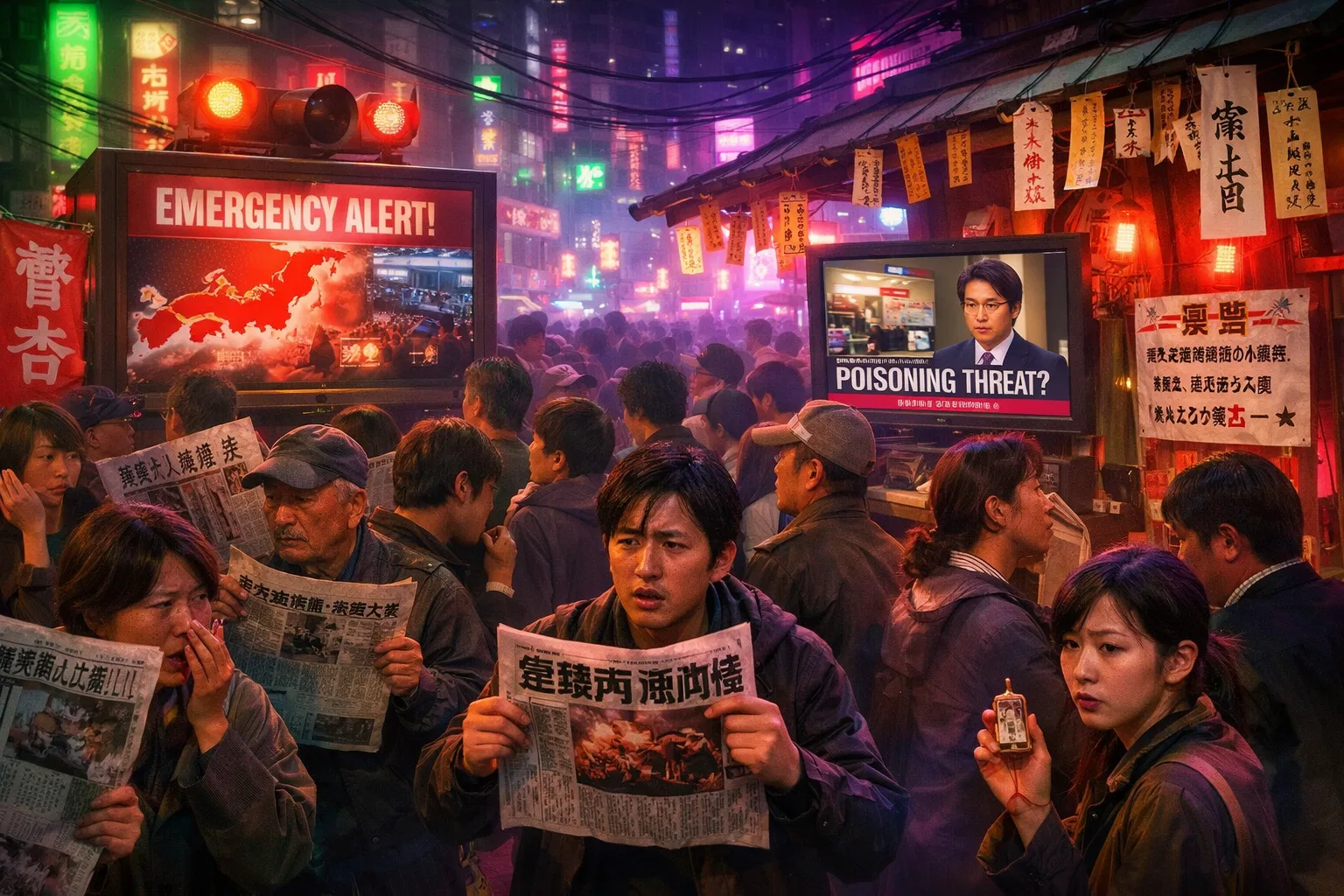
Several episodes reveal a recurring pattern. Existing insecurity creates an audience for a compelling explanation; newspapers, television or word of mouth make that explanation seem widely shared; and official action then either calms the situation or lends the fear greater authority. The consequences range from empty shop shelves to discriminatory law enforcement and mass murder. Japan’s most important cases therefore concern not national credulity, but the interaction of uncertainty, social pressure, modern media and institutional power.
Sacred signs and dancing at the end of an era
Collective religious excitement long predates Japan’s modern mass media. Medieval Buddhist expectations that society had entered a declining age of religious truth encouraged fears of disorder and hopes for rescue through devotion. Such ideas did not amount to a constant national panic, but wars, epidemics, crop failures, unusual celestial events and political instability could make end-times teachings feel immediately relevant. Research comparing eleventh-century Japan with Byzantium suggests that climatic disruption and astronomical phenomena acquired apocalyptic significance because they coincided with existing religious chronologies and social turmoil.[arXiv]arxiv.orgarXiv Global apocalypse at the turn of the first Millennium AD?Climate fluctuations, astronomic phenomena and socio-political turbulences in 10th and 11th century Byzantium and Japan in comparative pe…
One of Japan’s most vivid episodes of contagious public behaviour occurred in 1867–68, as the Tokugawa government collapsed. Reports that sacred amulets had fallen from the sky were followed by festivals, pilgrimages and mass dancing across parts of central and western Japan. Participants sang a repeated refrain roughly expressing “why not?” or “who cares?”, temporarily overturning ordinary discipline through extravagant dress, cross-dressing, public drinking and other carnival behaviour. Some gatherings also became disorderly or violent.[UAL Research Online]ualresearchonline.arts.ac.ukUAL Research OnlineEe ja nai ka (1867-1868), The Dawn of Transgression in Japanby M Oki · 2022 — Ee ja nai ka were carnivalesque riots th…
Calling this a Japanese “dancing plague” is tempting but misleading. Unlike illnesses reported in some European dancing epidemics, the Japanese events were organised celebrations in which religious thanksgiving, entertainment and social protest overlapped. There is no evidence of one centrally directed movement or a shared political programme. The phenomenon spread because communities copied reports from elsewhere, local organisers reproduced the supposed miraculous signs, and ordinary people found temporary release from taxation, hierarchy and uncertainty at a moment when the old political order was visibly failing.[UAL Research Online]ualresearchonline.arts.ac.ukUAL Research OnlineEe ja nai ka (1867-1868), The Dawn of Transgression in Japanby M Oki · 2022 — Ee ja nai ka were carnivalesque riots th…
The episode matters because it resists a simple choice between sincere belief and cynical manipulation. Some people apparently treated the amulets as divine gifts; others used the celebrations as an excuse for festivity, protest or profit. Collective belief often works in precisely this mixed form: people can participate enthusiastically without agreeing on whether the miracle is literally true.
When earthquake rumours became licence to kill
The deadliest Japanese rumour panic followed the Great Kantō earthquake of 1 September 1923. The earthquake and fires devastated Tokyo, Yokohama and surrounding districts, killing more than 100,000 people and destroying communications, homes and public services. In the confusion, false stories circulated that ethnic Koreans were poisoning wells, setting fires, looting or preparing an uprising.[AP News]apnews.comThe earthquake, of 7.9 magnitude, caused a massive fire in the Tokyo region, destroying nearly 300,000 homes. A tragic aftermath saw the…
These rumours did not remain harmless folklore. Vigilante groups erected checkpoints and attacked people they believed to be Korean. Koreans, Chinese people, political dissidents and Japanese citizens mistaken for foreigners were killed. Police, soldiers and officials were implicated to varying degrees, while official messages and newspaper reporting sometimes repeated or legitimised the allegations instead of firmly disproving them. The precise death toll remains disputed, but historians generally describe thousands of killings.[apjjf.org]apjjf.orgAsia-Pacific Journal: Japan Focus The Tongue That Divided Life and DeathThe 1923 Tokyo…September 3, 2007 — 3 Sept 2007 — I am speaking of the September 1923 massacre of six thousand Koreans in the Kanto are…
The massacre cannot be explained as a spontaneous psychological reaction to an earthquake. Japan had annexed Korea in 1910, and Koreans in Japan already faced colonial prejudice, labour conflict and suspicion. The disaster created conditions in which existing hostility could be converted into an apparently urgent security threat. Rumour supplied a target; racism made the rumour believable; and participation by state personnel gave violence a degree of perceived legitimacy.
Language tests became especially notorious. Vigilantes demanded that suspected outsiders pronounce Japanese phrases and attacked those whose accents appeared unfamiliar. Such tests were unreliable and also endangered Japanese people with regional speech differences or disabilities. The episode shows how a crowd can turn arbitrary signs into “proof” once it believes a hidden enemy is present.[Asia-Pacific Journal: Japan Focus]apjjf.orgAsia-Pacific Journal: Japan Focus The Tongue That Divided Life and DeathThe 1923 Tokyo…September 3, 2007 — 3 Sept 2007 — I am speaking of the September 1923 massacre of six thousand Koreans in the Kanto are…
The massacre remains culturally and politically important because commemoration is contested. Survivors’ accounts, witness testimony and civic memorial work have preserved evidence that official narratives sometimes minimised. Recent scholarship continues to examine how remembrance and denial shape public understanding a century later.[OUP Academic]academic.oup.comOUP Academicthe politics of commemorating the massacre of Koreans after…25 Nov 2025 — This section examines the background of Korean m…
Shortages, television and self-reinforcing scares
Not every Japanese panic centred on religion or an alleged enemy. Post-war consumer society created new forms of collective fear in which attempts to protect oneself helped produce the feared shortage.
In November 1973, during the global oil crisis, shoppers began queuing for toilet paper. Shelves emptied, prices rose and television images of crowds encouraged further buying. The episode is often remembered as an outbreak of irrational hoarding, but historian Eiko Maruko Siniawer argues that the label “panic” obscures the real uncertainty of the period. Japanese households were facing inflation, commodity disruption, fears of profiteering and declining confidence in government assurances. Buying extra supplies was individually understandable even though thousands of similar decisions worsened scarcity.[OUP Academic]academic.oup.comOpen source on oup.com.
This is a classic feedback loop. A person sees a queue and concludes that other shoppers know something important. Buying becomes evidence that buying is necessary. News coverage can intensify the loop by showing the most dramatic stores and longest queues, making a local shortage look universal. The 1973 scare has remained Japan’s main historical reference point whenever rumours about paper supplies reappear during earthquakes, epidemics or international disruption.
A more medically complicated case occurred on 16 December 1997, when an episode of the television animation Pokémon displayed rapidly alternating flashes. Hundreds of children were taken to hospital with seizures, nausea, dizziness, headaches and other symptoms. The programme was suspended, and the incident led broadcasters to introduce stricter guidance on flashing images.[PubMed]pubmed.ncbi.nlm.nih.govOpen source on nih.gov.
The event involved a real physical hazard: flashing light could provoke seizures in susceptible viewers. It should therefore not be dismissed as imaginary illness. However, more than 12,000 children were subsequently reported to have experienced symptoms, many after extensive news coverage or exposure to rebroadcast footage. A published medical analysis argued that genuine photosensitive seizures formed the initial core of the incident, while many later headaches, nausea and fainting episodes were more consistent with mass psychogenic illness—a spread of real bodily symptoms shaped by anxiety, expectation and social communication.[PubMed]pubmed.ncbi.nlm.nih.govOpen source on nih.gov.
The case demonstrates why “real” and “psychological” are not opposites. Some children experienced neurologically triggered seizures; others experienced genuine distress without epilepsy; and dramatic reporting expanded awareness of symptoms throughout schools and families. Responsible interpretation must preserve all three parts of that account.
Aum Shinrikyo and the reality behind the cult fear
No event transformed Japanese attitudes towards new religions more profoundly than Aum Shinrikyo’s attack on the Tokyo subway on 20 March 1995. Members released the nerve agent sarin on trains passing through the government district, killing passengers and workers and injuring thousands. The group had also carried out earlier murders, abductions and a sarin attack in Matsumoto in 1994.[moj.go.jp]moj.go.jpenglish aum shinrikyoenglish aum shinrikyo
Aum combined religious practices drawn from several traditions with claims that its founder possessed exceptional spiritual authority. Its teaching became increasingly apocalyptic. It expected catastrophic conflict, portrayed outsiders as agents of persecution and developed a secret weapons programme. Scholars emphasise that this radicalisation was gradual rather than an automatic consequence of unconventional belief. Organisational isolation, obedience to the leader, rivalry, failed political ambitions and escalating conflict with critics all helped turn prophecy into a justification for violence.[qub.ac.uk]pure.qub.ac.ukOpen source on qub.ac.uk.
The attack was therefore not a baseless “cult scare”. It was organised terrorism by a group that had acquired chemical expertise and concealed serious crimes. Yet the aftermath also produced a broader moral panic in which the characteristics of Aum were projected onto diverse new religions. Media discussion frequently treated unusual dress, communal living, intense devotion or apocalyptic language as warning signs of another attack, even when no evidence of criminal preparation existed. Ian Reader and other scholars argue that Japan’s response contained both necessary scrutiny and an exaggerated tendency to imagine Aum as representative of unconventional religion generally.[SciSpace]scispace.comOpen source on scispace.com.
Aum also exposed failures that preceded the attack. Authorities had received complaints and evidence of suspicious activity but were cautious about intervening in a legally recognised religious organisation. After 1995, the danger reversed: pressure to prove vigilance encouraged intrusive surveillance and public suspicion even where the evidence was weak. The challenge was—and remains—to investigate coercion, fraud and violence without treating religious difference itself as probable cause.
Aum’s successor organisations continue to be monitored under Japanese law. The Public Security Intelligence Agency states that the founder’s influence persists within parts of the movement and describes continued recruitment and organisational activity. That surveillance reflects the group’s documented history, not merely an abstract fear of minority religion. At the same time, official terminology and media shorthand can blur distinctions among successor factions, former believers and unrelated spiritual movements.[moj.go.jp]moj.go.jpenglish aum shinrikyoenglish aum shinrikyo
The post-Aum search for “the next Aum”
The danger of learning the wrong lesson became clear during the Pana Wave Laboratory affair of 2003. This small religious community travelled in white vehicles and covered objects with white cloth, which members believed offered protection from harmful electromagnetic waves. Its leader predicted a planetary catastrophe, and the group’s unusual appearance provided striking television images. News outlets repeatedly compared it with Aum, while police mounted a conspicuous investigation.[JSTOR]jstor.orgOpen source on jstor.org.
The predicted catastrophe did not occur, and the investigation uncovered no equivalent weapons programme or plan for mass violence. Much of the actionable misconduct involved comparatively minor traffic and vehicle matters. Academic analyses consequently describe the affair as a post-Aum moral panic: authorities and journalists responded not simply to what the group had done, but to its visual resemblance to a public image of dangerous apocalyptic religion.[jstor.org]jstor.orgOpen source on jstor.org.
That does not mean the group’s beliefs were harmless to every member or that officials should have ignored legitimate complaints. It means the scale of the public threat was inferred before it was demonstrated. The apparent strangeness of the community—white clothing, convoys and prophecies—became evidence in itself.
Popular prophecy helped create the atmosphere in which such comparisons flourished. Japanese editions and reinterpretations of Nostradamus had enjoyed substantial popularity since the 1970s, and anxiety revived as 1999 approached. Books, magazines, television programmes and early internet sites discussed a supposed end-of-century catastrophe. Aum had incorporated Nostradamus into its own apocalyptic imagination, but most readers of such material did not join violent organisations or abandon everyday life.[theguardian.com]theguardian.comThe Guardian Nostradamus has Japan quaking | World newsThe Guardian Nostradamus has Japan quaking | World news
The distinction is essential. A prophecy may be entertainment, a loosely held fear, a commercial publishing phenomenon or part of a tightly controlled group’s ideology. Treating all four as the same hides the organisational processes that make a movement dangerous.
Abuse, political influence and the Unification Church controversy
The controversy surrounding the Family Federation for World Peace and Unification, widely known as the Unification Church, illustrates the difficulty of separating moral panic from documented harm.
Public scrutiny intensified after former prime minister Shinzo Abe was assassinated in July 2022. The killer said he held a grievance against the church because his mother’s large donations had devastated his family and that he targeted Abe because of the former leader’s perceived connection to the organisation. The killing prompted investigations into the church’s fundraising and its links with politicians, particularly members of the governing Liberal Democratic Party.[AP News]apnews.comAP News Court in Japan orders the dissolution of the Unification ChurchAP News Court in Japan orders the dissolution of the Unification Church
In March 2025, the Tokyo District Court ordered the dissolution of the organisation as a legally recognised religious corporation. The decision removed privileges associated with that status but did not outlaw private belief or voluntary religious activity. The court accepted the government’s case that harmful fundraising and recruitment practices had been extensive and persistent. The organisation appealed, arguing that the ruling threatened religious freedom and that donations were part of legitimate religious practice.[eastasiaforum.org]eastasiaforum.orgEast Asia Forum The Unification Church dissolution and Japan's evolvingEast Asia Forum The Unification Church dissolution and Japan's evolving
This episode differs from the Pana Wave scare because it rests on decades of civil claims, victim testimony and evidence of financial harm, not simply unconventional theology or appearance. Critics described techniques in which fears about ancestors, misfortune or spiritual danger were allegedly used to solicit costly donations and purchases. The legal controversy concerns where persuasion ends and exploitation begins, and how the state can protect families without deciding which doctrines are true.
Yet the aftermath also revived sweeping language about “cults” in public debate. That label can help former members name experiences of coercion, but it can also imply that every participant lacks agency or that all minority religions share one structure. More precise questions are usually more useful: Did leaders conceal information? Were members isolated? Were threats used to obtain money? Could people leave without punishment? Did the organisation violate criminal or civil law?

What these episodes reveal
Japan’s cases do not support the idea that crowds suddenly become irrational for no reason. Each major episode had a recognisable social setting.
Uncertainty came first. Political collapse shaped the dancing celebrations of 1867–68; disaster and colonial prejudice shaped the 1923 rumours; inflation and energy insecurity shaped the toilet-paper scare; and the trauma of Aum shaped later fear of apocalyptic groups.
Communication changed the scale. Sacred tokens, neighbourhood gossip, newspapers, television pictures and online discussion all allowed people to observe one another’s reactions. A belief seemed more credible because it appeared to be spreading.
Authority could interrupt or amplify fear. Clear medical guidance after the Pokémon broadcast helped reduce future risk. By contrast, officials who repeated anti-Korean rumours in 1923 made murderous suspicion appear legitimate. The high-profile policing of Pana Wave signalled danger before investigators had established it.
Real threats and exaggerated reactions could coexist. The Pokémon incident included both photosensitive seizures and socially spread symptoms. Aum presented an extraordinary genuine danger, while its crimes encouraged indiscriminate suspicion of unrelated religions. The 1973 oil crisis disrupted prices and supplies, while defensive buying deepened the visible shortage.
Labels often conceal responsibility. Calling an event “mass hysteria” may shift attention from racism, poor communication, unsafe broadcasting, corporate behaviour or failures of policing. Calling every unpopular religion a “cult” may similarly replace investigation with stereotype.
The most important lesson is therefore not that Japanese society is unusually vulnerable to contagious belief. Japan’s experiences show a wider human tendency: under pressure, people use the information, prejudices and cultural stories available to them. Collective fear becomes most dangerous when institutions convert uncertain rumours into authorised facts—or when an authentic threat is used to justify suspicion of everyone who appears strange.
Amazon book picks
Further Reading
Books and field guides related to When Fear and Belief Swept Through Japan. Use these as the next step if you want deeper reading beyond the article.
Japan, a modern history
Broad context for recurring episodes of fear, belief and social change.
Endnotes
1.
Source: arxiv.org
Title: arXiv Global apocalypse at the turn of the first Millennium AD?
Link:https://arxiv.org/abs/2206.10109
Source snippet
Climate fluctuations, astronomic phenomena and socio-political turbulences in 10th and 11th century Byzantium and Japan in comparative pe...
2.
Source: library.brown.edu
Link:https://library.brown.edu/cds/kanto/denewa.html
Source snippet
Brown University LibraryBehind the Accounts of the Great Kanto Earthquake of 1923In what came to be known as the Korean Massacre, 6,000 K...
3.
Source: academic.oup.com
Link:https://academic.oup.com/ssjj/article/doi/10.1093/ssjj/jyaf035/8342788
Source snippet
OUP Academicthe politics of commemorating the massacre of Koreans after...25 Nov 2025 — This section examines the background of Korean m...
4.
Source: academic.oup.com
Link:https://academic.oup.com/ahr/article/126/2/530/6316740?rss=1
5.
Source: moj.go.jp
Title: english aum shinrikyo
Link:https://www.moj.go.jp/psia/english_aum_shinrikyo
6.
Source: moj.go.jp
Link:https://www.moj.go.jp/psia/25years_after_the_tokyo_subway_sarin_gas_attacks
7.
Source: books.google.com
Link:https://books.google.com/books/about/Religious_Violence_in_Contemporary_Japan.html?id=CBzX7y3gwsEC
8.
Source: scispace.com
Link:https://scispace.com/pdf/editors-introduction-impact-and-ramifications-the-aftermath-52puqefy6g.pdf
9.
Source: core.ac.uk
Link:https://core.ac.uk/download/pdf/70022.pdf
10.
Source: moj.go.jp
Title: PUBLI C SECURITY
Link:https://www.moj.go.jp/content/001394744.pdf
11.
Source: jstor.org
Link:https://www.jstor.org/stable/10.1525/nr.2005.8.3.83
12.
Source: researchgate.net
Link:https://www.researchgate.net/publication/249980885_Pana_Wave_The_New_Aum_Shinrikyoo_or_Another_Moral_Panic
13.
Source: time.com
Title: tick tick tick 2
Link:https://time.com/archive/6955406/tick-tick-tick-2/
14.
Source: researchgate.net
Link:https://www.researchgate.net/publication/270416354_Competing_for_the_Apocalypse_Religious_Rivalry_and_Millennial_Transformations_in_a_Japanese_New_Religion
15.
Source: researchgate.net
Link:https://www.researchgate.net/publication/261979081_Editors%27_Introduction_Impact_and_Ramifications_The_Aftermath_of_the_Aum_Affair_in_the_Japanese_Religious_Context
16.
Source: researchgate.net
Link:https://www.researchgate.net/publication/397868816_Perennial_Fears_Novel_Responses_The_Unification_Church_in_Japan_after_the_Abe_Assassination
17.
Source: researchgate.net
Link:https://www.researchgate.net/publication/353066955_Toilet_Paper_Panic_Uncertainty_and_Insecurity_in_Early_1970s_Japan
18.
Source: moj.go.jp
Link:https://www.moj.go.jp/content/000122262.pdf
19.
Source: moj.go.jp
Link:https://www.moj.go.jp/content/001393313.pdf
20.
Source: moj.go.jp
Link:https://www.moj.go.jp/content/001370282.pdf
21.
Source: moj.go.jp
Link:https://www.moj.go.jp/content/000122197.pdf
22.
Source: moj.go.jp
Link:https://www.moj.go.jp/content/000112383.pdf
23.
Source: moj.go.jp
Link:https://www.moj.go.jp/psia/24years_note_asakawa
24.
Source: moj.go.jp
Link:https://www.moj.go.jp/content/001145574.pdf
25.
Source: jstor.org
Link:https://www.jstor.org/stable/2645835
26.
Source: jstor.org
Link:https://www.jstor.org/stable/20718446
27.
Source: academic.oup.com
Title: upso 9780197267370
Link:https://academic.oup.com/british-academy-scholarship-online/book/44964/book-pdf/49633868/upso-9780197267370.pdf
28.
Source: ualresearchonline.arts.ac.uk
Link:https://ualresearchonline.arts.ac.uk/id/eprint/18785/
Source snippet
UAL Research OnlineEe ja nai ka (1867-1868), The Dawn of Transgression in Japanby M Oki · 2022 — Ee ja nai ka were carnivalesque riots th...
29.
Source: apnews.com
Link:https://apnews.com/article/64e84452dacfec3b7b6024b107b1a77d
Source snippet
The earthquake, of 7.9 magnitude, caused a massive fire in the Tokyo region, destroying nearly 300,000 homes. A tragic aftermath saw the...
30.
Source: apjjf.org
Title: Asia-Pacific Journal: Japan Focus The Tongue That Divided Life and Death
Link:https://apjjf.org/sonia-ryang/2513/article
Source snippet
The 1923 Tokyo...September 3, 2007 — 3 Sept 2007 — I am speaking of the September 1923 massacre of six thousand Koreans in the Kanto are...
Published: September 3, 2007
31.
Source: pubmed.ncbi.nlm.nih.gov
Link:https://pubmed.ncbi.nlm.nih.gov/11235034/
32.
Source: theguardian.com
Title: pokemon explosion tv japan children hospital
Link:https://www.theguardian.com/tv-and-radio/2022/dec/16/pokemon-explosion-tv-japan-children-hospital
33.
Source: pure.qub.ac.uk
Link:https://pure.qub.ac.uk/files/397404827/97801972673701.pdf
34.
Source: theguardian.com
Link:https://www.theguardian.com/world/2003/may/06/japan.jonathanwatts
35.
Source: theguardian.com
Title: The Guardian Nostradamus has Japan quaking | World news
Link:https://www.theguardian.com/world/1999/jul/01/jonathanwatts
36.
Source: apnews.com
Title: AP News Court in Japan orders the dissolution of the Unification Church
Link:https://apnews.com/article/d5e1fdf3cb671d6ffeb45d75620ef8b2
37.
Source: eastasiaforum.org
Title: East Asia Forum The Unification Church dissolution and Japan’s evolving
Link:https://eastasiaforum.org/2025/05/03/the-unification-church-dissolution-and-japans-evolving-religious-governance/
38.
Source: Wikipedia
Title: Mass psychogenic illness
Link:https://en.wikipedia.org/wiki/Mass_psychogenic_illness
39.
Source: Wikipedia
Title: Pana Wave
Link:https://en.wikipedia.org/wiki/Pana_Wave
40.
Source: pmc.ncbi.nlm.nih.gov
Link:https://pmc.ncbi.nlm.nih.gov/articles/PMC4884863/
41.
Source: pmc.ncbi.nlm.nih.gov
Link:https://pmc.ncbi.nlm.nih.gov/articles/PMC9683553/
42.
Source: pmc.ncbi.nlm.nih.gov
Link:https://pmc.ncbi.nlm.nih.gov/articles/PMC11973352/
43.
Source: theguardian.com
Title: carol morley the falling mass hysteria is a powerful group activity
Link:https://www.theguardian.com/film/2015/mar/29/carol-morley-the-falling-mass-hysteria-is-a-powerful-group-activity
Additional References
44.
Source: youtube.com
Title: AUM: The Cult at the End of the World | Official Trailer
Link:https://www.youtube.com/watch?v=v60pp4TGV4U
Source snippet
The Religious Cult Armed With Chemical Weapons | The Business of Crime...
45.
Source: youtube.com
Title: The Religious Cult Armed With Chemical Weapons | The Business of Crime
Link:https://www.youtube.com/watch?v=_ssq96g-cfE
Source snippet
How To Get Rich Off Japanese Cult Worship (1998)...
46.
Source: youtube.com
Title: Japan’s Dancing Plague Of “What The Hell!” | Historia Ephemera
Link:https://www.youtube.com/watch?v=YucIAZGn45Q
Source snippet
Japan's Strange and Deadly Insurrectionist Cult (1995)...
47.
Source: youtube.com
Link:https://www.youtube.com/watch?v=O8b5yMjSgl8
Source snippet
Japan's Dancing Plague Of "What The Hell!" | Historia Ephemera...
48.
Source: academia.edu
Link:https://www.academia.edu/5368224/Apocalyptic_and_Millenarian_Movements
49.
Source: bioteach.ubc.ca
Link:https://www.bioteach.ubc.ca/TeachingResources/GeneralScience/PokemonSeizures.pdf
50.
Source: facebook.com
Link:https://www.facebook.com/smithsonianmagazine/posts/fueled-by-xenophobia-religious-extremism-and-long-brewing-social-tensions-the-wi/702684705057056/
51.
Source: medium.com
Link:https://medium.com/%40jabed.akib.iitd/have-you-watched-pok%C3%A9mon-as-a-kid-7a220b4277e1
52.
Source: reuters.com
Link:https://www.reuters.com/world/asia-pacific/head-japans-unification-church-vows-fight-loss-legal-protections-2025-03-27/
53.
Source: facebook.com
Link:https://www.facebook.com/webjapanmofajp/videos/nihonbuyo-traditional-dance-beauty-in-movement/275506564079615/
Topic Tree
Follow this branch
Related pages 192
- Antigua and Barbuda
- Argentina Belief Scares
- Azerbaijan Belief
- Bahrain Beliefs
- North Korea
- +187 more in sidebar