Within Andorra Witch Trials
Why Did Neighbours Accuse Women of Witchcraft?
Quarrels, illness, dead livestock and damaged reputations could combine until a neighbour was treated as the cause of misfortune.
On this page
- Misfortune, threats and supernatural explanations
- Gender, poverty and vulnerable reputations
- How rumours accumulated inside small communities
Page outline Jump by section
Introduction
In Andorra’s witch trials, accusations rarely began with dramatic claims about secret gatherings or pacts with the devil. More often, they started with ordinary village tensions. A child fell ill after an argument, livestock died without an obvious cause, a violent storm ruined crops, or a neighbour made an angry remark shortly before disaster struck. In the close-knit communities of the Pyrenees, where almost everyone knew one another’s history, these events could gradually transform suspicion into formal accusations of witchcraft. Historians studying Andorra’s court records argue that this slow accumulation of rumour and reputation was one of the most important mechanisms behind the country’s witch persecutions.[historia.ad]historia.adOpen source on historia.ad.
Rather than imagining a sudden outbreak of mass panic, it is more accurate to see Andorran witchcraft accusations as a social process. Small disagreements, longstanding resentments and unexplained misfortune reinforced one another until neighbours became convinced that supernatural harm offered the best explanation.
Why did ordinary misfortune become evidence of witchcraft?
Life in early modern Andorra was precarious. Harvests could fail, animals died unexpectedly, disease spread rapidly, and medical knowledge offered few satisfying explanations for sudden illness. When disaster struck, communities often searched for a human cause rather than accepting chance.
Court records show recurring accusations that women had:
- caused sickness in children or adults;
- poisoned people or animals;
- killed livestock through magical means;
- ruined crops by bringing destructive hailstorms;
- deliberately spread misfortune after personal quarrels.[historia.ad]historia.adOpen source on historia.ad.
What mattered was not simply that bad things happened, but that people believed a pattern existed. If illness followed an argument or an animal died soon after someone issued a threat, coincidence could be interpreted as proof of hidden supernatural power.
Modern historians describe this as a process of retrospective interpretation. Once someone acquired a reputation for witchcraft, earlier accidents and unrelated tragedies were reinterpreted as evidence that they had been responsible all along.[revistes.uab.cat]revistes.uab.catApril 25, 2017…
Misfortune, threats and supernatural explanations
The most dangerous accusations often grew from everyday neighbourly conflict rather than abstract religious ideas.
Disputes over grazing rights, debts, family honour or damaged property could leave lasting bitterness. If one party later experienced misfortune, memories of previous arguments acquired new meaning. Witnesses might recall hearing a suspected woman utter an angry warning or curse, then connect that remark to later illness or death.
This did not require everyone to believe they had personally seen magic. Instead, witnesses combined observations, memories and hearsay into a narrative that seemed convincing within their own worldview. A series of individually ordinary events could therefore become persuasive when assembled together before the court.[revistes.uab.cat]revistes.uab.catApril 25, 2017…
The accusations reflected the fears of mountain farming communities. Healthy children, surviving livestock and successful harvests determined whether families prospered or struggled. When these foundations collapsed without explanation, witchcraft offered an explanation that neighbours believed they could identify and punish.
Why were certain women especially vulnerable?
Although not every accused person shared the same circumstances, historians have identified recurring social patterns in Andorra and across the neighbouring Pyrenean regions.
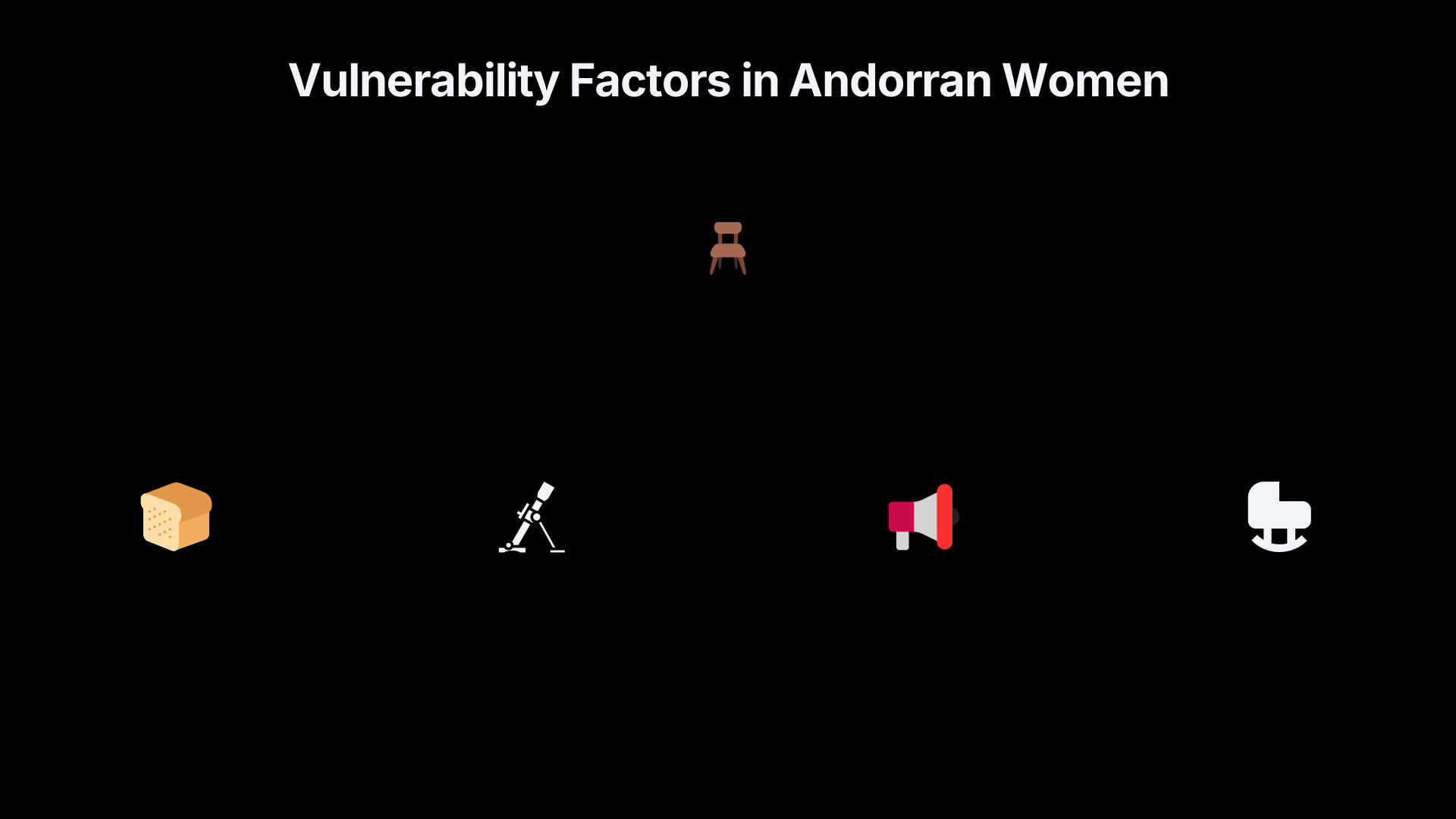
Women became especially vulnerable when they already occupied uncertain positions within village society. Risk factors included:
- widowhood or living without strong male family protection;
- poverty or dependence on neighbours;
- advancing age;
- difficult or outspoken personalities;
- involvement with household remedies or traditional healing;
- previous quarrels with other families.[historia.ad]historia.adOpen source on historia.ad.
These characteristics did not make someone a witch. Instead, they made accusations easier to believe. Once distrust already existed, later misfortunes appeared to confirm existing suspicions rather than challenge them.
Researchers also note that women’s domestic responsibilities placed them close to the very events most often linked with alleged witchcraft: caring for children, tending food, looking after animals and visiting neighbours’ homes. This everyday proximity could unintentionally create opportunities for suspicion whenever illness followed a visit or shared meal.[revistes.uab.cat]revistes.uab.catApril 25, 2017…
How rumours accumulated inside small communities
Perhaps the most striking feature of the Andorran records is the central role of reputation.
Witnesses were frequently questioned not only about specific incidents but also about whether the accused had a general reputation for being a witch. Historians describe this as the importance of fama—public reputation—which allowed rumours to acquire legal significance. Courts repeatedly investigated whether neighbours already regarded someone as a “witch and poisoner”, even when direct evidence of supernatural acts was absent.[Govern d’Andorra]govern.add’Andorra“La peça del mes”Govern d’Andorra“La peça del mes” - Govern d’Andorra…
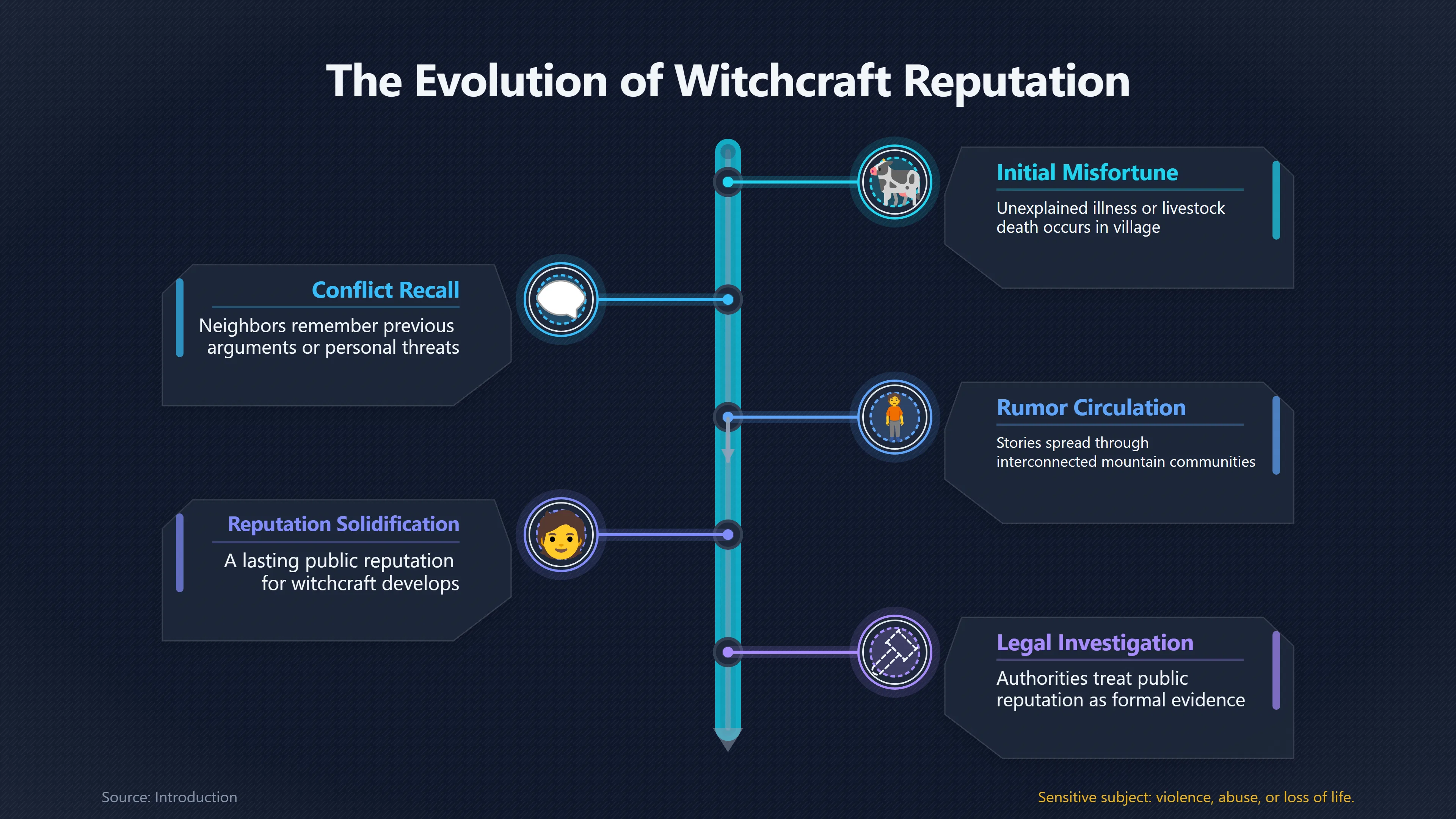
Rumours tended to grow through several stages:
- An unexplained misfortune occurred.
- People recalled earlier conflicts or threats.
- Stories circulated between neighbours.
- More incidents were attached to the same suspect.
- A lasting reputation developed.
- Authorities treated that reputation as evidence worthy of investigation.
Each step reinforced the next. Because villages were small and socially interconnected, information spread quickly and was repeatedly retold, often becoming more convincing through repetition.
When reputation became inherited
Rumour did not always stop with one individual. One of the distinctive findings from Andorran research is that suspicion could become attached to entire families.
As the sixteenth century progressed, historians have identified what they describe as “witch lineages”. Daughters and granddaughters of previously accused women sometimes attracted suspicion simply because of their family connections. Existing rumours encouraged investigators to view later misfortunes through the same lens, making fresh accusations easier to sustain.[historia.ad]historia.adOpen source on historia.ad.
Confessions extracted under judicial pressure could worsen the process. Women who admitted guilt after torture or coercion were often expected to identify supposed accomplices, allowing rumours to spread into new households and widening the circle of suspicion.[historia.ad]historia.adOpen source on historia.ad.
Why these accusations became deadly
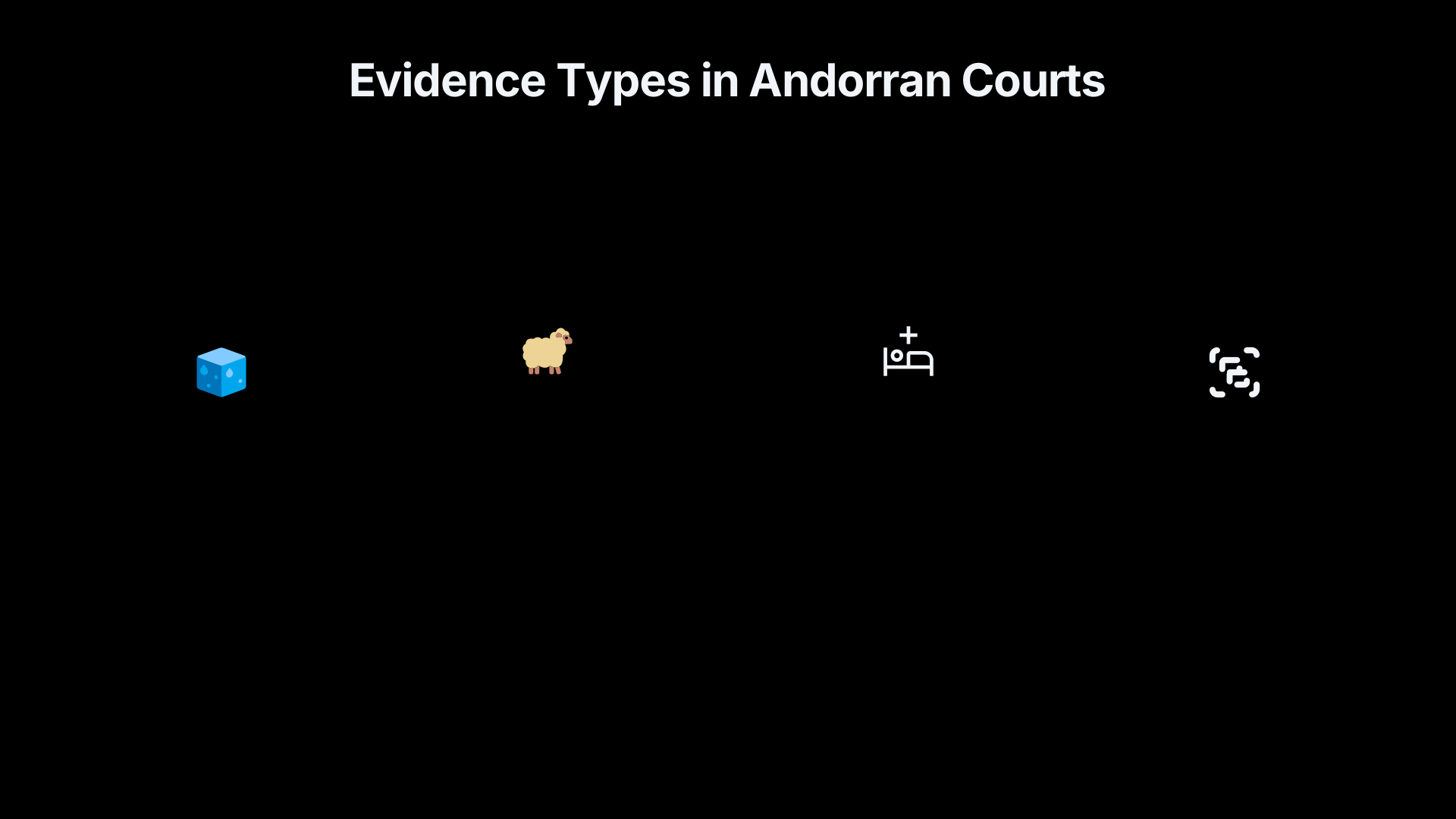
Village suspicion alone did not determine someone’s fate. The crucial step came when local courts accepted communal reputation as credible evidence.
Research into Andorra’s Tribunal de Corts shows that neighbourhood testimony, accumulated rumour and judicial torture combined to transform suspicion into criminal prosecution. Unlike the more sceptical approach often adopted by the Spanish Inquisition in witchcraft cases, Andorra’s secular courts proved willing to pursue prosecutions based largely on community belief, helping explain why accusations that began as local gossip could ultimately lead to executions.[historia.ad]historia.adOpen source on historia.ad.
Understanding this mechanism helps explain why Andorra’s witch trials unfolded over generations rather than as a single explosion of fear. The danger lay not in one extraordinary event but in the gradual way that everyday conflicts, repeated rumours and vulnerable reputations accumulated until neighbours came to believe that ordinary misfortune had a supernatural cause.
Amazon book picks
Further Reading
Books and field guides related to Why Did Neighbours Accuse Women of Witchcraft?. Use these as the next step if you want deeper reading beyond the article.

The witch-hunt in early modern Europe
Explains why accusations spread within communities.


The Penguin book of witches
Shows how neighbourly accusations appeared in original records.
Endnotes
1.
Source: historia.ad
Link:https://www.historia.ad/terra-de-bruixes/
2.
Source: historia.ad
Link:https://www.historia.ad/terra-de-bruixes-atles-2/
3.
Source: govern.ad
Title: d’Andorra“La peça del mes”
Link:https://www.govern.ad/ca/tematiques/cultura-i-esports/arxiu-nacional/publicacions/la-peca-del-mes/2018
Source snippet
Govern d’Andorra“La peça del mes” - Govern d’Andorra...
4.
Source: revistes.uab.cat
Link:https://revistes.uab.cat/manuscrits/article/view/v34-xam-mar
Source snippet
April 25, 2017...
Published: April 25, 2017
5.
Source: historia.ad
Link:https://www.historia.ad/terra-de-bruixes-atles-3
6.
Source: historia.ad
Link:https://www.historia.ad/terra-de-bruixes-atles-5/
7.
Source: govern.ad
Link:https://www.govern.ad/ca/w/s-amplia-el-fons-documental-sobre-la-cacera-de-bruixes-a-l-arxiu-nacional-amb-una-tesi-doctoral-de-l-historiador-pau-castell-1
8.
Source: historia.ad
Link:https://www.historia.ad/terra-de-bruixes-atles-7/
10.
Source: ddd.uab.cat
Title: cat La repressió de la bruixeria als Pirineus centrals
Link:https://ddd.uab.cat/record/286680
11.
Source: diariandorra.ad
Link:https://www.diariandorra.ad/opinio/la-tribuna/211114/bruixes_93533.html
12.
Source: terradebruixes.cultura.ad
Link:https://terradebruixes.cultura.ad/
Additional References
13.
Source: bondia.ad
Title: La persecució a les bruixes | Bondia
Link:https://www.bondia.ad/opinio/la-persecucio-a-les-bruixes
Source snippet
November 8, 2024 — Image: miquel-huguet Miquel Huguet Professor al màster de psicocreativitat a la UAB i inversor Plaça del Poble LA PERS...
Published: November 8, 2024
14.
Source: doi.org
Link:https://doi.org/10.7591/cornell/9781501779718.003.0002
Source snippet
The Witches of Sixteenth- and Seventeenth-Century Navarra | Bad Christians and Hanging Toads: Witch Crafting in Northern Spain, 1525-1675...
15.
Source: youtube.com
Link:https://www.youtube.com/watch?v=plN6onTiJpw
Source snippet
The Secret History of Witches | Witch Trials and Fear in History...
16.
Source: youtube.com
Title: The Witch-Hunt in Early Modern Europe: A Discussion with Brian Levack
Link:https://www.youtube.com/watch?v=eSvFMkcO2d4
Source snippet
A History of Witchcraft and Magic in Europe Part 7: The Early Modern Witch Trials...
17.
Source: youtube.com
Title: The Terror of History: The Witch Hunt in Early Modern Europe, UCLA
Link:https://www.youtube.com/watch?v=LOQND4fVF_w
Source snippet
The Witch-Hunt in Early Modern Europe: A Discussion with Brian Levack...
18.
Source: onlinelibrary.wiley.com
Title: 1468 0424.12717
Link:https://onlinelibrary.wiley.com/doi/full/10.1111/1468-0424.12717
Source snippet
wiley.comWork, Gender and Witchcraft in Early Modern England - Carter - 2025 - Gender & History - Wiley Online LibraryMarch 1, 2025 — WOR...
Published: March 1, 2025
19.
Source: bondia.ad
Link:https://www.bondia.ad/cultura/robert-pastor-historiador-les-quinze-dones-executades-per-bruixeria-les-va-condemnar-corts
20.
Source: youtube.com
Title: Witchcraft and Magic
Link:https://www.youtube.com/watch?v=1rHSu2oDZXE
Source snippet
The Terror of History: The Witch Hunt in Early Modern Europe, UCLA...
21.
Source: youtube.com
Title: The Secret History of Witches | Witch Trials and Fear in History
Link:https://www.youtube.com/watch?v=HvNHzeM3EjU
22.
Source: bondia.ad
Title: Benvinguts a la terra de les bruixes | Bondia
Link:https://www.bondia.ad/cultura/benvinguts-a-la-terra-de-les-bruixes
Topic Tree