Within Eswatini
What Really Happened at Sobokazane School?
The 2022 Sobokazane crisis mixed frightening symptoms, possession claims, abuse allegations and deep mistrust of school leadership.
On this page
- The October 2022 outbreak
- Possession, psychogenic illness and uncertainty
- Abuse allegations and institutional mistrust
Page outline Jump by section
Introduction
The events at Sobokazane High School in October 2022 became one of the most widely discussed school crises in modern Eswatini because they brought together several competing explanations for the same frightening events. Reports described pupils screaming, collapsing, rolling on the ground, claiming to see frightening visions or behaving as though they were under supernatural control. Some families and religious leaders interpreted the outbreak as demonic possession, while others pointed to mass psychogenic illness—a recognised phenomenon in which genuine physical and behavioural symptoms spread through a closely connected group without evidence of a toxic or infectious cause. At the same time, allegations of sexual abuse, poor leadership and institutional mistrust complicated both explanations, making Sobokazane far more than a simple story of either “mass hysteria” or possession.[nih.gov]pubmed.ncbi.nlm.nih.govPredictors of mass psychogenic illness in a junior secondary school in rural Botswana: A case control study - PubMedMay 30, 2022…
Rather than producing a single accepted explanation, the episode exposed how fear, trauma, rumour, religious belief and distrust of authority can reinforce one another. It has consequently become the clearest recent case through which to examine how collective crises develop in Eswatini.
The October 2022 outbreak
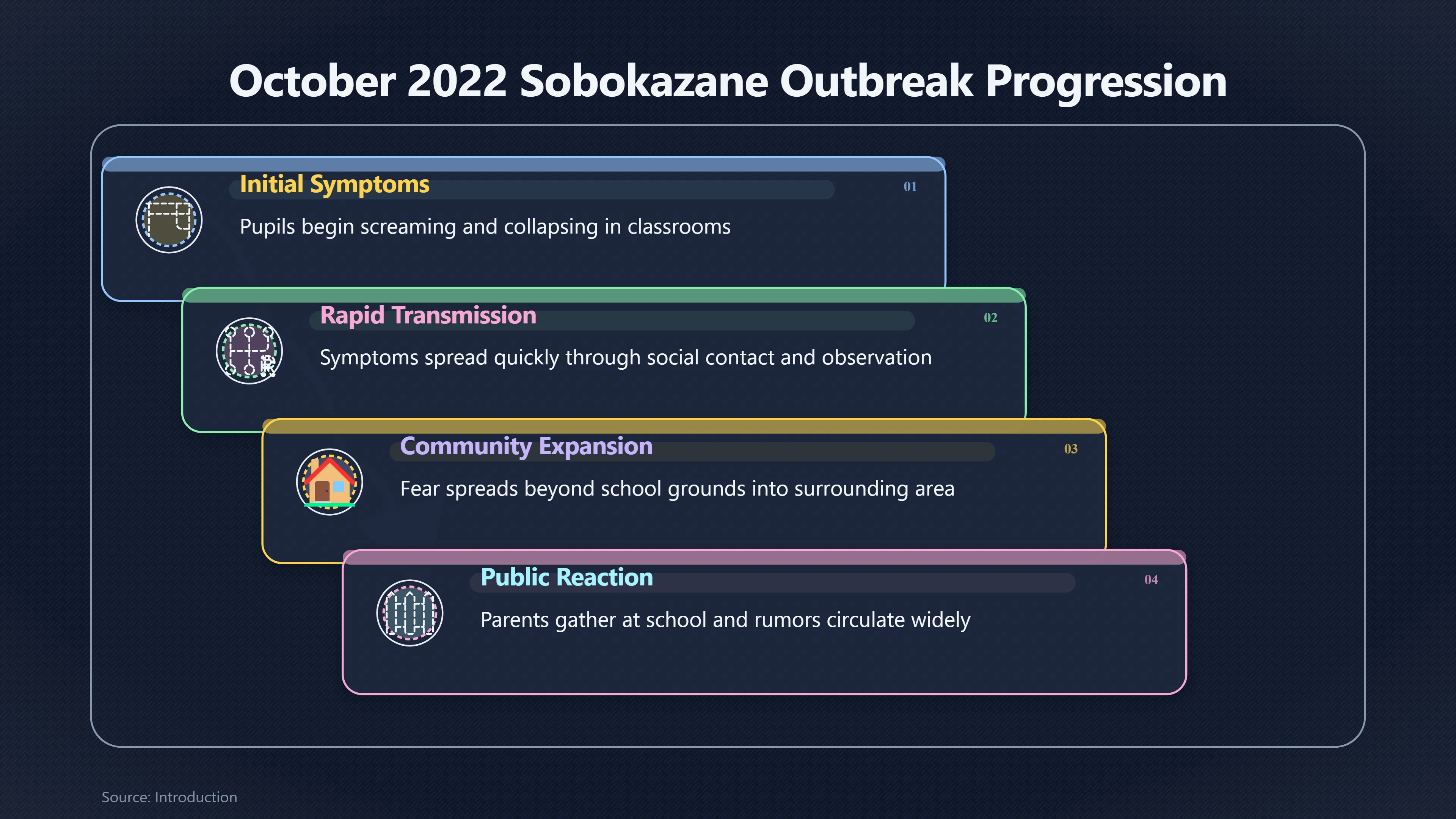
The crisis emerged at Sobokazane High School near Hhelehhele during October 2022. Local reports described dozens of pupils displaying dramatic symptoms including screaming, fainting, shaking, rolling on the ground and apparently losing awareness of their surroundings. Community reports suggested that more than one hundred learners were affected, prompting parents to gather at the school in large numbers while classes were severely disrupted.[Africa Press English]africa-press.netAfrica Press EnglishEducation Minister Lady Howard-Mabuza announces date for exams - Eswatini…
As often happens in school outbreaks across Africa, the symptoms spread rapidly through social contact. Pupils witnessed classmates becoming distressed, rumours circulated, anxious parents arrived, and the incident quickly expanded beyond the school grounds into the surrounding community. Accounts varied between newspapers and witnesses, illustrating how rapidly details changed as fear spread.
The outbreak occurred in an already difficult educational environment. Schools in Eswatini were operating after years of disruption caused by the COVID-19 pandemic and the political unrest of 2021, with compressed academic calendars and examination pressures adding further strain to learners and staff.[Africa Press English]africa-press.netminister announces compressed school calendar for 2022Africa Press EnglishMINISTER ANNOUNCES COMPRESSED SCHOOL CALENDAR FOR 2022 - EswatiniJanuary 22, 2022…
Possession, psychogenic illness and uncertainty
One reason Sobokazane remains controversial is that no single explanation gained universal acceptance.
Many parents and community members interpreted the behaviour through a religious framework. Reports referred to pupils being possessed by evil spirits or demons, and calls were made for prayer meetings, deliverance ministries and other spiritual interventions. Within communities where belief in spiritual forces forms part of everyday religious life, this interpretation appeared entirely reasonable to many observers.
Medical and psychological researchers, however, note that the reported pattern also resembles documented episodes of mass psychogenic illness. These outbreaks commonly occur in schools, especially among adolescents, and involve real symptoms rather than deliberate acting. Researchers emphasise that stress, fear and observation of affected classmates can contribute to the rapid spread of symptoms once anxiety takes hold.[PMC]pmc.ncbi.nlm.nih.govOpen source on nih.gov.
Importantly, mass psychogenic illness is not simply another name for pretending. Those affected experience genuine distress, even when no infectious disease or environmental toxin is identified.
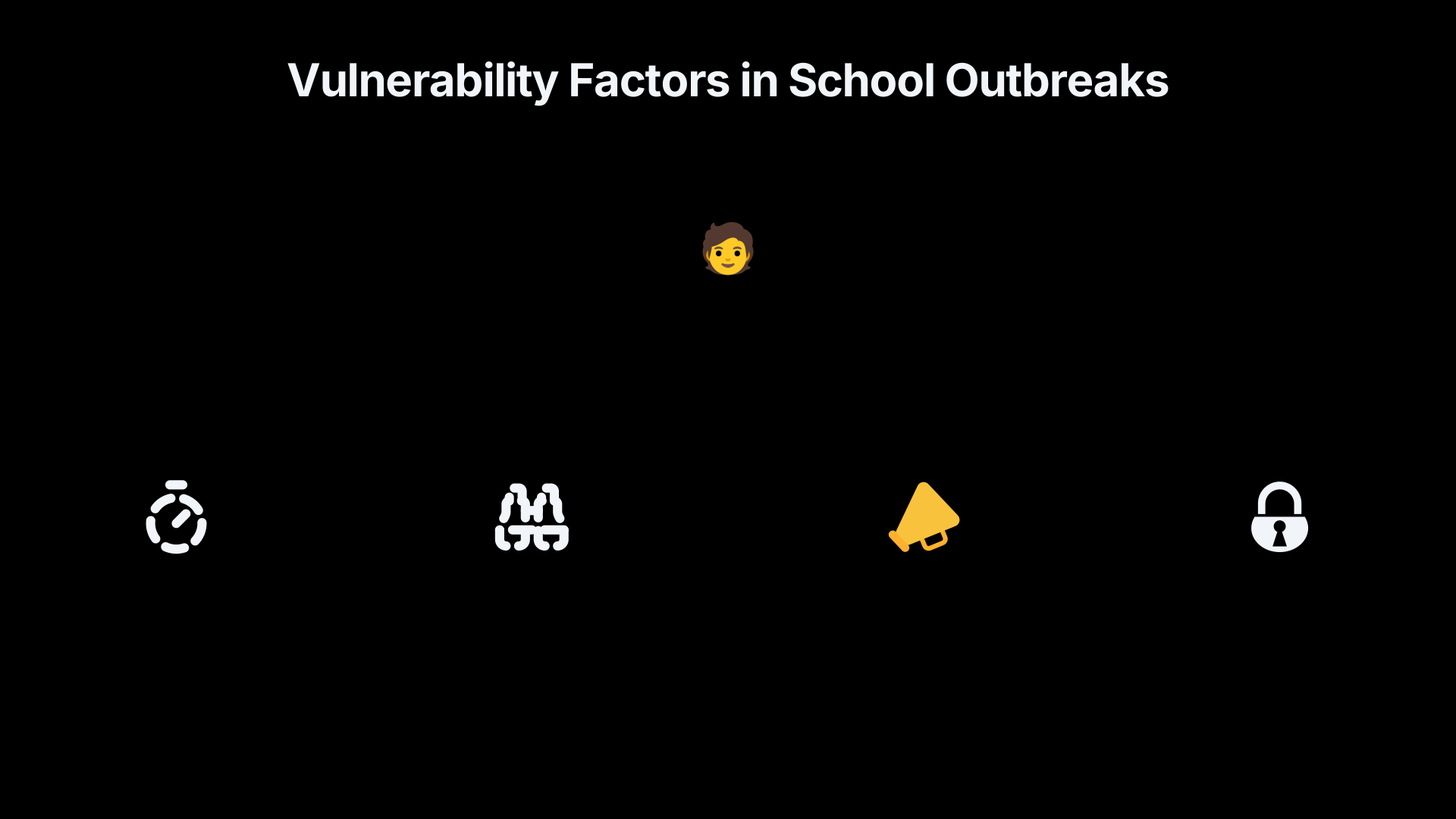
Researchers studying similar outbreaks elsewhere in southern Africa have identified several factors that increase vulnerability:
- recent traumatic experiences;
- psychological stress;
- close observation of affected classmates;
- rumours and heightened expectation;
- insecure or stressful boarding environments; and
- pre-existing belief that supernatural forces may be responsible.[PubMed]pubmed.ncbi.nlm.nih.govPredictors of mass psychogenic illness in a junior secondary school in rural Botswana: A case control study - PubMedMay 30, 2022…
These findings do not prove that Sobokazane followed exactly the same mechanism, but they provide a well-established scientific framework for understanding why such incidents can spread rapidly without requiring deliberate deception.
Why abuse allegations changed the story
What distinguished Sobokazane from many previous school possession scares was that the episode became intertwined with allegations extending beyond unexplained symptoms.
Parents and members of the community reportedly raised concerns about school management and allegations of sexual abuse involving members of staff. Whether or not every allegation could be substantiated, their existence fundamentally altered public understanding of the crisis. Instead of asking only whether pupils were possessed or psychologically affected, many observers began asking whether the outbreak reflected deeper institutional failures.
This distinction matters because psychological research consistently shows that environments marked by fear, insecurity, mistrust or unresolved conflict are more vulnerable to collective stress reactions. Allegations involving authority figures can intensify anxiety throughout a school community, especially when pupils believe adults cannot or will not protect them.[PubMed]pubmed.ncbi.nlm.nih.govPredictors of mass psychogenic illness in a junior secondary school in rural Botswana: A case control study - PubMedMay 30, 2022…
Consequently, some commentators argued that the outbreak should not be understood primarily as a supernatural mystery but as a symptom of broader distress within the institution.
Why investigators could not settle on one explanation
The available evidence leaves important questions unanswered.
No publicly available investigation established an environmental poison or infectious disease capable of explaining the pattern of illness. At the same time, no objective evidence demonstrated supernatural possession. The competing explanations therefore rested on different ways of interpreting the same observable behaviour.
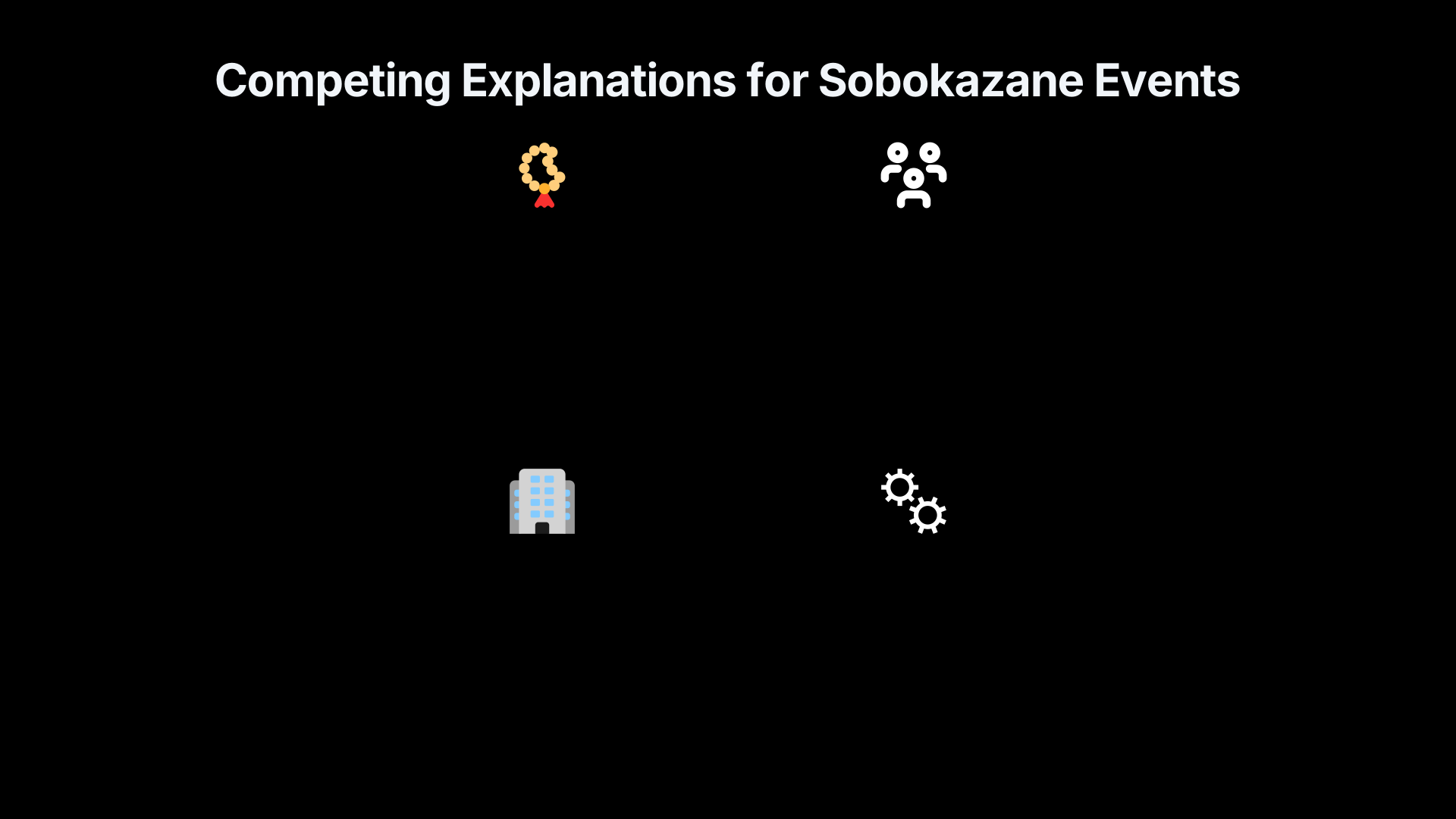
The principal interpretations can be summarised as follows:
ExplanationSupporting argumentsLimitationsSpiritual possessionMatched many families’ religious beliefs and eyewitness descriptions of unusual behaviour.Cannot be independently verified through scientific investigation.Mass psychogenic illnessClosely resembles numerous documented school outbreaks in Africa and elsewhere involving genuine symptoms spreading socially.Cannot explain every individual experience and requires exclusion of physical causes first.Stress linked to abuse allegations and institutional conflictFits evidence that fear, trauma and mistrust increase vulnerability to collective psychological reactions.Does not by itself explain every reported symptom.Multiple interacting causesRecognises that psychological distress, religious interpretation, rumours and institutional problems may all reinforce one another.Difficult to prove precisely how much each factor contributed.
Rather than pointing decisively toward one explanation, the evidence suggests that several processes may have operated simultaneously.
What Sobokazane reveals about collective fear
Sobokazane demonstrates that collective crises rarely spread because of one cause alone.
Once the first pupils became visibly distressed, several reinforcing processes appeared to operate:
- classmates witnessed alarming behaviour;
- rumours circulated rapidly;
- parents arrived already expecting a spiritual explanation;
- media attention increased public anxiety;
- allegations concerning the school heightened distrust of official reassurances; and
- religious and psychological interpretations competed rather than replacing one another.
This combination created a feedback loop in which every new incident strengthened existing expectations, regardless of which explanation individuals accepted.
Why the case remains important in Eswatini
Sobokazane has become an important reference point whenever unusual behaviour occurs in schools because it illustrates the limits of simple labels such as “mass hysteria” or “demonic possession”.
The case also highlights practical lessons for authorities. Medical assessment remains essential to exclude poisoning, infectious disease or other physical illness before concluding that an outbreak is psychogenic. At the same time, simply dismissing frightened pupils as suffering from “hysteria” risks overlooking genuine trauma, abuse allegations or failures of institutional trust.
For historians and social scientists, Sobokazane stands as a modern example of how collective fear develops when psychological stress, religious belief and social conflict intersect. Rather than showing that one explanation defeated the others, the episode demonstrates how multiple interpretations can coexist, each reflecting different understandings of the same unsettling events.



Endnotes
1.
Source: pmc.ncbi.nlm.nih.gov
Link:https://pmc.ncbi.nlm.nih.gov/articles/PMC9210177/
2.
Source: africa-press.net
Link:https://www.africa-press.net/eswatini/all-news/education-minister-lady-howard-mabuza-announces-date-for-exams
Source snippet
Africa Press EnglishEducation Minister Lady Howard-Mabuza announces date for exams - Eswatini...
3.
Source: africa-press.net
Title: minister announces compressed school calendar for 2022
Link:https://www.africa-press.net/eswatini/all-news/minister-announces-compressed-school-calendar-for-2022
Source snippet
Africa Press EnglishMINISTER ANNOUNCES COMPRESSED SCHOOL CALENDAR FOR 2022 - EswatiniJanuary 22, 2022...
Published: January 22, 2022
4.
Source: africa-press.net
Title: EDUCATIO N MINISTER TO RELEASE JC, EPC RESULTS TODAY
Link:https://www.africa-press.net/eswatini/all-news/education-minister-to-release-jc-epc-results-today
5.
Source: africa-press.net
Title: U S EMBASSY TO THE RESCUE, GIVES SCHOOL FACELIFT
Link:https://www.africa-press.net/eswatini/all-news/us-embassy-to-the-rescue-gives-school-facelift
6.
Source: africa-press.net
Title: ZENKOS I TSELA CROWNED MISS LOBAMBA HERITAGE
Link:https://www.africa-press.net/eswatini/all-news/zenkosi-tsela-crowned-miss-lobamba-heritage
7.
Source: africa-press.net
Title: PRINCIPAL S VOW TO DEFY MINISTER
Link:https://www.africa-press.net/eswatini/?p=5263
8.
Source: pubmed.ncbi.nlm.nih.gov
Link:https://pubmed.ncbi.nlm.nih.gov/35747341/
Source snippet
Predictors of mass psychogenic illness in a junior secondary school in rural Botswana: A case control study - PubMedMay 30, 2022...
Published: May 30, 2022
9.
Source: pmc.ncbi.nlm.nih.gov
Link:https://pmc.ncbi.nlm.nih.gov/articles/PMC3588562/
Additional References
10.
Source: times.co.sz
Link:https://times.co.sz/news/readmore.php?bhsadjgfoh=Mazombizwe+High+in+turmoil+as+disgruntled+parents+stage+walkout&bvhdgsj=News&yiphi=2709
Source snippet
January 29, 2026 — Thursday, July 9, 2026 Mazombizwe High in turmoil as disgruntled parents stage walkout Image: Mazombizwe High in turmo...
Published: January 29, 2026
11.
Source: eswatiniobserver.com
Title: Pre-School Teachers Arrested for Alleged E217,000 Fraud in Manzini
Link:https://eswatiniobserver.com/pre-school-fraud-teachers-nabbed-for-e217-000-fraud/
Source snippet
December 10, 2025 — PRE-SCHOOL FRAUD: TEACHERS NABBED FOR E217 000 FRAUD By Bongiwe Dlamini - December 10, 2025 248 0 Reading Time: 2 min...
Published: December 10, 2025
12.
Source: youtube.com
Link:https://www.youtube.com/watch?v=W1g5p8jOX3o
Source snippet
Episode 72. Mass Psychogenic Illness with Robert Baloh– Author of Medically Unexplained Symptoms...
13.
Source: youtube.com
Title: The Razor-Thin Line Between Contagion and Connection | Dan Taberski | TED
Link:https://www.youtube.com/watch?v=u0fFIJapsRY
Source snippet
'Case Of Students Being Fearful And Hungry': Dy CMO On Mass Hysteria In Uttarakhand School...
14.
Source: youtube.com
Link:https://www.youtube.com/watch?v=mnmv9erAqkM
Source snippet
Episode 71. Frenzy – The Turmoil of Mass Psychogenic Illness...
15.
Source: youtube.com
Title: Episode 71. Frenzy – The Turmoil of Mass Psychogenic Illness
Link:https://www.youtube.com/watch?v=e2AdorYLDF8
Source snippet
Believing is Seeing | Mysterious Tik Tok Tic Outbreak Documentary...
16.
Source: eswatiniobserver.com
Title: Contact Us
Link:https://www.eswatiniobserver.com/contact-us/
Source snippet
Eswatini Observer2 days ago — HEAD OFFICE Bakhi Street, Plot 969, Sidwashini Industrial Site, Mbabane H100, Eswatini P.O Box A385 Swazi P...
17.
Source: eswatiniobserver.com
Link:https://www.eswatiniobserver.com/news/
Source snippet
Eswatini Observer3 days ago — Thursday, July 9, 2026 Breaking News Eswatini hailed for combating HIV, TBMurder-Accused Pastor: Blue pillo...
Published: July 9, 2026
18.
Source: tandfonline.com
Link:https://www.tandfonline.com/doi/full/10.1080/14725843.2025.2474002
19.
Source: scielo.org.za
Link:https://scielo.org.za/scielo.php?pid=S2078-67862022000100038&script=sci_arttext
Topic Tree