Within Luxembourg Panics
Was Echternach Really a Dancing Plague?
Echternach's procession and Luxembourg's plague-era pilgrimage are real traditions, but neither proves a dancing plague or mass psychogenic outbreak.
On this page
- The hopping procession and the dancing plague legend
- Our Lady of Luxembourg during plague, war and famine
- How to distinguish ritual, folklore and mass psychogenic illness
Page outline Jump by section
Introduction
Echternach is often mentioned in discussions of medieval “dancing plagues”, yet the evidence does not support the claim that Luxembourg experienced a documented outbreak of mass psychogenic illness comparable to the famous episodes reported elsewhere in Europe. Instead, Echternach is home to one of Europe’s oldest surviving religious processions: a pilgrimage centred on the tomb of Saint Willibrord that developed over centuries as an organised act of devotion, healing and communal identity. Likewise, Luxembourg’s national pilgrimage to Our Lady of Luxembourg arose during times of plague, war and famine, but it was a structured religious response to crisis rather than evidence of contagious irrational behaviour. The confusion largely stems from later writers who blended folklore, miracle traditions and historical accounts of medieval dancing manias into a single story that the surviving evidence does not support.
Was Echternach really a dancing plague?
The famous Echternach procession is a genuine historical tradition, but it should not be confused with an uncontrolled epidemic of compulsive dancing.
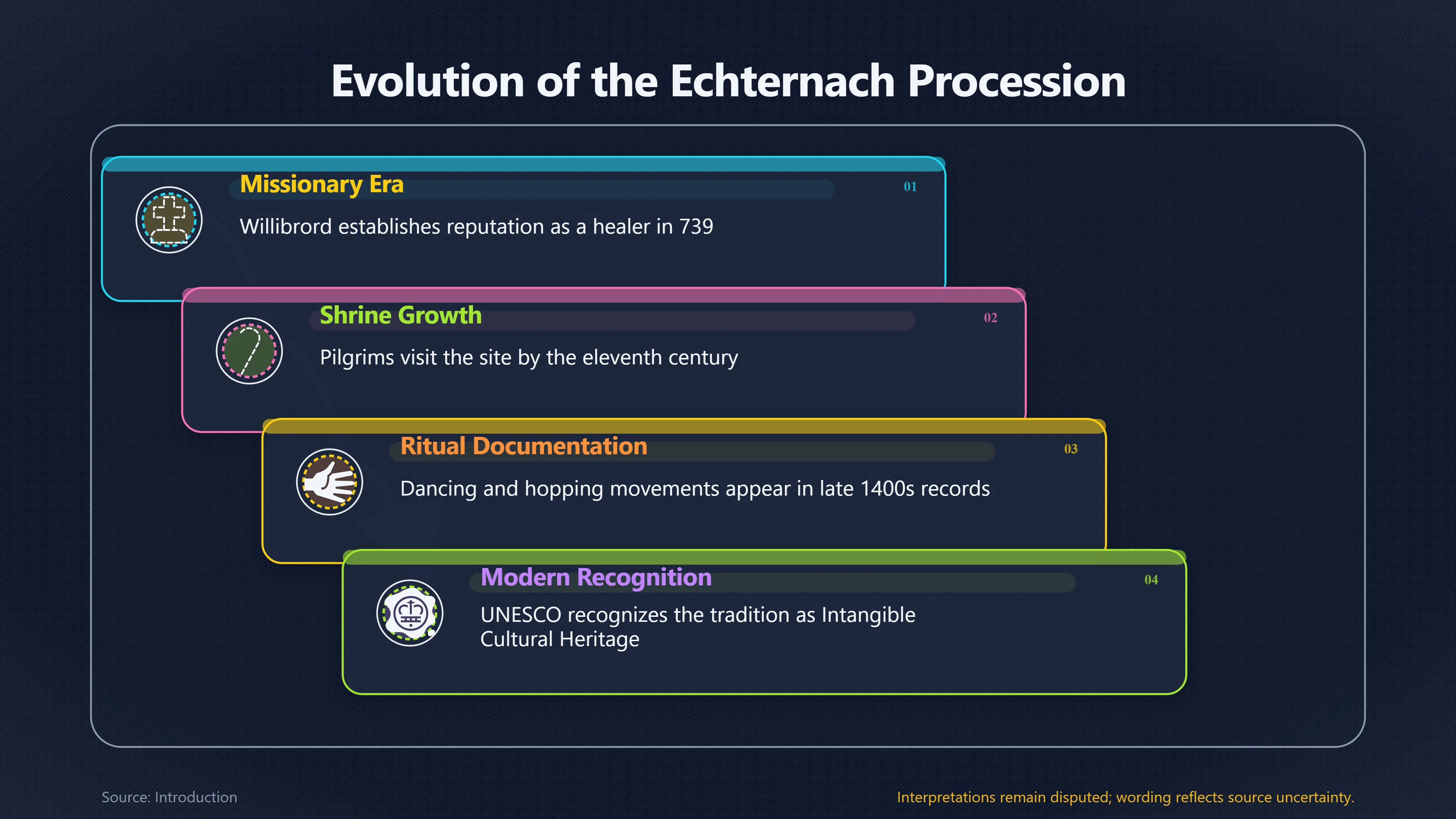
Pilgrims have travelled to the shrine of Saint Willibrord in Echternach since the early Middle Ages. Willibrord, an Anglo-Saxon missionary who died in 739, quickly acquired a reputation as a healer, particularly for people suffering from neurological or movement disorders. Reports of cures attracted pilgrims from across the surrounding regions, and by the eleventh century the shrine had become an important destination. The distinctive dancing or hopping procession itself appears clearly in documentary records only from the late fifteenth century, although earlier pilgrimage traditions certainly existed.[nih.gov]pubmed.ncbi.nlm.nih.govPub Med Relicts of dancing mania: the dancing procession of EchternachRelicts of dancing mania: the dancing procession of Echternach - PubMedDecember 10, 1999…
Today the procession follows a carefully organised ritual. Participants move through the streets in synchronised side-steps while holding white handkerchiefs, accompanied by music and prayer before gathering at the basilica containing Willibrord’s tomb. Rather than spontaneous or uncontrollable movement, the event is highly structured and transmitted from one generation to the next as an element of Luxembourg’s cultural and religious heritage. UNESCO recognised it as Intangible Cultural Heritage precisely because of its continuity as a living tradition.[ICH UNESCO]ich.unesco.orgICH UNESCOHopping procession of EchternachUNESCO Intangible Cultural Heritage…
Why the procession became linked with dancing mania
The misunderstanding developed because the procession includes rhythmic movement and because Willibrord became associated with illnesses affecting movement, including conditions historically grouped under names such as “Saint Vitus’ dance”.
Nineteenth- and twentieth-century writers interested in medieval choreomania—the phenomenon often called “dancing mania” or “dancing plague”—sometimes treated Echternach as a surviving remnant of those earlier episodes. Neurologist Paul Krack argued that the procession preserves elements of older traditions surrounding healing and movement disorders, but even his historical discussion does not claim that the modern procession itself demonstrates an outbreak of mass hysteria. Instead, he describes it as a ritual shaped by centuries of religious belief and pilgrimage.[American Academy of Neurology]neurology.orgAmerican Academy of Neurology Relicts of dancing mania | NeurologyAmerican Academy of NeurologyRelicts of dancing mania | NeurologyDecember 1, 1999…
An illuminating episode occurred in 1900 when the French neurologist Henri Meige travelled to Echternach hoping to observe something resembling pathological dancing. He found nothing of the sort. Although impressed by the spectacle, he reportedly expressed disappointment that there was no evidence of the kind of hysteria some earlier writers had imagined. His experience highlights the gap between popular expectations and the reality of an organised religious ceremony.[PubMed]pubmed.ncbi.nlm.nih.govPub Med Relicts of dancing mania: the dancing procession of EchternachRelicts of dancing mania: the dancing procession of Echternach - PubMedDecember 10, 1999…
The hopping procession and the dancing-plague legend
Several legends have become attached to the procession, but they should not be mistaken for historical documentation.
Among the best-known stories are:
- A plague legend, claiming the procession began after a town was delivered from epidemic disease.
- The fiddler legend, in which an unjustly condemned musician supposedly forced the townspeople into endless dancing through supernatural means until divine intervention ended the curse.
- Healing traditions, which link participation with protection against epilepsy, paralysis or other movement disorders.
These stories explain the ritual symbolically rather than historically. Modern historians find little evidence that they describe the actual origin of the procession. Instead, they reflect the medieval habit of attaching miracle narratives to important pilgrimage sites and saints. The procession itself appears to have evolved gradually through pilgrimage practices rather than emerging from a single dramatic event.[uni.lu]uni.luENThe story of the Echternach processionUNI ENThe story of the Echternach procession - FHSE news I University of Luxembourg…
The comparison with documented dancing manias elsewhere in Europe can also be misleading. Famous episodes such as Strasbourg in 1518 involved reports of apparently involuntary, prolonged dancing affecting groups of people over days or weeks under conditions of severe social stress. Echternach, by contrast, is a recurring religious festival with prescribed movements, clergy, music and ritual order. Even scholars who see cultural connections between medieval choreomania and later religious dance emphasise that these are different phenomena requiring different explanations.[PubMed]pubmed.ncbi.nlm.nih.govPub Med Relicts of dancing mania: the dancing procession of EchternachRelicts of dancing mania: the dancing procession of Echternach - PubMedDecember 10, 1999…
Our Lady of Luxembourg during plague, war and famine
A second misunderstanding concerns Luxembourg’s national Marian pilgrimage.
The annual Oktav pilgrimage honours the Virgin Mary as Consoler of the Afflicted and patron saint of Luxembourg. Its origins lie in 1624, when plague and other hardships affected the country. Authorities dedicated Luxembourg to Mary’s protection, and annual pilgrimages developed as acts of prayer for relief from disease and suffering. The Virgin was formally recognised as patron saint in 1666.[Luxembourg Public]luxembourg.public.luLuxembourg Public The Oktav: pilgrimage in honour of Luxembourg's patron saintThe Oktav: pilgrimage in honour of Luxembourg's patron saint - the Virgin Mary - LuxembourgMay 7, 2025…
This history is sometimes presented in sensational ways that imply panic or irrational collective behaviour. The surviving evidence instead points to something much more familiar across early modern Europe: organised communal devotion during periods of genuine danger.
People processed together because plague, war and famine created understandable fear. Religious pilgrimage offered:
- a recognised way to seek divine help;
- communal solidarity during crisis;
- opportunities for public prayer and charity; and
- reassurance that suffering had religious meaning.
Such behaviour reflects established Catholic practice rather than a medically documented episode of collective psychological contagion. The pilgrimage continues today as one of Luxembourg’s most important annual religious events, attracting participants from Luxembourg and neighbouring regions.[Luxembourg Public]luxembourg.public.luLuxembourg Public The Oktav: pilgrimage in honour of Luxembourg's patron saintThe Oktav: pilgrimage in honour of Luxembourg's patron saint - the Virgin Mary - LuxembourgMay 7, 2025…
How to distinguish ritual, folklore and mass psychogenic illness
Echternach illustrates why historians draw careful distinctions between different kinds of collective behaviour.
Religious ritual involves voluntary, organised participation following recognised traditions. Participants know what is expected, and the movements have symbolic meaning.
Folklore explains traditions through memorable stories, miracles or legends. These narratives preserve cultural identity but do not necessarily describe historical events literally.
Mass psychogenic illness refers to genuine outbreaks in which symptoms spread socially without an identifiable physical cause. Such episodes require evidence that people experienced involuntary symptoms which propagated through observation, expectation or shared anxiety.
The Echternach procession satisfies the first two categories far more clearly than the third. Its repeated annual structure, documented organisation and continuity over centuries argue against interpreting it as an example of ongoing collective psychological illness. Although medieval dancing manias remain an important subject in European history, using Echternach as straightforward proof of one oversimplifies both the historical record and the religious tradition.[unesco.org]ich.unesco.orgICH UNESCOHopping procession of EchternachUNESCO Intangible Cultural Heritage…
Why the myth persists
The idea that Echternach represents a surviving dancing plague remains attractive because it combines several memorable themes: mysterious medieval illness, miracle cures, pilgrimage, rhythmic movement and colourful local legend.
Popular books, documentaries and online summaries sometimes merge these separate traditions into a single narrative, making it appear that thousands of people have continued to re-enact a medieval outbreak of hysteria for centuries. The evidence does not support that conclusion.
Instead, Echternach demonstrates something more historically interesting. It shows how genuine pilgrimage traditions can accumulate legends over time, how later scholars sometimes reinterpret religious customs through medical theories, and how modern audiences often blur the boundary between ritual performance and spontaneous collective behaviour. For Luxembourg’s history of belief and social fears, the lesson is not that the country experienced a famous dancing plague, but that careful reading of the evidence separates enduring religious practice from later mythmaking and misplaced claims of mass hysteria.
Amazon book picks
Further Reading
Books and field guides related to Was Echternach Really a Dancing Plague?. Use these as the next step if you want deeper reading beyond the article.
The witch-hunt in early modern Europe
First published 1987. Subjects: Witchcraft, History, Hexenglaube, Geschichte (1450-1750), Heksenvervolgingen.

The Oxford illustrated history of witchcraft and magic
First published 2017. Subjects: History, Magic, Witchcraft, Magic, history.

Magic : A History
First published 2020. Subjects: Psychology, Ethnology, Religion, history, Magic, Social history.
The dancing plague
First published 2009. Subjects: Social conditions, Epidemic Chorea, Biography, History, Strasbourg (france).
Endnotes
1.
Source: uni.lu
Title: ENThe story of the Echternach procession
Link:https://www.uni.lu/fhse-en/news/the-story-of-the-echternach-procession/
Source snippet
UNI ENThe story of the Echternach procession - FHSE news I University of Luxembourg...
2.
Source: ich.unesco.org
Title: ICH UNESCOHopping procession of Echternach
Link:https://ich.unesco.org/en/RL/hopping-procession-of-echternach-00392
Source snippet
UNESCO Intangible Cultural Heritage...
3.
Source: basilika.lu
Title: Willibrordus Basilika Echternach Basilica & Willibrord
Link:https://basilika.lu/en/
Source snippet
Willibrordus Basilika EchternachBasilica & Willibrord - Willibrordus Basilika Echternach...
4.
Source: neurology.org
Title: American Academy of Neurology Relicts of dancing mania | Neurology
Link:https://www.neurology.org/doi/10.1212/WNL.53.9.2169
Source snippet
American Academy of NeurologyRelicts of dancing mania | NeurologyDecember 1, 1999...
Published: December 1, 1999
5.
Source: history.com
Title: what was the dancing plague of 1518
Link:https://www.history.com/articles/what-was-the-dancing-plague-of-1518
Source snippet
What Was the Dancing Plague of 1518? | HISTORY...
6.
Source: luxembourg.public.lu
Title: Luxembourg Public The Oktav: pilgrimage in honour of Luxembourg’s patron saint
Link:https://luxembourg.public.lu/en/society-and-culture/festivals-and-traditions/oktav.html
Source snippet
The Oktav: pilgrimage in honour of Luxembourg's patron saint - the Virgin Mary - LuxembourgMay 7, 2025...
Published: May 7, 2025
7.
Source: luxembourg.public.lu
Title: lu Our Lady of Fatima Pilgrimage: Honoring Heritage and Faith
Link:https://luxembourg.public.lu/en/society-and-culture/festivals-and-traditions/our-lady-fatima.html
8.
Source: luxembourg.public.lu
Link:https://luxembourg.public.lu/de/gesellschaft-und-kultur/feste-und-traditionen/oktav.html
9.
Source: luxembourg.public.lu
Link:https://luxembourg.public.lu/fr/societe-et-culture/fetes-et-traditions/oktav.html
10.
Source: luxembourg.public.lu
Link:https://luxembourg.public.lu/fr/societe-et-culture/fetes-et-traditions/notre-dame-de-fatima.html
11.
Source: luxembourg.public.lu
Title: lu Echternach Hopping Procession – a musical pilgrimage and UNESCO heritage
Link:https://luxembourg.public.lu/en/society-and-culture/festivals-and-traditions/echternach-hopping-procession.html
12.
Source: uni.lu
Title: The Octave, a pilgrimage like no other
Link:https://www.uni.lu/fhse-en/news/the-octave-a-pilgrimage-like-no-other/
13.
Source: orbilu.uni.lu
Title: lu OR Bilu: Miraculés de Notre-Dame de Luxembourg au 17e siècle
Link:https://orbilu.uni.lu/handle/10993/50548
14.
Source: orbilu.uni.lu
Title: lu OR Bilu: Wunderheilungen Unserer Lieben Frau von Luxemburg im 17. Jahrhundert
Link:https://orbilu.uni.lu/handle/10993/25535
15.
Source: gr-atlas.uni.lu
Link:https://gr-atlas.uni.lu/index.php/de/articles/re61/wu77
16.
Source: gr-atlas.uni.lu
Link:https://gr-atlas.uni.lu/index.php/fr/articles/re61/wu77
17.
Source: ich.unesco.org
Link:https://ich.unesco.org/en/decisions/5.COM/6.27
18.
Source: pubmed.ncbi.nlm.nih.gov
Title: Pub Med Relicts of dancing mania: the dancing procession of Echternach
Link:https://pubmed.ncbi.nlm.nih.gov/10599799/
Source snippet
Relicts of dancing mania: the dancing procession of Echternach - PubMedDecember 10, 1999...
Published: December 10, 1999
Additional References
19.
Source: justarrived.lu
Title: Pilgrimage of the Octave (Oktav) and Maërtchen in Luxembourg
Link:https://www.justarrived.lu/en/evenements/oktav-maertchen-pelerinage-octave
Source snippet
May 11, 2026 — Image: Pilgrimage and Octave Market at Luxembourg Cathedral Apr 18 Pilgrimage and Octave Market at Luxembourg Cathedral PI...
Published: May 11, 2026
20.
Source: justarrived.lu
Title: Echternach, pilgrimage and dancing procession in Luxembourg
Link:https://www.justarrived.lu/en/evenements/procession-dansante-echternach
Source snippet
June 1, 2026 — Sprangspressessioun dancing procession in Echternach SPRANGSPRESSESSIOUN DANCING PROCESSION IN ECHTERNACH Echternach, Luxe...
Published: June 1, 2026
21.
Source: youtube.com
Link:https://www.youtube.com/watch?v=Lkb_fcWey94
Source snippet
Echternach Dancing Procession 2025 - The big report...
22.
Source: youtube.com
Link:https://www.youtube.com/watch?v=0OExmzZDAbU
Source snippet
1928 RELIGION/ LUXEMBOURG: Dancing procession of Echternach...
23.
Source: youtube.com
Link:https://www.youtube.com/watch?v=hxbHhzlpdK4
Source snippet
TRADITION: Echternach Spring Procession 2025...
24.
Source: researchgate.net
Title: Relicts of dancing mania: The dancing procession of Echternach
Link:https://www.researchgate.net/publication/12701215_Relicts_of_dancing_mania_The_dancing_procession_of_Echternach
25.
Source: justarrived.lu
Title: Echternach, pèlerinage et procession dansante au Luxembourg
Link:https://www.justarrived.lu/en/generalites-luxembourg/procession-dansante-echternach/
26.
Source: youtube.com
Link:https://www.youtube.com/watch?v=AMmOdhxJIQI
Source snippet
Dancing Procession Of Echternach (1924)...
27.
Source: youtube.com
Link:https://www.youtube.com/watch?v=vHzGgF4Qfe0
28.
Source: iechternach.lu
Title: The Echternach dancing procession
Link:https://www.iechternach.lu/sprangprozessioun1913-part1.html
Topic Tree