Within Georgia
How the Threatened Family Replaced the Dangerous Sect
Anti-LGBT mobilisation reused an older panic structure by presenting a vulnerable minority as a threat to faith, children and national survival.
On this page
- The 2012 anti LGBT attack
- Faith, children and national survival
- Continuities with the earlier sect panic
Page outline Jump by section
Introduction
Georgia’s most visible episodes of religious and moral panic did not end with campaigns against supposedly dangerous religious “sects”. Instead, the central threat narrative gradually shifted. By the early 2010s, public mobilisation increasingly portrayed lesbian, gay, bisexual and transgender (LGBT) people as a danger to children, the traditional family and the survival of the Georgian nation. The target changed, but the underlying mechanism remained strikingly similar: a vulnerable minority was presented not simply as different, but as an organised force bringing foreign moral corruption into Georgia. This change helps explain why anti-LGBT mobilisation became one of the country’s most powerful forms of collective moral campaigning and why historians and human-rights researchers often see important continuities with the earlier anti-sect panic.[Human Rights Watch]hrw.orgHuman Rights WatchWorld Report 2014: World Report 2014: Georgia | Human Rights Watch…
How the threatened family replaced the dangerous sect
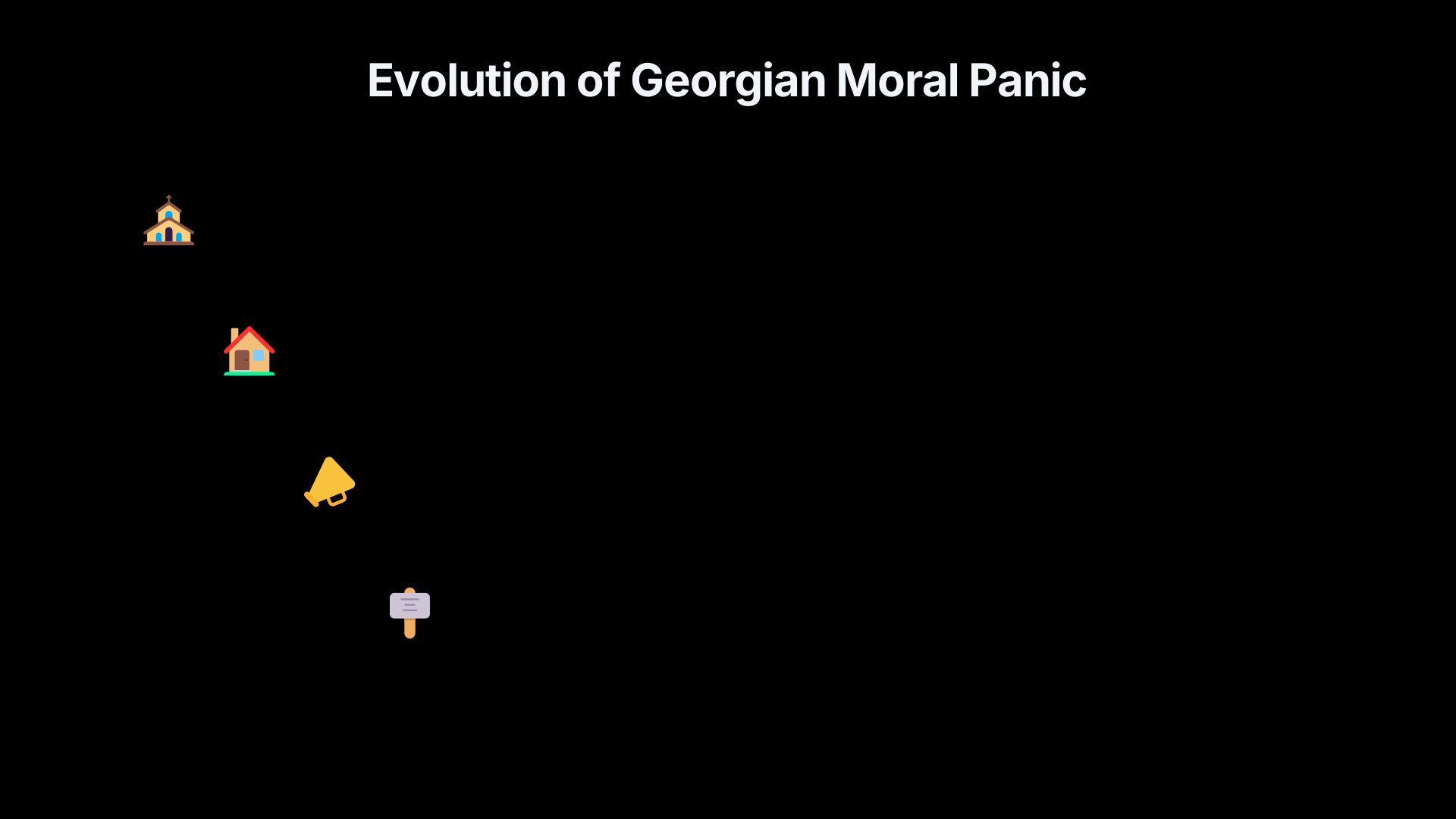
The anti-sect campaigns of the late 1990s and early 2000s largely focused on religious minorities such as Jehovah’s Witnesses, who were accused of destroying families, manipulating believers and weakening Georgian identity. As those campaigns lost momentum following court rulings, stronger law enforcement and international pressure, the same pattern of argument increasingly appeared in debates over sexuality and gender.
Instead of warning that foreign religious groups were infiltrating society, campaigners argued that Western ideas about LGBT equality threatened the family itself. Public discussion became less about theological disagreement and more about protecting children, preserving national traditions and resisting alleged moral decay. Rather than claiming that a secretive religious organisation endangered society, activists increasingly claimed that public visibility for LGBT people would undermine Georgia’s cultural future.[Human Rights Watch]hrw.orgHuman Rights WatchWorld Report 2014: World Report 2014: Georgia | Human Rights Watch…
This rhetorical shift mattered because it broadened the audience. Almost everyone belongs to a family, and appeals to defending children or protecting future generations could unite people who were not otherwise interested in religious disputes. The language of family protection therefore became a more effective vehicle for mass mobilisation than older warnings about “sects”.
The 2012 anti-LGBT attack
The transition became publicly visible on 17 May 2012, when activists organised Georgia’s first public event marking the International Day Against Homophobia. The gathering was quickly disrupted by counter-demonstrators, including Orthodox clergy and members of radical religious groups. Participants reported being assaulted before police restored order, and some activists criticised the authorities for intervening only after violence had begun.[Human Rights Watch]hrw.orgHuman Rights WatchWorld Report 2014: World Report 2014: Georgia | Human Rights Watch…
Although much larger violence followed during the 2013 commemoration, the 2012 incident demonstrated that the centre of moral panic had shifted. Instead of religious minorities accused of corrupting believers, LGBT activists became the new symbolic threat. Public arguments increasingly portrayed equal rights not as a question of civil liberties but as an attack on Georgia’s moral foundations.[ecoi.net]ecoi.netHRW – Human Rights Watch (Author): “World Report 2014 - Georgia”, Document #1109828 - ecoi.net…
Faith, children and national survival
The power of this mobilisation lay less in specific claims than in the emotional framework surrounding them.
Three recurring themes appeared repeatedly:
- Children at risk. Campaigners argued that recognising LGBT people would expose children to harmful moral influences, even though demonstrations primarily concerned equality and freedom of assembly rather than schools or child welfare.
- Religion under attack. LGBT rights were frequently presented as incompatible with Orthodox Christianity, allowing opposition to be framed as a defence of faith rather than discrimination.
- National survival. Western support for LGBT equality was often portrayed as evidence of foreign cultural pressure, making resistance appear patriotic rather than simply conservative.[Human Rights Watch]hrw.orgHuman Rights WatchWorld Report 2014: World Report 2014: Georgia | Human Rights Watch…
These arguments echoed older anti-sect rhetoric. Previously, minority religions had allegedly threatened family unity through conversion and foreign influence. Now, sexual minorities were described as threatening families through changing social norms. In both cases, minorities were depicted less as neighbours with different beliefs or identities than as symbols of outside interference.
Continuities with the earlier sect panic
The similarities between the two episodes are notable even though the targeted groups differed.
First, both campaigns relied on foreignness. Jehovah’s Witnesses had been portrayed as international organisations undermining Georgian traditions. LGBT equality was likewise framed as an imported Western ideology rather than a domestic human-rights issue.
Second, both relied on moral contamination. Earlier claims warned that “sects” would destroy families from within. Later campaigns suggested that public acceptance of LGBT people would corrupt children and traditional family life.
Third, both involved religious authority as a source of public legitimacy. Statements by influential clergy often shaped public understanding of the perceived threat, giving moral campaigns greater social reach than ordinary political protests.[ecoi.net]ecoi.netHRW – Human Rights Watch (Author): “World Report 2014 - Georgia”, Document #1109828 - ecoi.net…
Finally, both episodes revealed similar questions about state responsibility. Human-rights organisations and later judgments by the European Court of Human Rights criticised Georgia for failing to protect peaceful assemblies from organised violence, just as earlier investigations had criticised official passivity during attacks on religious minorities. In both settings, inadequate policing allowed symbolic campaigns to become physical confrontations.[Human Rights Watch]hrw.orgHuman Rights WatchWorld Report 2023: Georgia | Human Rights Watch…
Why historians see a recurring pattern
Researchers generally do not treat these episodes as identical. Opposition to minority religions and hostility towards LGBT people emerged from different political debates and involved different communities. Yet many scholars identify a common social mechanism.
During periods of uncertainty, rapid social change or contested national identity, fears often become concentrated on a visible minority that can be portrayed as representing wider cultural threats. The identity of that minority may change over time, while the underlying narrative remains remarkably stable: outside forces are said to be attacking faith, corrupting children and weakening the nation.
Seen from this perspective, Georgia’s transition from fears about dangerous sects to fears about threatened families was not simply a change of subject. It represented the adaptation of an established moral-panic framework to new political and cultural conflicts. Rather than disappearing after the decline of anti-sect violence, the language of defending society found a new target, demonstrating how collective fears can persist even as the groups they focus upon change.[Human Rights Watch]hrw.orgHuman Rights WatchWorld Report 2014: World Report 2014: Georgia | Human Rights Watch…

Amazon book picks
Further Reading
Books and field guides related to How the Threatened Family Replaced the Dangerous Sect. Use these as the next step if you want deeper reading beyond the article.

The Coddling of the American Mind
Examines fear, moral conflict and cultural polarization.
Endnotes
1.
Source: ecoi.net
Link:https://www.ecoi.net/en/document/1109828.html
Source snippet
HRW – Human Rights Watch (Author): “World Report 2014 - Georgia”, Document #1109828 - ecoi.net...
2.
Source: civil.ge
Title: U.S. Human Rights Report on Georgia – Civil Georgia
Link:https://civil.ge/archives/123541
3.
Source: ecoi.net
Link:https://www.ecoi.net/en/document/1115293.html
4.
Source: hrw.org
Link:https://www.hrw.org/world-report/2014/country-chapters/georgia
Source snippet
Human Rights WatchWorld Report 2014: World Report 2014: Georgia | Human Rights Watch...
5.
Source: hrw.org
Link:https://www.hrw.org/world-report/2023/country-chapters/georgia
Source snippet
Human Rights WatchWorld Report 2023: Georgia | Human Rights Watch...
6.
Source: hrw.org
Title: Bulgaria: Denounce Call to Stone Gays | Human Rights Watch
Link:https://www.hrw.org/news/2012/06/26/bulgaria-denounce-call-stone-gays
7.
Source: hrw.org
Link:https://www.hrw.org/legacy/wr2k2/europe9.html
8.
Source: hrw.org
Link:https://www.hrw.org/world-report/2022/country-chapters/georgia
Additional References
9.
Source: tandfonline.com
Link:https://www.tandfonline.com/doi/abs/10.1080/09637494.2024.2429941
Source snippet
January 27, 2025 — Research Article ‘WHERE WAS I THEN AND WHERE AM I NOW!’: CONTESTING SEXUALITIES, SECULARITY, AND THE SELF IN GEORGIA B...
Published: January 27, 2025
10.
Source: youtube.com
Link:https://www.youtube.com/watch?v=AxF5ws7pPCU
Source snippet
In Georgia, Church-Led 'Family Purity Day' Forces Out LGBTQ+ Events...
11.
Source: cambridge.org
Title: Galloway [Opens in a n
Link:https://www.cambridge.org/core/product/identifier/S1049096524001197/type/journal_article
Source snippet
Grooming Authoritarianism: Anti-Trans/Queer Panic as Pedagogy for Democratic Decline | PS: Political Science & Politics | Cambridge CoreJ...
12.
Source: eng.ghn.ge
Title: is offering execut
Link:https://eng.ghn.ge/news/7562-us-department-of-state-on-georgias-human-rights-practices-in-2013
Source snippet
Department of State - on Georgia’s Human Rights Practices in 2013 | GHN - News AgencyFebruary 28, 2014 — * Politics 28 February 2014, 13...
Published: February 28, 2014
13.
Source: youtube.com
Title: Anti-LGBT Protesters Break Up Pride Parade in Georgia | VOA News
Link:https://www.youtube.com/watch?v=w09DbPrDqZA
Source snippet
Tbilisi Pride march cancelled after far-right attack on headquarters | Georgia...
14.
Source: youtube.com
Title: In Georgia, Church-Led ‘Family Purity Day’ Forces Out LGBTQ+ Events
Link:https://www.youtube.com/watch?v=yJkImrG43Qo
Source snippet
Thousands of anti-LGBTQ+ protesters storm Georgia Pride festival...
15.
Source: youtube.com
Title: Thousands of anti-LGBTQ+ protesters storm Georgia Pride festival
Link:https://www.youtube.com/watch?v=_4R-Eijifi4
Source snippet
Anti-LGBT Protesters Break Up Pride Parade in Georgia | VOA News...
16.
Source: journals.sagepub.com
Link:https://journals.sagepub.com/doi/10.1177/13634607241297115
Source snippet
of impossible identities: Exploring biographical narratives of gay ex-Jehovah’s Witnesses - Chris Greenough, 2026October 27, 2024 — MEMOI...
Published: October 27, 2024
17.
Source: journals.sagepub.com
Link:https://journals.sagepub.com/doi/abs/10.1177/13634607241297115
Source snippet
of impossible identities: Exploring biographical narratives of gay ex-Jehovah’s Witnesses - Chris Greenough, 2026October 27, 2024 — First...
Published: October 27, 2024
18.
Source: refworld.org
Link:https://www.refworld.org/reference/annualreport/ilga/2013/en/34125
Topic Tree