Within Lesotho Panics
How Rumour Overwhelmed Colonial Authority
Fear spread because chiefs, courts and British officials were all suspected of protecting power rather than protecting ordinary people.
On this page
- Why chiefs and officials lost credibility
- The Jones inquiry and disputed official truth
- How the panic fed early nationalist politics
Page outline Jump by section
Introduction
The medicine murder crisis in late colonial Basutoland (now Lesotho) became far more than a series of criminal investigations. It developed into a profound crisis of public trust in which many Basotho doubted not only suspected killers but also the chiefs, courts and British colonial administration that claimed to protect them. As rumours spread, every official explanation risked being interpreted as evidence of concealment or political favouritism. This collapse of confidence helped transform a criminal problem into a wider moral and political panic, weakening colonial authority while strengthening demands for political reform and greater accountability. Historians now argue that the crisis cannot be understood simply through belief in ritual killing; it must also be seen as a story about governance, legitimacy and the consequences of institutions that had lost public credibility.[Cambridge University Press & Assessment]cambridge.orgCambridge University Press & AssessmentMedicine Murder in Basutoland: Colonial Rule and Moral Crisis | Africa | Cambridge CoreMarch 3, 2011…

Why chiefs and officials lost credibility
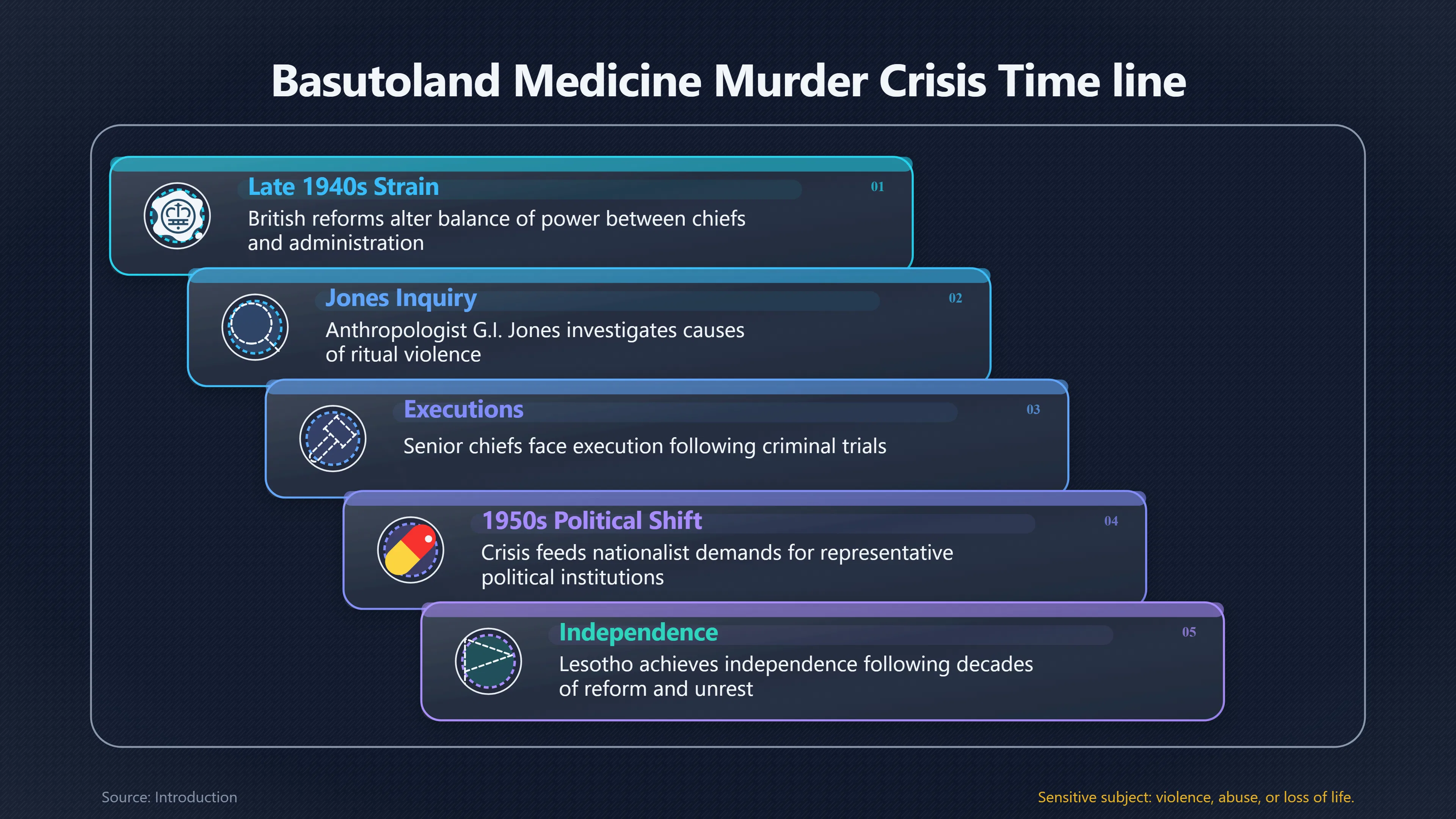
By the late 1940s, Basutoland’s political system was already under strain. British reforms had altered the balance of power between the colonial administration, the Paramount Chieftainship and local chiefs. Administrative and judicial changes reduced some traditional powers while increasing bureaucratic oversight, leaving many chiefs uncertain about their future authority and many ordinary people uncertain about who truly governed the country.[OUP Academic]academic.oup.comOUP AcademicBasutoland: ‘A Very Prickly Hedgehog’ | Medicine Murder in Colonial Lesotho: The Anatomy of a Moral Crisis | Edinburgh Schola…
These political changes coincided with disputes over succession to the Paramount Chieftainship and growing tensions within the chiefly hierarchy. When allegations emerged that prominent chiefs were connected to medicine murders, they struck at the heart of the political system. Chiefs were expected to provide justice and protection. Instead, some appeared to stand accused of exploiting supernatural beliefs to preserve power. Even where allegations were unproven, public confidence suffered because those responsible for maintaining order were themselves under suspicion.[Cambridge University Press & Assessment]cambridge.orgCambridge University Press & AssessmentMedicine Murder in Basutoland: Colonial Rule and Moral Crisis | Africa | Cambridge CoreMarch 3, 2011…
Colonial officials also faced growing scepticism. Police investigations often depended heavily upon accomplice testimony, which many observers regarded as unreliable or vulnerable to coercion. Trials produced convictions, including the execution of senior chiefs in 1949, yet they failed to settle public opinion. For some Basotho the convictions proved that powerful figures were guilty; for others they suggested that deeper conspiracies remained hidden or that political enemies had been selectively prosecuted. Either interpretation reinforced distrust rather than restoring confidence.[Cambridge University Press & Assessment]cambridge.orgCambridge University Press & AssessmentMedicine Murder in Basutoland: Colonial Rule and Moral Crisis | Africa | Cambridge CoreMarch 3, 2011…
Rumour flourished because neither traditional nor colonial institutions commanded universal confidence. In such an environment, every unexplained disappearance, mutilated body or contradictory official statement became further evidence that the authorities were either powerless or complicit.
The Jones inquiry and disputed official truth
In response to mounting anxiety, the colonial government appointed the anthropologist G. I. Jones in 1949 to investigate the apparent increase in medicine murders, identify their causes and recommend reforms. The inquiry recognised that the violence was real but rejected simplistic explanations that treated it solely as a matter of irrational belief or timeless custom. Instead, Jones argued that political instability and institutional change had made the crimes more frequent and more socially disruptive.[Wikisource]en.wikisource.orgPage:Basutoland Medicine Murder Report.pdf/5Page:Basutoland Medicine Murder Report.pdf/5 - Wikisource, the free online library…
Jones distinguished between what he regarded as the primary cause—the widespread belief that medicines containing human body parts possessed supernatural power—and the secondary causes that allowed the murders to become politically significant. These included succession disputes, struggles within the chiefly hierarchy and the unintended consequences of colonial administrative reforms. Rather than presenting ritual killing as evidence of an unchanging culture, the inquiry linked the crisis to rapidly changing political conditions.[OUP Academic]academic.oup.comOUP AcademicNarrative and Counter-Narrative: Explaining Medicine Murder | Medicine Murder in Colonial Lesotho: The Anatomy of a Moral Cri…
Yet the report did not produce a single accepted version of events. Colonial officials largely treated it as confirmation that reforms to local government and administration were needed. Some Basotho accepted its conclusions, while others believed it understated official responsibility or ignored evidence that influential people remained protected. Historians describe competing “official” and “counter-narrative” explanations emerging from the inquiry, illustrating how deeply divided public opinion had become.[oup.com]academic.oup.comOUP AcademicNarrative and Counter-Narrative: Explaining Medicine Murder | Medicine Murder in Colonial Lesotho: The Anatomy of a Moral Cri…
The inquiry therefore illustrates an important feature of crises of trust: even careful investigation cannot easily restore confidence once large sections of society believe that political institutions have become self-protective.
How rumour overwhelmed colonial authority
Rumours spread rapidly because they filled gaps left by uncertain information and weak institutional legitimacy. Every new allegation could be interpreted through existing fears that powerful individuals were sacrificing ordinary people to preserve wealth, office or influence.
Several conditions encouraged this process:
- Visible political conflict. Disputes over succession and authority made secret political violence appear plausible.
- Contradictory official messages. Investigations, prosecutions and public statements often failed to provide a coherent narrative that convinced all audiences.
- High-profile defendants. The involvement of senior chiefs meant accusations could not easily be dismissed as isolated criminal acts.
- Everyday insecurity. Communities experiencing rapid political and economic change were more receptive to explanations that linked misfortune to hidden networks of power.[oup.com]academic.oup.comOUP AcademicBasutoland: ‘A Very Prickly Hedgehog’ | Medicine Murder in Colonial Lesotho: The Anatomy of a Moral Crisis | Edinburgh Schola…
This dynamic resembles what sociologists describe as a crisis of institutional legitimacy. Rumours became persuasive not simply because they were dramatic but because many people no longer trusted official channels to establish the truth. In such circumstances, informal networks, local gossip and personal testimony often carried as much weight as court judgments.
Modern historians caution against treating every rumour as fact. While medicine murders unquestionably occurred, evidence does not support claims of an unlimited nationwide conspiracy directed by all chiefs or sanctioned by the colonial government. The panic expanded because documented crimes merged with widespread suspicion, political rivalry and uncertainty about how much the authorities actually knew.[Cambridge University Press & Assessment]cambridge.orgCambridge University Press & AssessmentMedicine Murder in Basutoland: Colonial Rule and Moral Crisis | Africa | Cambridge CoreMarch 3, 2011…
How the panic fed early nationalist politics
The crisis damaged two pillars of colonial government simultaneously. It undermined confidence in the hereditary chieftainship while also exposing the limits of British indirect rule, which depended upon those same chiefs to administer much of the country.
For emerging nationalist voices, this failure became evidence that Basutoland required more representative political institutions rather than continued reliance on colonial administrators and disputed chiefly authority. Public debates increasingly shifted from individual murders towards broader questions about accountability, constitutional reform and who possessed legitimate authority to govern.
The medicine murder controversy therefore entered political discourse alongside debates over constitutional change during the 1950s. Campaigns against medicine murder became intertwined with arguments about reforming local government, strengthening public institutions and redefining the relationship between chiefs, elected representatives and the colonial state. Rather than ending with criminal prosecutions, the crisis became part of the wider political transition that eventually led to Lesotho’s independence in 1966.[oup.com]academic.oup.comOUP AcademicDiagnoses and Resolutions: From Failure to Recrimination to Silence | Medicine Murder in Colonial Lesotho: The Anatomy of a M…

Why this crisis still matters
The Basutoland medicine murder panic remains significant because it demonstrates that collective fear often grows where trust in institutions has already weakened. The crimes themselves were horrifying, but they became politically explosive because many people believed that those responsible for protecting society were protecting themselves instead.
For historians of Lesotho, the episode is therefore not only a story about ritual killing or rumour. It is also a case study in how colonial governance, contested authority and public suspicion interacted to produce a broader collapse of confidence. Once that trust had broken down, official inquiries, criminal trials and administrative reforms could only partly restore legitimacy. The political consequences outlasted the panic itself, shaping debates about governance, justice and national leadership well into the independence era.[cambridge.org]cambridge.orgCambridge University Press & AssessmentMedicine Murder in Basutoland: Colonial Rule and Moral Crisis | Africa | Cambridge CoreMarch 3, 2011…
Amazon book picks
Further Reading
Books and field guides related to How Rumour Overwhelmed Colonial Authority. Use these as the next step if you want deeper reading beyond the article.
The Psychology of Conspiracy Theories
Explains rumour, distrust and conspiracy thinking.
Endnotes
1.
Source: cambridge.org
Link:https://www.cambridge.org/core/journals/africa/article/abs/medicine-murder-in-basutoland-colonial-rule-and-moral-crisis/D29C9ED05F553C9CFAA53C5C203BF46B
Source snippet
Cambridge University Press & AssessmentMedicine Murder in Basutoland: Colonial Rule and Moral Crisis | Africa | Cambridge CoreMarch 3, 2011...
Published: March 3, 2011
2.
Source: academic.oup.com
Link:https://academic.oup.com/edinburgh-scholarship-online/book/35571
Source snippet
OUP AcademicMedicine Murder in Colonial Lesotho: The Anatomy of a Moral Crisis | Edinburgh Scholarship Online | Oxford Academic...
3.
Source: academic.oup.com
Link:https://academic.oup.com/edinburgh-scholarship-online/book/35571/chapter-abstract/306171160
Source snippet
OUP AcademicBasutoland: ‘A Very Prickly Hedgehog’ | Medicine Murder in Colonial Lesotho: The Anatomy of a Moral Crisis | Edinburgh Schola...
4.
Source: academic.oup.com
Link:https://academic.oup.com/edinburgh-scholarship-online/book/35571/chapter-abstract/306172351
Source snippet
OUP AcademicNarrative and Counter-Narrative: Explaining Medicine Murder | Medicine Murder in Colonial Lesotho: The Anatomy of a Moral Cri...
5.
Source: en.wikisource.org
Title: Page:Basutoland Medicine Murder Report.pdf/5
Link:https://en.wikisource.org/wiki/Page%3ABasutoland_Medicine_Murder_Report.pdf/5
Source snippet
Page:Basutoland Medicine Murder Report.pdf/5 - Wikisource, the free online library...
6.
Source: en.wikisource.org
Title: Page:Basutoland Medicine Murder Report.pdf/70
Link:https://en.wikisource.org/wiki/Page%3ABasutoland_Medicine_Murder_Report.pdf/70
Source snippet
Page:Basutoland Medicine Murder Report.pdf/70 - Wikisource, the free online library...
7.
Source: academic.oup.com
Link:https://academic.oup.com/edinburgh-scholarship-online/book/35571/chapter/306172351
Source snippet
OUP AcademicNarrative and Counter-Narrative: Explaining Medicine Murder | Medicine Murder in Colonial Lesotho: The Anatomy of a Moral Cri...
8.
Source: en.wikisource.org
Title: Page:Basutoland Medicine Murder Report.pdf/6
Link:https://en.wikisource.org/wiki/Page%3ABasutoland_Medicine_Murder_Report.pdf/6
Source snippet
Page:Basutoland Medicine Murder Report.pdf/6 - Wikisource, the free online library...
9.
Source: academic.oup.com
Link:https://academic.oup.com/edinburgh-scholarship-online/book/35571/chapter/306172763
Source snippet
OUP AcademicDiagnoses and Resolutions: From Failure to Recrimination to Silence | Medicine Murder in Colonial Lesotho: The Anatomy of a M...
10.
Source: academic.oup.com
Link:https://academic.oup.com/shm/article-pdf/19/1/175/6872370/hkj027.pdf
11.
Source: academic.oup.com
Link:https://academic.oup.com/edinburgh-scholarship-online/book/35571/chapter/306171004
12.
Source: en.wikisource.org
Title: Page:Basutoland Medicine Murder Report
Link:https://en.wikisource.org/wiki/Page%3ABasutoland_Medicine_Murder_Report.pdf/45
13.
Source: cdn.nationalarchives.gov.uk
Link:https://cdn.nationalarchives.gov.uk/documents/migratedarchives-2.guidance.pdf
Additional References
14.
Source: africabib.org
Title: Africa Bib | Medicine Murder in Basutoland: Colonial Rule and Moral Crisis
Link:https://www.africabib.org/rec.php?RID=200800280
Source snippet
AfricaBib | Medicine Murder in Basutoland: Colonial Rule and Moral Crisis...
15.
Source: researchgate.net
Link:https://www.researchgate.net/publication/290076238_Medicine_Murder_in_Basutoland_Colonial_Rule_and_Moral_Crisis
16.
Source: youtube.com
Title: Lesotho History in 3 Minutes
Link:https://www.youtube.com/watch?v=J7ZhqIi0Oos
Source snippet
Exploring the Rich History of Basutoland Stamps...
17.
Source: youtube.com
Title: Kingdom of the Sky A History of Lesotho
Link:https://www.youtube.com/watch?v=Y-Uze1FFuoY
Source snippet
Why Isn't Lesotho Part of South Africa?...
18.
Source: youtube.com
Title: Why Isn’t Lesotho Part of South Africa?
Link:https://www.youtube.com/watch?v=4aAcGTDFKJI
Source snippet
Lesotho History in 3 Minutes...
19.
Source: youtube.com
Title: Exploring the Rich History of Basutoland Stamps
Link:https://www.youtube.com/watch?v=Fy5AnyFqxeM
20.
Source: hansard.parliament.uk
Title: uk Oral Answers To Questions
Link:https://hansard.parliament.uk/%E2%80%8CCommons/1958-12-18/debates/a4e3d8cc-0d50-430c-9a61-5dd3910fffce/OralAnswersToQuestions
21.
Source: youtube.com
Title: History of Lesotho
Link:https://www.youtube.com/watch?v=RiL1u8duaMU
Source snippet
Kingdom of the Sky A History of Lesotho...
22.
Source: hansard.parliament.uk
Title: Hansard Ritual Murder
Link:https://hansard.parliament.uk/commons/1958-12-18/debates/6390e041-fa18-4029-945a-6ec3bffdba20/RitualMurder
23.
Source: hansard.parliament.uk
Title: uk Basutoland
Link:https://hansard.parliament.uk/Commons/1958-12-18/debates/4cea0424-998a-46f6-b486-33e24a46b6e0/Basutoland
Topic Tree