Within Kyrgyzstan Panics
Why Did New Religions Seem So Threatening?
Post-Soviet anxiety turned unfamiliar churches and converts into symbols of foreign influence, often without evidence of real danger.
On this page
- Religious revival after Soviet rule
- How the label 'destructive sect' spread
- The Unification Church and wider suspicion
Page outline Jump by section
Introduction
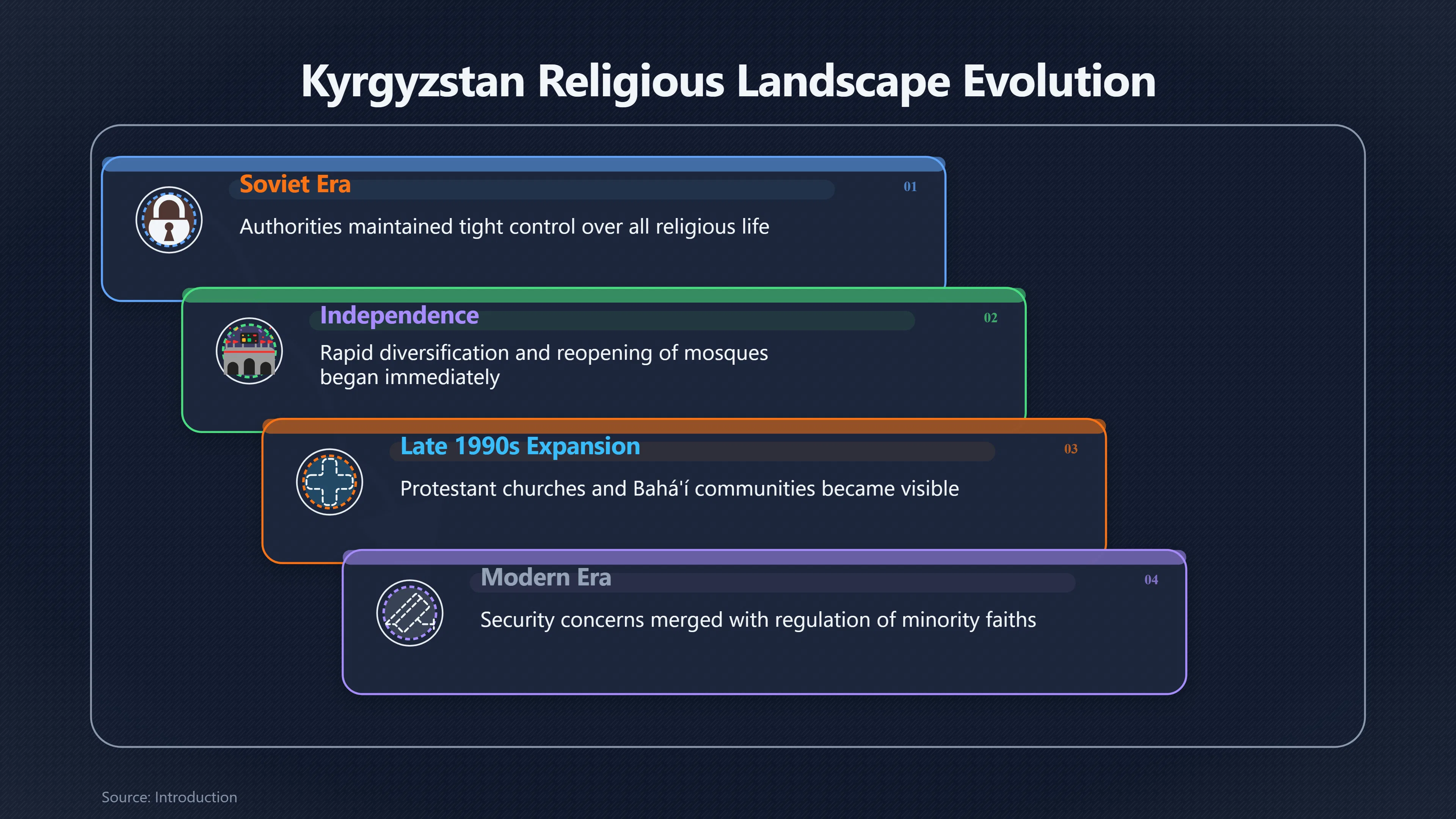
After Kyrgyzstan became independent in 1991, religious life changed with remarkable speed. Mosques reopened, foreign missionaries arrived, and new Christian, Bahá’í and other religious communities became far more visible than they had been under Soviet rule. This rapid diversification coincided with economic hardship, political uncertainty and a search for national identity. In that atmosphere, unfamiliar religious groups were often portrayed not simply as different faiths but as dangerous foreign influences or “destructive sects”, even where there was little evidence that they posed a genuine public threat. The resulting anxieties became one of Kyrgyzstan’s most significant examples of a modern moral panic: fears about religious difference were frequently treated as evidence of political or cultural subversion rather than assessed on the behaviour of individual groups.[Eurasianet]eurasianet.orgProtestants in Kyrgyzstan Face Hostile Reception | EurasianetProtestants in Kyrgyzstan Face Hostile Reception | EurasianetDecember 8, 2003…
Why unfamiliar religions suddenly appeared threatening
Soviet authorities had tightly controlled religious life for decades. When those restrictions disappeared, people encountered an unusually rapid expansion of religious organisations. Protestant churches, Jehovah’s Witnesses, Bahá’ís, Korean missionary groups and international Islamic charities all became more visible within only a few years.
For many citizens, the pace of change itself generated suspicion. Conversion away from Islam or Russian Orthodoxy could appear to challenge family traditions as well as religious belief. Missionary organisations often possessed foreign funding, overseas links and educational programmes, making them easy targets for rumours that they were advancing political or cultural agendas rather than simply practising religion. Researchers have argued that these fears reflected wider post-Soviet uncertainty more than evidence of widespread harmful activity.[Eurasianet]eurasianet.orgProtestants in Kyrgyzstan Face Hostile Reception | EurasianetProtestants in Kyrgyzstan Face Hostile Reception | EurasianetDecember 8, 2003…
The concern was especially strong because religion became intertwined with national identity. Although Kyrgyzstan remained officially secular, many people increasingly viewed Islam as an important marker of Kyrgyz identity and Russian Orthodoxy as historically linked with the country’s Russian minority. New religious movements therefore appeared not merely unfamiliar but symbolically foreign.
How the label “destructive sect” spread
The language of “sects” became one of the most influential ways of framing religious minorities during the late 1990s and early 2000s. Newspapers, officials and commentators increasingly described unfamiliar religious organisations as “destructive sects”, often without distinguishing between peaceful missionary churches, controversial high-control movements and genuinely violent extremist organisations.
One frequently cited example was a reported blacklist of 32 so-called “destructive religious sects”. The list reportedly included internationally recognised religious communities such as Jehovah’s Witnesses, Seventh-day Adventists and the Bahá’í Faith alongside organisations that critics considered more controversial. Observers noted that the classification appeared driven more by unfamiliarity and public anxiety than by documented criminal conduct.[Eurasianet]eurasianet.orgProtestants in Kyrgyzstan Face Hostile Reception | EurasianetProtestants in Kyrgyzstan Face Hostile Reception | EurasianetDecember 8, 2003…
The term itself carried considerable emotional force. Rather than inviting investigation into particular practices, it encouraged the assumption that religious minorities were inherently manipulative, anti-family or politically dangerous. As a result, public debate often focused less on what individual communities actually believed than on broader fears about foreign influence.
The Unification Church and wider suspicion
The controversy surrounding the Unification Church illustrated how quickly official recognition could become politically sensitive. Founded by Sun Myung Moon in South Korea, the movement had already attracted controversy internationally because of allegations concerning authoritarian leadership, aggressive fundraising and recruitment practices.
When Kyrgyz officials gave representatives of the church a relatively warm reception in 2006, critics reacted strongly. The debate was not confined to the organisation itself. Instead, the episode became a symbol of wider anxiety that foreign religious groups were gaining influence over a newly independent state.
Whether or not concerns about the Unification Church’s own practices were justified, the public discussion broadened into suspicion of foreign missionaries generally. Groups with entirely different beliefs and histories increasingly became associated in public discourse simply because they were perceived as imported religions. This illustrates how moral panics often spread by merging unrelated organisations into a single imagined threat.
Religious minorities caught in the backlash
The communities most affected were often those with little connection to the dramatic claims circulating about them.
Protestant churches reported increasing hostility, particularly outside the capital. Converts from Muslim backgrounds sometimes faced intense family pressure, social exclusion and disputes over burial rights. In several widely reported cases, local communities resisted allowing Protestant converts to be buried in public cemeteries because conversion was viewed as a rejection of communal identity rather than solely a personal religious choice.[ecoi.net]ecoi.netUSDOS – US Department of State (Author): “2017 Report on International Religious Freedom - Kyrgyz Republic”, Document #1436788 - ecoi.net…
Jehovah’s Witnesses encountered repeated legal and administrative obstacles despite successful court challenges. Registration difficulties limited their ability to establish congregations in parts of the country, while official rhetoric sometimes portrayed them as socially harmful despite international human rights rulings supporting their religious freedom claims.[ecoi.net]ecoi.netUSDOS – US Department of State (Author): “2020 Report on International Religious Freedom: Kyrgyzstan”, Document #2051642 - ecoi.net…
Other small communities, including Bahá’ís and smaller Protestant denominations, similarly found themselves discussed less in terms of their own beliefs than as examples of supposedly alien religious influence.
When fears about “sects” merged with fears about extremism
Kyrgyzstan has faced genuine security threats from violent Islamist organisations operating in Central Asia. Governments therefore had legitimate reasons to combat terrorism and armed extremist movements.
The difficulty arose when public discussion blurred the distinction between violent organisations and peaceful minority religions. Official lists of banned extremist organisations included internationally recognised terrorist groups, but at various times also listed the Family Federation for World Peace and Unification (formerly known as the Unification Church), creating confusion between security policy and broader regulation of unpopular religions. Human rights organisations have argued that increasingly broad religious legislation risked treating peaceful religious diversity as a security problem rather than protecting freedom of belief while targeting genuine violence.[ecoi.net]ecoi.netUSDOS – US Department of State (Author): “2022 Report on International Religious Freedom: Kyrgyzstan”, Document #2091949 - ecoi.netMay 15…
This pattern is characteristic of many moral panics. A real danger—in this case violent extremism—can make unrelated minorities appear suspicious simply because they fall outside familiar religious traditions.

Why these fears proved so persistent
Several social pressures reinforced anxiety about unfamiliar religions:
- Rapid post-Soviet change left many people searching for stable identities after the collapse of Communist institutions.
- Foreign funding and missionaries made new churches easy to portray as instruments of outside influence.
- Conversion within families sometimes created personal conflicts that became interpreted as wider social problems.
- Media language frequently used emotionally charged terms such as “sects” without carefully distinguishing among different organisations.
- State concern about extremism encouraged a security-focused approach to religion that sometimes extended beyond violent movements.[eurasianet.org]eurasianet.orgProtestants in Kyrgyzstan Face Hostile Reception | EurasianetProtestants in Kyrgyzstan Face Hostile Reception | EurasianetDecember 8, 2003…
Rather than arising from a single conspiracy or coordinated campaign, these fears developed through the interaction of political uncertainty, cultural change and genuine concern about security.
What historians and religious-freedom researchers conclude
Most researchers do not argue that every new religious movement entering Kyrgyzstan was benign. Like many countries, Kyrgyzstan has hosted organisations that have attracted criticism over leadership, recruitment methods or financial practices. Those questions deserve examination on a case-by-case basis.
The broader historical pattern, however, shows that the category of the “dangerous foreign sect” often expanded far beyond evidence of actual harm. Peaceful religious minorities were frequently grouped together despite profound differences in belief and practice. Human rights organisations have repeatedly warned that broad restrictions based on vague notions of “non-traditional” religion risk undermining freedom of religion while doing little to improve public security.[USCIRF]uscirf.govKyrgyzstan Country Update | USCIRFKyrgyzstan Country Update | USCIRF…
For historians of collective fear, Kyrgyzstan therefore provides an instructive example of a post-Soviet moral panic. The central story is not one of hidden cult conspiracies but of how rapid social change, uncertainty over national identity and legitimate security concerns combined to make unfamiliar religious minorities appear far more threatening than the available evidence usually justified.
Amazon book picks
Further Reading
Books and field guides related to Why Did New Religions Seem So Threatening?. Use these as the next step if you want deeper reading beyond the article.
The Psychology of Conspiracy Theories
Explains why unfamiliar groups become targets of suspicion.

Endnotes
1.
Source: eurasianet.org
Title: Protestants in Kyrgyzstan Face Hostile Reception | Eurasianet
Link:https://eurasianet.org/protestants-in-kyrgyzstan-face-hostile-reception
Source snippet
Protestants in Kyrgyzstan Face Hostile Reception | EurasianetDecember 8, 2003...
Published: December 8, 2003
2.
Source: ecoi.net
Link:https://www.ecoi.net/en/document/2051642.html
Source snippet
USDOS – US Department of State (Author): “2020 Report on International Religious Freedom: Kyrgyzstan”, Document #2051642 - ecoi.net...
3.
Source: ecoi.net
Link:https://www.ecoi.net/en/document/1436788.html
Source snippet
USDOS – US Department of State (Author): “2017 Report on International Religious Freedom - Kyrgyz Republic”, Document #1436788 - ecoi.net...
4.
Source: uscirf.gov
Title: Kyrgyzstan Country Update | USCIRF
Link:https://www.uscirf.gov/publications/kyrgyzstan-country-update
Source snippet
Kyrgyzstan Country Update | USCIRF...
5.
Source: ecoi.net
Link:https://www.ecoi.net/en/document/2091949.html
Source snippet
USDOS – US Department of State (Author): “2022 Report on International Religious Freedom: Kyrgyzstan”, Document #2091949 - ecoi.netMay 15...
6.
Source: uscirf.gov
Title: Kyrgyzstan | USCIRF
Link:https://www.uscirf.gov/countries/kyrgyzstan
Source snippet
Kyrgyzstan | USCIRF...
7.
Source: uscirf.gov
Link:https://www.uscirf.gov/news-room/releases-statements/new-religion-law-kyrgyzstan-marks-deterioration-religious-freedom
Source snippet
New Religion Law in Kyrgyzstan Marks the Deterioration of Religious Freedom | USCIRFOctober 24, 2025 — NEW RELIGION LAW IN KYRGYZSTAN MAR...
Published: October 24, 2025
8.
Source: uscirf.gov
Title: alarmed regressive amendments kyrgyz laws
Link:https://www.uscirf.gov/news-room/releases-statements/uscirf-alarmed-regressive-amendments-kyrgyz-laws
Source snippet
USCIRF Alarmed by Regressive Amendments to Kyrgyz Laws | USCIRFJanuary 31, 2025 — USCIRF ALARMED BY REGRESSIVE AMENDMENTS TO KYRGYZ LAWS...
Published: January 31, 2025
9.
Source: uscirf.gov
Title: releases report religious freedom kyrgyzstan
Link:https://www.uscirf.gov/news-room/releases-statements/uscirf-releases-report-religious-freedom-kyrgyzstan
Source snippet
USCIRF Releases Report on Religious Freedom in Kyrgyzstan | USCIRFOctober 3, 2023 — USCIRF RELEASES REPORT ON RELIGIOUS FREEDOM IN KYRGYZ...
Published: October 3, 2023
10.
Source: ecoi.net
Link:https://www.ecoi.net/en/document/2031347.html
Source snippet
USDOS – US Department of State (Author): “2019 Report on International Religious Freedom: Kyrgyz Republic”, Document #2031347 - ecoi.netJ...
11.
Source: eurasianet.org
Title: Kyrgyzstan: Court Confuses Jehovah’s Witnesses for Islamic Radicals | Eurasianet
Link:https://eurasianet.org/kyrgyzstan-court-confuses-jehovahs-witnesses-for-islamic-radicals
Source snippet
June 3, 2011 — KYRGYZSTAN: COURT CONFUSES JEHOVAH’S WITNESSES FOR ISLAMIC RADICALS Chris Rickleton Jun 3, 2011 A district court in Kyrgyz...
Published: June 3, 2011
12.
Source: uscirf.gov
Title: kyrgyzstan country update
Link:https://www.uscirf.gov/publication/kyrgyzstan-country-update
Source snippet
KYRGYZSTAN COUNTRY UPDATE In June 2025, a USCIRF delegation traveled to Kyrgyzstan to meet with civil society and government offici...
Published: June 2025
Additional References
13.
Source: youtube.com
Link:https://www.youtube.com/watch?v=LKT5opg2Isw
Source snippet
Kyrgyz Christian's Body Buried Three Times Amid Religious Tension illustrates the real-world impact of post-Soviet social and sectarian f...
14.
Source: youtube.com
Title: Kyrgyzstan to regulate religious schools
Link:https://www.youtube.com/watch?v=I6gUgnEJOVg
Source snippet
Church Gatherings Banned in Kyrgyzstan: Barnabas Aid Urges Prayers for Persecuted Christians...
15.
Source: youtube.com
Title: Kyrgyzstan religion: Descendants of Russian Cossacks celebrate roots
Link:https://www.youtube.com/watch?v=jLOZmfELY2k
Source snippet
Kyrgyzstan to regulate religious schools...
16.
Source: youtube.com
Title: Kyrgyz Christian’s Body Buried Three Times Amid Religious Tension
Link:https://www.youtube.com/watch?v=0SLO_3LfFCk
Source snippet
Questions Abound Over Salafism In Kyrgyzstan...
17.
Source: youtube.com
Title: Questions Abound Over Salafism In Kyrgyzstan
Link:https://www.youtube.com/watch?v=sW7H4kFf7ts
Source snippet
Kyrgyzstan religion: Descendants of Russian Cossacks celebrate roots...
Topic Tree