Within Ireland's Strange Beliefs
Why Did Ireland Avoid a Great Witch Hunt?
Ireland had witchcraft accusations and trials, but legal, political and religious divisions stopped them becoming a national campaign.
On this page
- Alice Kyteler and elite accusations
- Islandmagee and Ireland's last mass trial
- Why prosecutions remained rare
Page outline Jump by section
Introduction
Ireland believed in witches, harmful magic and supernatural forces for centuries, yet it never experienced the kind of nationwide witch-hunting that devastated parts of Scotland, Germany, Switzerland or France. That apparent contradiction has fascinated historians because belief alone does not explain why witch trials became mass persecutions in some places but remained relatively rare in others.
Modern scholarship has largely rejected the old idea that Ireland was somehow immune to fear of witchcraft. Instead, historians argue that accusations were common enough, but the legal, political and religious conditions needed to turn suspicion into sustained judicial campaigns rarely existed. Ireland did have dramatic cases—notably the prosecution of Alice Kyteler in 1324 and the Islandmagee witch trials of 1711—but these remained exceptional rather than the beginning of a wider panic.[Ulster University]pure.ulster.ac.ukUlster University Witchcraft belief and trials in early modern IrelandUlster UniversityWitchcraft belief and trials in early modern Ireland - Ulster University…
Why belief in witchcraft did not become a nationwide hunt
The key point is that belief and prosecution were not the same thing. Early modern Irish people frequently attributed illness, failed crops, bad luck or unexplained misfortune to supernatural causes. Magic, curses and protective rituals formed part of everyday popular culture across both Gaelic Irish and English or Scottish settler communities. Yet accusations usually stopped at the level of neighbourhood conflict, family dispute or local gossip rather than becoming criminal investigations.[Ulster University]pure.ulster.ac.ukUlster University Witchcraft belief and trials in early modern IrelandUlster UniversityWitchcraft belief and trials in early modern Ireland - Ulster University…
Several factors combined to prevent a large-scale witch-hunt.
- A fragmented legal system. English common law operated unevenly across Ireland, especially before the seventeenth century. Large areas retained Gaelic customs or were only loosely controlled by the Dublin administration, making coordinated prosecution difficult.[Ulster University]pure.ulster.ac.ukUlster University Witchcraft belief and trials in early modern IrelandUlster UniversityWitchcraft belief and trials in early modern Ireland - Ulster University…
- Religious diversity. Ireland contained Catholic, Anglican and later Presbyterian communities, each with different traditions concerning magic, sin and spiritual authority. There was no single religious institution capable of driving a nationwide campaign against witches.[Ulster University]pure.ulster.ac.ukUlster University Witchcraft belief and trials in early modern IrelandUlster UniversityWitchcraft belief and trials in early modern Ireland - Ulster University…
- Judicial scepticism. Irish judges generally demanded stronger evidence than was accepted in many continental courts. Historians have found repeated examples of civil authorities refusing to transform rumours into convictions.[Ulster University]pure.ulster.ac.ukUlster University Witchcraft belief and trials in early modern IrelandUlster UniversityWitchcraft belief and trials in early modern Ireland - Ulster University…
- Alternative ways of resolving accusations. Instead of resorting to criminal courts, many communities relied on clergy, reconciliation, folk healing or counter-magic to deal with suspected witchcraft. This reduced the likelihood that one accusation would trigger many others.[Ulster University]pure.ulster.ac.ukUlster University Witchcraft belief and trials in early modern IrelandUlster UniversityWitchcraft belief and trials in early modern Ireland - Ulster University…
Together, these conditions meant that the chain reactions characteristic of Europe’s great witch-hunts rarely developed in Ireland.
Alice Kyteler shows what happened when elite politics entered the picture
The famous prosecution of Alice Kyteler in Kilkenny in 1324 is often presented as Ireland’s first great witch trial, but it was not the beginning of a national panic.
Kyteler was a wealthy woman whose repeated marriages, property disputes and political connections made her a controversial figure. Richard de Ledrede, Bishop of Ossory, accused her of heresy, sorcery and making a pact with the Devil. The case reflected broader European ideas about organised demonic conspiracies that were spreading through church courts, but it also centred on inheritance disputes, episcopal authority and struggles between local elites.
Most importantly, the case did not generate copycat prosecutions across Ireland. Kyteler escaped, while her servant Petronilla de Meath was tortured and executed, making her the principal victim of the affair. The episode demonstrated that witchcraft accusations could become deadly under exceptional political circumstances, but it remained an isolated prosecution rather than the start of an Irish witch craze.[Ulster University]pure.ulster.ac.ukUlster University Witchcraft belief and trials in early modern IrelandUlster UniversityWitchcraft belief and trials in early modern Ireland - Ulster University…
Islandmagee: Ireland’s closest approach to a witch panic
If any Irish case resembled the better-known Scottish witch-hunts, it was the trial at Carrickfergus in 1711.
The accusations
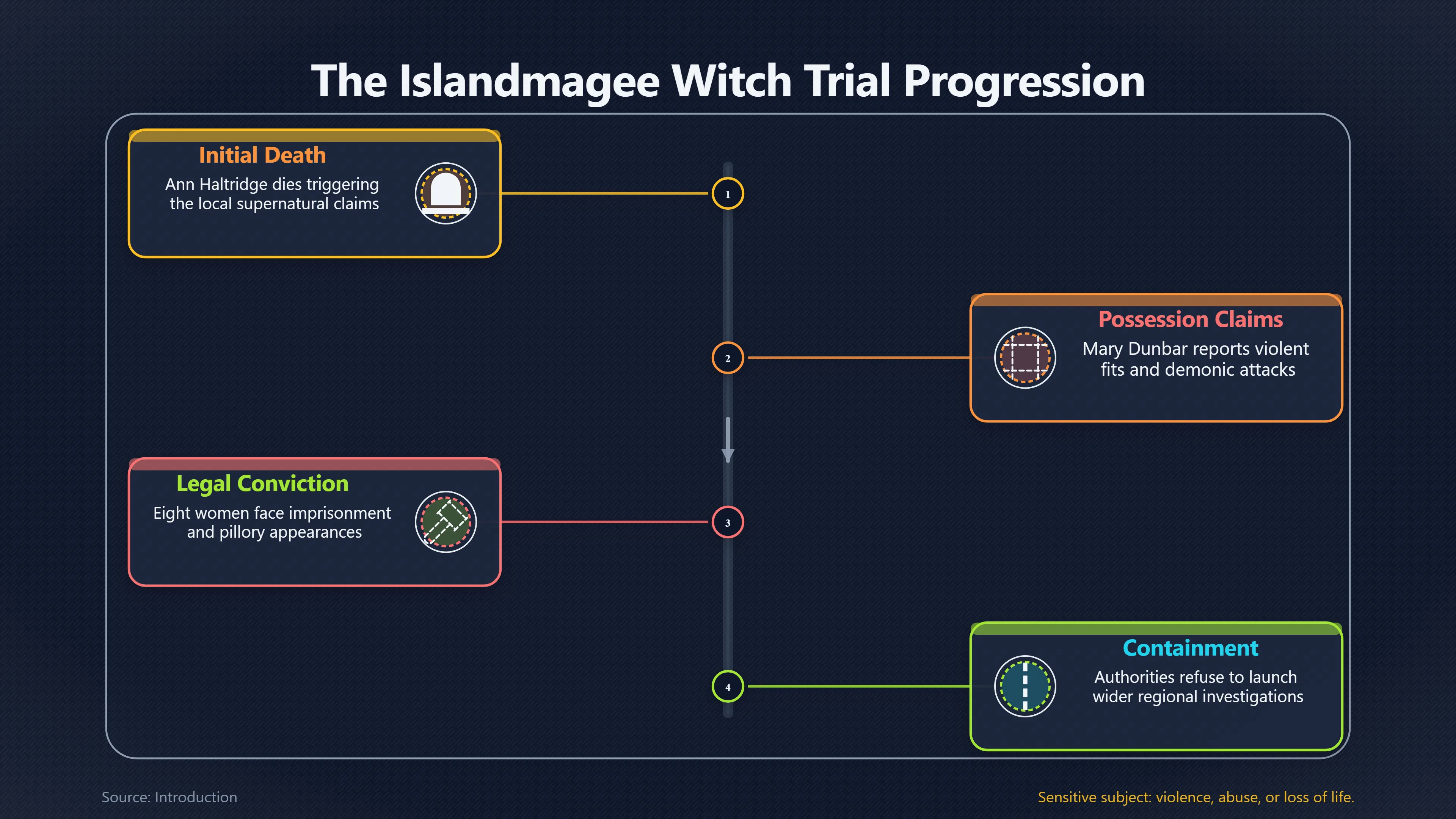
The affair began after the death of Ann Haltridge in Islandmagee, County Antrim. Soon afterwards, her young relative Mary Dunbar claimed to suffer violent fits and alleged that eight local women attacked her through witchcraft and demonic spirits. Witnesses described convulsions, strange behaviour and the supposed appearance of pins, nails and other objects emerging from her body—symptoms familiar from contemporary possession cases elsewhere in Britain.[Witches of Islandmagee]w1711.orgWitches of Islandmagee HISTORY – Witches of IslandmageeWitches of IslandmageeHISTORY – Witches of IslandmageeDecember 6, 2021…
Why the case remained exceptional
Eight women were convicted under the Irish Witchcraft Act of 1586 and sentenced to imprisonment and repeated appearances in the pillory. A further prosecution later that year targeted William Sellor. Yet even this extraordinary case failed to spark wider investigations.
Unlike Scotland, where interrogations often produced long chains of alleged accomplices, the Irish proceedings largely stopped with the original defendants. The authorities did not launch extensive regional investigations or encourage confessions naming dozens of additional witches. The panic remained geographically contained and soon subsided.[Witches of Islandmagee]w1711.orgWitches of Islandmagee HISTORY – Witches of IslandmageeWitches of IslandmageeHISTORY – Witches of IslandmageeDecember 6, 2021…
Modern historians increasingly interpret Islandmagee as a local crisis shaped by the beliefs of a Presbyterian community with close cultural ties to Scotland rather than evidence that Ireland generally embraced large-scale witch persecution.[Ulster University]pure.ulster.ac.ukUlster University Witchcraft belief and trials in early modern IrelandUlster UniversityWitchcraft belief and trials in early modern Ireland - Ulster University…
Why Ireland differed from Scotland
The contrast with neighbouring Scotland is particularly revealing because the two societies shared many supernatural beliefs.
Scotland experienced several major waves of witch-hunting between the late sixteenth and seventeenth centuries, resulting in thousands of prosecutions and a high execution rate. Historians attribute this partly to Scotland’s legal procedures, the authority of kirk sessions, widespread acceptance of demonic conspiracies and interrogation practices that encouraged suspects to implicate others.
Ireland lacked this combination. Even where Scottish settlers brought similar beliefs into Ulster, Irish courts and church structures proved less willing to sustain escalating prosecutions. As Andrew Sneddon’s research argues, Presbyterian church courts often managed accusations internally rather than pushing them into the criminal justice system, while judges remained comparatively reluctant to endorse weak supernatural evidence.[Ulster University]pure.ulster.ac.ukUlster University Witchcraft belief and trials in early modern IrelandUlster UniversityWitchcraft belief and trials in early modern Ireland - Ulster University…
This comparison shows that identical beliefs do not necessarily produce identical outcomes. Institutions mattered as much as popular fears.
Historians have revised the old explanation
Earlier writers sometimes suggested that Ireland escaped a major witch-hunt because Irish society was unusually tolerant or less superstitious than the rest of Europe.
Modern research paints a more complicated picture. Evidence now shows that accusations of harmful magic were considerably more frequent than historians once believed. The rarity lay not in belief but in prosecution.
Current scholarship therefore emphasises several interacting explanations:
- Witchcraft beliefs varied between Gaelic Irish, English settlers and Scottish Presbyterians rather than forming a single national tradition.
- Political instability and uneven state authority made coordinated campaigns difficult.
- Courts generally showed greater scepticism than those in regions with severe witch-hunts.
- Community and church mechanisms often defused disputes before they became criminal cases.
- Ireland never developed the self-reinforcing cycle in which one confession produced dozens of further accusations.[ulster.ac.uk]pure.ulster.ac.ukUlster University Witchcraft belief and trials in early modern IrelandUlster UniversityWitchcraft belief and trials in early modern Ireland - Ulster University…
Rather than asking why Ireland was “immune” to witch-hunting, historians now ask why its legal and social structures repeatedly interrupted processes that elsewhere produced mass persecution.
Why this matters for understanding collective fear
Ireland’s experience illustrates an important lesson in the history of moral panics and collective belief. Strong supernatural beliefs did not automatically produce mass hysteria or judicial terror. Fear required institutions capable of transforming rumour into official action.
The Alice Kyteler prosecution and the Islandmagee trials show that Ireland could generate dramatic witchcraft cases under particular local conditions. However, those cases remained isolated because political divisions, competing religious traditions, cautious judges and alternative ways of managing accusations prevented suspicion from spreading into the kind of nationwide witch-hunts seen elsewhere in Europe.
For historians of collective fear, Ireland is therefore significant not because witchcraft beliefs were absent, but because widespread belief repeatedly failed to become a sustained campaign of persecution.[ulster.ac.uk]pure.ulster.ac.ukUlster University Witchcraft belief and trials in early modern IrelandUlster UniversityWitchcraft belief and trials in early modern Ireland - Ulster University…
Amazon book picks
Further Reading
Books and field guides related to Why Did Ireland Avoid a Great Witch-Hunt?. Use these as the next step if you want deeper reading beyond the article.

The Burning of Bridget Cleary
Shows how supernatural belief persisted after the era of witch trials.

The Penguin book of witches
Introduces historical witchcraft cases and source material.

Witchcraft in Europe,
Provides comparative context for Ireland's relatively limited prosecutions.
Endnotes
1.
Source: researchgate.net
Title: Research Gate(PDF) Witchcraft Belief and Trials in Early Modern Ireland
Link:https://www.researchgate.net/publication/269900998_Witchcraft_Belief_and_Trials_in_Early_Modern_Ireland
2.
Source: researchgate.net
Title: 328746880 WITCHCRAFT the PRESS and CRIME in IRELAND 1822 1922
Link:https://www.researchgate.net/publication/328746880_WITCHCRAFT_the_PRESS_and_CRIME_in_IRELAND
3.
Source: pure.ulster.ac.uk
Title: Ulster University Witchcraft belief and trials in early modern Ireland
Link:https://pure.ulster.ac.uk/en/publications/witchcraft-belief-and-trials-in-early-modern-ireland-3/
Source snippet
Ulster UniversityWitchcraft belief and trials in early modern Ireland - Ulster University...
4.
Source: w1711.org
Title: Witches of Islandmagee HISTORY – Witches of Islandmagee
Link:https://w1711.org/history/
Source snippet
Witches of IslandmageeHISTORY – Witches of IslandmageeDecember 6, 2021...
Published: December 6, 2021
5.
Source: w1711.org
Title: Witches of Islandmagee ORIGINAL DOCS – Witches of Islandmagee
Link:https://w1711.org/originaldocs/
6.
Source: w1711.org
Title: Witches of Islandmagee ABOUT – Witches of Islandmagee
Link:https://w1711.org/about-me/
7.
Source: pure.ulster.ac.uk
Title: possessed by the devil the history of the islandmagee witch trial
Link:https://pure.ulster.ac.uk/en/publications/possessed-by-the-devil-the-history-of-the-islandmagee-witch-trial/
Source snippet
By the Devil: The History of the Islandmagee Witch Trials, 1711 New Edition - Ulster UniversityDecember 2, 2024 — POSSESSED BY THE DEVIL...
Published: December 2, 2024
8.
Source: pure.ulster.ac.uk
Title: roundtable the islandmagee witches 1711 creative and digital proj
Link:https://pure.ulster.ac.uk/en/publications/roundtable-the-islandmagee-witches-1711-creative-and-digital-proj/
9.
Source: pure.ulster.ac.uk
Title: ulster.ac.uk Witchcraft Belief, Representation and Memory in Modern Ireland
Link:https://pure.ulster.ac.uk/en/publications/witchcraft-belief-representation-and-memory-in-modern-ireland/
10.
Source: pure.ulster.ac.uk
Title: witchcraft the press and crime in ireland 1822 1922
Link:https://pure.ulster.ac.uk/en/publications/witchcraft-the-press-and-crime-in-ireland-1822-1922/
11.
Source: pure.ulster.ac.uk
Title: documents from the trial of the islandmagee witches at carrickfer
Link:https://pure.ulster.ac.uk/en/publications/documents-from-the-trial-of-the-islandmagee-witches-at-carrickfer/
Additional References
12.
Source: irishgetaways.com
Title: The Witch Trials of Ireland: Islandmagee and Beyond | Irish Getaways
Link:https://www.irishgetaways.com/blog/witch-trials-ireland-islandmagee-guide
Source snippet
May 25, 2026 — Culture & History THE WITCH TRIALS OF IRELAND: ISLANDMAGEE AND BEYOND Aidan O'Keenan May 25, 2026 7 min read Between 1450...
Published: May 25, 2026
13.
Source: theirishjewelrycompany.com
Title: Witch Trials in Ireland: Kilkenny, Islandmagee & Irish Folklore
Link:https://www.theirishjewelrycompany.com/blog/post/witch-trials-in-ireland
Source snippet
Surprisingly, the Emerald Isle witnessed far fewer witch trials than its neighbors. In fact, only a handful are recorded in the historica...
14.
Source: doi.org
Title: Witchcraft Belief in Early Modern Ireland | Springer Nature Link
Link:https://doi.org/10.1057/9781137319173_2
Source snippet
Witchcraft Belief in Early Modern Ireland | Springer Nature Link...
15.
Source: youtube.com
Title: Ireland’s Witch Trials | Witches: Truth Behind the Trials
Link:https://www.youtube.com/watch?v=I70imtvIdqU
Source snippet
Alice Kyteler and the Kilkenny Witch Trials...
16.
Source: fourcourtspress.ie
Link:https://www.fourcourtspress.ie/books/2015/templars-witch-wild-irish
17.
Source: historyireland.com
Link:https://historyireland.com/possessed-devil-real-history-islandmagee-witches-irelands-mass-witchcraft-trial/
18.
Source: catalogue.nli.ie
Link:https://catalogue.nli.ie/Record/vtls000492031
19.
Source: youtube.com
Title: Alice Kyteler and the Kilkenny Witch Trials
Link:https://www.youtube.com/watch?v=QueIpw4tJys
Source snippet
The Infamous Medieval Witch Case of Alice Kyteler...
20.
Source: socialhistory.org.uk
Title: Toil and Trouble: Ireland’s Last Witch Trial – The Social History Society
Link:https://socialhistory.org.uk/shs_exchange/toil-and-trouble-irelands-last-witch-trial/
21.
Source: colab.ws
Title: Witchcraft Trials and Demonic Possession in Early Modern Ireland | Co Lab
Link:https://colab.ws/articles/10.1057%2F9781137319173_6
Topic Tree