Within Bulgaria Beliefs
Were the Bogomils Heretics or Convenient Enemies?
Bogomilism became dangerous to rulers because disputes over ritual and church wealth were recast as threats to public order.
On this page
- What the Bogomils may have believed
- How hostile sources shaped their image
- Why religious dissent became political danger
Page outline Jump by section
Introduction
The Bogomils became one of medieval Bulgaria’s most controversial religious movements not simply because their teachings challenged Orthodox Christianity, but because church and state authorities increasingly portrayed them as a danger to the entire social order. Whether the movement truly posed a political threat remains debated. Almost everything historians know about the Bogomils comes from writings by their opponents, especially the tenth-century priest Cosmas (also known as Kosmas Presbyter), whose denunciation mixed theological criticism with warnings that Bogomil beliefs undermined obedience to both clergy and rulers. Modern scholarship therefore treats the Bogomils as both a genuine religious movement and an example of how medieval authorities could transform religious dissent into a matter of public security.[Cambridge University Press & Assessment]cambridge.orgUniversity Press & Assessment Bogomils (Chapter 14Cambridge University Press & AssessmentBogomils (Chapter 14) - The Cambridge Companion to Christian HeresyJuly 17, 2025…

What the Bogomils may have believed
Reconstructing Bogomil belief is unusually difficult because almost no writings produced by the Bogomils themselves have survived. Historians instead rely largely on hostile descriptions, comparing them with later dualist traditions and the few independent references that exist.
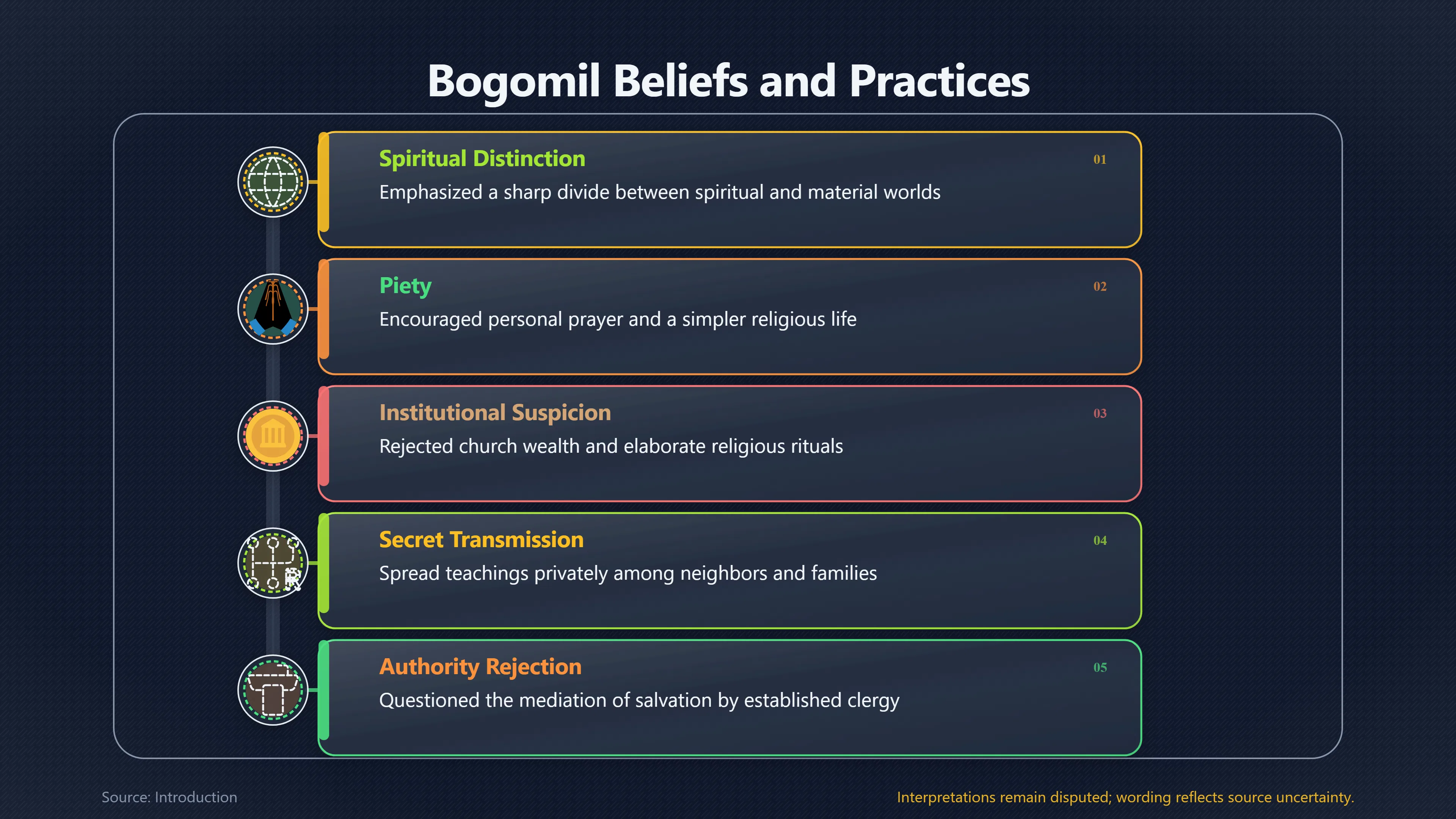
Most scholars agree that the movement probably rejected many features of the established Church, including its wealth, elaborate rituals and claim to mediate salvation. Bogomil teaching appears to have emphasised a sharp distinction between the spiritual and material worlds, regarding earthly institutions with deep suspicion. The movement encouraged personal piety, prayer and a simpler religious life while questioning practices that Orthodox clergy regarded as essential.[Cambridge University Press & Assessment]cambridge.orgUniversity Press & Assessment Bogomils (Chapter 14Cambridge University Press & AssessmentBogomils (Chapter 14) - The Cambridge Companion to Christian HeresyJuly 17, 2025…
Exactly how dualist the earliest Bogomils were remains disputed. Earlier scholarship often described them as heirs to older Manichaean traditions with a fully developed theology of two opposing cosmic powers. More recent historians argue that this picture may partly reflect the language used by opponents, who routinely classified unfamiliar religious movements by comparing them with earlier condemned heresies. The result is an incomplete and sometimes distorted picture of what ordinary Bogomil believers actually believed.[Cambridge University Press & Assessment]cambridge.orgUniversity Press & Assessment Bogomils (Chapter 14Cambridge University Press & AssessmentBogomils (Chapter 14) - The Cambridge Companion to Christian HeresyJuly 17, 2025…
How hostile sources shaped their image
The single most important source for early Bogomilism is Cosmas’s Sermon Against the Heretics, written in Bulgaria during the late tenth century. Rather than providing a neutral description, Cosmas aimed to persuade readers that the movement endangered both religion and society.
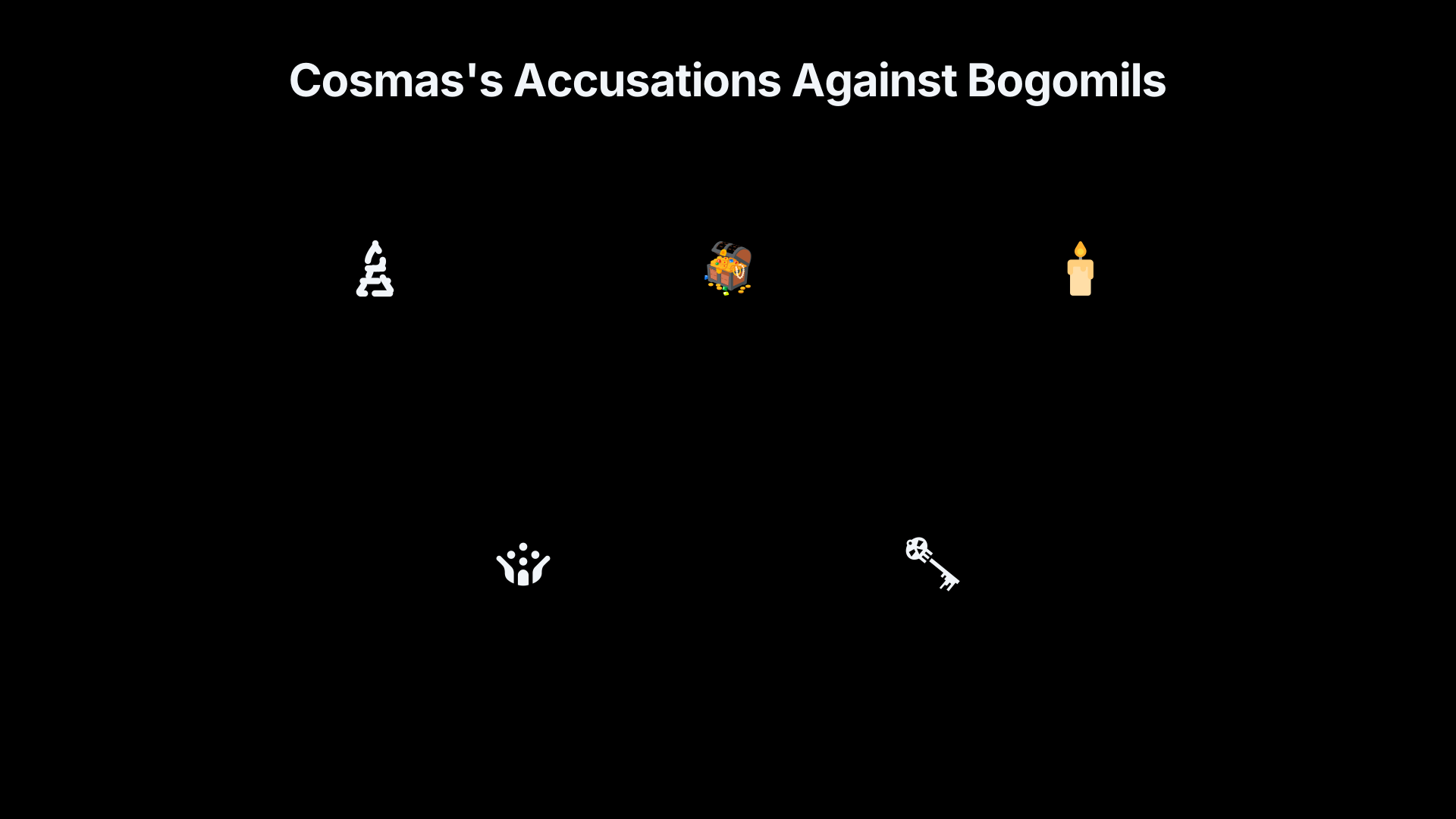
His accusations went well beyond doctrine. He portrayed the Bogomils as people who:
- rejected the authority of priests and bishops;
- criticised the wealth and corruption of the Church;
- ignored accepted religious ceremonies;
- encouraged ordinary people to distrust established authority;
- spread their teachings secretly among neighbours and families.
This combination of religious and social accusations was significant. Medieval heresy was rarely presented as a private matter of belief. Instead, religious error was described as contagious, capable of corrupting entire communities if left unchecked. By depicting the Bogomils as deceptive missionaries working quietly within society, hostile writers created an image of a hidden internal enemy rather than merely a group with unusual theological opinions.[Cambridge University Press & Assessment]cambridge.orgUniversity Press & Assessment Bogomils (Chapter 14Cambridge University Press & AssessmentBogomils (Chapter 14) - The Cambridge Companion to Christian HeresyJuly 17, 2025…
Modern historians therefore read Cosmas carefully but critically. His work remains indispensable because it preserves otherwise lost information, yet it is also a work of religious polemic designed to persuade rather than impartially document events. Separating observation from rhetorical exaggeration is one of the central challenges in studying Bogomilism.[Cambridge University Press & Assessment]cambridge.orgUniversity Press & Assessment Bogomils (Chapter 14Cambridge University Press & AssessmentBogomils (Chapter 14) - The Cambridge Companion to Christian HeresyJuly 17, 2025…
Why religious dissent became a political danger
The Bogomils emerged during a period when the Bulgarian state and the Orthodox Church were still strengthening Christianity after the country’s conversion. Religious unity was closely tied to political stability.
If believers questioned the authority of priests, they also challenged institutions that helped legitimise royal authority. Medieval rulers depended upon the Church to perform ceremonies, uphold law, collect influence across local communities and reinforce the idea that political authority formed part of God’s order. A movement that criticised clerical wealth or denied the spiritual value of established institutions therefore appeared capable of weakening the foundations of government itself.[Cambridge University Press & Assessment]cambridge.orgUniversity Press & Assessment The Bogomils (Chapter 23Cambridge University Press & AssessmentThe Bogomils (Chapter 23) - Church and Society in Byzantium under the Comneni, 1081–1261…
Hostile sources also claimed that Bogomils encouraged people to reject worldly obligations. Whether these accusations accurately reflected everyday Bogomil practice remains uncertain, but they helped transform theological disagreement into an issue of governance. In medieval political thinking, refusal to respect earthly authority could easily be interpreted as rebellion, even when no organised political revolt existed.[Encyclopedia.com]encyclopedia.comBogomils | Encyclopedia.comBogomils | Encyclopedia.com
This helps explain why rulers did not distinguish sharply between religious dissent and political loyalty. Protecting orthodoxy was viewed as protecting the kingdom.
Were the Bogomils really enemies of the state?
Modern historians generally reject the simple picture presented in medieval polemics.
There is little evidence that the Bogomils organised armed revolts or sought to overthrow governments directly. Instead, their reputation as political enemies largely stemmed from the implications that church and secular authorities drew from their beliefs. A movement that denied the legitimacy of important institutions could be portrayed as threatening public order even without advocating violence.[Cambridge University Press & Assessment]cambridge.orgUniversity Press & Assessment Bogomils (Chapter 14Cambridge University Press & AssessmentBogomils (Chapter 14) - The Cambridge Companion to Christian HeresyJuly 17, 2025…
Scholars therefore distinguish between two related but different realities:
- A genuine religious movement that criticised established religious authority and attracted followers across Bulgaria and neighbouring regions.
- An official political narrative that magnified the movement into a broader danger because it challenged institutions central to medieval governance.
Both elements mattered. The Bogomils were not simply invented by their enemies, but neither can hostile descriptions be accepted at face value.
The power of the label “heretic”
The accusation of heresy served practical political purposes throughout medieval Europe. Once a group was declared heretical, disagreement no longer appeared as an honest difference of interpretation. Instead, it became a moral threat requiring suppression.
For Bulgarian authorities, labelling the Bogomils as heretics achieved several goals simultaneously. It reinforced the authority of the Orthodox Church, justified intervention by rulers, discouraged sympathisers and warned the wider population against adopting alternative forms of Christianity. The charge of heresy therefore functioned not only as a theological judgement but also as a tool of governance.[Cambridge University Press & Assessment]cambridge.orgUniversity Press & Assessment The Bogomils (Chapter 23Cambridge University Press & AssessmentThe Bogomils (Chapter 23) - Church and Society in Byzantium under the Comneni, 1081–1261…
This pattern later appeared elsewhere in medieval Europe, where movements associated—sometimes accurately, sometimes only rhetorically—with Bogomilism or other dualist traditions were likewise presented as dangers to both religion and political order.
Why the debate still matters
The Bogomils occupy an unusual place in Bulgarian history because they illustrate how easily religious disagreement can become intertwined with fears about social stability and state authority. They are relevant to the history of collective fears not because they produced a classic episode of mass hysteria, but because official institutions constructed an image of hidden internal enemies whose beliefs supposedly threatened the entire kingdom.
Modern interpretations have swung between extremes. Some nineteenth- and twentieth-century writers romanticised the Bogomils as champions of freedom or precursors of later reform movements. Others repeated medieval condemnations with little criticism. Contemporary scholarship adopts a more cautious position: the Bogomils were a real religious movement, but nearly every surviving description was written by people determined to prove that they were dangerous. Understanding that imbalance in the evidence is essential for separating medieval political rhetoric from the more limited historical reality.[cambridge.org]cambridge.orgUniversity Press & Assessment Bogomils (Chapter 14Cambridge University Press & AssessmentBogomils (Chapter 14) - The Cambridge Companion to Christian HeresyJuly 17, 2025…
Amazon book picks
Further Reading
Books and field guides related to Were the Bogomils Heretics or Convenient Enemies?. Use these as the next step if you want deeper reading beyond the article.
Extraordinary Popular Delusions and the Madness of Crowds
Rating: 4.0/5 from 5 Google Books ratings
Illustrates how dissent and belief become public threats.
Endnotes
1.
Source: cambridge.org
Title: University Press & Assessment Bogomils (Chapter 14)
Link:https://www.cambridge.org/core/books/cambridge-companion-to-christian-heresy/bogomils/7CE28C6F475CCF7D0E3F7CDF29DDFADB
Source snippet
Cambridge University Press & AssessmentBogomils (Chapter 14) - The Cambridge Companion to Christian HeresyJuly 17, 2025...
Published: July 17, 2025
2.
Source: cambridge.org
Title: University Press & Assessment The Bogomils (Chapter 23)
Link:https://www.cambridge.org/core/books/abs/church-and-society-in-byzantium-under-the-comneni-10811261/bogomils/F377E4CF26C06EC2DFB05AA41283416C
Source snippet
Cambridge University Press & AssessmentThe Bogomils (Chapter 23) - Church and Society in Byzantium under the Comneni, 1081–1261...
3.
Source: encyclopedia.com
Title: Bogomils | Encyclopedia.com
Link:https://www.encyclopedia.com/philosophy-and-religion/other-religious-beliefs-and-general-terms/miscellaneous-religion/bogomils
4.
Source: cambridge.org
Title: University Press & Assessment Bogomils (Chapter 14)
Link:https://www.cambridge.org/core/books/abs/cambridge-companion-to-christian-heresy/bogomils/7CE28C6F475CCF7D0E3F7CDF29DDFADB
Source snippet
Cambridge University Press & AssessmentBogomils (Chapter 14) - The Cambridge Companion to Christian HeresyJuly 17, 2025...
Published: July 17, 2025
5.
Source: cambridge.org
Title: Roach Edited by Richard Flower * * * Richard Flower Affiliation: Universi
Link:https://www.cambridge.org/core/product/identifier/9781108556620%23bp17/type/book_part
Source snippet
Bogomils (Chapter 14) - The Cambridge Companion to Christian HeresyJuly 17, 2025 — 14 - BOGOMILS from Part II - Case Studies Published on...
Published: July 17, 2025
6.
Source: cambridge.org
Link:https://www.cambridge.org/core/search?filters%5Bkeywords%5D=Kosmas+Presbyter
Source snippet
July 17, 2025 — [INPUT] [INPUT] 1 RESULTS Keyword: kosmas presbyter ×Keyword: kosmas presbyter Click to remove [Select] [Button: Save sea...
Published: July 17, 2025
7.
Source: resolve.cambridge.org
Link:https://resolve.cambridge.org/core/books/abs/cambridge-companion-to-christian-heresy/pelagius/762CFF5D57C9C50D8261FF3A0AE21D87
8.
Source: cambridge.org
Title: Case Studies (Part II)
Link:https://www.cambridge.org/core/books/abs/cambridge-companion-to-christian-heresy/case-studies/15E1E5BC12873445DF76CCE16AF1CABD
9.
Source: eprints.gla.ac.uk
Title: Enlighten Publications Bogomils
Link:https://eprints.gla.ac.uk/319036/
10.
Source: en.wikisource.org
Link:https://en.wikisource.org/wiki/1911_Encyclop%C3%A6dia_Britannica/Bogomils
Additional References
11.
Source: eprints.gla.ac.uk
Title: gla.ac.uk Bogomils
Link:https://eprints.gla.ac.uk/364907/
Source snippet
In: Flower, Richard (ed.) Cambridge Companion to Christian Heresy. Series: Cambridge Companions to Religion. Camb...
12.
Source: youtube.com
Title: A History of the Cathars | The Cathar Heresy | Human Voiced, No Ads
Link:https://www.youtube.com/watch?v=PpGMa0et9jo
Source snippet
What was the Sin of Jesus? The Cathar Lord's Prayer...
13.
Source: youtube.com
Title: Forgotten Heretics Called BOGOMILS Terrified Europe
Link:https://www.youtube.com/watch?v=ERvI0NyP3O8
Source snippet
Who Were the Bogomils? A Deep Dive into a Medieval Christian Revolution...
14.
Source: youtube.com
Title: The Origins and History of the Bogomils
Link:https://www.youtube.com/watch?v=3Ln1hEf_NZk
Source snippet
A History of the Cathars | The Cathar Heresy | Human Voiced, No Ads...
15.
Source: chestofbooks.com
Link:https://chestofbooks.com/reference/Encyclopedia-Britannica-2/The-Bulgarian-Literature.html
16.
Source: youtube.com
Title: Who Were the Bogomils? A Deep Dive into a Medieval Christian Revolution
Link:https://www.youtube.com/watch?v=YNntphVhcm4
Source snippet
The Origins and History of the Bogomils...
17.
Source: youtube.com
Title: What was the Sin of Jesus? The Cathar Lord’s Prayer
Link:https://www.youtube.com/watch?v=1hAYzwrUVEg
18.
Source: kci.go.kr
Title: 보고밀파(Bogomils)에 대한 비잔티움의 대응 의미
Link:https://www.kci.go.kr/kciportal/ci/sereArticleSearch/ciSereArtiView.kci?sereArticleSearchBean.artiId=ART001804909
19.
Source: en.wikisource.org
Link:https://en.wikisource.org/wiki/1911_Encyclop%C3%A6dia_Britannica/Albigenses
20.
Source: en.wikisource.org
Link:https://en.wikisource.org/wiki/1911_Encyclop%C3%A6dia_Britannica/Cathars
Topic Tree