Within Norway's Collective Fears
How Did the Bjugn Abuse Case Escalate?
The Bjugn case reveals how genuine concern for children can produce unreliable evidence when interviews become repetitive, suggestive and expectation-led.
On this page
- From initial allegations to mass investigation
- How repeated questioning can shape testimony
- Acquittal, reform and lessons for child protection
Page outline Jump by section
Introduction
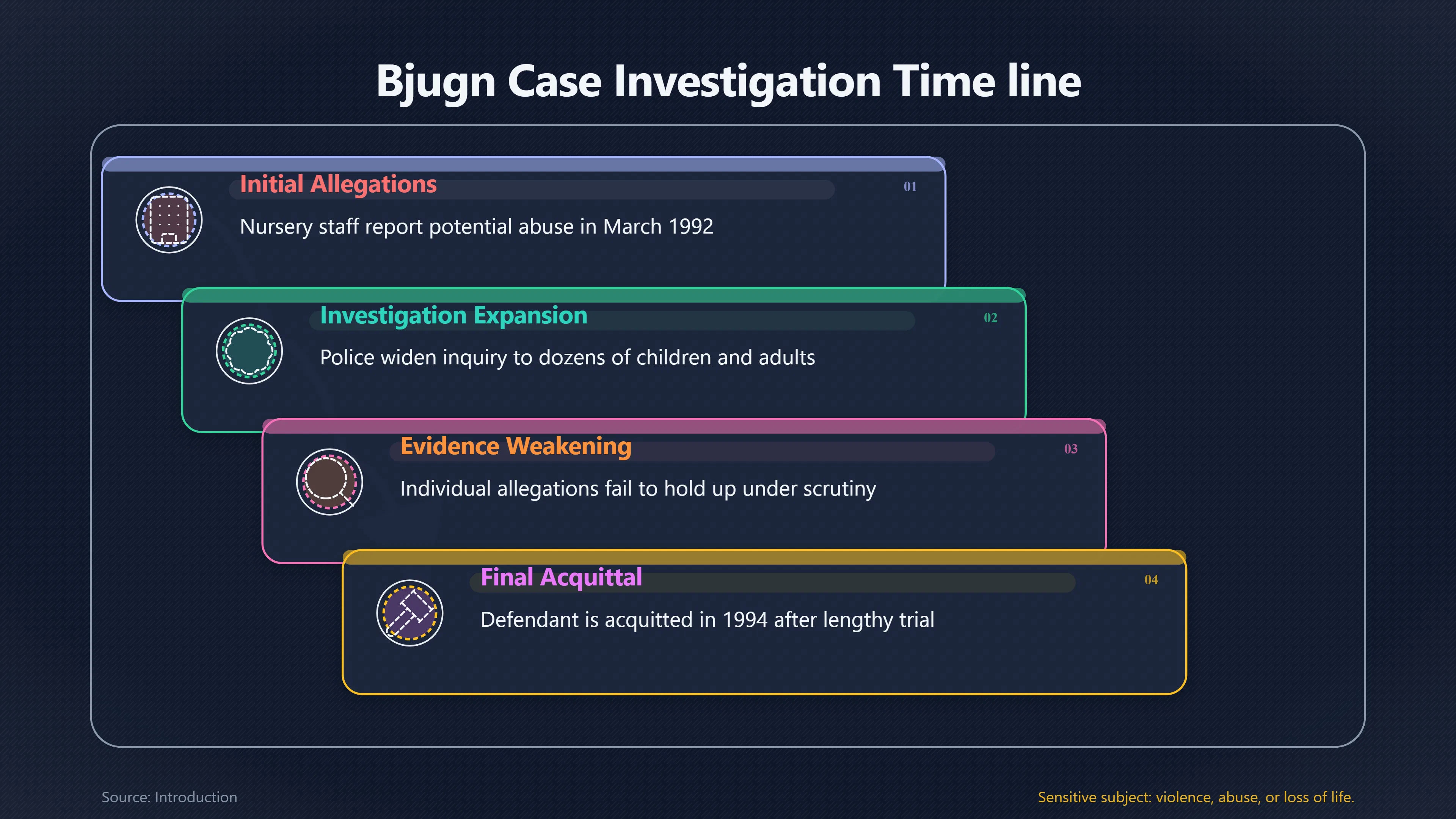
The Bjugn nursery case became one of the most important criminal investigations in modern Norwegian legal history, not because it uncovered an organised abuse network, but because it exposed how child-abuse investigations can go badly wrong when interviewing methods are flawed. Beginning in 1992 in the small municipality of Bjugn, allegations of sexual abuse at a nursery rapidly expanded into a major police investigation involving dozens of children, multiple suspects and intense national media attention. By the time the legal process ended, six suspects had been cleared without trial and the only remaining defendant was acquitted. The case fundamentally changed Norwegian thinking about interviewing child witnesses, demonstrating that genuine concern for children’s safety must be matched by rigorous safeguards to ensure that children’s evidence is gathered reliably.[Store norske leksikon]snl.noStore norske leksikon Bjugn-saken – Store norske leksikonStore norske leksikonBjugn-saken – Store norske leksikonNovember 25, 2024…
How Did the Bjugn Abuse Case Escalate?
The investigation began after concerns were raised by nursery staff in March 1992 that a male nursery assistant might have sexually abused children. Once the initial allegations reached child-protection authorities and police, investigators widened the inquiry dramatically. More children were interviewed, additional adults came under suspicion, and rumours spread through the local community that abuse had been widespread rather than involving a single individual.[HUDOC]hudoc.echr.coe.intECHRMay 31, 2018…
At its height, the investigation became extraordinarily large for a small Norwegian community. Police conducted hundreds of interviews, dozens of children were questioned repeatedly, and several adults were arrested or investigated. Although suspicion initially expanded, the evidence steadily weakened as investigators examined individual allegations more closely. Charges against six suspects were eventually dropped, leaving only the original nursery assistant to stand trial. After a lengthy trial lasting around two and a half months, he was acquitted in 1994.[Springer Link]link.springer.comLink The Nordic Model of Handling Children’s Testimonies | Springer Nature LinkSpringer LinkThe Nordic Model of Handling Children’s Testimonies | Springer Nature Link…
The acquittal did not prove that child abuse never occurs in nursery settings. Instead, it demonstrated that criminal convictions require reliable evidence, and the courts concluded that the prosecution had failed to establish guilt beyond reasonable doubt. The distinction became an important lesson in Norwegian child-protection policy: taking allegations seriously is not the same as assuming they are accurate.
How Repeated Questioning Can Shape Testimony
The lasting significance of Bjugn lies less in the verdict than in what psychologists, lawyers and investigators learned about interviewing young children.
Research on children’s memory shows that preschool children can provide accurate accounts of events, but they are also more vulnerable than adults to suggestion. If interviewers repeatedly ask the same questions, imply that a particular answer is expected, praise certain responses or introduce new information during questioning, children may gradually incorporate those suggestions into their own recollections without intending to mislead. This process is often described as contaminated testimony because later statements reflect both memory and the interviewing process itself.[Taylor & Francis Online]tandfonline.comTaylor & Francis OnlineTheory and practice in interviewing young children: A study of Norwegian police interviews 1985–2002: Psychology…
Criticism of the Bjugn investigation centred on several recurring problems:
- some children were interviewed many times before formal evidence was collected;
- interviewers sometimes relied on leading or option-posing questions instead of inviting children to describe events in their own words;
- children could become aware that adults expected abuse to have occurred;
- different professionals questioned children at different stages, increasing the risk that earlier conversations influenced later accounts.
None of these practices necessarily creates false allegations on its own. The concern is cumulative: when repeated interviewing is combined with strong expectations, it becomes increasingly difficult to distinguish an independent memory from information that has emerged through the questioning process. These concerns were widely debated after the trial and became central to later reforms in forensic interviewing.[tandfonline.com]tandfonline.comTaylor & Francis OnlineTheory and practice in interviewing young children: A study of Norwegian police interviews 1985–2002: Psychology…
Importantly, the Bjugn case has often been compared with similar nursery-abuse investigations elsewhere during the late 1980s and early 1990s, when several countries experienced investigations that expanded rapidly before courts found significant weaknesses in interview methods. The Norwegian experience therefore became part of a broader international discussion about child testimony rather than an isolated national event.[ResearchGate]researchgate.netResearchGate(PDF) Theory and practice in interviewing young children: A Study of Norwegian police interviews 1985–2002…
Why the Case Became a National Moral Panic
Bjugn illustrates how a moral panic can develop without requiring widespread bad faith.
Everyone involved was responding to a legitimate fear: the possibility that children had suffered serious sexual abuse. During the early 1990s, awareness of child sexual abuse was increasing internationally, encouraging professionals to look more carefully for previously overlooked victims. That shift brought genuine benefits for child protection, but it also created a risk that investigators might interpret ambiguous behaviour through a single explanatory framework.
Within Bjugn itself, suspicion spread through ordinary social networks. As more families were contacted, more interviews were conducted, and more rumours circulated, the investigation acquired its own momentum. The possibility of hidden abuse encouraged further searches for evidence, while each new allegation appeared to reinforce earlier suspicions. In retrospect, many commentators have described this as a feedback loop in which institutional expectations, community anxiety and media attention amplified one another.[Store norske leksikon]snl.noStore norske leksikon Bjugn-saken – Store norske leksikonStore norske leksikonBjugn-saken – Store norske leksikonNovember 25, 2024…
The case therefore occupies an unusual place in discussions of moral panic. Unlike historical witch trials, nobody claimed supernatural forces were at work, and unlike conspiracy scares, the fear concerned a genuine crime that unquestionably exists. The lesson is more subtle: sincere efforts to protect vulnerable children can still produce unreliable evidence if investigative methods fail to guard against suggestion.

Acquittal, Reform and Lessons for Child Protection
The Bjugn acquittal did not end concern about child abuse in Norway. Instead, it encouraged reforms designed to improve both child protection and the fairness of criminal investigations.
Over the following years, Norwegian police increasingly adopted evidence-based forensic interviewing methods that emphasise:
- beginning with open invitations for children to describe events in their own words;
- avoiding leading or repetitive questioning;
- reducing the number of interviews wherever possible;
- ensuring interviews are conducted by specially trained professionals;
- recording interviews so courts can evaluate exactly how testimony was obtained.
Studies of Norwegian police interviews covering the years after Bjugn found measurable reductions in suggestive questioning and greater use of recall-based interviewing techniques, although researchers also noted that further improvements remained necessary, particularly in increasing genuinely open-ended questioning.[Taylor & Francis Online]tandfonline.comTaylor & Francis OnlineTheory and practice in interviewing young children: A study of Norwegian police interviews 1985–2002: Psychology…
Norway also continued developing its system of specialised judicial interviews for child witnesses, aiming to minimise repeated questioning while preserving both children’s welfare and defendants’ rights. Modern Norwegian practice generally seeks to obtain a carefully structured pre-trial interview conducted by trained specialists rather than exposing children to multiple separate interviews.[sciencedirect.com]sciencedirect.comThe experience of the child witness: Legal and psychological issues - ScienceDirect…
Why Bjugn Still Matters
More than three decades later, the Bjugn case remains a reference point whenever Norway debates child-protection investigations, forensic interviewing or the reliability of children’s testimony.
Its legacy is not that children should be disbelieved. Modern psychological research consistently shows that children can provide valuable and accurate evidence. Rather, Bjugn demonstrated that the way adults ask questions can influence what children say, making investigative technique as important as investigative intent.
For historians of moral panics and collective fear, the case illustrates a distinctive modern pattern. Instead of persecution driven by superstition, Bjugn shows how institutional confidence, community anxiety and imperfect investigative practices can combine to produce an expanding cycle of suspicion. The reforms that followed sought to preserve two principles simultaneously: protecting children from genuine abuse while ensuring that criminal justice rests on evidence collected through methods designed to minimise contamination and maximise reliability.[tandfonline.com]tandfonline.comTaylor & Francis OnlineTheory and practice in interviewing young children: A study of Norwegian police interviews 1985–2002: Psychology…
Amazon book picks
Further Reading
Books and field guides related to How Did the Bjugn Abuse Case Escalate?. Use these as the next step if you want deeper reading beyond the article.

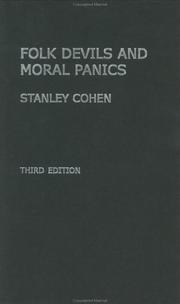
Folk Devils and Moral Panics the Creation of the Mods and Roc...
First published 1972. Subjects: Youth, great britain, Deviant behavior, Case studies, Subculture, Young adults.
Folk devils and moral panics
Explains the dynamics of moral panic surrounding allegations.
Endnotes
1.
Source: link.springer.com
Title: Link The Nordic Model of Handling Children’s Testimonies | Springer Nature Link
Link:https://link.springer.com/chapter/10.1007/978-3-319-58388
Source snippet
Springer LinkThe Nordic Model of Handling Children’s Testimonies | Springer Nature Link...
2.
Source: doi.org
Link:https://doi.org/10.1007/s42448-020-00052-8
Source snippet
What Is a Child-Appropriate Interview? Interaction Between Child Witnesses and Police Officers | International Journal on Child Maltre...
3.
Source: researchgate.net
Link:https://www.researchgate.net/publication/247500517_Theory_and_practice_in_interviewing_young_children_A_Study_of_Norwegian_police_interviews
Source snippet
ResearchGate(PDF) Theory and practice in interviewing young children: A Study of Norwegian police interviews 1985–2002...
4.
Source: sciencedirect.com
Link:https://www.sciencedirect.com/science/article/pii/S0160252715001326
Source snippet
The experience of the child witness: Legal and psychological issues - ScienceDirect...
5.
Source: link.springer.com
Link:https://link.springer.com/article/10.1007/s42448-020-00052-8
6.
Source: doi.org
Link:https://doi.org/10.1002/acp.3647
7.
Source: researchgate.net
Title: (PDF) The Nordic Model of Handling Children’s Testimonies
Link:https://www.researchgate.net/publication/320449087_The_Nordic_Model_of_Handling_Children%27s_Testimonies
8.
Source: sciencedirect.com
Title: Children’s eyewitness memory: Effects of participation and forensic context
Link:https://www.sciencedirect.com/science/article/pii/0145213492900812
9.
Source: snl.no
Title: Store norske leksikon Bjugn-saken – Store norske leksikon
Link:https://snl.no/Bjugn-saken
Source snippet
Store norske leksikonBjugn-saken – Store norske leksikonNovember 25, 2024...
Published: November 25, 2024
10.
Source: hudoc.echr.coe.int
Link:https://hudoc.echr.coe.int/app/conversion/docx/pdf?filename=HAMMERN+v.+NORWAY.pdf&id=001-21949&library=ECHR&logEvent=False
Source snippet
ECHRMay 31, 2018...
Published: May 31, 2018
11.
Source: tandfonline.com
Link:https://www.tandfonline.com/doi/abs/10.1080/10683160500350546
Source snippet
Taylor & Francis OnlineTheory and practice in interviewing young children: A study of Norwegian police interviews 1985–2002: Psychology...
Additional References
12.
Source: ojp.gov
Link:https://www.ojp.gov/ncjrs/virtual-library/abstracts/interviewing-child-witnesses-under-memorandum-good-practice
13.
Source: ojp.gov
Link:https://ojp.gov/ncjrs/virtual-library/abstracts/official-ideals-and-current-practice-work-child-witnesses-sexual
14.
Source: nkmr.org
Title: Bjugn saken
Link:https://www.nkmr.org/nb/norske-saker/bjugn-saken
Source snippet
Detaljer Skrevet av: Hannes Hansson Kategori: Bjugn saken Publisert 28. mars 2023 Treff: 1351 Tilleggstraume for Bjugn- barna? Av Lena He...
15.
Source: helsetilsynet.no
Link:https://www.helsetilsynet.no/publikasjoner/rapport-fra-helsetilsynet/
16.
Source: stortinget.no
Link:https://www.stortinget.no/no/Saker-og-publikasjoner/Stortingsforhandlinger/Saksside/?did=DIVL6548&mtid=10&pid=1993-1997&vt=a
17.
Source: youtube.com
Title: Takeaway Tuesday S1E8: Suggestibility
Link:https://www.youtube.com/watch?v=GGubEYgEBTM
Source snippet
The Power of Suggestion: How to Implant False Memories...
18.
Source: youtube.com
Title: Mc Martin Preschool: Anatomy of a Panic | Retro Report | The New York Times
Link:https://www.youtube.com/watch?v=2R21tWs-qCw
Source snippet
Truth and Consequence...
19.
Source: domstol.no
Title: Witnesses without a duty to testify should have appeared in court
Link:https://www.domstol.no/en/supremecourt/rulings/rulings-2022/supreme-court-criminal-cases/HR-2022-1703-A/
20.
Source: domstol.no
Title: Childrens’ statements to the police could be used as evidence
Link:https://www.domstol.no/en/supremecourt/rulings/2023/supreme-court-criminal-cases/HR-2023-2212-A/
21.
Source: dagsavisen.no
Title: Slo så hardt at skjelettet mitt falt ut – Dagsavisen
Link:https://www.dagsavisen.no/nyheter/slo-sa-hardt-at-skjelettet-mitt-falt-ut/6493969
Topic Tree