Within Nigeria
Why Were Nigerian Children Accused of Witchcraft?
Children blamed for illness, poverty or family conflict faced abuse even though the supernatural accusations against them lacked evidence.
On this page
- How misfortune became an accusation
- Pastors, confessions and deliverance
- Abuse, rescue work and legal protection
Page outline Jump by section
Introduction
From the late 1990s onwards, parts of southern Nigeria experienced a wave of child witchcraft accusations that led to one of the country’s most serious child-protection crises. The accusations were not supported by evidence that children possessed supernatural powers, yet they had devastating real-world consequences. Thousands of children, particularly in Akwa Ibom and Cross River states, were blamed for illness, deaths, poverty, business failures or family conflict. Many were beaten, abandoned, tortured into making false confessions or subjected to harmful “deliverance” rituals. Rather than reflecting an unchanging tradition, researchers argue that these accusations emerged from a modern mix of economic insecurity, changing family structures, charismatic religious teachings, media influences and long-standing beliefs about spiritual causation.[unicef.org]unicef.orgChildren accused of witchcraft | UNICEF NigeriaChildren accused of witchcraft | UNICEF Nigeria…
Understanding why these accusations spread is important because they reveal how collective fear can transform vulnerable children into scapegoats. The episode also shows how religious organisations, charities, journalists, lawmakers and child-protection agencies responded, and why the problem remains a concern despite legal reforms.
How misfortune became an accusation
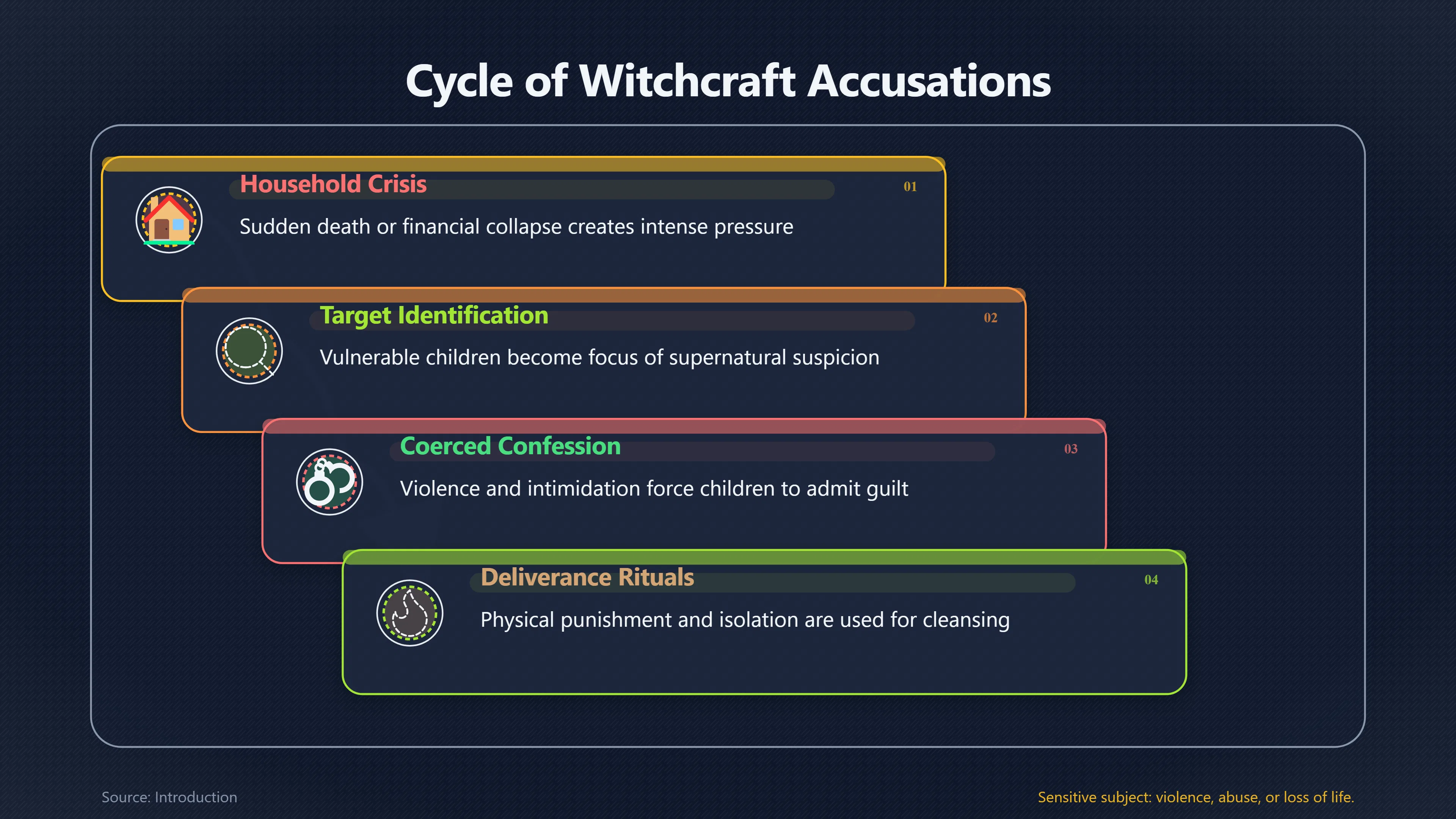
In many reported cases, the accusation began not with unusual behaviour by a child but with a crisis affecting the household. A sudden death, prolonged illness, infertility, unemployment, financial collapse or repeated family disagreements created pressure to identify a hidden cause. Where belief in witchcraft remained influential, a vulnerable child could become the focus of suspicion.[UNICEF]unicef.orgChildren accused of witchcraft | UNICEF NigeriaChildren accused of witchcraft | UNICEF Nigeria…
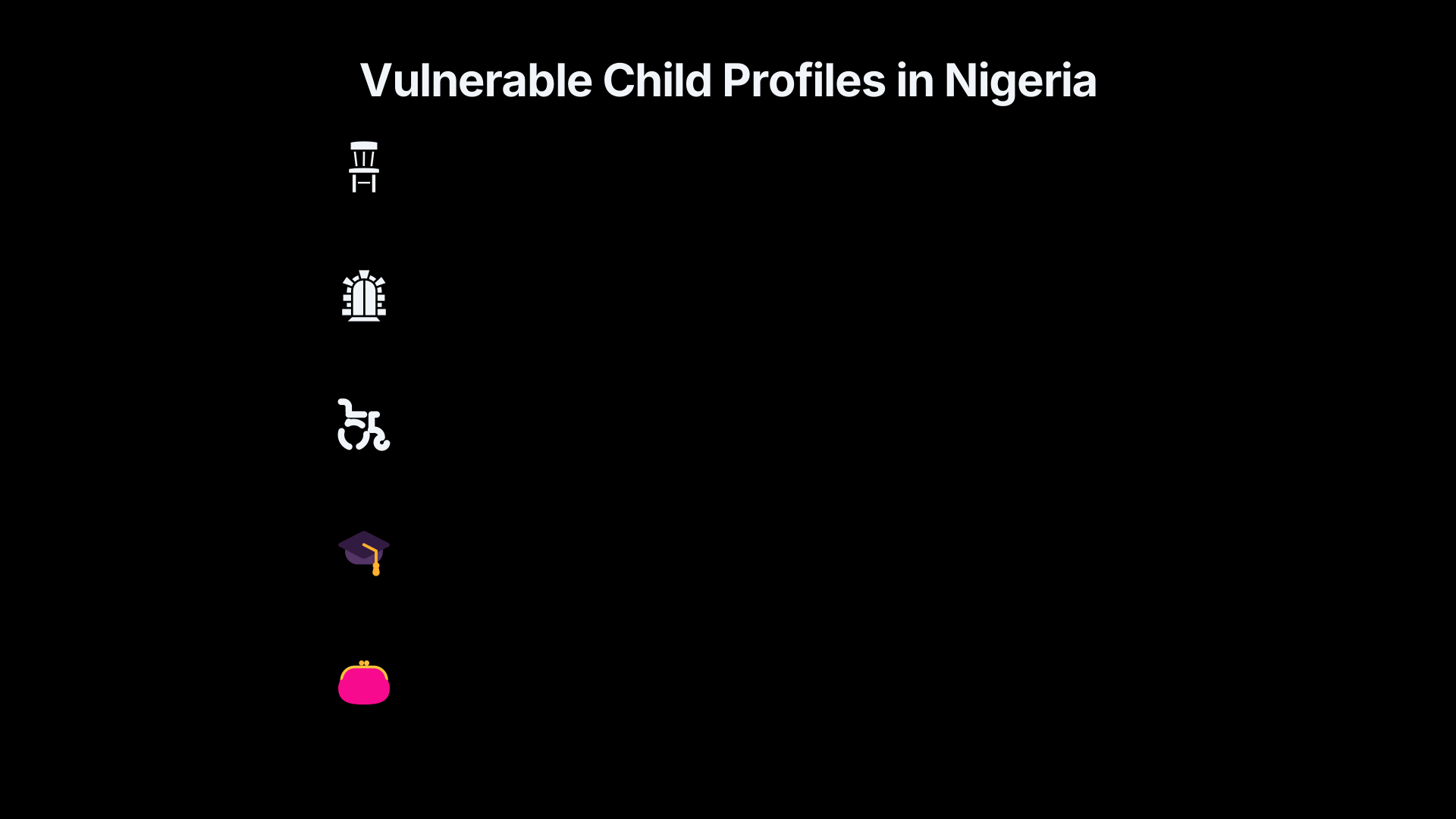
Researchers have found that certain children were especially vulnerable:
- Orphans or children who had lost one parent.
- Stepchildren living in unstable households.
- Children with disabilities or chronic illness.
- Children considered unusually quiet, stubborn or academically gifted.
- Children already facing neglect or poverty.
These characteristics were not evidence of witchcraft. Instead, they often reflected the child’s already vulnerable position within the family, making them easier to blame when misfortune demanded an explanation. UNICEF’s anthropological study stresses that the accusations cannot be explained simply as ancient custom. They developed within changing social and economic conditions, including rapid urbanisation, family disruption and new religious interpretations of spiritual warfare.[UNICEF]unicef.orgChildren accused of witchcraft | UNICEF NigeriaChildren accused of witchcraft | UNICEF Nigeria…
The accusation often worked backwards. A family first experienced hardship, then searched for someone responsible, and only afterwards interpreted ordinary childhood behaviour as proof of supernatural guilt. This pattern differs from criminal investigations or evidence-based reasoning, where evidence is expected before blame.
Pastors, confessions and deliverance
One distinctive feature of the Nigerian child witch panic was the role played by some independent churches and self-proclaimed spiritual specialists who claimed they could identify witches and perform deliverance or exorcism ceremonies. It is important to distinguish these individuals from Nigeria’s many churches that rejected child witch accusations and participated in child-protection efforts.[UNICEF]unicef.orgChildren accused of witchcraft | UNICEF NigeriaChildren accused of witchcraft | UNICEF Nigeria…
In documented cases, accusations were sometimes reinforced through:
- Public declarations by pastors that a child carried an evil spirit.
- Interrogations designed to obtain a confession.
- Fasting, isolation or physical punishment presented as spiritual cleansing.
- Deliverance rituals performed in exchange for payment or donations.
Children frequently confessed after prolonged intimidation, violence or psychological pressure rather than because any supernatural event had occurred. UNICEF found that confessions were often produced through coercion and should not be treated as reliable evidence.[UNICEF]unicef.orgChildren accused of witchcraft | UNICEF NigeriaChildren accused of witchcraft | UNICEF Nigeria…
Researchers also note that popular books, films and preaching during the late 1990s and 2000s helped spread new ideas that children could secretly possess destructive supernatural powers. These messages circulated alongside older beliefs about witchcraft but reshaped them into a specifically child-focused panic.[UNICEF]unicef.orgChildren accused of witchcraft | UNICEF NigeriaChildren accused of witchcraft | UNICEF Nigeria…
The human cost of the accusations
Although the accusations themselves lacked evidence, the suffering they produced was thoroughly documented.
Children accused of witchcraft experienced:[unicef.org]unicef.orgChildren accused of witchcraft | UNICEF NigeriaChildren accused of witchcraft | UNICEF Nigeria…
- Physical assaults and torture.
- Starvation or deliberate neglect.
- Abandonment by parents or guardians.
- Social isolation and exclusion from school.
- Homelessness and life on the streets.
- Psychological trauma and long-term stigma.
Some children were permanently rejected by their families. Others survived only because neighbours, charities or local activists intervened. International agencies, Nigerian child-rights organisations and journalists documented children wandering without shelter after being expelled from home because relatives believed they carried supernatural powers.[unicef.org]unicef.orgChildren accused of witchcraft | UNICEF NigeriaChildren accused of witchcraft | UNICEF Nigeria…
The consequences often continued long after rescue. Many children required years of medical care, counselling and education before they could rebuild their lives. Even then, returning to their communities remained difficult because accusations could persist despite the absence of evidence.
Rescue work and changing public attitudes
The growing visibility of these abuses prompted Nigerian and international organisations to establish rescue programmes. Among the best-known has been the Child Rights and Rehabilitation Network (CRARN), alongside organisations such as Stepping Stones Nigeria and other local partners that provide shelter, education and rehabilitation for children rejected by their families.[Docslib]docslib.orgReport on Accusations of Witchcraft Against Children in Akwa Ibom State, NigeriaReport on Accusations of Witchcraft Against Children in Akwa Ibom State, Nigeria - DocsLib…
Their work has included:
- Emergency rescue from abusive households.
- Temporary accommodation.
- School enrolment and vocational training.
- Family mediation where safe.
- Public education campaigns challenging child witch accusations.
These organisations have consistently argued that education, child protection and community awareness are more effective than confrontation alone. Their work has also highlighted that many accusations arise in contexts of poverty and family stress rather than organised persecution directed by the state.[Child’s Right and Rehabilitation Network]crarn.netChild’s Right and Rehabilitation Network CRARNChild’s Right and Rehabilitation NetworkCRARN - Child’s Right and Rehabilitation Network…
Media reporting, documentary films and advocacy campaigns gradually brought international attention to the issue. This visibility increased pressure on state governments to strengthen child-protection policies and encouraged broader public debate about the treatment of accused children.

Legal protection and continuing challenges
Nigeria has adopted legal measures intended to protect children from abuse, including child-rights legislation at federal and state levels. Several states have also introduced provisions aimed at preventing violence linked to witchcraft accusations. Nevertheless, enforcement has often proved uneven, particularly where accusations arise within families or religious settings.[Reuters]reuters.comThe issue, fueled by evangelical pastors and local witch doctors who perform exorcisms for profit, often leads to children being abused…
The issue has continued to attract legal scrutiny. In 2025, the African Committee of Experts on the Rights and Welfare of the Child concluded that Nigeria had violated several rights of children affected by witchcraft accusations, including protections relating to life, education, non-discrimination and freedom from abuse. The decision reflected continuing concern that legal safeguards have not always translated into effective protection on the ground.[IHRDA - Defend, Edicate, Inform.]ihrda.orgDefend, Edicate, Inform.001/2025 – CRARN, CHR and IHRDA on Behalf of Children Affected by Witchcraft Accusations in Nigeria vs Th…
Many child-protection advocates argue that lasting progress depends on several linked measures:
- Consistent enforcement of child-protection laws.
- Greater accountability for abusive deliverance practices.
- Better support for vulnerable families.
- Public education about children’s rights.
- Cooperation between religious leaders, schools, social workers and community organisations.
Why the episode remains important
The Nigerian child witch accusations demonstrate how collective fear can produce genuine social harm even when the underlying supernatural claims cannot be verified. The crisis was not simply a survival of ancient beliefs but a modern phenomenon shaped by poverty, changing religious movements, family instability and persuasive public narratives about spiritual danger.[UNICEF]unicef.orgChildren accused of witchcraft | UNICEF NigeriaChildren accused of witchcraft | UNICEF Nigeria…
For historians, anthropologists and child-protection specialists, the episode illustrates the difference between sincerely held belief and evidence. Families, neighbours and religious leaders could be convinced that a child was responsible for terrible misfortune, yet investigations repeatedly found that the children themselves were victims rather than perpetrators. The lasting significance of the episode lies not in proving the accusations but in understanding how fear, authority and social pressure combined to justify abuse—and how legal reform, education and community intervention have sought to reverse that process.
Amazon book picks
Further Reading
Books and field guides related to Why Were Nigerian Children Accused of Witchcraft?. Use these as the next step if you want deeper reading beyond the article.

Extraordinary Popular Delusions and the Madness of Crowds
Rating: 4.0/5 from 5 Google Books ratings
Examines how false beliefs spread collectively.
Endnotes
1.
Source: unicef.org
Title: Children accused of witchcraft | UNICEF Nigeria
Link:https://www.unicef.org/nigeria/reports/children-accused-witchcraft
Source snippet
Children accused of witchcraft | UNICEF Nigeria...
2.
Source: docslib.org
Title: Report on Accusations of Witchcraft Against Children in Akwa Ibom State, Nigeria
Link:https://docslib.org/doc/5153523/report-on-accusations-of-witchcraft-against-children-in-akwa-ibom-state-nigeria
Source snippet
Report on Accusations of Witchcraft Against Children in Akwa Ibom State, Nigeria - DocsLib...
3.
Source: crarn.net
Title: Child’s Right and Rehabilitation Network CRARN
Link:https://crarn.net/
Source snippet
Child’s Right and Rehabilitation NetworkCRARN - Child’s Right and Rehabilitation Network...
4.
Source: reuters.com
Link:https://www.reuters.com/world/africa/nigerian-aid-groups-help-children-accused-witchcraft-rebuild-lives-2025-11-13/
Source snippet
The issue, fueled by evangelical pastors and local witch doctors who perform exorcisms for profit, often leads to children being abused...
5.
Source: ihrda.org
Link:https://ihrda.org/en/case/001-2025-crarn-chr-and-ihrda-on-behalf-of-children-affected-by-witchcraft-accusations-in-nigeria-vs-the-federal-republic-of-nigeria/
Source snippet
Defend, Edicate, Inform.001/2025 – CRARN, CHR and IHRDA on Behalf of Children Affected by Witchcraft Accusations in Nigeria vs Th...
6.
Source: ihrda.org
Title: ACERW C Finds Nigeria in Violation in Child Witchcraft Accusation Case
Link:https://ihrda.org/en/acerwc-finds-nigeria-in-violation-in-child-witchcraft-accusation-case
Source snippet
ACERWC Finds Nigeria in Violation in Child Witchcraft Accusation Case - IHRDAApril 23, 2026 — CASE UPDATES / FEATURED ARTICLES Image ACER...
Published: April 23, 2026
7.
Source: experts.com
Link:https://www.experts.com/articles/accusations-of-witchcraft-against-children-by-gary-foxcroft
8.
Source: crarn.net
Link:https://crarn.net/history/
Additional References
9.
Source: chr.up.ac.za
Link:https://www.chr.up.ac.za/latest-news/4372-case-update-acerwc-finds-nigeria-in-violation-in-child-witchcraft-accusation-case
Source snippet
DATE: ACERWC Finds Nigeria in Violation in Child Witchcraft Accusation Case - Centre for Human RightsMay 12, 2026 — CASE UPDATE: ACERWC...
Published: May 12, 2026
10.
Source: youtube.com
Title: Nigeria: The Plight of the Witch Children (Reupload) | ARTE.tv Documentary
Link:https://www.youtube.com/watch?v=fD6BlzUSGt0
Source snippet
Costly Superstition: How Children Branded Witches Endure Torture, Abuse In Akwa Ibom...
11.
Source: youtube.com
Title: Dispatches: Return To Africa’s Witch Children | Extreme Christianity Documentary
Link:https://www.youtube.com/watch?v=5Y06sKAg9Do
Source snippet
Nigeria: The Plight of the Witch Children (Reupload) | ARTE.tv Documentary...
12.
Source: refworld.org
Link:https://www.refworld.org/reference/themreport/unicef/2011/104141
13.
Source: euaa.europa.eu
Link:https://www.euaa.europa.eu/country-guidance-nigeria-2021/29-individuals-accused-witchcraft
14.
Source: doczz.net
Link:https://doczz.net/doc/8904545/report-on-accusations-of-witchcraft-against-children
15.
Source: ecoi.net
Link:https://www.ecoi.net/en/document/1273271.html
16.
Source: repository.ui.edu.ng
Link:https://repository.ui.edu.ng/items/40f96213-a5d2-4e36-ab86-b706d031fcd1
17.
Source: youtube.com
Link:https://www.youtube.com/watch?v=MoF0UEJox-A
Source snippet
Accused of being a witch | Witness...
18.
Source: researchgate.net
Link:https://www.researchgate.net/publication/334810303_Witchcraft_stigmatization_and_abuse_of_children_in_Akwa-Ibom_state_Nigeria
Topic Tree