Within Luxembourg Panics
Why Were Luxembourg's Witch Hunts So Severe?
Repeated witch-hunt waves from the fifteenth century to the 1680s made Luxembourg one of the region's most severely affected territories.
On this page
- From early accusations to the great waves of 1586 1636
- War, plague and the late revival around Echternach
- Death estimates, lost records and changing borders
Page outline Jump by section
Introduction
Luxembourg experienced some of the most intense witch persecutions in early modern Europe when measured against the size of its population. Although the duchy formed part of a wider European wave of witch-hunting, its repeated outbreaks between the fifteenth century and the 1680s were unusually persistent and destructive. Rather than one continuous campaign, persecution came in distinct waves that swept through different districts as fear, judicial procedure and neighbourly suspicion reinforced one another. Thousands of people were investigated, hundreds and probably well over a thousand were executed, and entire communities were left marked by loss, confiscated property and enduring distrust. Because many court records have disappeared and the borders of historic Luxembourg differed greatly from those of the modern state, historians continue to debate the precise scale of the killings. What is not disputed is that the duchy ranked among the hardest-hit territories in the European witch persecutions.[Deutsches Historisches Museum (DHM)]dhm.deDeutsches Historisches Museum (DHM)HEXENWAHNÄngste der Neuzeit…
From early accusations to the great waves of 1586–1636
The first documented witch trials in the Duchy of Luxembourg appeared during the middle of the fifteenth century. Early prosecutions were relatively scattered, but they established legal and religious assumptions that later allowed accusations to spread rapidly. Courts increasingly accepted the idea that witchcraft was not simply harmful magic but participation in a conspiracy against Christianity through a pact with the Devil. Once this belief became embedded in judicial practice, ordinary misfortunes could be reinterpreted as evidence of hidden enemies within the community.[Deutsches Historisches Museum (DHM)]dhm.deDeutsches Historisches Museum (DHM)HEXENWAHNÄngste der Neuzeit…
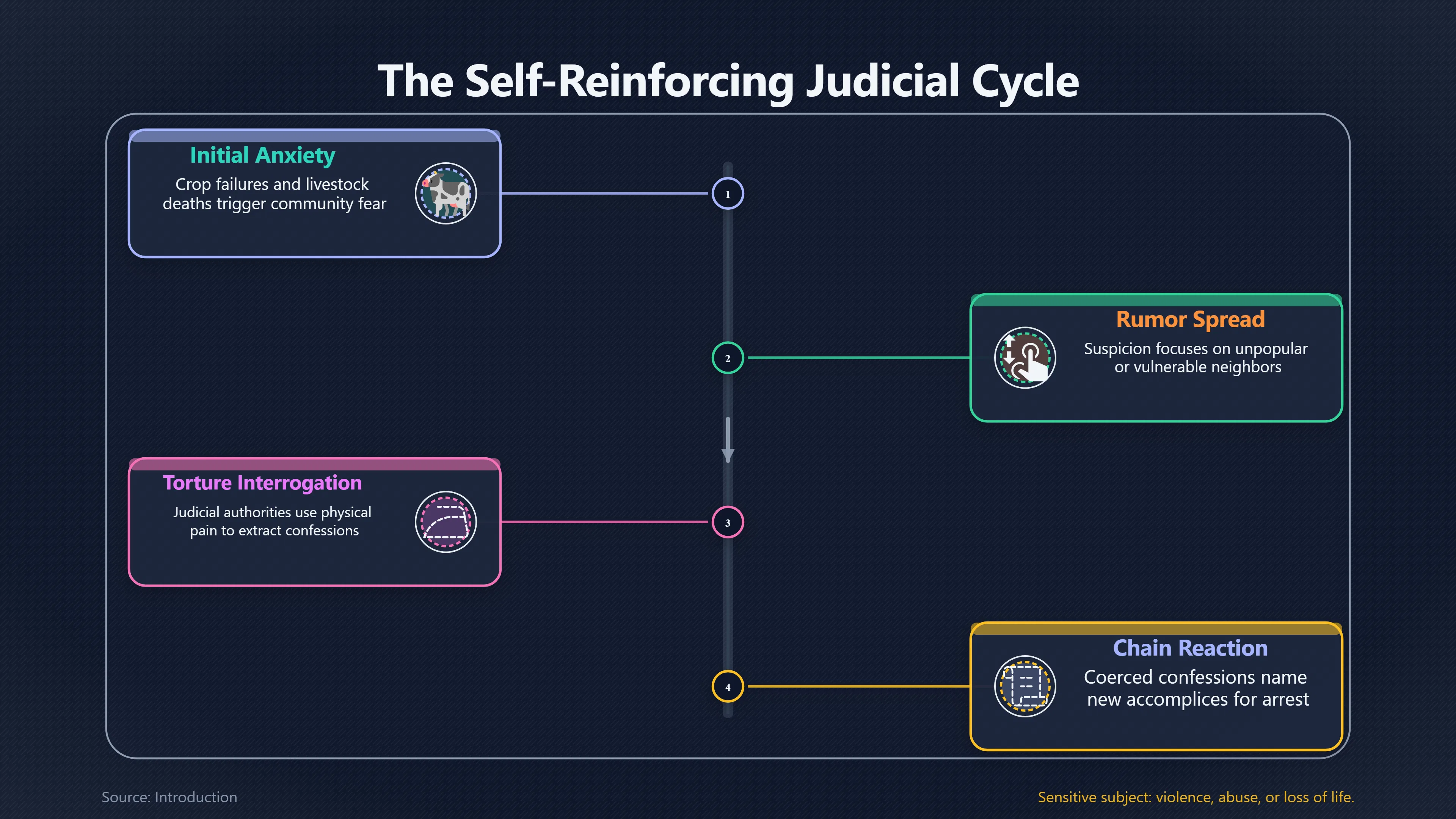
The most devastating phase began around 1586. Over roughly the next fifty years, successive waves of prosecutions appeared across different parts of the duchy rather than remaining confined to one district. Local outbreaks often followed a recognisable pattern:
- illness, livestock deaths or failed harvests created anxiety;
- rumours centred on unpopular or vulnerable neighbours;
- arrests led to interrogation under torture;
- confessions named alleged accomplices;
- each confession generated further arrests, producing a chain reaction.
The legal process itself became one of the main engines of expansion. Rather than ending with a single conviction, trials frequently generated fresh lists of suspects, allowing persecution to move from household to household. Historians describe this as a self-reinforcing judicial system in which coerced testimony produced the next round of accusations.[Deutsches Historisches Museum (DHM)]dhm.deDeutsches Historisches Museum (DHM)HEXENWAHNÄngste der Neuzeit…
Luxembourg’s fragmented political geography also contributed to repeated outbreaks. Numerous local courts exercised criminal jurisdiction, while the duchy sat on the frontier between several territories that experienced similarly severe witch persecutions, including Trier and Lorraine. Ideas, legal practices and experienced judges crossed these borders more easily than modern national maps might suggest.[Deutsches Historisches Museum (DHM)]dhm.deDeutsches Historisches Museum (DHM)HEXENWAHNÄngste der Neuzeit…
Why persecution became unusually severe
Luxembourg was small, largely rural and economically vulnerable. Communities depended heavily on agriculture, making crop failures, animal disease and severe weather especially frightening. Epidemics and periods of military instability intensified uncertainty. In such conditions, witchcraft accusations offered an apparently understandable explanation for events that otherwise seemed random or uncontrollable.[Deutsches Historisches Museum (DHM)]dhm.deDeutsches Historisches Museum (DHM)HEXENWAHNÄngste der Neuzeit…
Yet hardship alone cannot explain the scale of the persecutions. Comparable crises occurred elsewhere without producing equally intense witch-hunts. Historians instead emphasise the interaction of several factors:
- widespread belief in diabolical witchcraft among educated authorities;
- criminal procedures that allowed torture to obtain confessions;
- willingness to treat accusations made under torture as reliable evidence;
- local rivalries over reputation, inheritance and personal disputes;
- overlapping jurisdictions that sometimes encouraged rather than restrained prosecutions.
This combination meant that ordinary village conflicts could quickly become capital criminal cases. Once courts accepted that witches operated as organised groups, every execution seemed to justify searching for additional conspirators.[Deutsches Historisches Museum (DHM)]dhm.deDeutsches Historisches Museum (DHM)HEXENWAHNÄngste der Neuzeit…
Interestingly, Luxembourg also possessed early attempts at legal restraint. The Provincial Council issued ordinances in 1563 and again in 1573 requiring lower courts to seek legal advice before imprisoning or torturing suspected witches. These measures show that higher authorities recognised the danger of uncontrolled prosecutions. In practice, however, they slowed rather than prevented the great persecution that followed after 1586.[Deutsches Historisches Museum (DHM)]dhm.deDeutsches Historisches Museum (DHM)HEXENWAHNÄngste der Neuzeit…
War, plague and the late revival around Echternach
The main waves declined during the 1630s as the Thirty Years’ War and plague transformed everyday priorities. Warfare devastated populations, disrupted administration and reduced the capacity of courts to conduct lengthy witch prosecutions. Rather than representing a sudden rejection of belief in witchcraft, this lull reflected wider social collapse.[Deutsches Historisches Museum (DHM)]dhm.deDeutsches Historisches Museum (DHM)HEXENWAHNÄngste der Neuzeit…
Persecution nevertheless returned in the late seventeenth century. The best-known revival occurred around Echternach in 1679–80, at a time when many other parts of Europe were already abandoning large-scale witch trials. Cases from Echternach illustrate how older patterns of suspicion still operated. Public rumour, denunciations from previous trials and allegations of supernatural harm combined with judicial interrogation to produce new prosecutions. The case of Maria Keuffer became one of the best documented examples from this final phase.[wort.lu]atavist-archive.wort.lu“Die Zauberinnen sollst du nicht leben lassen” (Ex. 22, 17“Die Zauberinnen sollst du nicht leben lassen” (Ex. 22, 17
This revival demonstrates that witch-hunting did not disappear everywhere at the same pace. Local political culture, judicial traditions and religious beliefs could sustain persecution even after neighbouring regions had begun to retreat from it. Only after French occupation in 1684 and the growing influence of stricter legal standards did executions finally cease in Luxembourg.[Deutsches Historisches Museum (DHM)]dhm.deDeutsches Historisches Museum (DHM)HEXENWAHNÄngste der Neuzeit…
Death estimates, lost records and changing borders
Determining the human cost remains difficult because the surviving evidence is incomplete. Many original trial records have been destroyed, deliberately discarded or survive only as fragments. Historians therefore reconstruct events from financial records, correspondence, legal summaries and scattered local archives.[Deutsches Historisches Museum (DHM)]dhm.deDeutsches Historisches Museum (DHM)HEXENWAHNÄngste der Neuzeit…
This incomplete documentation has produced differing estimates.
Some older local histories and museum research suggest that at least 2,000 people may have been executed within the historical Duchy of Luxembourg, making it one of Europe’s worst-affected regions relative to population. Other modern databases record only a few hundred securely documented executions because they count surviving archival evidence rather than estimated losses. These figures are not necessarily contradictory: one measures documented cases, while the other attempts to estimate victims whose records no longer exist. Historians therefore caution against treating any single number as definitive.[wort.lu]atavist-archive.wort.lu“Die Zauberinnen sollst du nicht leben lassen” (Ex. 22, 17“Die Zauberinnen sollst du nicht leben lassen” (Ex. 22, 17
Changing borders add another complication. The early modern Duchy of Luxembourg covered a much larger area than today’s Grand Duchy, extending into territories now belonging to Belgium, France and Germany. Modern statistics based solely on present-day borders therefore cannot be compared directly with estimates for the historic duchy. Much apparent disagreement in published totals reflects different geographical definitions rather than conflicting evidence about individual cases.[wort.lu]atavist-archive.wort.lu“Die Zauberinnen sollst du nicht leben lassen” (Ex. 22, 17“Die Zauberinnen sollst du nicht leben lassen” (Ex. 22, 17
The wider human cost beyond executions
Executions were only the most visible consequence of the witch-hunts. Families suffered in many other ways.
Those acquitted after torture often carried permanent physical injuries. Property could be confiscated, leaving relatives impoverished. Children lost parents, spouses lost partners and communities lost experienced farmers, artisans and local leaders. Even neighbours who escaped prosecution lived with the knowledge that a careless accusation or an old quarrel might one day be turned against them. The judicial process therefore damaged trust long before any death sentence was carried out.[Deutsches Historisches Museum (DHM)]dhm.deDeutsches Historisches Museum (DHM)HEXENWAHNÄngste der Neuzeit…
Women formed the majority of those executed, reflecting wider European patterns, but men also appeared among the accused. The stereotype of the elderly female witch captures only part of the picture. Accusations often reflected local relationships, reputation and vulnerability more than any single social category.[RTL Today]today.rtl.luToday Knowledge Bites: Double, double toil and trouble: Witchcraft in LuxembourgRTL TodayKnowledge Bites: Double, double toil and trouble: Witchcraft in Luxembourg - RTL Today…
The psychological effects also endured. Because accusations frequently originated within villages, persecution transformed neighbours into witnesses, informers and prosecutors. The resulting breakdown of communal trust may have lasted for generations, even after executions ended.

Why Luxembourg’s witch-hunts remain historically important
Luxembourg’s experience illustrates that Europe’s witch persecutions were not driven by popular superstition alone. They required courts willing to accept demonological ideas, legal systems that permitted torture and authorities prepared to convert rumour into criminal evidence. The duchy’s repeated waves show how these conditions could repeatedly recreate fear over many decades rather than producing a single isolated panic.[Deutsches Historisches Museum (DHM)]dhm.deDeutsches Historisches Museum (DHM)HEXENWAHNÄngste der Neuzeit…
The country’s history also highlights the importance of careful historical interpretation. Missing archives, changing borders and differing methods of counting victims make exact totals impossible to establish with certainty. Nevertheless, the surviving evidence consistently places the historic Duchy of Luxembourg among the regions that suffered most severely during Europe’s early modern witch persecutions, making it an essential case for understanding how judicial systems, religious belief and collective fear combined to produce catastrophic human consequences.[Deutsches Historisches Museum (DHM)]dhm.deDeutsches Historisches Museum (DHM)HEXENWAHNÄngste der Neuzeit…
Amazon book picks
Further Reading
Books and field guides related to Why Were Luxembourg's Witch Hunts So Severe?. Use these as the next step if you want deeper reading beyond the article.
The witch-hunt in early modern Europe
Best single explanation of why witch hunts intensified.

Endnotes
1.
Source: dhm.de
Title: Deutsches Historisches Museum (DHM)HEXENWAHN
Link:https://www.dhm.de/archiv/ausstellungen/hexenwahn/aufsaetze/12.htm
Source snippet
Ängste der Neuzeit...
2.
Source: dhm.de
Title: Deutsches Historisches Museum (DHM)HEXENWAHN
Link:https://www.dhm.de/archiv/ausstellungen/hexenwahn/katalog/opfer.htm
Source snippet
Ängste der Neuzeit...
3.
Source: atavist-archive.wort.lu
Title: “Die Zauberinnen sollst du nicht leben lassen” (Ex. 22, 17)
Link:https://atavist-archive.wort.lu/hexenverfolgung/index.html
4.
Source: today.rtl.lu
Title: Today Knowledge Bites: Double, double toil and trouble: Witchcraft in Luxembourg
Link:https://today.rtl.lu/luxembourg-insider/history/double-double-toil-and-trouble-witchcraft-in-luxembourg-1997152
Source snippet
RTL TodayKnowledge Bites: Double, double toil and trouble: Witchcraft in Luxembourg - RTL Today...
5.
Source: researchgate.net
Title: 26269700 Witchcraft trials in the Duchy of Luxembourg Echternach 1679 80
Link:https://www.researchgate.net/publication/26269700_Witchcraft_trials_in_the_Duchy_of_Luxembourg_Echternach
Source snippet
ResearchGate(PDF) [Witchcraft trials in the Duchy of Luxembourg: Echternach, 1679-80]...
6.
Source: dhm.de
Title: Deutsches Historisches Museum (DHM)HEXENWAHN
Link:https://www.dhm.de/archiv/ausstellungen/hexenwahn/aufsaetze/05.htm
Source snippet
Ängste der Neuzeit...
7.
Source: wort.lu
Link:https://www.wort.lu/luxemburg/echternach-1679-als-hexerei-noch-als-verbrechen-galt/100898463.html
Source snippet
Echternach 1679: Als Hexerei noch als Verbrechen galt | Luxemburger WortNovember 8, 2025 — Hexenverfolgung in Luxemburg ECHTERNACH 1679...
Published: November 8, 2025
8.
Source: dhm.de
Title: HEXENWAH N
Link:https://www.dhm.de/archiv/ausstellungen/hexenwahn/aufsaetze/11.htm
Source snippet
HEXENWAHN - Ängste der NeuzeitGunther Franz Prominente Gegner der Hexenprozesse in Luxemburg und Kurtrier Die Hexenverfolgung im Erzbistu...
Additional References
9.
Source: youtube.com
Title: The Secret History of Witches | Witch Trials and Fear in History
Link:https://www.youtube.com/watch?v=HvNHzeM3EjU
Source snippet
3 The Horrors of the German Witch Hunts | Human Voiced, No Ads...
10.
Source: youtube.com
Title: European Witch Trials and Forgotten History
Link:https://www.youtube.com/watch?v=rB4rYVvKaXI
Source snippet
5 Fall Asleep to the ENTIRE Story of the European Witch Hunts — The Age of Fear and Accusation...
11.
Source: youtube.com
Title: Witch-Hunting in European and World History
Link:https://www.youtube.com/watch?v=snAicO9WHGY
Source snippet
2 The Secret History of Witches | Witch Trials and Fear in History...
12.
Source: youtube.com
Title: The Horrors of the German Witch Hunts | Human Voiced, No Ads
Link:https://www.youtube.com/watch?v=NvEzvu_uYEI
Source snippet
4 European Witch Trials and Forgotten History...
13.
Source: summerlands.com
Link:https://www.summerlands.com/crossroads/remembrance/current.htm
Source snippet
Recorded...
14.
Source: um.edu.mt
Link:https://www.um.edu.mt/library/oar/handle/123456789/42316
15.
Source: routledgetextbooks.com
Link:https://routledgetextbooks.com/textbooks/9781138808102/
16.
Source: scribd.com
Link:https://www.scribd.com/document/978927963/The-Witchhunt-In-Early-Modern-Europe-3rd-Edition-Brian-Levack
17.
Source: youtube.com
Link:https://www.youtube.com/watch?v=6nxzZbmd6HU
18.
Source: pubmed.ncbi.nlm.nih.gov
Link:https://pubmed.ncbi.nlm.nih.gov/19499610/
Topic Tree