What Made Kazakhstan's Modern Panics Take Hold?
Kazakhstan’s history does not offer a well-documented equivalent of the Salem witch trials or Europe’s dancing plagues. Its strongest cases instead involve modern rumours, unexplained illness, religious scares and state-led warnings about supposedly “destructive” beliefs.
Page outline Jump by section
Introduction
Religion forms a second major strand. Since independence, officials and supportive commentators have often grouped very different minority faiths, missionary movements and militant organisations under labels such as “sects”, “non-traditional religions” or “destructive movements”. Some security concerns were real, but critics argue that the language of danger also created a lasting moral panic in which peaceful religious activity could be treated as evidence of extremism.[hrw.org]hrw.orgHuman Rights Watch An Atmosphere of Quiet Repression: Freedom of ReligionHuman Rights WatchAn Atmosphere of Quiet Repression: Freedom of Religion…December 1, 2008 — 1 Dec 2008 — The authorities increasingly…
Why Kazakhstan’s cases look different
Kazakhstan emerged from the Soviet Union in 1991 after decades in which organised religion had been suppressed, monitored or channelled through state-approved institutions. Independence brought a rapid religious revival. Mosques, churches, missionaries and new spiritual movements appeared in a society where many people had limited knowledge of religious distinctions and where the government valued political stability above unrestricted organisation.
This helps explain why Kazakhstan’s most important collective-belief stories are not ancient supernatural panics but post-Soviet struggles over uncertainty. New faiths could be portrayed as foreign manipulation; unfamiliar Islamic practices could be associated with militancy; mysterious illnesses could revive anxieties about abandoned Soviet industrial sites; and online rumours could flourish because trusted, independent sources were weak or slow.
The categories must be kept separate. Kazakhstan has faced genuine terrorist violence and recruitment by militant organisations. It has also restricted peaceful believers, circulated exaggerated stereotypes about minority religions and amplified unverified security narratives. Treating all of this as one “cult problem” conceals the difference between criminal conduct, unconventional belief, moral panic and ordinary religious freedom.[state.gov]2009-2017.state.govState DepartmentChapter 2. Country Reports: South and Central Asia Overview18 Aug 2011 — Although no terrorist incidents occurred in 2010…
Kalachi and the village that could not stay awake
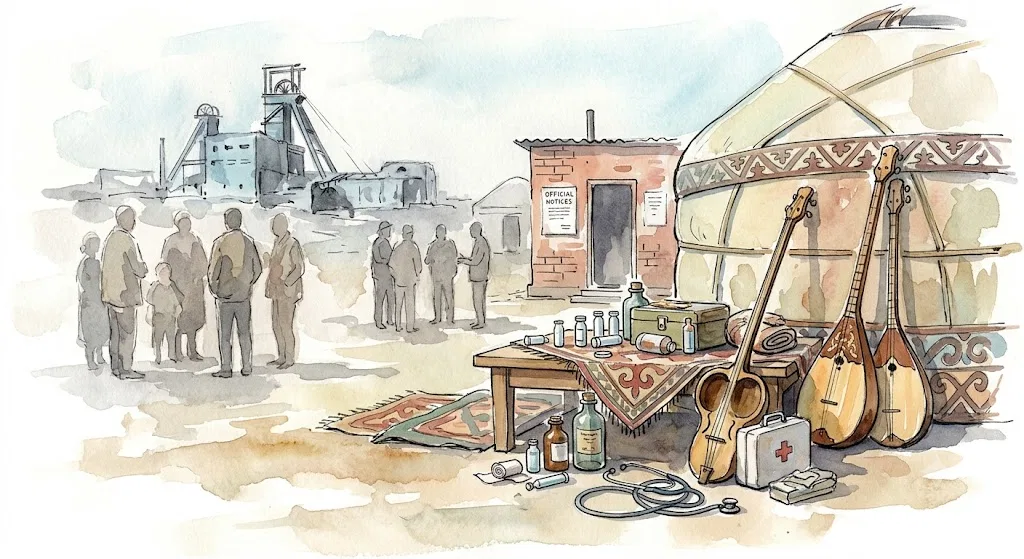
The sleeping sickness reported in Kalachi and nearby Krasnogorsk from 2013 became Kazakhstan’s clearest episode of collective medical fear. Residents suddenly fell into unusually deep sleep, sometimes for several days. Others experienced headaches, weakness, memory loss, disorientation, nausea or hallucinations. The cases affected adults and children and occurred in homes, at school and during everyday work. Reports eventually placed the number affected at well over a hundred.[WIRED]wired.comThe Mystery of the Kazakhstani Sleeping SicknessKazakhstani officials recently attributed the sickness to carbon monoxide emissions from a nearby Soviet-era uranium mine, though this ma…
The symptoms were real, but their cause was obscure. Kalachi lay near a disused Soviet uranium mine, making radiation an obvious suspect. Testing reportedly found no radiation levels sufficient to explain the sudden episodes, however. Infectious disease and deliberate poisoning were also investigated, while journalists recorded speculation about radon, contaminated water, mine gases, military chemicals and mass psychosis.[Smithsonian Magazine]smithsonianmag.comSmithsonian Magazine What's Causing This Village's Weird Sleeping SicknessSmithsonian Magazine What's Causing This Village's Weird Sleeping Sickness
In July 2015, Kazakhstan’s government announced that carbon monoxide and other hydrocarbons escaping from the abandoned mine, combined with reduced oxygen, were responsible. The explanation was medically plausible because impaired oxygen delivery can produce confusion, unconsciousness and neurological symptoms. Officials began relocating families from the affected settlements.[The Guardian]theguardian.comThe Guardian Mystery of Kazakhstan sleeping sickness solved, saysThe Guardian Mystery of Kazakhstan sleeping sickness solved, says
Yet the official conclusion did not resolve every question. Specialists quoted at the time noted that carbon monoxide is normally associated with combustion and asked how dangerous concentrations could repeatedly travel from an inactive mine into open village spaces. Earlier tests on some patients had apparently failed to confirm carbon monoxide poisoning. Later researchers from Nazarbayev University proposed that chemical contamination of drinking water deserved further investigation, although they did not identify a single responsible substance.[WIRED]wired.comThe Mystery of the Kazakhstani Sleeping SicknessKazakhstani officials recently attributed the sickness to carbon monoxide emissions from a nearby Soviet-era uranium mine, though this ma…
Kalachi is therefore misleadingly described as straightforward “mass hysteria”. A psychological component may have shaped people’s expectations or interpretation of symptoms, but the repeated loss of consciousness was investigated as an environmental and medical event. The most reasonable assessment is that villagers suffered a genuine exposure syndrome whose exact mechanism remains disputed. The panic around it arose from uncertainty, not from imaginary illness.
The case became culturally powerful because it condensed several post-Soviet fears into one place: abandoned industrial infrastructure, possible radiation, distrust of official reassurance and suspicion that dangerous secrets had been left underground. The nickname “sleeping village” turned a complex public-health mystery into a modern legend, while relocation transformed the rumour into a permanent social consequence.
How the “destructive sect” became a public enemy
Following independence, Kazakhstan’s religious field became much more diverse. Alongside the country’s established Sunni Muslim and Russian Orthodox communities were Protestant churches, Jehovah’s Witnesses, Hare Krishna devotees, Catholic congregations, independent Muslim circles and numerous missionary or spiritual organisations. Public and official discussion frequently described these groups as “non-traditional”, even though that category had no consistent theological or legal meaning.
By the late 2000s, the vocabulary had hardened. Government-linked publications, educational material and some academics warned of “destructive sects” said to manipulate minds, divide families, recruit vulnerable young people and threaten national stability. One compulsory religious-studies course outline placed “non-traditional religious cults”, “destructive cults” and extremist or terrorist organisations in the same teaching unit. Critics argued that this encouraged pupils to associate peaceful minority religions with violence.[forum18.org]forum18.orgOpen source on forum18.org.
This was a recognisable moral-panic mechanism. A broad social change—the sudden visibility of unfamiliar religions—was reduced to a story about predatory groups attacking the family and nation. The concept became difficult to challenge because “destructive” was often treated as self-explanatory. Evidence of isolation, coercion or financial abuse in one organisation could be used rhetorically against unrelated communities.
The state’s 2011 religion law required religious associations to register and imposed membership thresholds and controls on missionary work, religious literature and public activity. The government presented regulation as necessary to protect citizens and prevent extremism. United Nations experts and human-rights organisations argued that mandatory registration and related restrictions burdened peaceful communities and gave officials wide discretion over acceptable belief.[refworld.org]refworld.orgOpen source on refworld.org.
Media analysis from Kazakhstan and neighbouring Central Asian states found recurring narratives in which religious organisations were blamed for destroying families, rejecting social rules, harming health or recruiting people through material promises. Such stories did not always fabricate individual disputes, but they often treated a participant’s religious affiliation as the main cause without demonstrating that connection.[documents.sfcg.org]documents.sfcg.orgcases of kazakhstan, tajikistan and uzbekistan27 Jan 2021 — Among the discrediting key messages in the media are those of religious organ…
The persistence of this language is visible in current official guidance, which continues to warn citizens about “destructive cults” recruiting through social media, sport, prisons and institutions serving vulnerable people. Such advice may describe genuine high-pressure recruitment techniques, yet it also shows how the contested anti-cult framework has become embedded in public administration.[eGov Kazakhstan]egov.kzdestructive ideas 1destructive ideas 1
When extremism and minority belief were blurred
Kazakhstan’s fears about religious radicalisation were not wholly invented. The country designated violent organisations, prosecuted militant recruitment and experienced attacks linked to armed Islamist networks. Some citizens travelled to conflict zones in Syria and Iraq, and security institutions faced the difficult task of distinguishing ideological militancy from conservative but non-violent religious practice.
The problem was that official categories often extended far beyond groups advocating violence. Human Rights Watch reported that independent Muslims, Hare Krishna adherents, Jehovah’s Witnesses and other minority communities were subjected to harassment while being characterised as sectarian, extremist or socially dangerous.[Human Rights Watch]hrw.orgHuman Rights Watch An Atmosphere of Quiet Repression: Freedom of ReligionHuman Rights WatchAn Atmosphere of Quiet Repression: Freedom of Religion…December 1, 2008 — 1 Dec 2008 — The authorities increasingly…
The treatment of Tablighi Jamaat illustrates the ambiguity. It is a transnational Islamic missionary movement whose members encourage greater personal observance. Kazakhstan banned the movement as extremist in 2013 and subsequently imprisoned participants for membership or missionary activity. Critics of the prosecutions stressed that the organisation’s teachings and methods could be socially conservative without amounting to advocacy of violence. The case shows how a security label can transform ordinary association into criminal evidence.
Jehovah’s Witness Teymur Akhmedov provides an even clearer example. Security agents arranged and recorded discussions about religion, after which Akhmedov was prosecuted for inciting religious discord and advocating religious superiority. In May 2017, a court sentenced him to five years in prison. International monitors argued that he had been punished for peaceful religious speech rather than a demonstrable call to violence.[csce.gov]csce.govReligious Freedom in Kazakhstan: The Case of TeymurReligious Freedom in Kazakhstan: The Case of Teymur
These cases matter to the history of panic because they show the practical effect of hostile labelling. Once a community is widely imagined as secretive, manipulative or extremist, normal behaviour—meeting in a home, discussing scripture or inviting others to join—can appear inherently suspicious. The accusation does not need to prove coercion; the group identity itself becomes the warning sign.
At the same time, describing every restriction as mere hysteria would be equally inaccurate. Kazakhstan’s authorities were responding to a regional environment that included militant organisations and political violence. The central dispute is proportionality: whether measures designed for genuine threats were applied too broadly, and whether the public language of “sects” encouraged that expansion.
Rumours, meningitis and child-abduction scares
A different form of collective fear developed through messaging apps and weakly regulated online news. By the late 2010s, viral warnings in Kazakhstan could reach large audiences before journalists or authorities had verified them. In 2018, Eurasianet described a meningitis scare in which alarming reports and public demands for quarantine spread despite the Health Ministry saying that the number of recorded cases was not unusually high. The panic subsided after roughly two weeks.[Eurasianet]eurasianet.orgkazakhstan with media weak online mischief makers run amokkazakhstan with media weak online mischief makers run amok
The same report identified supposed child-abduction warnings as one of the country’s most persistent viral formats. Messages typically described strangers in cars, attempted kidnappings or organised criminal groups targeting children. Some reports began with a real but ambiguous encounter; others recycled old footage or claims from elsewhere. Because the subject involved children, caution felt morally safer than scepticism, and forwarding the warning became an act of care.
These episodes fit the definition of rumour panic better than mass psychogenic illness. People were not developing common physical symptoms. Instead, uncertain information produced rapid changes in behaviour: parents became frightened, ordinary strangers were treated as potential offenders, and authorities were pressured to respond to threats that had not been established.
The information environment helped. Independent media operated under political and legal constraints, while official institutions often communicated slowly or defensively. That left a trust gap filled by personal contacts, influencers and closed messaging groups. When people doubted both government reassurances and professional journalism, an unverified message from a relative could feel more credible than a formal statement.[Freedom House]freedomhouse.orgfreedom netfreedom net
Korday: when rumour met ethnic tension
The violence in Korday District in February 2020 demonstrates the point at which contagious fear can become physical persecution. A confrontation involving police and members of the Dungan minority was followed by escalating disputes, online claims and mobilisation. Mobs attacked Dungan-populated villages; homes, businesses and vehicles were burned, people were killed and injured, and thousands fled across the border into Kyrgyzstan.[ADC "Memorial"]adcmemorial.orgADC "Memorial"The Korday Pogrom: The Dungan People of KazakhstanADC "Memorial"The Korday Pogrom: The Dungan People of Kazakhstan
This was not an imaginary panic. There were real local disputes, criminal acts and longstanding grievances. But the scale of the violence cannot be understood without examining how individual incidents were generalised into collective blame. Reports and social-media posts encouraged the idea that an entire ethnic community posed a threat or had to be punished for the actions of particular people.
Accounts of the aftermath differed sharply. Officials initially described the events as a mass brawl or criminal conflict, while Dungan witnesses and rights groups called them a pogrom and accused the authorities of obscuring the ethnic nature of the attacks.[ADC "Memorial"]adcmemorial.orgADC "Memorial"The Korday Pogrom: The Dungan People of KazakhstanADC "Memorial"The Korday Pogrom: The Dungan People of Kazakhstan
Korday therefore belongs in the history of social panics not because the violence lacked causes, but because rumour and group stereotyping converted a limited confrontation into a wider atmosphere of fear and retaliation. It also reveals a recurring danger in the language of mass disorder: calling an event a spontaneous “brawl” can conceal organised intimidation, while calling every participant irrational can hide political and economic tensions that preceded the outbreak.
Bloody January and the power of an unverified enemy
Kazakhstan’s January 2022 crisis began with protests over fuel prices and widened into nationwide unrest, elite political conflict, looting and deadly confrontation. An internet shutdown made reliable reporting extremely difficult. In this information vacuum, demonstrators, residents, journalists and officials struggled to distinguish protest, opportunistic crime, organised violence and security operations.[Time]time.comOpen source on time.com.
President Kassym-Jomart Tokayev said that Kazakhstan had been attacked by 20,000 terrorists. The figure was not substantiated publicly and was later removed from his social-media account. Other dramatic claims—including stories about beheaded police officers and attacks on medical workers—circulated through official and unofficial channels without adequate verification. A later media assessment described some of these reports as obvious misinformation that news organisations repeated without correction.[IREX]irex.orgvibrant information barometer 2023 kazakhstanvibrant information barometer 2023 kazakhstan
The “20,000 terrorists” claim offered a simple explanation for a chaotic event. It divided the country into innocent citizens and a vast, coordinated external enemy, leaving little room for the mixed reality of peaceful demonstrators, armed groups, criminal opportunists, state violence and possible struggles within the ruling elite.
This was not merely rhetorical. The government invited troops from the Collective Security Treaty Organization, declared a counter-terrorism operation and authorised security forces to shoot without warning. Hundreds died during the unrest, and subsequent investigations and trials left major questions about responsibility unresolved.[Time]time.comOpen source on time.com.
January 2022 demonstrates how a state can participate in collective threat construction. Rumour does not always rise from below. In a crisis, official claims may spread further and carry greater consequences than anonymous online messages. When communications are cut and independent verification becomes impossible, the authority making the claim also controls much of the public’s ability to test it.
Vaccine fears and a measurable public-health cost
Vaccine hesitancy in Kazakhstan is another form of contagious belief with direct consequences, although it should not be dismissed as irrational panic. Distrust can arise from poor communication, disrupted health services, previous medical experiences, religious concerns and suspicion of state institutions. Social media then allows individual stories or alleged injuries to circulate without the statistical context used to assess vaccine safety.
Kazakhstan experienced a major measles resurgence after routine immunisation was disrupted during the COVID-19 period. The World Health Organization reported a rapid escalation in 2023 and supported catch-up vaccination and public-information measures. In 2024, Kazakhstan recorded more than 28,000 measles cases, the second-highest national total in the wider European and Central Asian region reported by WHO and UNICEF.[World Health Organization]who.int23 01 2024 kazakhstan responds to rapid escalation of measles cases23 01 2024 kazakhstan responds to rapid escalation of measles cases
Research on vaccine acceptance in Kazakhstan identifies misinformation and a growing anti-vaccination movement as significant barriers, while noting that most measles cases occurred among unvaccinated people. UNICEF-backed campaigns responded by using doctors, survivors and parents to explain vaccination and counter misleading claims in accessible language.[Frontiers]frontiersin.orgFrontiers Barriers to vaccine acceptance and immunization coverageFrontiers Barriers to vaccine acceptance and immunization coverage
The important distinction is between fear and falsity. A parent’s anxiety is real even when the information producing it is wrong. Treating hesitant people as ignorant may deepen distrust. Effective responses depend on rapid disclosure, credible local messengers and acknowledgement of uncertainty rather than ridicule or coercive slogans.
What should and should not be called mass hysteria
The phrase “mass hysteria” is tempting because it offers a dramatic label for very different events. In Kazakhstan, however, it often conceals more than it explains.
Kalachi was primarily a medical and environmental mystery. Anxiety and expectation may have influenced the social response, but the physical episodes were repeatedly documented and should not be reduced to collective imagination.
The anti-sect campaign was a moral panic. It turned a broad range of unfamiliar religious groups into symbols of manipulation and national danger, even while some genuinely coercive or militant organisations existed.
Child-abduction and meningitis alarms were rumour panics. Their principal mechanism was rapid information transmission under uncertainty, not shared bodily illness.
Korday was ethnic violence intensified by collective blame. Calling it hysteria risks minimising organised attacks, local grievances and the vulnerability of the targeted minority.
January 2022 was a real political crisis surrounded by threat inflation and misinformation. The violence was not imaginary, but some official explanations were unsupported and helped legitimise an exceptionally forceful response.
These distinctions matter because each problem requires a different remedy. Environmental illness needs open scientific investigation. Harmful religious organisations should be judged by evidence of abuse or crime, not by unfamiliar theology. Rumours require trusted and rapid communication. Ethnic violence requires accountability and protection of minorities. State misinformation requires independent scrutiny.

Why these stories remain important
Kazakhstan’s panic history is ultimately a history of trust. The country inherited secretive Soviet institutions, hazardous industrial sites and traditions of controlling public information. Its post-independence government built a strong central state that promoted religious harmony while closely supervising religious organisation and political speech. Digital media then created channels through which information could move faster than either official verification or professional journalism.
Across the cases, fear spread most effectively where an information gap already existed. Kalachi residents did not know what lay beneath their village. Parents receiving abduction messages did not trust that authorities could protect children. Citizens watching the January violence could not communicate freely. People encountering unfamiliar religious movements lacked a shared vocabulary for separating unconventional belief from coercion or militancy.
The lasting lesson is not that Kazakhstan is unusually susceptible to irrational behaviour. Similar mechanisms appear worldwide. What is distinctive is the combination of post-Soviet secrecy, rapid religious change, centralised security policy, ethnic diversity and an online public sphere operating under constrained independent media.
The most responsible interpretation therefore avoids both sensationalism and complacency. Some feared threats were real; others were exaggerated, misidentified or politically useful. The crucial question is not whether a crowd “went mad”, but who defined the danger, what evidence was available, how the story travelled and whose rights or safety were damaged when belief hardened into action.
Amazon book picks
Further Reading
Books and field guides related to What Made Kazakhstan's Modern Panics Take Hold?. Use these as the next step if you want deeper reading beyond the article.
Extraordinary Popular Delusions and the Madness of Crowds
Rating: 4.0/5 from 5 Google Books ratings
Places Kazakhstan's panics into a wider historical framework.

The new Central Asia
Provides broad regional context for religion, politics and social change.
Endnotes
1.
Source: ohchr.org
Title: un rights expert urges kazakhstan end mandatory registration religious
Link:https://www.ohchr.org/en/press-releases/2014/04/un-rights-expert-urges-kazakhstan-end-mandatory-registration-religious
Source snippet
UN rights expert urges Kazakhstan to end mandatory...4 Apr 2014 — However, the 2011 Law on Religious Associations requires all reli...
2.
Source: documents.sfcg.org
Link:https://documents.sfcg.org/wp-content/uploads/2021/01/Mass_media_and_social_media_analysis_on_religious_freedom_and_violent_extremism_in_Central_Asia.pdf
Source snippet
cases of kazakhstan, tajikistan and uzbekistan27 Jan 2021 — Among the discrediting key messages in the media are those of religious organ...
3.
Source: 2009-2017.state.gov
Link:https://2009-2017.state.gov/j/ct/rls/crt/2010/170258.htm
Source snippet
State DepartmentChapter 2. Country Reports: South and Central Asia Overview18 Aug 2011 — Although no terrorist incidents occurred in 2010...
4.
Source: wired.com
Title: The Mystery of the Kazakhstani Sleeping Sickness
Link:https://www.wired.com/2015/07/mystery-kazakhstani-sleeping-sickness
Source snippet
Kazakhstani officials recently attributed the sickness to carbon monoxide emissions from a nearby Soviet-era uranium mine, though this ma...
5.
Source: time.com
Link:https://time.com/3759511/sleeping-disorder-kazakhstan/
Source snippet
Despite extensive investigations over the past two years, the cause remains unclear. The affliction affects hundreds living near a uraniu...
6.
Source: forum18.org
Link:https://www.forum18.org/archive.php?article_id=1458
7.
Source: refworld.org
Link:https://www.refworld.org/legal/legislation/natlegbod/2011/151288
8.
Source: egov.kz
Title: destructive ideas 1
Link:https://egov.kz/cms/en/articles/religion/destructive-ideas_1
9.
Source: csce.gov
Title: Religious Freedom in Kazakhstan: The Case of Teymur
Link:https://www.csce.gov/articles/religious-freedom-kazakhstan-case-teymur-akhmedov/
10.
Source: 2021-2025.state.gov
Link:https://2021-2025.state.gov/reports/2017-report-on-international-religious-freedom/kazakhstan/
11.
Source: eurasianet.org
Title: kazakhstan with media weak online mischief makers run amok
Link:https://eurasianet.org/kazakhstan-with-media-weak-online-mischief-makers-run-amok
12.
Source: time.com
Link:https://time.com/6137439/kazakhstan-protests-russia/
13.
Source: irex.org
Title: vibrant information barometer 2023 kazakhstan
Link:https://www.irex.org/files/vibrant-information-barometer-2023-kazakhstan.pdf
14.
Source: who.int
Title: 23 01 2024 kazakhstan responds to rapid escalation of measles cases
Link:https://www.who.int/europe/news/item/23-01-2024-kazakhstan-responds-to-rapid-escalation-of-measles-cases
15.
Source: unicef.org
Link:https://www.unicef.org/kazakhstan/media/11551/file/How%20a%20measles%20outbreak%20triggered%20investment%20in%20health%20systems%20strengthening%20and%20demand%20generation%20in%20Kazakhstan.pdf
16.
Source: eurasianet.org
Title: kazakhstan to spend 840m on countering religious extremism
Link:https://eurasianet.org/kazakhstan-to-spend-840m-on-countering-religious-extremism
17.
Source: eurasianet.org
Title: kazakhstan misinformation over vaccinations facilitates measles outbreak
Link:https://eurasianet.org/kazakhstan-misinformation-over-vaccinations-facilitates-measles-outbreak
18.
Source: history.com
Title: mysterious illnesses mass hysteria
Link:https://www.history.com/articles/mysterious-illnesses-mass-hysteria
20.
Source: csce.gov
Title: Greater Regulation of Religion in Kazakhstan?
Link:https://www.csce.gov/statements/greater-regulation-religion-kazakhstan/
21.
Source: refworld.org
Link:https://www.refworld.org/en/download/120912
22.
Source: hrw.org
Title: Human Rights Watch An Atmosphere of Quiet Repression: Freedom of Religion
Link:https://www.hrw.org/report/2008/12/01/atmosphere-quiet-repression/freedom-religion-assembly-and-expression-kazakhstan
Source snippet
Human Rights WatchAn Atmosphere of Quiet Repression: Freedom of Religion...December 1, 2008 — 1 Dec 2008 — The authorities increasingly...
Published: December 1, 2008
23.
Source: hrw.org
Title: submission universal periodic review kazakhstan
Link:https://www.hrw.org/news/2019/10/01/hrw-submission-universal-periodic-review-kazakhstan
Source snippet
Civil Society. Following its second UPR in 2014, Kazakhstan...Read more...
24.
Source: smithsonianmag.com
Title: Smithsonian Magazine What’s Causing This Village’s Weird Sleeping Sickness
Link:https://www.smithsonianmag.com/smart-news/whats-causing-villages-weird-sleeping-sickness-epidemic-180954711/
25.
Source: theguardian.com
Title: The Guardian Mystery of Kazakhstan sleeping sickness solved, says
Link:https://www.theguardian.com/world/2015/jul/17/mystery-kazakhstan-sleeping-sickness-solved
26.
Source: freedomhouse.org
Title: freedom net
Link:https://freedomhouse.org/country/kazakhstan/freedom-net/2020
27.
Source: adcmemorial.org
Title: ADC “Memorial”The Korday Pogrom: The Dungan People of Kazakhstan
Link:https://adcmemorial.org/en/articles/korday-pogrom/
28.
Source: frontiersin.org
Title: Frontiers Barriers to vaccine acceptance and immunization coverage
Link:https://www.frontiersin.org/journals/public-health/articles/10.3389/fpubh.2025.1600363/full
29.
Source: Wikipedia
Title: Mass psychogenic illness
Link:https://en.wikipedia.org/wiki/Mass_psychogenic_illness
30.
Source: ws1.enbek.gov.kz
Link:https://ws1.enbek.gov.kz/attachments/article/7042/%D0%9A%D0%9E%D0%9D%D0%A1%D0%A2%D0%A0%D0%A3%D0%9A%D0%A2%D0%98%D0%92%D0%9D%D0%AB%D0%99%20%D0%94%D0%98%D0%90%D0%9B%D0%9E%D0%93%20%E2%80%93%20%D0%9E%D0%A1%D0%9D%D0%9E%D0%92%D0%90%20%D0%A1%D0%9E%D0%A6%D0%98%D0%90%D0%9B%D0%AC%D0%9D%D0%9E%D0%93%D0%9E%20%D0%93%D0%9E%D0%A1%D0%A3%D0%94%D0%90%D0%A0%D0%A1%D0%A2%D0%92%D0%90.pdf
31.
Source: hrw.org
Link:https://www.hrw.org/world-report/2011/country-chapters/kazakhstan
32.
Source: hrw.org
Title: kazakhstan 7
Link:https://www.hrw.org/sites/default/files/related_material/kazakhstan_7.pdf
33.
Source: hrw.org
Title: An Atmosphere of Quiet Repression
Link:https://www.hrw.org/reports/kazakhstan1208web_0.pdf
34.
Source: hrw.org
Title: covid 19 triggers wave free speech abuse
Link:https://www.hrw.org/news/2021/02/11/covid-19-triggers-wave-free-speech-abuse
35.
Source: healthline.com
Title: mass hysteria
Link:https://www.healthline.com/health/mental-health/mass-hysteria
36.
Source: freedomhouse.org
Title: nations transit
Link:https://freedomhouse.org/country/kazakhstan/nations-transit/2021
Additional References
37.
Source: youtube.com
Title: Kalachi: The Town That Couldn’t Stop Sleeping
Link:https://www.youtube.com/watch?v=oB950juqTnA
Source snippet
Kazakhstanis hit by mystery sleeping sickness that causes them to doze for days...
38.
Source: researchgate.net
Link:https://www.researchgate.net/publication/11580450_Collective_Behaviors_Mass_Panic_and_Outbreaks_of_Multiple_Unexplained_Symptoms
39.
Source: researchgate.net
Link:https://www.researchgate.net/publication/344387826_The_representation_of_cults_new_religious_movements_in_the_media
40.
Source: facebook.com
Link:https://www.facebook.com/cnnnews18/posts/a-unique-problem-in-kalachi-village-in-kazakhstan-makes-people-fall-asleep-for-a/10161117821304202/
41.
Source: facebook.com
Link:https://www.facebook.com/police.assam/posts/a-fake-news-is-being-circulated-on-whatsapp-as-well-as-social-media-facebook-twi/1759171210863904/
42.
Source: upr-info.org
Link:https://upr-info.org/sites/default/files/documents/2019-10/eajw_upr34_kaz_e_main.pdf
43.
Source: lemonde.fr
Link:https://www.lemonde.fr/en/international/article/2024/06/24/victims-of-kazkhstan-s-bloody-january-long-for-justice_6675593_4.html
44.
Source: study.com
Link:https://study.com/learn/lesson/mass-hysteria-moral-panic.html
45.
Source: magellantv.com
Link:https://www.magellantv.com/articles/its-all-in-your-mind-mass-hysteria-psychogenic-illness-and-moral-panic
46.
Source: nu.edu.kz
Link:https://nu.edu.kz/news-en/nu-scientists-come-closer-to-solving-the-mystery-of-the-sleepy-village-of-kalachi/
Topic Tree
Follow this branch
Related pages 192
- Antigua and Barbuda
- Argentina Belief Scares
- Azerbaijan Belief
- Bahrain Beliefs
- North Korea
- +187 more in sidebar