Within Syria
Were Syria's Assassins Really Brainwashed Killers?
Hostile medieval stories turned Syria's Nizari Ismailis from a vulnerable political minority into a mythic order of drugged killers.
On this page
- Who the Syrian Nizari Ismailis were
- How the drugged assassin story developed
- Why the legend still shapes popular culture
Page outline Jump by section
Introduction
The medieval Nizari Ismailis of Syria are among the most misunderstood religious communities in history. Their leaders did order a number of carefully targeted political killings, but the familiar image of a secret order of drugged, brainwashed killers controlled by an all-powerful “Old Man of the Mountain” is largely a product of hostile storytelling rather than reliable historical evidence. Modern scholarship, drawing on Ismaili manuscripts alongside Muslim and Crusader sources, has shown that the most famous elements of the Assassin legend—hashish-fuelled obedience, paradise gardens and mind-controlled followers—developed gradually through polemic, misunderstanding and literary embellishment.[The Institute of Ismaili Studies]iis.ac.ukIntroduction to The Assassin Legends…
The story matters far beyond medieval Syria. It illustrates how a vulnerable religious minority became the subject of one of history’s most enduring conspiracy narratives, with myths that still shape novels, films, games and popular ideas about secret societies.
Who were the Syrian Nizari Ismailis?
The Syrian Nizari Ismailis were a branch of Shia Islam that established themselves in a chain of mountain fortresses during the twelfth century, most famously at Masyaf. They existed in a difficult political landscape dominated by larger powers including Sunni rulers, Crusader states and, later, Saladin’s expanding empire. Survival depended on diplomacy, shifting alliances, fortified strongholds and, on occasion, the elimination of particularly dangerous political opponents.[The Institute of Ismaili Studies]iis.ac.ukIntroduction to The Assassin Legends…
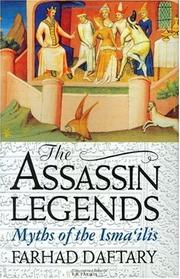
This historical reality is important because it differs sharply from the popular stereotype. The Nizaris were not an organisation devoted solely to murder. They were a religious community with its own theology, leadership and political interests. Their use of targeted assassination was an unusual military strategy adopted by a relatively weak power that lacked the resources for conventional warfare against larger armies. Marshall Hodgson’s classic study and later work by Farhad Daftary both emphasise that these killings were selective rather than indiscriminate, aimed mainly at political or military figures rather than random civilians.[The Institute of Ismaili Studies]iis.ac.ukThe Institute of Ismaili Studies AssassinThe Institute of Ismaili Studies Assassin
Their secrecy also had practical causes. The Ismailis faced sustained persecution from rival Muslim powers, making discretion about leadership, doctrine and internal organisation a matter of survival rather than evidence of occult practices.[The Institute of Ismaili Studies]iis.ac.ukIntroduction to The Assassin Legends…
How did the story of drugged assassins develop?
The legend emerged in stages rather than appearing all at once.
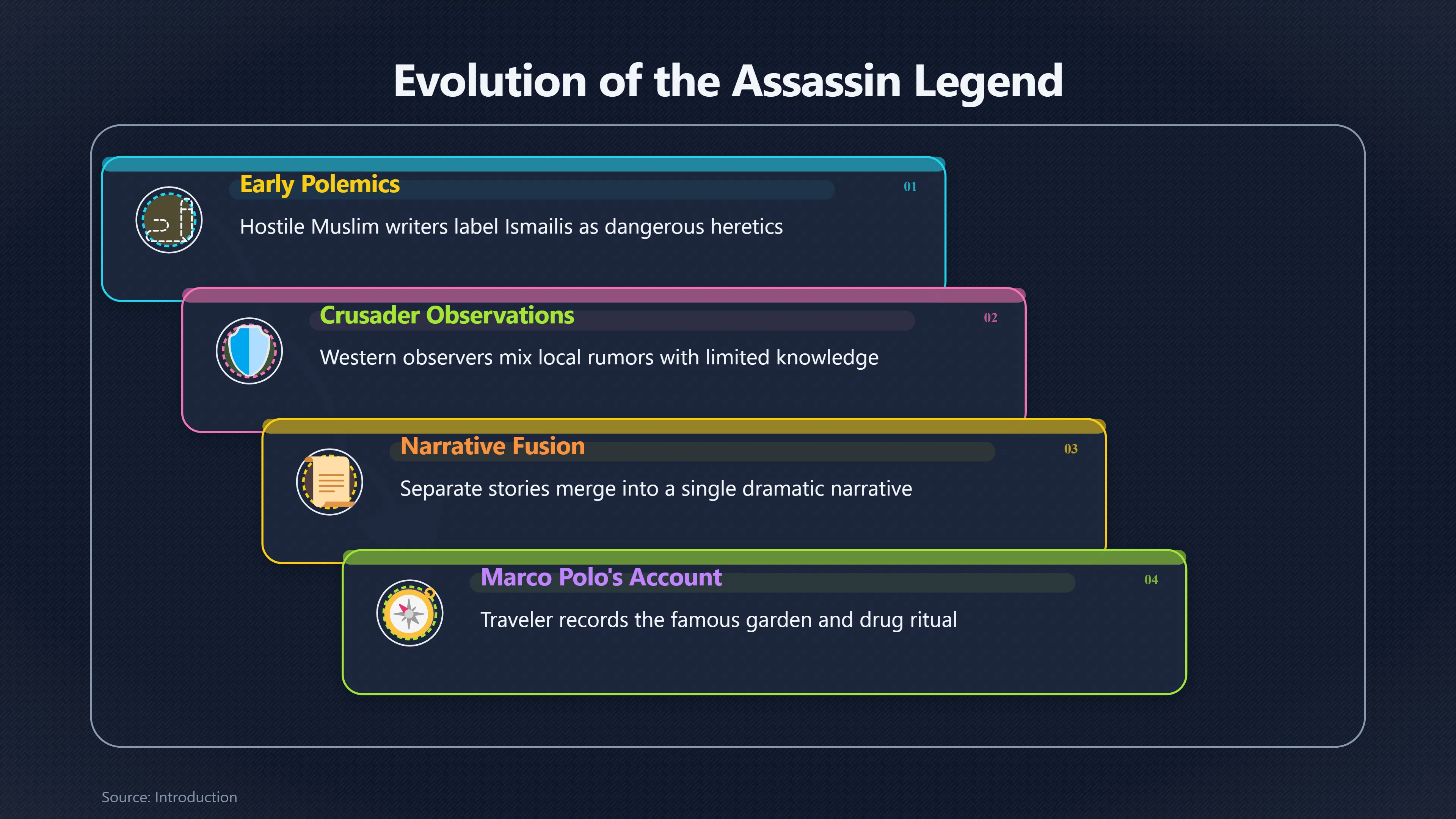
Early hostile Muslim writers often portrayed the Ismailis as dangerous heretics. These accounts criticised their beliefs and political ambitions but generally did not describe elaborate gardens of paradise or armies of drugged killers. Those more extravagant stories appeared primarily through western observers during and after the Crusades, who combined local rumours with limited knowledge of Islamic society.[The Institute of Ismaili Studies]iis.ac.ukIntroduction to The Assassin Legends…
Over time several separate stories merged into a single dramatic narrative:
- an enigmatic leader became the mysterious “Old Man of the Mountain”;
- political assassinations became evidence of supernatural obedience;
- a derogatory nickname associated with “hashish” evolved into claims that killers were routinely drugged;
- later writers added an artificial paradise where recruits supposedly experienced heaven before carrying out missions.
By the time Marco Polo wrote his famous travel account, these separate traditions had fused into the classic European version of the legend. His description of a secret garden where young followers were intoxicated before being sent to kill enemies became the best-known version, despite being written long after the destruction of the main Nizari strongholds in Iran and after the period when the Syrian community had exercised its greatest political influence. Modern historians therefore do not regard Marco Polo as a reliable eyewitness for these events.[The Institute of Ismaili Studies]iis.ac.ukThe Institute of Ismaili Studies AssassinThe Institute of Ismaili Studies Assassin
Was hashish really used to control assassins?
This is the best-known claim about the Assassins, but it is also among the weakest historically.
No contemporary Nizari records describe a system of drugging recruits before missions. Likewise, educated contemporary Muslim historians hostile to the Nizaris did not describe the elaborate paradise-and-hashish ritual that later became famous. Instead, modern scholars argue that the story developed through misunderstanding of hostile labels and later literary embellishment.[The Institute of Ismaili Studies]iis.ac.ukIntroduction to The Assassin Legends…
The precise origin of the word “Assassin” remains debated. For many years scholars connected it to an abusive nickname related to hashish. Other linguistic explanations have also been proposed, and there is no consensus that the name proves drug use. What modern scholarship broadly agrees upon is that the famous story of recruits being intoxicated, shown paradise and then manipulated into murder lacks convincing historical support.[The Institute of Ismaili Studies]iis.ac.ukThe Institute of Ismaili Studies AssassinThe Institute of Ismaili Studies Assassin
This distinction matters because it separates a genuine historical practice—politically motivated targeted killings—from the much more sensational claim of systematic psychological or narcotic mind control.

Why outsiders found the legend believable
The Assassin legend solved several puzzles for medieval observers.
A small religious minority repeatedly survived against much stronger enemies. Individual Nizari agents sometimes willingly undertook missions from which they were unlikely to return alive. To outside observers unfamiliar with Ismaili religious commitment or political organisation, supernatural loyalty seemed easier to understand than disciplined strategy or ideological conviction.
The legend also appealed because it reflected broader medieval European ideas about the mysterious East. Crusaders returned with stories that mixed observation, rumour and imagination for audiences with little independent knowledge of Islamic societies. Dramatic tales of hidden gardens, secret rituals and absolute obedience proved far more memorable than the complicated political realities of Syria’s fragmented medieval landscape.[The Institute of Ismaili Studies]iis.ac.ukIntroduction to The Assassin Legends…
The process resembles many later conspiracy narratives. Ordinary political behaviour becomes reinterpreted as evidence of hidden powers, secret techniques or extraordinary psychological control.
How historians separate fact from myth
Modern understanding changed significantly during the twentieth century as scholars gained access to authentic Ismaili texts that had long remained inaccessible.
Earlier European histories relied heavily on Crusader accounts, hostile Muslim polemics and later Orientalist interpretations. As more genuine Ismaili manuscripts became available, historians were able to compare hostile descriptions with internal evidence from the community itself. This broader documentary base showed that many famous stories lacked contemporary support and had accumulated over centuries of repetition.[The Institute of Ismaili Studies]iis.ac.ukIntroduction to The Assassin Legends…
That does not mean everything about the traditional story is false. The Nizaris did carry out high-profile assassinations. Leaders such as Rashid al-Din Sinan, associated with Masyaf, were real historical figures who exercised considerable political influence. What has changed is the interpretation of how and why these operations occurred. Rather than seeing them as products of brainwashing or narcotics, historians increasingly explain them through the political and military realities facing a persecuted minority.[The Institute of Ismaili Studies]iis.ac.ukThe Institute of Ismaili Studies AssassinThe Institute of Ismaili Studies Assassin
Why the legend still shapes popular culture
Few medieval myths have proved as durable as the Assassin legend.
The word “assassin” itself entered many European languages as a general term for a political murderer, long outliving the medieval Nizari state. Nineteenth-century Orientalist literature revived and romanticised the old stories, presenting the community as exotic, mysterious and fanatically devoted to its leader.[The Institute of Ismaili Studies]iis.ac.ukThe Institute of Ismaili Studies AssassinThe Institute of Ismaili Studies Assassin
In recent decades, novels, films and especially the Assassin’s Creed video game series have introduced the medieval Nizaris to new global audiences. These works openly blend historical settings with fiction, often retaining the familiar imagery of the “Old Man of the Mountain”, secret fortresses and elite assassins while dramatically expanding or reinventing the historical narrative.[Le Monde.fr]lemonde.frA billionaire philanthropist and spiritual leader, he headed the Nizari Ismaili community, an esoteric branch of Shia Islam. He was globa…
The continuing popularity of these stories demonstrates how myths can become culturally independent from the events that originally inspired them. For many people, the fictional Assassins are now better known than the real Syrian Nizari community whose history first gave rise to the legend.
What the Assassin legend reveals about collective belief
Within Syria’s wider history of rumours and social fears, the Assassin legend stands as an early example of how political hostility can produce enduring myths about a religious minority.
The Nizari Ismailis certainly practised targeted political violence, but the enduring image of drugged, brainwashed killers emerged through centuries of hostile reporting, misunderstanding and imaginative storytelling rather than contemporary evidence. The legend transformed a vulnerable religious community into an archetype of secret manipulation and invisible conspiracy.
Its survival into modern popular culture also shows how collective beliefs can outlast the circumstances that created them. Once repeated through chronicles, travel literature, novels and entertainment, stories that begin as polemic can become accepted as historical fact, even after the documentary record points towards a far more complex reality.[The Institute of Ismaili Studies]iis.ac.ukThe Institute of Ismaili StudiesIntroduction to The Assassin Legends…

Endnotes
1.
Source: iis.ac.uk
Title: The Institute of Ismaili Studies
Link:https://www.iis.ac.uk/scholarly-contributions/introduction-to-the-assassin-legends/
Source snippet
Introduction to The Assassin Legends...
2.
Source: iis.ac.uk
Title: The Institute of Ismaili Studies Assassin
Link:https://www.iis.ac.uk/scholarly-contributions/assassin/
3.
Source: iis.ac.uk
Link:https://www.iis.ac.uk/publications-listing/the-assassin-legends/
Source snippet
The Assassin Legends | The Institute of Ismaili StudiesImage: Front cover for The Assassin Legends Buy now * ## By (author) Farhad Daftar...
4.
Source: lemonde.fr
Link:https://www.lemonde.fr/en/religions/article/2025/02/05/death-of-the-aga-khan-what-is-ismaili-islam-an-esoteric-branch-of-the-shia-faith_6737830_63.html
Source snippet
A billionaire philanthropist and spiritual leader, he headed the Nizari Ismaili community, an esoteric branch of Shia Islam. He was globa...
5.
Source: iis.ac.uk
Title: Each reading guide features a brief
Link:https://www.iis.ac.uk/publications/reading-guides-lists/
Source snippet
Reading Guides & Lists | The Institute of Ismaili StudiesDecember 1, 2024 — Overview Reading lists The reading guides available here on s...
Published: December 1, 2024
6.
Source: youtube.com
Title: Who Were the Original Assassins? (The Nizari Ismaili State)
Link:https://www.youtube.com/watch?v=anxyPNc7DLo
Source snippet
Assassins - The History of The Nizari Ismaili...
7.
Source: youtube.com
Link:https://www.youtube.com/watch?v=zCKnffKR6vw
Source snippet
Hashshashins EXPOSED The Hidden Truth Behind the Original Assassins...
Additional References
8.
Source: bloomsbury.com
Title: The Assassin Legends: Myths of the Isma’ilis: Farhad Daftary: I.B
Link:https://www.bloomsbury.com/uk/assassin-legends-9781850437055/
Source snippet
Tauris - BloomsburyJanuary 1, 1995 — THE ASSASSIN LEGENDS MYTHS OF THE ISMA'ILIS Farhad Daftary (Author) Online Access / Resources Image...
Published: January 1, 1995
9.
Source: brownsbfs.co.uk
Title: The Assassin Legends
Link:https://www.brownsbfs.co.uk/Product/Daftary-Dr-Farhad-The-Institute-of-Ismaili-Studies-UK/The-Assassin-Legends/9781850437055
Source snippet
January 1, 1995 — Image: Image for The Assassin Legends THE ASSASSIN LEGENDS: MYTHS OF THE ISMA'ILIS Daftary, Dr Farhad (The Institute o...
Published: January 1, 1995
10.
Source: brownsbfs.co.uk
Title: The Assassin Legends
Link:https://www.brownsbfs.co.uk/Product/Daftary-Dr-Farhad-The-Institute-of-Ismaili-Studies-UK/The-Assassin-Legends/9781850439509
Source snippet
October 26, 2001 — Image: Image for The Assassin Legends THE ASSASSIN LEGENDS: MYTHS OF THE ISMA'ILIS Daftary, Dr Farhad (The Institute...
Published: October 26, 2001
11.
Source: youtube.com
Title: Hashshashins EXPOSED The Hidden Truth Behind the Original Assassins
Link:https://www.youtube.com/watch?v=2gyCxLZ5UhM
Source snippet
The Rise and Fall of the Assassins: From Fearsome Killers to Mongol Defeat...
12.
Source: youtube.com
Title: The Origins | Assassins: Beyond the Legend Episode 1
Link:https://www.youtube.com/watch?v=T0B-EY53p1o
Source snippet
Who Were the Original Assassins? (The Nizari Ismaili State)...
13.
Source: youtube.com
Title: The Rise and Fall of the Assassins: From Fearsome Killers to Mongol Defeat
Link:https://www.youtube.com/watch?v=5nOaFF_LPs8
14.
Source: docslib.org
Link:https://docslib.org/doc/3365266/introduction-to-the-assassin-legends-farhad-daftary
15.
Source: openlibrary.org
Title: The Assassin legends
Link:https://openlibrary.org/books/OL1122767M/The_Assassin_legends
16.
Source: books.google.ca
Title: ca The Assassin Legends: Myths of the Isma’ilis
Link:https://books.google.ca/books?id=V2PisfCC7gkC
17.
Source: books.google.com
Title: The Assassin Legends
Link:https://books.google.com/books/about/The_Assassin_Legends.html?id=Tk4NcAAACAAJ
Topic Tree