When Shared Beliefs Shaped Somalia's History
Somalia does not have a securely documented equivalent of the Salem witch trials, the European dancing plagues or the Tanganyika laughter epidemic.
Page outline Jump by section
Introduction
These subjects must be kept distinct. A possession ceremony is not automatically “mass hysteria”; an anti-colonial religious movement is not necessarily a cult; and belief in spiritual causes of illness is not evidence that symptoms are invented. Somalia’s record instead shows how shared beliefs can give suffering a recognisable form, create supportive rituals, legitimise political authority or, in more dangerous circumstances, turn suspicion into punishment. It also demonstrates why language matters: words such as “mad”, “fanatic”, “witch” and “cult” have often revealed as much about the accuser’s power as about the people being described.
Why Somalia does not fit the familiar panic template
Evidence for Somalia’s social and religious history is uneven. Colonial observers concentrated heavily on rebellions and religious leadership, while anthropologists documented possession and healing more thoroughly than short-lived panics. Decades of conflict have since disrupted medical records, local archives and systematic public-health investigation. Consequently, claims about nationwide “mass hysteria” episodes should be treated cautiously rather than assembled from repeated but poorly sourced stories.
The most defensible approach is to separate four kinds of event:
- Ritualised possession and healing, in which distress is interpreted through a culturally recognised spiritual system.
- Religious mobilisation, including reformist and anti-colonial movements whose followers shared expectations of moral renewal or divine assistance.
- Sorcery accusations, where claims about supernatural harm become instruments of judgement, intimidation or violence.
- Psychological and medical distress, which may be described spiritually because specialist mental-health care is scarce or stigmatised.
These categories can overlap, but they are not interchangeable. In particular, a group ceremony involving music, trance or altered behaviour should not be diagnosed retrospectively as collective mental illness merely because it appears unfamiliar to an outsider.
Spirit possession as a language of distress
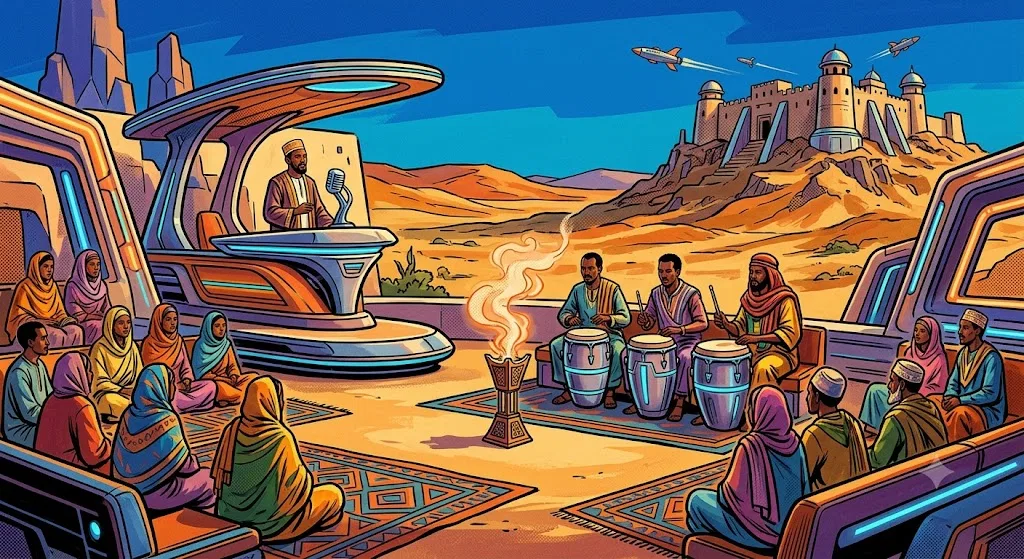
One of the clearest collective-belief traditions associated with Somalia is the regional possession complex commonly known elsewhere as zar. In Somalia it has been recorded under local names including saar and mingis. Because this article uses English wherever possible, these terms are best understood simply as names for recognised possessing spirits and the ceremonies intended to identify, negotiate with or placate them. Medical and anthropological literature describes the wider tradition as simultaneously a belief about the cause of illness, a category of spirits and a method of ritual treatment.[PMC]pmc.ncbi.nlm.nih.govZār Spirit Possession in Iran and African Countries - PMC - NIHby F Mianji · 2015 · Cited by 36 — Zār refers to a type of spirit, to t…
Reported ceremonies have included rhythmic music, incense, dancing, animal offerings and trance. The precise practices vary by community and by the identity attributed to the spirit. Participation has often been associated particularly with women, although men may also take part. An individual’s headaches, fainting, sleeplessness, fear, exhaustion, infertility, bodily pain or disturbed behaviour might be incorporated into a possession explanation rather than treated as unrelated complaints.[PMC]pmc.ncbi.nlm.nih.govZār Spirit Possession in Iran and African Countries - PMC - NIHby F Mianji · 2015 · Cited by 36 — Zār refers to a type of spirit, to t…
From the outside, several people responding to the same songs, expectations and movements can look like emotional contagion. Yet the ceremony is usually better understood as an organised healing setting than as a spontaneous panic. It supplies a name for otherwise confusing suffering, places the patient among people who recognise the condition, and provides a structured response. The ritual may also create socially acceptable space for expressing unhappiness, marital strain, grief or anger that cannot easily be voiced in everyday life.
That does not establish that every claimed cure works, nor does it prove that every symptom has a psychological origin. It means that the ritual’s social function cannot be judged solely by whether the possessing spirit exists in biomedical terms. A person may experience genuine relief from attention, music, expectation, social support and the restoration of a meaningful role, even when clinicians would explain the original symptoms differently.
When possession beliefs meet mental-health care
Somalia’s limited mental-health infrastructure has made supernatural and religious explanations particularly influential. A World Health Organization assessment reported that behavioural disturbance may be attributed to divine will, curses or possession and that healing is frequently sought through spiritual or metaphysical methods. The same report described an extremely weak formal care system, shaped by conflict, poverty, shortages of trained staff and the absence of accessible community services.[EMRO Dashboards]applications.emro.who.intEMRO DashboardsA SITUATION ANALYSIS OF MENTAL HEALTH IN SOMALIAMay 22, 2012 — by World Health Organization · 2010 — Somalis traditionally…
This creates a difficult boundary between culturally meaningful care and harmful delay. Religious recitation, family support and a trusted healer may provide reassurance and companionship. However, someone experiencing epilepsy, severe depression, psychosis, trauma symptoms or another medical condition may not receive appropriate assessment if every problem is interpreted as supernatural. Studies of Somali communities outside Somalia similarly find that beliefs about spirit influence, stigma and mistrust of formal institutions can delay engagement with mental-health or developmental services.[councilofsomaliorgs.com]councilofsomaliorgs.comSomalis and Mental Health: Raising awareness and…February 27, 2018 — 27 Mar 2017 — Some Somalis continue to link it to evil spirit pos…
The humane response is not to ridicule spiritual belief or to describe patients as credulous. Nor should health workers assume that unusual behaviour proves possession. Better practice treats the person’s explanatory framework seriously while checking for neurological illness, infection, trauma, substance use, medication effects and psychiatric conditions. Traditional or religious helpers can sometimes become referral partners, provided that patients are protected from violence, confinement, financial exploitation and the withdrawal of necessary medical treatment.
The distinction from mass psychogenic illness is also important. That diagnosis concerns real symptoms spreading through a connected group without an identified toxic, infectious or other physical cause. Typical outbreaks occur rapidly in schools, workplaces or similarly close communities and may involve dizziness, fainting, headache or breathing difficulties. No comparably well-investigated Somali outbreak appears prominently in the available medical record. Absence from the literature does not prove that none has occurred, but it does rule out confident claims about a famous national “hysteria” episode.[nih.gov]pmc.ncbi.nlm.nih.govOpen source on nih.gov.
The Dervish movement and the politics of “madness”
Somalia’s best-known mass religious mobilisation was the Dervish resistance of the late nineteenth and early twentieth centuries. Led by Mohamed Abdullah Hassan, it fought British, Italian and Ethiopian power for roughly two decades. The movement combined anti-colonial warfare, religious reform, poetry, political organisation and an attempt to transcend at least some clan divisions through a disciplined community of followers.
British writers notoriously called Hassan the “Mad Mullah”. That label should not be treated as a clinical observation. It was colonial propaganda: a compact way of portraying a strategic political and religious opponent as irrational, fanatical and beyond legitimate negotiation. Modern commemorations and scholarship increasingly emphasise that the phrase helped reduce a complex anti-imperial movement to the personality of a supposedly deranged leader.[Royal African Society]royalafricansociety.orgRoyal African Society PostponedRoyal African Society Postponed
The Dervish movement did contain elements relevant to the history of contagious belief. Hassan presented conflict in moral and religious terms, demanded loyalty, condemned opponents and promised a purified community resisting foreign and Christian encroachment. Poetry and preaching carried accusations, praise, warnings and political claims through an oral society. Faith in divine justice and sacred obligation strengthened endurance during a long and destructive war.
Some historians place the movement within a wider period of Islamic revival and millennial expectation in north-east Africa. “Millennial” here does not necessarily mean that followers fixed a date for the end of the world. It can describe movements expecting an approaching transformation in which corrupt authority will be defeated and a righteous social order restored. Scholarship on the rise of the Somali Dervishes notes connections with the broader atmosphere that produced reform movements such as the Sudanese Mahdist state, while also warning against treating every Islamic resistance movement as identical.[Cambridge University Press & Assessment]resolve.cambridge.orgOpen source on cambridge.org.
The Dervishes should therefore not be filed casually under “cult history”. They were an armed political-religious movement with territorial organisation, shifting clan alliances and recognisable anti-colonial objectives. At the same time, their history shows how powerful collective conviction can bind followers together and how enemies use psychiatric language to delegitimise resistance.
Rival reformers and accusations of apostasy
The religious landscape was never divided simply between colonial rulers and one united Somali movement. Competing Sufi orders and scholars disputed doctrine, political strategy and legitimate authority. Sheikh Uways of Barawa led a major religious network that expanded across parts of East Africa, combining devotional renewal, teaching and opposition to European domination. Scholarship describes his movement as mass-based and regionally influential rather than as a marginal sect.[ArcAdiA]arcadia.sba.uniroma3.itGod Anti Colonialism and Drum Sheikh Uways and the UwaysiyyaGod Anti Colonialism and Drum Sheikh Uways and the Uwaysiyya
Uways and Mohamed Abdullah Hassan became bitter opponents. Their conflict involved poetry, doctrinal condemnation and accusations that the other side had departed from proper religion. Uways was killed with followers in 1909, reportedly by Dervish forces. Later accounts preserve hostile language portraying him as a magician or religious deviant, illustrating how supernatural and apostasy labels can transform political rivalry into a struggle against imagined moral contamination.[Wikipedia]WikipediaUways al-BarawiUways al-Barawi
This episode matters because hostile labels can outlive their original setting. A scholar, saint or resistance leader may be remembered as a holy reformer by one community and as a sorcerer, fanatic or traitor by another. Historians must therefore ask who produced each description, which conflict it served and whether later retellings have mistaken propaganda for neutral evidence.
Sorcery accusations under al-Shabaab
The clearest modern cases in which supernatural accusations have led directly to lethal harm involve al-Shabaab courts in areas controlled by the armed Islamist movement. Country-information reports record executions of people accused of witchcraft or sorcery, sometimes framed by the group as apostasy. One documented case concerned a man executed in Jilib in September 2020 after an al-Shabaab court reportedly convicted him of witchcraft. Other local reports describe similar killings in southern Somalia, although details are often difficult to verify independently because journalists and state investigators have limited access to the areas concerned.[ecoi.net]ecoi.netCountry Policy and Information Note. Somalia: Al ShabaabCountry Policy and Information Note. Somalia: Al Shabaab
These cases differ from a traditional village panic in several respects. The decisive force is not merely a rumour spreading through frightened neighbours. It is an armed organisation claiming judicial and religious authority, defining an alleged supernatural offence and imposing punishment without the safeguards expected of a credible court. The accusation can therefore operate as a technology of rule: it identifies supposed hidden enemies, demonstrates the group’s moral power and warns spectators against behaviour placed outside its approved religious order.
Evidence made public in such proceedings is generally inadequate. In other al-Shabaab executions, including cases involving alleged spying, judges have announced confessions or verdicts without releasing independently testable proof. Public punishment reinforces the message that unseen betrayal is everywhere and that the movement alone can detect it.[Voice of America]voanews.comVoice of America Al-Shabab Executes 5, Including Teenage BoyVoice of America Al-Shabab Executes 5, Including Teenage Boy
It would be misleading, however, to describe Somalia as experiencing a single nationwide witch panic. The documented sorcery executions are intermittent and concentrated in territory where al-Shabaab has exercised coercive authority. They reveal the deadly potential of supernatural accusations, but not an unbroken national culture of witch persecution.
Rumour, conflict and the search for hidden enemies
Somalia’s prolonged wars have produced ideal conditions for rumours: displacement, weak communications, fragmented authority, danger to reporters and widespread uncertainty about who controls armed men. In such settings, stories about spies, cursed individuals, secret collaborators or religious betrayal can spread because they offer a simple explanation for otherwise unpredictable violence.
Rumours thrive when ordinary verification is dangerous or impossible. A resident may be unable to question a local commander, inspect evidence or seek protection from an independent court. Repetition then substitutes for proof, while public punishment makes disbelief hazardous. Claims need not persuade everyone privately; they need only be dangerous enough that few people will challenge them openly.
The accusation of spying has been far more prominent in al-Shabaab’s recorded executions than witchcraft. Nevertheless, the two forms of accusation share a structure. Both concern a concealed threat said to be living among the community. Both rely on authorities claiming special power to expose what ordinary people cannot see. Both can redirect fear towards an individual whose guilt has not been independently established.[ecoi.net]ecoi.netCountry Policy and Information Note. Somalia: Al ShabaabCountry Policy and Information Note. Somalia: Al Shabaab
This is why episodes of collective fear should not be dismissed as simple ignorance. They are often shaped by real danger. Somalis living amid insurgency, air strikes, clan conflict or forced recruitment have rational reasons to fear infiltration and retaliation. The panic begins when genuine insecurity is attached to unreliable claims, when suspicion becomes self-confirming and when institutions punish people without meaningful scrutiny.
What should not be called a cult or mass hysteria
Somalia’s history is especially vulnerable to sensational retelling because several visually striking subjects—trance ceremonies, charismatic religious leaders, possession beliefs and public executions—fit stereotypes outsiders already hold. A responsible account applies stricter tests.
A cult label is least useful when it simply means an unfamiliar or unpopular religious group. The Dervishes and the followers of Sheikh Uways were substantial religious and political movements rooted in wider Islamic traditions. They can be studied for charismatic authority, discipline and millennial hopes without pretending that “cult” is a neutral classification.
A mass-hysteria label is inappropriate for a planned healing ceremony. Collective rhythm, trance and shared expectations may shape participants’ experiences, but the event has an accepted ritual script and social purpose. Mass psychogenic illness is a medical hypothesis requiring careful exclusion of environmental, infectious and toxic causes—not a synonym for strange group behaviour.
A witch panic requires more than isolated belief in sorcery. It normally involves multiplying accusations, pressure to identify further suspects and escalating communal or official punishment. Somalia has documented sorcery-related killings, particularly under al-Shabaab, but the available evidence does not support claims of a national historical witch-hunt comparable to the large early-modern European prosecutions.
Nor should every spiritual explanation be equated with abuse. Religious care may comfort patients and families. Harm arises when belief becomes an excuse for beating, chaining, starving, exploiting or abandoning someone, or when it prevents urgent medical treatment. The central question is not whether a practice looks modern to an outsider, but whether it respects the person’s safety, consent and access to effective care.
Why these histories still matter
Somalia’s cases reveal three recurring relationships between collective belief and power.
First, shared spiritual explanations can make suffering intelligible. Possession traditions transform private distress into a recognised social event, giving relatives and ritual specialists a way to respond. Their value and their risks both grow when formal care is unavailable.
Second, labels of irrationality are political weapons. The colonial description of Mohamed Abdullah Hassan as “mad” concealed the strategic and anti-imperial character of the Dervish movement. Similar language can still turn ideological disagreement into a supposed defect of mind rather than a conflict that must be historically explained.
Third, supernatural accusation becomes most dangerous when backed by coercive institutions. Al-Shabaab’s sorcery verdicts are not simply survivals of folklore. They are examples of armed governance using unverifiable claims to define enemies and display authority.
The broader lesson is that collective belief does not operate outside history. It responds to war, colonial intrusion, religious competition, gendered constraints, illness, insecure institutions and failures of public care. Somalia’s record is therefore less a catalogue of bizarre panics than a history of how communities interpret invisible threats—and of who gains the power to decide which interpretation becomes healing, orthodoxy, propaganda or a death sentence.
Amazon book picks
Further Reading
Books and field guides related to When Shared Beliefs Shaped Somalia's History. Use these as the next step if you want deeper reading beyond the article.

The anthropology of religion, magic, and witchcraft
Explains comparative belief systems relevant to Somalia.

Understanding Somalia and Somaliland
Broad foundation for religion, politics and belief.
Endnotes
1.
Source: applications.emro.who.int
Link:https://applications.emro.who.int/dsaf/emropub_2010_en_736.pdf
Source snippet
EMRO DashboardsA SITUATION ANALYSIS OF MENTAL HEALTH IN SOMALIAMay 22, 2012 — by World Health Organization · 2010 — Somalis traditionally...
Published: May 22, 2012
2.
Source: applications.emro.who.int
Link:https://applications.emro.who.int/dsaf/dsa702.pdf
Source snippet
Sudan has the experience of using traditional healers for provision of mental health services...
3.
Source: councilofsomaliorgs.com
Link:https://www.councilofsomaliorgs.com/assets/CSO-M.Health-Report.pdf
Source snippet
Somalis and Mental Health: Raising awareness and...February 27, 2018 — 27 Mar 2017 — Some Somalis continue to link it to evil spirit pos...
Published: February 27, 2018
4.
Source: pmc.ncbi.nlm.nih.gov
Link:https://pmc.ncbi.nlm.nih.gov/articles/PMC7396040/
5.
Source: sajp.org.za
Link:https://sajp.org.za/index.php/sajp/article/view/1671/2648
6.
Source: resolve.cambridge.org
Link:https://resolve.cambridge.org/core/services/aop-cambridge-core/content/view/E5CA25BB643591C58DAF28D6E6CA7453/9780511735370c3_p91-136_CBO.pdf/occupation_and_resistance_the_rise_of_the_somali_dervishes.pdf
7.
Source: Wikipedia
Title: Uways al-Barawi
Link:https://en.wikipedia.org/wiki/Uways_al-Barawi
8.
Source: ecoi.net
Title: Country Policy and Information Note. Somalia: Al Shabaab
Link:https://www.ecoi.net/en/file/local/2040615/Somalia-_Al_Shabaab_-CPIN-_V3.0e.pdf
9.
Source: irb-cisr.gc.ca
Link:https://www.irb-cisr.gc.ca/en/country-information/rir/Pages/index.aspx?doc=458779&pls=1
10.
Source: ecoi.net
Link:https://www.ecoi.net/en/document/2090361.html
11.
Source: cambridge.org
Link:https://www.cambridge.org/core/journals/journal-of-the-royal-asiatic-society/article/people-of-the-wind/E5200E53B13287DD27CB0FC074A190B4
12.
Source: cambridge.org
Link:https://www.cambridge.org/core/books/worlds-of-the-indian-ocean/ancient-routes-of-trade-and-cultural-exchanges-and-the-first-states-sixthsecond-millennium-bce/B0FA0F18A4E18A84B635E7B84092230F
13.
Source: cambridge.org
Link:https://www.cambridge.org/core/services/aop-cambridge-core/content/view/FFF0017134A2FD10FFC4BEDEFBFC9F11/S0002930000273077a.pdf/analytical_index.pdf
14.
Source: Wikipedia
Title: Religion in Somalia
Link:https://en.wikipedia.org/wiki/Religion_in_Somalia
15.
Source: Wikipedia
Title: List of mass panic cases
Link:https://en.wikipedia.org/wiki/List_of_mass_panic_cases
16.
Source: Wikipedia
Link:https://en.wikipedia.org/wiki/Z%C4%81r
17.
Source: Wikipedia
Title: Modern witch hunts
Link:https://en.wikipedia.org/wiki/Modern_witch_hunts
18.
Source: Wikipedia
Title: Dervish movement (Somali)
Link:https://en.wikipedia.org/wiki/Dervish_movement_%28Somali%29
19.
Source: Wikipedia
Title: List of people executed for witchcraft
Link:https://en.wikipedia.org/wiki/List_of_people_executed_for_witchcraft
20.
Source: iris.who.int
Link:https://iris.who.int/bitstreams/19246487-2476-496f-a1a8-3ad259a16962/download
21.
Source: iris.who.int
Link:https://iris.who.int/bitstreams/0ef225e0-5b0d-4476-92ad-6feaec8ae09b/download
22.
Source: iris.who.int
Link:https://iris.who.int/bitstreams/ac4226ff-cdaa-4429-8824-33228f8467f8/download
23.
Source: who.int
Link:https://www.who.int/docs/default-source/substance-use/who-psa-93-10.pdf
24.
Source: emro.who.int
Link:https://www.emro.who.int/polio-eradication/news/somalia-formal-closure-of-the-cvdpv3-outbreak.html
25.
Source: apps.who.int
Link:https://apps.who.int/gb/ebwha/pdf_files/wha67-rec1/a67_2014_rec1-en.pdf
26.
Source: applications.emro.who.int
Title: em mnh 181 e en
Link:https://applications.emro.who.int/docs/who_em_mnh_181_e_en.pdf
27.
Source: applications.emro.who.int
Link:https://applications.emro.who.int/dsaf/dsa1039.pdf
28.
Source: cdn.who.int
Link:https://cdn.who.int/media/docs/default-source/violence-prevention-alliance-section/9_jphp_vpa_special_issue_janzen.pdf?sfvrsn=ed8b0ae1_3
29.
Source: pmc.ncbi.nlm.nih.gov
Link:https://pmc.ncbi.nlm.nih.gov/articles/PMC4801492/
Source snippet
Zār Spirit Possession in Iran and African Countries - PMC - NIHby F Mianji · 2015 · Cited by 36 — Zār refers to a type of spirit, to t...
30.
Source: royalafricansociety.org
Title: Royal African Society Postponed
Link:https://royalafricansociety.org/event/marking-100-years-of-the-dervish-movement/
31.
Source: arcadia.sba.uniroma3.it
Title: God Anti Colonialism and Drum Sheikh Uways and the Uwaysiyya
Link:https://arcadia.sba.uniroma3.it/bitstream/2307/3821/1/God_%20Anti-Colonialism%20and%20Drum%20-%20Sheikh%20Uways%20and%20the%20Uwaysiyya.pdf
32.
Source: voanews.com
Title: Voice of America Al-Shabab Executes 5, Including Teenage Boy
Link:https://www.voanews.com/a/al-shabab-executes-5/4178422.html
33.
Source: pubmed.ncbi.nlm.nih.gov
Link:https://pubmed.ncbi.nlm.nih.gov/9443001/
34.
Source: pubmed.ncbi.nlm.nih.gov
Link:https://pubmed.ncbi.nlm.nih.gov/9239794/
35.
Source: pmc.ncbi.nlm.nih.gov
Link:https://pmc.ncbi.nlm.nih.gov/articles/PMC8475597/
36.
Source: pmc.ncbi.nlm.nih.gov
Link:https://pmc.ncbi.nlm.nih.gov/articles/PMC4060147/
37.
Source: nationalarchives.gov.uk
Link:https://www.nationalarchives.gov.uk/explore-the-collection/explore-by-time-period/early-modern/witchcraft/
38.
Source: ebsco.com
Link:https://www.ebsco.com/research-starters/social-sciences-and-humanities/mass-hysteria
Additional References
39.
Source: europepmc.org
Link:https://europepmc.org/article/med/7926995
Source snippet
Europe PMCMental disease related to belief in being possessed by the...by A Arieli · 1994 · Cited by 19 — According to this belief, bein...
40.
Source: researchcommons.waikato.ac.nz
Link:https://researchcommons.waikato.ac.nz/entities/publication/eb08efeb-63c8-475c-b595-9bc5fd30c127
Source snippet
Research CommonsExploring Somali expressions of psychological distress and...by JF Ryan · 2008 · Cited by 9 — The findings of all three...
41.
Source: jstor.org
Link:https://www.jstor.org/stable/40760924
Source snippet
IL CULTO DI SHEEKH XUSSEN E IL MINGISby E Pelizzari · 1992 · Cited by 1 — This article will present some ethnographic data concernin...
42.
Source: researchgate.net
Link:https://www.researchgate.net/publication/271759288_Mass_hysteria_among_South_African_primary_school_learners_in_Kwa-Dukuza_KwaZulu-Natal
43.
Source: researchgate.net
Link:https://www.researchgate.net/publication/381969099_Balancing_Belief_and_Burden_A_Comparative_Analysis_of_Spiritual_and_Exploitative_Practices_in_Somali_Traditional_Healing_for_Mental_Health_Case_Study_Mogadishu_Areas
44.
Source: zwemercenter.com
Link:https://www.zwemercenter.com/christian-heritage-and-the-rise-of-islam-in-somalia/
45.
Source: unicef.org
Link:https://www.unicef.org/stories/fighting-polio-vaccine-misinformation
46.
Source: facebook.com
Link:https://www.facebook.com/groups/149844915349213/posts/2877592949241049/
47.
Source: theatlantic.com
Link:https://www.theatlantic.com/international/archive/2017/10/somalia-shabaab-kenya-uganda-amisom/543063/
48.
Source: facebook.com
Link:https://www.facebook.com/trtafrika/videos/sayid-mohamed-abdulle-hassan-remains-one-of-the-most-influential-figures-in-soma/760005167173225/
Topic Tree
Follow this branch
Related pages 192
- Antigua and Barbuda
- Argentina Belief Scares
- Azerbaijan Belief
- Bahrain Beliefs
- North Korea
- +187 more in sidebar