Within Croatia
Was Jure Grando Really Croatia's First Vampire?
The Jure Grando story reveals how disease, decomposition and communal fear could turn a dead neighbour into a revenant.
On this page
- What Valvasor recorded about the village of Kringa
- Why corpses and continuing misfortune seemed connected
- How folklore became Gothic tourism and modern legend
Page outline Jump by section
Introduction
The story of Jure Grando is one of Croatia’s most famous supernatural legends because it sits at the point where folklore, fear and written history meet. According to accounts from the seventeenth century, Grando was a villager from Kringa in Istria who died in 1656 but was believed to have returned from the grave, bringing death and terror to his neighbours until villagers exhumed and decapitated his body in 1672. Whether the events happened as described is impossible to verify, but the story is historically significant because it is among the earliest named vampire accounts recorded in Europe rather than an anonymous folk tale. It also reveals how disease, unexplained deaths and unusual features of decomposition could convince an entire community that a dead neighbour remained dangerously active.

Was Jure Grando really Croatia’s first vampire?
Jure Grando is often described as Croatia’s first vampire, although “first recorded vampire” is more accurate than “first vampire”. Beliefs in dangerous returning dead were widespread across the Balkans and Central Europe long before his story was written down. What makes Grando distinctive is that he appears in a relatively detailed written account with a personal name, village and chronology rather than surviving only through oral tradition.[Istra]istra.hrKringa | Central Istria | Town and surroundings Istra-IstriaKringa | Central Istria | Town and surroundings Istra-Istria - official tourism portal…
The central source is the polymath and traveller Johann Weikhard Valvasor, who included the episode in his 1689 work The Glory of the Duchy of Carniola. Valvasor did not claim to have witnessed the events himself. Instead, he reported what local people in Kringa said had happened and presented it as a remarkable occurrence from recent memory. Because the account was published only a few years after the alleged events, historians treat it as an important document about local belief even if they do not accept its supernatural claims.[istrianet.org]istrianet.orgIstria on the InternetRelevant Non-Istrians - Johann Weichard ValvasorFebruary 22, 2006…
The figure described by Valvasor also differs from the modern literary vampire. Grando is not portrayed as an elegant aristocrat drinking blood in a Gothic castle. Instead, he belongs to local traditions about the dangerous dead, people believed to leave their graves to trouble relatives and neighbours after death. Later vampire fiction borrowed only some elements of these earlier traditions.
What Valvasor recorded about the village of Kringa
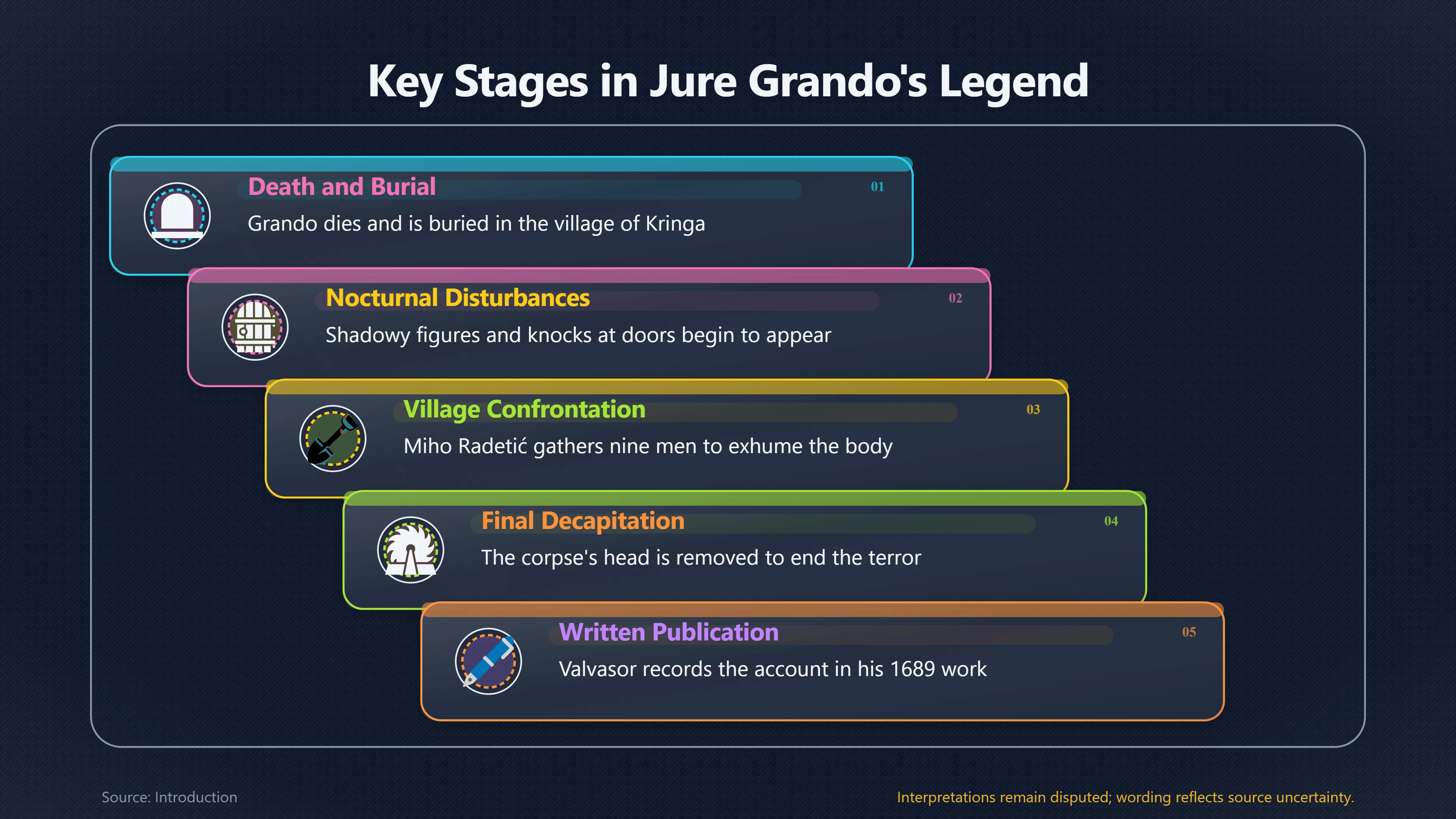
Valvasor’s narrative begins with Grando’s death and burial in 1656. Soon afterwards, villagers reportedly claimed that a shadowy figure walked through Kringa at night, knocking on doors. According to local belief, a knock from the dead foretold another death in that household, and several subsequent deaths appeared to confirm the pattern in people’s minds.[istrianet.org]istrianet.orgIstria on the InternetRelevant Non-Istrians - Johann Weichard ValvasorFebruary 22, 2006…
The story also says that Grando’s widow complained her dead husband returned to her house at night and assaulted her. This detail reflects a wider European tradition in which revenants did not merely haunt the living but continued relationships interrupted by death, making the threat intensely personal rather than abstract.[Istra]istra.hrKringa | Central Istria | Town and surroundings Istra-IstriaKringa | Central Istria | Town and surroundings Istra-Istria - official tourism portal…
After years of fear, the village leader Miho Radetić gathered nine men to confront the problem. When they opened the grave, they reportedly found the corpse unusually well preserved, with colour remaining in its face. Attempts to drive a hawthorn stake through the body supposedly failed, so one of the men finally cut off the corpse’s head. According to the legend, the disturbances immediately ceased.[Istra]istra.hrKringa | Central Istria | Town and surroundings Istra-IstriaKringa | Central Istria | Town and surroundings Istra-Istria - official tourism portal…
The dramatic details—including tears running down the corpse’s face, cries heard during the decapitation and blood flowing from the neck—became some of the most memorable features of the legend. Historians generally regard these as folkloric embellishments rather than evidence of supernatural events, but they illustrate how communities interpreted unfamiliar features of human decomposition.
Why corpses and continuing misfortune seemed connected
To modern readers, the villagers’ actions can appear irrational. Within the context of seventeenth-century rural Europe, however, they reflected accepted explanations for otherwise mysterious misfortune.
Several factors helped reinforce belief that Grando remained active after death.
- Repeated deaths: Infectious disease often spread through households and villages in waves. When deaths followed one another, people searched for a visible cause rather than accepting chance or invisible infection.
- The appearance of the corpse: Bodies buried in cool or sealed conditions can decompose more slowly than expected. Swelling, retained skin colour, apparent movement caused by gases, or blood-like fluids around the mouth were once interpreted as signs that a corpse had continued feeding or living after burial.
- Community testimony: Once respected neighbours reported seeing the dead or connected knocks at doors with later deaths, each new tragedy reinforced existing expectations.
- Religious belief: Early modern Christianity existed alongside older folk traditions about restless dead. Priests, local officials and villagers sometimes shared assumptions that certain corpses posed genuine danger, even if they disagreed about the correct response.[istrianet.org]istrianet.orgIstria on the InternetRelevant Non-Istrians - Johann Weichard ValvasorFebruary 22, 2006…
The Grando episode therefore illustrates not mass hysteria in the modern psychological sense but a community interpreting ordinary events through a widely accepted supernatural framework. The belief spread because it offered a coherent explanation for illness, bereavement and fear.

How much historical evidence exists?
The strongest historical evidence is that people in the region told this story and that Valvasor recorded it in print in 1689. Beyond that, certainty quickly diminishes.
No surviving judicial investigation confirms every detail, and the events cannot be independently reconstructed from multiple contemporary records. Nor is there archaeological evidence that could establish whether Grando’s body was actually exhumed and decapitated. Historians therefore distinguish carefully between the documented existence of the story and the supernatural interpretation offered within it.[Istrapedia]istrapedia.hrGrando, JureGrando, Jure - Istrapedia…
The account nevertheless has considerable historical value because it captures genuine beliefs about death in seventeenth-century Istria. Rather than asking whether vampires existed, scholars use the episode to explore how communities understood disease, mortality, unexplained misfortune and the physical changes occurring after burial.
From village legend to Gothic imagination
Although Grando himself remained a local figure, stories such as his contributed to the broader European fascination with vampires that expanded during the eighteenth century. Reports from the Habsburg lands about suspected revenants attracted attention among scholars, clergy and government officials, prompting official investigations into alleged vampire cases elsewhere in the empire.
As vampire stories entered Western European literature, many local features disappeared. Fiction gradually replaced the feared village corpse with the aristocratic, seductive vampire popularised during the nineteenth century. Grando therefore occupies an important place in the genealogy of vampire tradition, even though his story differs markedly from later literary creations.
Today Kringa openly embraces the legend as part of its cultural heritage. Tourism materials present Jure Grando as the village’s most famous historical figure, while carefully framing the tale as folklore rooted in local history rather than established fact.[Istra]istra.hrKringa | Central Istria | Town and surroundings Istra-IstriaKringa | Central Istria | Town and surroundings Istra-Istria - official tourism portal…

Why the story still matters
The legend of Jure Grando survives because it reveals more than a supposed vampire. It shows how communities under pressure from disease and repeated bereavement sought explanations that made emotional and cultural sense within their world.
For Croatia’s wider history of collective belief, the episode complements rather than duplicates the country’s witch trials. Witchcraft accusations focused on living neighbours blamed for hidden crimes, whereas the Grando story centred on fear that the dead themselves could continue harming the living. Both demonstrate how misfortune, uncertainty and communal anxiety could produce powerful shared beliefs, but they did so through different social mechanisms.
Seen in that light, Jure Grando is significant not because historians believe a vampire walked through Kringa, but because his story preserves an unusually vivid record of how seventeenth-century villagers understood death, fear and the fragile boundary they believed separated the living from the dead.
Amazon book picks
Further Reading
Books and field guides related to Was Jure Grando Really Croatia's First Vampire?. Use these as the next step if you want deeper reading beyond the article.


Bram Stoker's Dracula omnibus
First published 1897. Subjects: Fiction, horror, Children: Grades 3-4, Dracula, count (fictitious character), fiction, Frankenstein (fict...
The Essential Dracula
An essay on the history of the vampire myth in literature accompanies an annotated version of the classic vampire tale.
Endnotes
1.
Source: istra.hr
Title: Kringa | Central Istria | Town and surroundings Istra-Istria
Link:https://www.istra.hr/en/destinations/pazin/town-and-surroundings/884
Source snippet
Kringa | Central Istria | Town and surroundings Istra-Istria - official tourism portal...
2.
Source: istrapedia.hr
Title: Grando, Jure
Link:https://www.istrapedia.hr/hr/natuknice/1684/grando-jure
Source snippet
Grando, Jure - Istrapedia...
3.
Source: istrianet.org
Title: Istria on the Internet
Link:https://www.istrianet.org/istria/non-istrians/valvasor/works/themes.htm
Source snippet
Relevant Non-Istrians - Johann Weichard ValvasorFebruary 22, 2006...
Published: February 22, 2006
4.
Source: istrianet.org
Title: Istria on the Internet
Link:https://www.istrianet.org/istria/legends/supernatural/06_0424mg.htm
Source snippet
Legends and Myths - Evil and Supernatural Spirits...
5.
Source: istrianet.org
Title: Istria on the Internet
Link:https://www.istrianet.org/istria/legends/supernatural/istria-grando.htm
Source snippet
Legends and Myths - Evil Spirits and the Supernatural...
6.
Source: istrianet.org
Title: Istria on the Internet
Link:https://www.istrianet.org/istria/legends/supernatural/05_0930glasistre-eng.htm
Source snippet
Legends and Myths - Evil Spirits and the Supernatural...
7.
Source: istrianet.org
Title: Istria on the Internet
Link:https://www.istrianet.org/istria/legends/supernatural/05_1001glasistre-eng.htm
8.
Source: istra.hr
Title: Kringa | Press Releases Istra-Istria
Link:https://www.istra.hr/en/business-information/istria-in-media/press-releases/884-ch-0?l_over=1
9.
Source: vampire-encyclopedia.fandom.com
Title: Jure Grando
Link:https://vampire-encyclopedia.fandom.com/wiki/Jure_Grando
Additional References
10.
Source: rijekadanas.com
Link:https://www.rijekadanas.com/istarsko-selo-skriva-najmracniju-tajnu-europe-ovdje-je-pokopan-prvi-vampir-na-svijetu/
Source snippet
November 2, 2025 — ISTARSKO SELO SKRIVA NAJMRAČNIJU TAJNU EUROPE: OVDJE JE POKOPAN PRVI VAMPIR NA SVIJETU By dš - November 2, 2025 Ilustr...
Published: November 2, 2025
11.
Source: regardsurlacroatie.com
Link:https://www.regardsurlacroatie.com/jure-grando-vampire-europe/
Source snippet
March 7, 2025 — JURE GRANDO, LE PLUS ANCIEN VAMPIRE D’EUROPE: ENTRE LÉGENDE ET HISTOIRE EN CROATIE 7 mars 2025 LeGuide...
Published: March 7, 2025
12.
Source: esoteric.love
Title: Jure Grando: The First Documented Vampire | Hidden History | Esoteric.Love
Link:https://www.esoteric.love/past/mythology/vampires/jure-grando
Source snippet
May 10, 2026 — era · past · mythology JURE GRANDO: THE FIRST DOCUMENTED VAMPIRE A 17th-century corpse terrorised a village for sixteen ye...
Published: May 10, 2026
13.
Source: youtube.com
Title: Was Jure Grando The First Reported Case Of A Real-Life Vampire?
Link:https://www.youtube.com/watch?v=9P3-gOSN9wk
Source snippet
JURE GRANDO — THE FIRST DOCUMENTED VAMPIRE...
14.
Source: researchgate.net
Link:https://www.researchgate.net/publication/358767746_Balkan_Vampire_Myth_Urban_Legends_or_a_Publicity_tool
15.
Source: researchgate.net
Link:https://www.researchgate.net/publication/228581526_Fantastic_Creatures_and_Their_Valorisation_in_Tourism_Example_of_Istria
16.
Source: timeout.com
Link:https://www.timeout.com/croatia/travel/vampire-country
17.
Source: scribd.com
Link:https://www.scribd.com/document/980656477/Heritage-Tourism-Beyond-Borders-and-Civilizations-Proceedings-of-the-Tourism-Outlook-Conference-2018-1st-Edition-ISBN-9789811553691-9811553696-Enha
18.
Source: central-istria.com
Link:https://central-istria.com/pododredista/kringa
19.
Source: webbut.unitbv.ro
Link:https://webbut.unitbv.ro/index.php/Series_IV/article/view/962
Topic Tree