Within Malawi
Why Do Bloodsucker Panics Keep Returning?
Unsolved killings and recurring bloodsucker scares turned fears of bodily attack into stories about hidden technology, foreign power and official protection.
On this page
- The Chilobwe murders and rumours of stolen blood
- Recurring scares from 2002 to 2020
- How distrust turns rumours into mob violence
Page outline Jump by section
Introduction
Malawi’s recurring bloodsucker panics are among the country’s most striking examples of how fear, rumour and political distrust can reinforce one another. Although the stories vary, they usually centre on claims that organised groups are secretly extracting human blood for sale, ritual purposes or the benefit of powerful political or foreign interests. These rumours have repeatedly led to roadblocks, attacks on strangers, assaults on health workers and, in some cases, killings of innocent people mistaken for “bloodsuckers”. The pattern is not simply a story of unusual beliefs. It reflects deeper problems of insecurity, unresolved crimes, weak trust in public institutions and the rapid spread of rumours during periods of political uncertainty. Scholars generally argue that the rumours should be understood as attempts to explain danger and unequal power rather than as isolated episodes of irrational panic.[umich.edu]deepblue.lib.umich.eduDeep Blue Repositories Adam AshforthDeep Blue RepositoriesAdam AshforthNovember 1, 2025…

Why do bloodsucker panics keep returning?
Unlike a single historical event, Malawi’s bloodsucker scares have appeared repeatedly over several decades. The central claim changes little: hidden networks are said to collect human blood with the protection of influential officials. What changes is the identity of the suspected conspirators, who may include politicians, foreign organisations, aid workers, medical researchers or unknown strangers.
Researchers note that these rumours emerge most readily when three conditions overlap:
- public insecurity caused by crime, disease or economic hardship;
- low confidence that authorities are telling the truth; and
- existing cultural ideas about hidden forms of supernatural or political power.
Rather than replacing ordinary political concerns, bloodsucker rumours often become a language through which those concerns are expressed. Suspicion about corruption, inequality or foreign influence becomes attached to vivid stories of stolen blood, making abstract fears feel immediate and personal.[Deep Blue Repositories]deepblue.lib.umich.eduDeep Blue Repositories Adam AshforthDeep Blue RepositoriesAdam AshforthNovember 1, 2025…
The Chilobwe murders and rumours of stolen blood
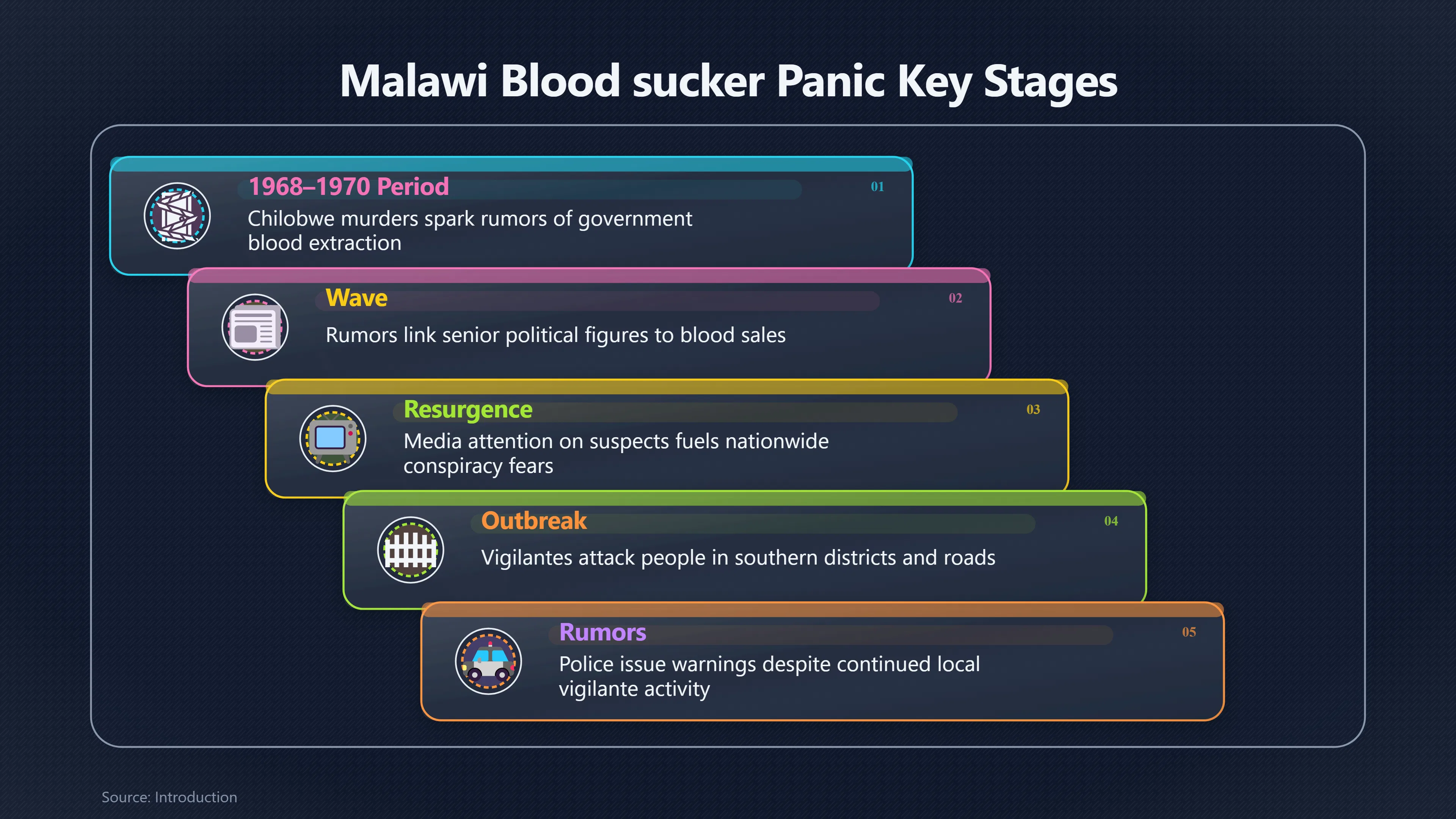
One of the most influential precedents came during the Chilobwe murders of 1968–1970, when at least 31 people were murdered in and around Blantyre. Many victims were mutilated, and police struggled for months to identify those responsible. The lack of arrests encouraged widespread speculation that the killings formed part of something much larger than ordinary criminal violence.[Wikipedia]WikipediaChilobwe murdersChilobwe murders
Among the most persistent rumours was the claim that government figures were draining victims’ blood and sending it to South Africa. Historians have found no evidence supporting these accusations, but the rumours became politically significant because they reflected widespread distrust of the government during the later years of President Hastings Banda’s rule. Rather than reassuring the public, official denials were frequently interpreted as further evidence of concealment.[wikipedia.org]WikipediaChilobwe murdersChilobwe murders
The eventual conviction of Walla Laini Kawisa for multiple murders resolved only part of the mystery. Contemporary observers and later historians note that many Malawians continued to believe that broader conspiracies had never been uncovered. The case therefore entered national memory not simply as a series of murders but as an example of how unresolved violence can generate lasting political rumours.[Cambridge University Press & Assessment]cambridge.orgCambridge University Press & AssessmentThe Chilobwe Murders Trial | African Studies Review | Cambridge Core…
Recurring scares from 2002 to 2020
Beginning in the early 2000s, bloodsucker rumours returned in repeated waves.
The 2002 rumours
In late 2002, reports spread across Malawi claiming that blood was being collected and sold abroad with the involvement of senior political figures. According to researchers, newspapers amplified many of the claims while communities organised vigilante patrols. At least one person was reportedly killed after being accused of involvement in blood collection. The rumours directly implicated the government of President Bakili Muluzi, illustrating how quickly conspiracy narratives became intertwined with party politics.[Deep Blue Repositories]deepblue.lib.umich.eduDeep Blue Repositories Adam AshforthDeep Blue RepositoriesAdam AshforthNovember 1, 2025…
The 2009 resurgence
Another major wave followed in 2009 after reports involving an alleged blood-collecting suspect attracted intense media attention. Individual criminal incidents became interpreted as evidence for an organised nationwide network, prompting attacks on suspected conspirators and renewed accusations against influential business and political figures despite the absence of evidence for such a network.[Deep Blue Repositories]deepblue.lib.umich.eduDeep Blue Repositories Adam AshforthDeep Blue RepositoriesAdam AshforthNovember 1, 2025…
The 2017 panic
The largest recent outbreak occurred in 2017, particularly in southern districts including Mulanje, Phalombe and Chiradzulu. Rumours claimed that vampires or bloodsuckers were operating with official protection. Communities erected roadblocks, searched vehicles and attacked people regarded as suspicious.
At least several people were killed by vigilantes, while many more were assaulted. The United Nations temporarily withdrew some staff from affected districts after aid workers became targets because they were suspected of involvement in blood collection. Families of some victims later described how ordinary possessions, including bags and medical bottles, were mistaken for equipment used to collect blood.[reutersconnect.com]reutersconnect.comReuters Connect Malawi 'vampirism' mania spreads. | Reuters ConnectReuters Connect Malawi 'vampirism' mania spreads. | Reuters Connect
The 2020 rumours
Fresh rumours appeared again in northern Malawi during 2020. Police repeatedly announced that investigations had found no verified victims of organised bloodsucking but warned that innocent people had already been attacked or killed because of the allegations. Despite these statements, local vigilante activity continued in some communities, demonstrating how difficult official reassurances can be once rumours become embedded in local networks of trust.[Malawi Police Service]police.gov.mwBlood suckers RumorMalawi Police ServiceCable Address: POLGEN LILONGWE 3March 22, 2020…
How distrust turns rumours into mob violence
The most dangerous feature of these episodes is not the rumour itself but the way it alters ordinary assumptions about evidence.
When communities become convinced that officials are protecting bloodsuckers, several consequences follow:
- official denials are interpreted as proof of a cover-up rather than reassurance;
- strangers become objects of suspicion, especially travellers or aid workers;
- communities organise their own patrols and checkpoints;
- ordinary objects or behaviour are reinterpreted as evidence of blood collection; and
- violence becomes justified as self-defence against an invisible threat.
Political scientists and anthropologists argue that these reactions are rooted in distrust rather than simple credulity. Where confidence in police, courts or political leaders is weak, rumours provide an alternative explanation for uncertainty. Young men acting as vigilantes often present themselves as defending the community when they believe official institutions have failed.[umich.edu]deepblue.lib.umich.eduDeep Blue Repositories Adam AshforthDeep Blue RepositoriesAdam AshforthNovember 1, 2025…

Why blood became the centre of the rumour
Blood occupies an unusually powerful symbolic place in many societies because it represents both life and vulnerability. In Malawi’s rumours it also became associated with wealth, political power and unequal relationships between ordinary citizens and distant elites.
Anthropologist Adam Ashforth argues that stories about bloodsucking should not be read literally as beliefs about vampires in the European sense. Instead, they express fears that powerful people enrich themselves by exploiting ordinary citizens in hidden ways. The image of stolen blood becomes a metaphor for invisible extraction, whether economic, political or supernatural. This helps explain why the rumours repeatedly adapt to new circumstances while retaining the same underlying structure.[Deep Blue Repositories]deepblue.lib.umich.eduDeep Blue Repositories Adam AshforthDeep Blue RepositoriesAdam AshforthNovember 1, 2025…
Lasting consequences beyond the panic
Although each outbreak eventually subsides, the effects can persist for years.
Researchers studying medical research and public health in Malawi found that memories of the 2017 bloodsucker rumours continued to influence attitudes towards scientific studies involving blood samples. Community leaders warned that misunderstandings about blood collection could easily revive earlier fears unless researchers communicated openly and built trust before beginning their work.[PMC]pmc.ncbi.nlm.nih.govPMCStakeholder views on the acceptability of human infection studies in MalawiPMCStakeholder views on the acceptability of human infection studies in Malawi
The recurring panics therefore illustrate a broader lesson. Rumours are most resilient where genuine uncertainty already exists. Solving individual criminal cases or issuing official denials may not be enough if large parts of the population continue to believe that powerful institutions routinely conceal the truth. Malawi’s bloodsucker scares remain important not because they demonstrate belief in supernatural attackers, but because they reveal how unresolved violence, political suspicion and weak institutional trust can repeatedly transform rumours into deadly collective action.[umich.edu]deepblue.lib.umich.eduDeep Blue Repositories Adam AshforthDeep Blue RepositoriesAdam AshforthNovember 1, 2025…
Amazon book picks
Further Reading
Books and field guides related to Why Do Bloodsucker Panics Keep Returning?. Use these as the next step if you want deeper reading beyond the article.
Extraordinary Popular Delusions and the Madness of Crowds
Rating: 4.0/5 from 5 Google Books ratings
Places recurring moral panics in historical perspective.


Speaking with Vampires
Examines African blood rumours and vampire stories, including Central Africa.
Endnotes
1.
Source: researchgate.net
Link:https://www.researchgate.net/publication/336246171_Vampires_in_the_News_A_Critical_Analysis_of_News_Framing_in_Malawi%27s_Newspapers
2.
Source: Wikipedia
Title: Chilobwe murders
Link:https://en.wikipedia.org/wiki/Chilobwe_murders
3.
Source: cambridge.org
Link:https://www.cambridge.org/core/journals/african-studies-review/article/chilobwe-murders-trial/F7A61344F86401A7D648C8A66DD76A35
Source snippet
Cambridge University Press & AssessmentThe Chilobwe Murders Trial | African Studies Review | Cambridge Core...
4.
Source: researchgate.net
Link:https://www.researchgate.net/publication/272001563Traumatic_Memory_and%27Scriptotherapy%27_in_Malawian_Poetry_The_Case_of_Bright_Molande%27s_Seasons
5.
Source: pmc.ncbi.nlm.nih.gov
Title: PMCStakeholder views on the acceptability of human infection studies in Malawi
Link:https://pmc.ncbi.nlm.nih.gov/articles/PMC7003337/
6.
Source: researchgate.net
Link:https://www.researchgate.net/publication/340204681_Stakeholder_views_on_the_acceptability_of_Human_Infection_Studies_in_Malawi
7.
Source: news.trust.org
Title: 20171020164943 810z0
Link:https://news.trust.org/item/20171020164943-810z0/
8.
Source: news.trust.org
Title: 20171009175256 ved7s
Link:https://news.trust.org/item/20171009175256-ved7s/
9.
Source: cambridge.org
Title: The Chilobwe Murders Trial | African Studies Review | Cambridge Core
Link:https://www.cambridge.org/core/journals/african-studies-review/article/abs/chilobwe-murders-trial/F7A61344F86401A7D648C8A66DD76A35
10.
Source: cambridge.org
Title: The Chilobwe Murders Trial | African Studies Review | Cambridge Core
Link:https://www.cambridge.org/core/services/aop-cambridge-core/content/view/F7A61344F86401A7D648C8A66DD76A35/S0002020600020291a.pdf/chilobwe_murders_trial.pdf
11.
Source: deepblue.lib.umich.edu
Title: Deep Blue Repositories Adam Ashforth
Link:https://deepblue.lib.umich.edu/bitstream/handle/2027.42/116818/Ashforth%20on%20bloodsuckers%20in%20Malawi.pdf?isAllowed=y&sequence=1
Source snippet
Deep Blue RepositoriesAdam AshforthNovember 1, 2025...
Published: November 1, 2025
12.
Source: reutersconnect.com
Title: Reuters Connect Malawi ‘vampirism’ mania spreads. | Reuters Connect
Link:https://www.reutersconnect.com/item/malawi-vampirism-mania-spreads/dGFnOnJldXRlcnMuY29tLDIwMTc6bmV3c21sX1ZBNzNVOFpNRg
13.
Source: police.gov.mw
Title: Blood suckers Rumor
Link:https://www.police.gov.mw/sites/default/files/2020-08/Blood%20suckers%20Rumor.pdf
Source snippet
Malawi Police ServiceCable Address: POLGEN LILONGWE 3March 22, 2020...
Published: March 22, 2020
Additional References
14.
Source: africanews.com
Title: Malawi ‘vampire’ rumours and hunt [The Morning Call] | Africanews
Link:https://www.africanews.com/2017/10/30/malawi-vampire-rumours-and-hunt-the-morning-call/
Source snippet
August 13, 2024 — MALAWI 'VAMPIRE' RUMOURS AND HUNT [THE MORNING CALL] By Africanews with Jerry Bambi Last updated: 13/08/2024 THE MORNIN...
Published: August 13, 2024
15.
Source: theguardian.com
Title: [Input] President Peter
Link:https://www.theguardian.com/world/2020/apr/09/vigilantes-kill-eight-people-in-malawi-amid-fear-of-bloodsuckers
Source snippet
Vigilantes kill eight people in Malawi amid fear of 'bloodsuckers' | Malawi | The GuardianApril 9, 2020 — Image: President Peter Mutharik...
Published: April 9, 2020
16.
Source: youtube.com
Title: 5 Lynched as ‘Blood-Sucking Vampire’ Scare Prompts UN Withdrawals in Malawi
Link:https://www.youtube.com/watch?v=tYDTfp6FwGk
Source snippet
Malawi bloodsuckers vampires panic Vampire scare rattles Malawi WION...
17.
Source: youtube.com
Title: 9 killed as ‘Vampire’ mania spreads in Malawi
Link:https://www.youtube.com/watch?v=Vw2ABsv4wsI
Source snippet
5 Lynched as ‘Blood-Sucking Vampire’ Scare Prompts UN Withdrawals in Malawi...
18.
Source: africanarguments.org
Link:https://africanarguments.org/2017/11/a-symbolic-representation-of-life-behind-malawis-blood-sucking-beliefs/
19.
Source: africabib.org
Link:https://www.africabib.org/rec.php?RID=188838805
20.
Source: africabib.org
Link:https://www.africabib.org/rec.php?RID=183761634
21.
Source: africabib.org
Link:https://www.africabib.org/rec.php?RID=317714902
22.
Source: profillengkap.com
Link:https://profillengkap.com/en/Albert_Muwalo
23.
Source: malawimuslims.com
Link:https://malawimuslims.com/news/bloodsuckers-saga-mam-condemns-brutal-acts-of-killing-innocent-people/
Topic Tree