Within Belarus
When Belief Became a Soviet Enemy
Soviet authorities recast religion as ignorance and political danger, shifting collective suspicion from witches to committed believers.
On this page
- How scientific atheism defined superstition
- Surveillance, closures and informal worship
- When anti religious policy became moral panic
Page outline Jump by section
Introduction
For much of the Soviet period, the greatest officially recognised “dangerous belief” in Belarus was not witchcraft, miracle claims or secret societies. It was religion itself. Communist ideology treated organised faith as a relic of the past that encouraged superstition, weakened scientific thinking and, potentially, challenged the authority of the state. In Belarus, as elsewhere in the Soviet Union, churches, monasteries and religious communities came under surveillance, many places of worship were closed, and public expressions of faith were discouraged or punished. Yet religious life did not disappear. Instead, many people adapted by worshipping quietly, preserving traditions within families or meeting informally outside official institutions.
Understanding this period is important because it shows how the target of collective suspicion changed. Earlier societies often feared witches or supposed sorcerers. Soviet authorities instead portrayed committed believers, clergy and unofficial religious networks as obstacles to progress or even potential political enemies. The result was not simply secularisation, but a state-sponsored campaign that encouraged suspicion towards independent religious belief while presenting “scientific atheism” as the only legitimate worldview.[Wiley Online Library]onlinelibrary.wiley.comWiley Online LibraryForced Secularization in Soviet Russia: Why an Atheistic Monopoly Failed - Froese - 2004 - Journal for the Scientific…
When belief became a Soviet enemy
Marxist-Leninist ideology viewed religion as a product of exploitation and ignorance that would disappear as socialism advanced. Soviet leaders therefore considered atheism not merely a personal opinion but part of building a modern socialist society. Schools, youth organisations, newspapers and public lectures all promoted the idea that scientific knowledge would replace religious belief.
In Belarus, which became the Belarusian Soviet Socialist Republic, this programme unfolded in a landscape where Orthodox Christianity, Roman Catholicism, Judaism and local religious customs had long coexisted. The authorities did not simply argue against theology. They increasingly treated independent religious authority as politically suspect because churches maintained loyalties and community networks outside direct state control.[Wiley Online Library]onlinelibrary.wiley.comWiley Online LibraryForced Secularization in Soviet Russia: Why an Atheistic Monopoly Failed - Froese - 2004 - Journal for the Scientific…
The message evolved over time:
- Religious belief was presented as superstition rather than knowledge.
- Clergy were frequently portrayed as socially backward or politically unreliable.
- Public religious practice was discouraged in favour of officially approved secular ceremonies.
- Loyalty to socialist ideals was framed as incompatible with strong religious commitment.[The Library of Congress]loc.govThe Library of Congress Internal Workings of the Soviet UnionThe Library of CongressInternal Workings of the Soviet Union - Revelations from the Russian Archives | Exhibitions - Library of Congress…
Rather than accusing believers of supernatural crimes, the state increasingly implied that religion itself encouraged irrational thinking and hindered social progress.
How scientific atheism defined superstition
Scientific atheism became a formal subject taught in universities and promoted through lectures, museums, publications and exhibitions. Its purpose was not only to criticise religion intellectually but to persuade citizens that religious belief belonged to an outdated stage of human development.
Campaigns often blurred several different ideas into a single category. Christian worship, pilgrimage, miracle stories, folk healing and traditional customs could all be dismissed as “superstition”, regardless of their different meanings within local communities. This simplified complex religious cultures into a single ideological problem requiring correction.
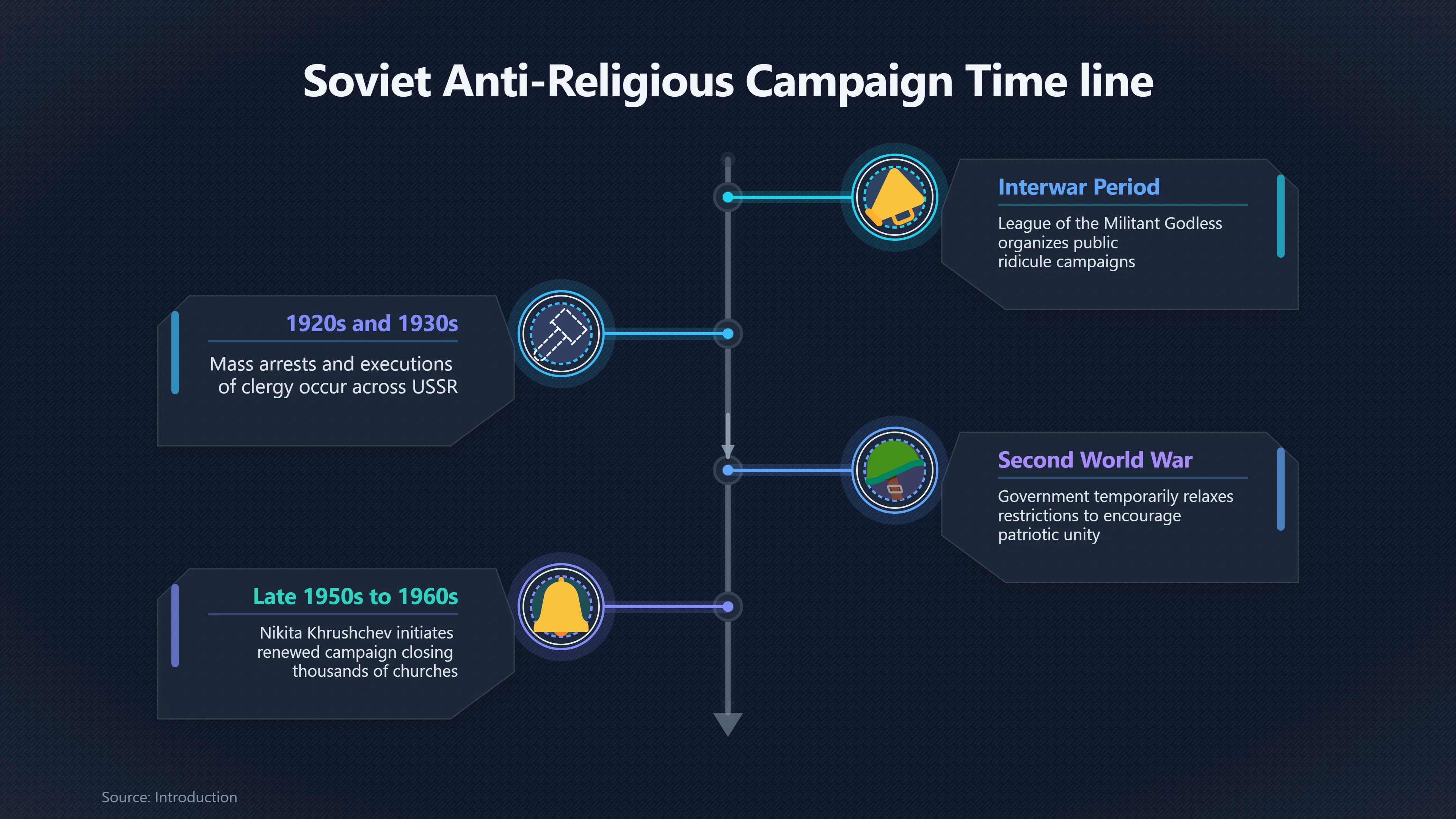
Organisations such as the League of the Militant Godless organised lectures, exhibitions and public campaigns ridiculing religion during the interwar decades. Although methods varied between periods, the underlying assumption remained that religion represented false consciousness rather than a legitimate alternative worldview.[loc.gov]loc.govThe Library of Congress Internal Workings of the Soviet UnionThe Library of CongressInternal Workings of the Soviet Union - Revelations from the Russian Archives | Exhibitions - Library of Congress…
Surveillance, closures and informal worship
Anti-religious policy was enforced through administration as much as through dramatic repression. Authorities registered religious organisations, monitored clergy, limited theological education and controlled religious publications. Places of worship could lose permission to operate, while church buildings were frequently converted into warehouses, museums or other secular facilities.
The harshest repression came during the 1920s and 1930s, when many clergy across the Soviet Union were arrested, executed or sent to labour camps. By the late 1930s only a small fraction of pre-revolutionary churches remained open. During the Second World War the Soviet government temporarily relaxed some restrictions to encourage patriotic unity, but a renewed anti-religious campaign under Nikita Khrushchev again closed thousands of churches during the late 1950s and early 1960s.[loc.gov]loc.govThe Library of Congress Internal Workings of the Soviet UnionThe Library of CongressInternal Workings of the Soviet Union - Revelations from the Russian Archives | Exhibitions - Library of Congress…
In Belarus these policies produced a quieter form of religious persistence. Many people continued to:
- baptise children privately;
- celebrate religious festivals within families rather than publicly;
- maintain icons and devotional objects in their homes;
- attend services only on major occasions;
- rely on elderly relatives to pass on prayers and customs.
Religious practice therefore became less visible rather than disappearing altogether. Historians often describe this as the survival of “informal religion” beneath an officially atheist public culture.[Wiley Online Library]onlinelibrary.wiley.comWiley Online LibraryForced Secularization in Soviet Russia: Why an Atheistic Monopoly Failed - Froese - 2004 - Journal for the Scientific…
When anti-religious policy became a moral panic
The Soviet campaign was not a classic moral panic in the sense of a sudden public frenzy driven by rumours. It was a sustained state project. Nevertheless, it displayed several features associated with moral panic.
Official propaganda repeatedly suggested that religion threatened the creation of a rational socialist society. Believers could be portrayed as people who spread ignorance, resisted progress or concealed political disloyalty behind religious practice. Independent religious gatherings attracted attention precisely because they operated outside state supervision.
This did not mean every believer was persecuted equally. Policy fluctuated considerably depending on the political climate, wartime needs and local officials. Yet the overall effect was to encourage suspicion towards visible religious commitment. Instead of fearing hidden witches, Soviet institutions often feared hidden believers whose loyalties supposedly lay elsewhere.[loc.gov]loc.govThe Library of Congress Internal Workings of the Soviet UnionThe Library of CongressInternal Workings of the Soviet Union - Revelations from the Russian Archives | Exhibitions - Library of Congress…
Why the campaign never fully succeeded
Despite decades of pressure, religion proved remarkably resilient. Sociologists argue that official atheism achieved broad secularisation in some respects but failed to eliminate religious identity. Many people complied outwardly with Soviet expectations while privately preserving family traditions.
Several factors limited the campaign’s success:
- Religious rituals marked births, marriages and deaths in ways that secular ceremonies often struggled to replace.
- Older generations transmitted beliefs within households even when public teaching was restricted.
- Wartime and personal crises often renewed interest in religious practice.
- Suppression sometimes strengthened believers’ commitment by making religious identity a form of quiet resistance.
Research on Soviet secularisation concludes that the expansion of atheism depended heavily on state power rather than widespread voluntary enthusiasm. When political controls weakened during the late Soviet period, many religious communities rapidly revived.[Wiley Online Library]onlinelibrary.wiley.comWiley Online LibraryForced Secularization in Soviet Russia: Why an Atheistic Monopoly Failed - Froese - 2004 - Journal for the Scientific…
Lasting significance for Belarus
The Soviet treatment of religion continues to shape Belarusian society. Many churches rebuilt their public role after the collapse of the Soviet Union, but memories of surveillance, registration requirements and state oversight did not disappear. Modern discussions of religious freedom in Belarus often draw comparisons with Soviet administrative practices, particularly regarding registration, monitoring and restrictions on independent religious activity.[ecoi.net]ecoi.netUSDOS – US Department of State (Author): “2023 Report on International Religious Freedom: Belarus”, Document #2111825 - ecoi.netJune 26…
Within the broader history of collective belief in Belarus, Soviet atheism marks a decisive shift. Earlier periods often focused suspicion on individuals accused of supernatural wrongdoing. Soviet authorities instead redirected suspicion towards organised religious belief itself, presenting faith as a social danger requiring correction through education, administration and political control. That transformation illustrates how definitions of “dangerous belief” can change dramatically across different political systems while still serving the same underlying purpose: identifying ideas that the authorities consider incompatible with the society they seek to build.
Amazon book picks
Further Reading
Books and field guides related to When Belief Became a Soviet Enemy. Use these as the next step if you want deeper reading beyond the article.

The Penguin History Of Modern Russia From Tsarism To The Twen...
First published 2009. Subjects: Soviet union, history, Russia (federation), history.

Bloodlands
First published 2010. Subjects: Massacres, Genocide, World War, 1939-1945, Holocaust, Jewish (1939-1945), Atrocities.
Endnotes
1.
Source: onlinelibrary.wiley.com
Link:https://onlinelibrary.wiley.com/doi/pdf/10.1111/j.1468-5906.2004.00216.x
Source snippet
Wiley Online LibraryForced Secularization in Soviet Russia: Why an Atheistic Monopoly Failed - Froese - 2004 - Journal for the Scientific...
2.
Source: Wikipedia
Title: USSR anti religious campaign (1921–1928)
Link:https://en.wikipedia.org/wiki/USSR_anti-religious_campaign_%281921%E2%80%931928%29
3.
Source: ecoi.net
Link:https://www.ecoi.net/en/document/2111825.html
Source snippet
USDOS – US Department of State (Author): “2023 Report on International Religious Freedom: Belarus”, Document #2111825 - ecoi.netJune 26...
4.
Source: ecoi.net
Link:https://www.ecoi.net/en/document/2091926.html
Source snippet
RELIGIOUS DEMOGRAPHY The U.S. government estimates the total population at 9.4 million (midyear 2022). According to a 2016 survey by the...
5.
Source: ecoi.net
Link:https://www.ecoi.net/en/document/2074068.html
Source snippet
USDOS – US Department of State (Author): “2021 Report on International Religious Freedom: Belarus”, Document #2074068 - ecoi.netJune 2, 2...
6.
Source: ecoi.net
Link:https://www.ecoi.net/en/document/1239325.html
Source snippet
USDOS – US Department of State (Author): “2013 International Religious Freedom Report - Belarus”, Document #1239325 - ecoi.netJuly 28, 20...
7.
Source: ecoi.net
Link:https://www.ecoi.net/en/document/1196972.html
8.
Source: history.state.gov
Link:https://history.state.gov/historicaldocuments/frus1946v06/d544
9.
Source: time.com
Title: Religion: Break-Through
Link:https://time.com/archive/6789474/religion-break-through/
10.
Source: loc.gov
Title: The Library of Congress Internal Workings of the Soviet Union
Link:https://www.loc.gov/exhibits/archives/intn
Source snippet
The Library of CongressInternal Workings of the Soviet Union - Revelations from the Russian Archives | Exhibitions - Library of Congress...
Additional References
11.
Source: degruyterbrill.com
Title: Storming the Heavens
Link:https://www.degruyterbrill.com/document/doi/10.7591/9781501735196/html?lang=en
Source snippet
Your documents are now available to view. Peris, Daniel. Storming the Heavens: The Soviet League of the Militant Godless, Ithaca, NY: Cor...
12.
Source: youtube.com
Title: The Strange Curriculum of Soviet Universities: Ideology Over Education?
Link:https://www.youtube.com/watch?v=ZTWvrpiyhyk
Source snippet
Atheist Propaganda in Soviet Schools. 10 Antireligious posters (USSR)...
13.
Source: youtube.com
Title: Atheist Propaganda in Soviet Schools. 10 Antireligious posters (USSR)
Link:https://www.youtube.com/watch?v=4nR08R-Nwfc
Source snippet
Atheism in the USSR: Positive Atheism under Brezhnev...
14.
Source: old.gmir.ru
Link:https://old.gmir.ru/eng/about/coll/fond_arch/
15.
Source: jta.org
Title: No Compulsion to Be Used in Anti-passover Campaign League of Godless Orders
Link:https://www.jta.org/archive/no-compulsion-to-be-used-in-anti-passover-campaign-league-of-godless-orders
16.
Source: uscirf.gov
Title: Belarus Country Update | USCIRF
Link:https://www.uscirf.gov/publications/belarus-country-update
Source snippet
Belarus Country Update | USCIRF...
17.
Source: forum18.org
Title: Forum 18: BELARUS: Anti-Protestant education policy persists
Link:https://www.forum18.org/archive.php/archive.php?article_id=824
18.
Source: forum18.org
Title: Forum 18: BELARUS: Lingering legacy of militant atheism
Link:https://www.forum18.org/archive.php?article_id=186
19.
Source: youtube.com
Title: Atheism in the USSR: Positive Atheism under Brezhnev
Link:https://www.youtube.com/watch?v=hAvzsWx2S6g
Source snippet
Belarus, A Seed Among Thorns...
20.
Source: digitalcollections-baylor.quartexcollections.com
Title: bezbozhnik no. 1 1923 2 e izdanie
Link:https://digitalcollections-baylor.quartexcollections.com/Documents/Detail/bezbozhnik-no.-1-1923-2-e-izdanie/1047534
Topic Tree