Within Togo
When Protection Movements Began Naming Hidden Enemies
Mobile religious movements offered healing and protection while sometimes turning private anxieties into public accusations.
On this page
- How anti witchcraft religions travelled through the Ewe region
- Why colonial disruption increased demand for protection
- How healing, divination and accusation became entangled
Page outline Jump by section
Introduction
Cross-border anti-witchcraft movements were among the most important ways that collective fear spread through what is now southern Togo during the late nineteenth and early twentieth centuries. Rather than remaining confined within modern national borders, religious specialists, shrines and protective rituals travelled through Ewe-speaking communities that today lie across Togo, Ghana and Benin. These movements promised protection against hidden spiritual threats such as witchcraft, unexplained illness, infertility and sudden misfortune. At the same time, some movements encouraged the public identification of supposed witches, turning private anxieties into community accusations. Historians argue that these developments are best understood as responses to rapid social change rather than as examples of irrational mass panic. They combined healing, religious innovation and social fear in ways that reshaped everyday life across the region.[Cambridge University Press & Assessment]cambridge.orgCambridge University Press & AssessmentWITCHCRAFT, ANTI-WITCHCRAFT AND TRANS-REGIONAL RITUAL INNOVATION IN EARLY COLONIAL GHANA: SAKRABUN…

How anti-witchcraft religions travelled through the Ewe region
Modern political borders can obscure how religious life actually functioned in the colonial era. The frontier separating British-controlled Gold Coast, German Togoland and French Dahomey cut across long-established trading routes, family networks and shared languages. Ewe communities in particular maintained extensive links across these borders, allowing religious ideas to circulate alongside commerce, labour migration and marriage.
Anti-witchcraft movements travelled through these existing networks. New shrines and ritual specialists did not simply replace older beliefs. Instead, they adapted local traditions while introducing new forms of protection against invisible dangers. Historians studying neighbouring Ghana have shown that movements such as Sakrabundi and later Aberewa spread remarkably quickly because they answered widespread fears about hidden spiritual attack during a period of profound political and economic disruption. Although these movements are best documented in present-day Ghana, the same transregional religious circuits extended into southern Togoland and neighbouring Benin, making national boundaries a poor guide to their influence.[Cambridge University Press & Assessment]cambridge.orgCambridge University Press & AssessmentWITCHCRAFT, ANTI-WITCHCRAFT AND TRANS-REGIONAL RITUAL INNOVATION IN EARLY COLONIAL GHANA: SAKRABUN…
This regional perspective is important because people often sought protection wherever respected ritual specialists were located rather than within a single colonial territory. A healer or shrine with a reputation for exposing witches could attract followers from communities many miles away, helping fears and protective practices spread across the wider Ewe region.
Why colonial disruption increased demand for protection
The popularity of these movements cannot be explained simply by longstanding belief in witchcraft. Researchers instead point to the extraordinary pressures created by colonial rule.
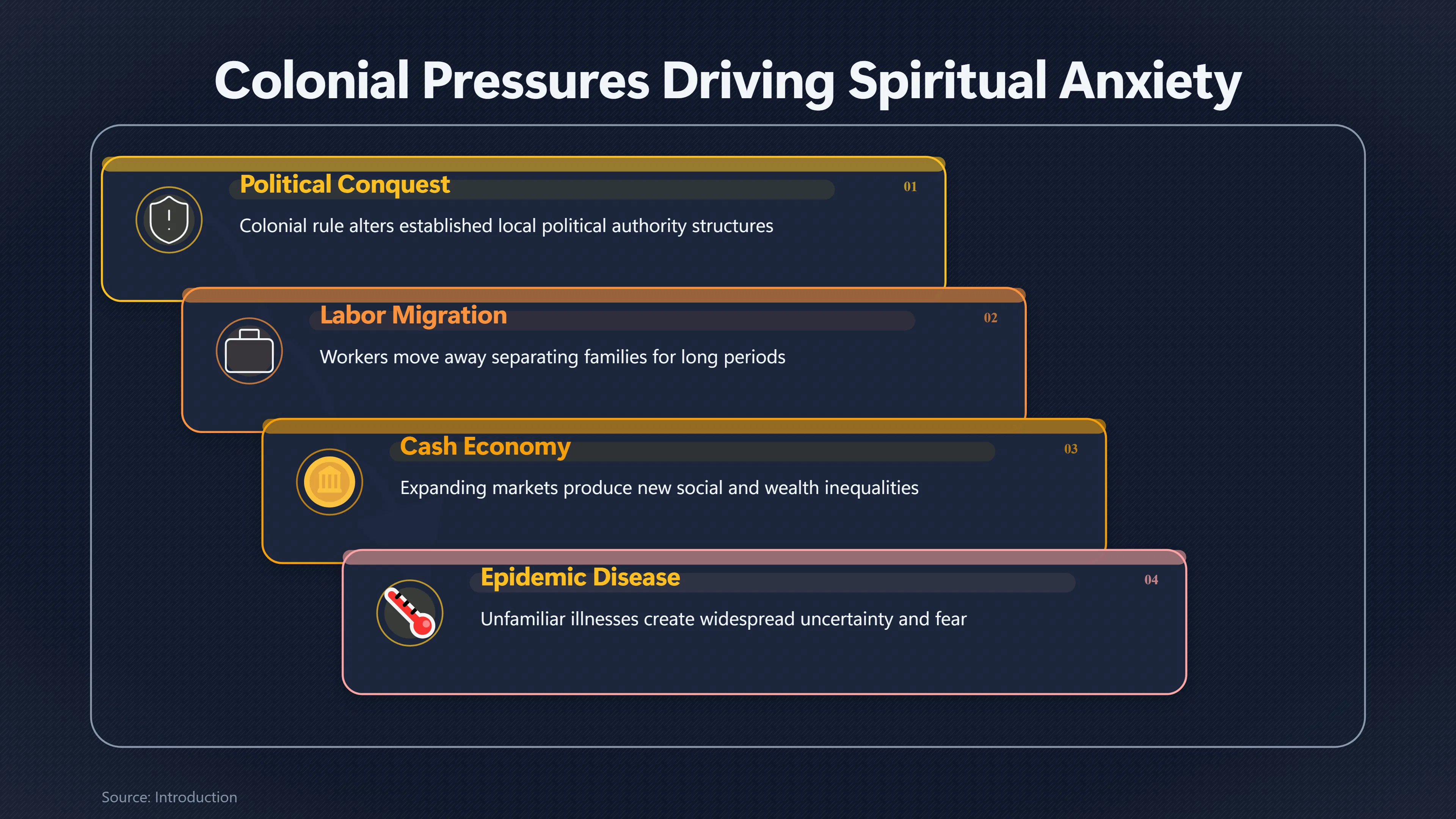
Several changes reinforced uncertainty at the same time:
- colonial conquest altered political authority;
- labour migration separated families for long periods;
- expanding cash economies produced new inequalities;
- epidemic disease and unfamiliar illnesses created uncertainty;
- missionary expansion challenged older religious practices without eliminating belief in spiritual causation.
These overlapping pressures made unexplained suffering appear even more threatening. When crops failed, relatives died unexpectedly or newly successful neighbours accumulated wealth, people searched for explanations that connected personal misfortune to hidden social conflict.
Anti-witchcraft movements offered practical responses. They promised rituals of cleansing, protective medicines, public ceremonies and authoritative diagnosis. For many followers, these movements represented security during a period when older systems of authority were being transformed. Rather than viewing them as survivals from an ancient past, historians describe them as innovative religious responses to colonial modernity.[Cambridge University Press & Assessment]cambridge.orgCambridge University Press & AssessmentWITCHCRAFT, ANTI-WITCHCRAFT AND TRANS-REGIONAL RITUAL INNOVATION IN EARLY COLONIAL GHANA: SAKRABUN…
How healing, divination and accusation became entangled
One reason these movements remain historically important is that they combined genuinely protective functions with mechanisms that could also generate social fear.
Many participants approached anti-witchcraft shrines seeking relief from illness, infertility or repeated personal misfortune. Ritual specialists diagnosed spiritual causes, prescribed protective actions and attempted to restore social harmony. In this sense, healing stood at the centre of the movements.
However, diagnosis could also involve identifying individuals believed to be responsible for supernatural harm. Once a hidden enemy was named, family disputes, inheritance conflicts or neighbourhood tensions could intensify rapidly. Suspicion sometimes spread beyond the original complaint, drawing wider sections of a community into accusations.
The relationship between healing and accusation therefore became inseparable in some settings. Protective rituals could reduce anxiety for believers, yet they could also legitimise public suspicion against vulnerable individuals. This dual character explains why historians avoid describing these movements simply as beneficial healing traditions or simply as witch-hunting campaigns. They functioned as both systems of protection and mechanisms through which fear could become socially organised.[Cambridge University Press & Assessment]cambridge.orgCambridge University Press & AssessmentWITCHCRAFT, ANTI-WITCHCRAFT AND TRANS-REGIONAL RITUAL INNOVATION IN EARLY COLONIAL GHANA: SAKRABUN…
Why fear crossed borders more easily than colonial governments
European colonial administrations attempted to regulate religious practices, but their authority rarely matched the reach of local religious networks.
British, German and later French officials often viewed witch-finding and anti-witchcraft movements with suspicion. Colonial legal systems generally rejected claims that witchcraft itself could be proved, while many African communities regarded invisible spiritual attack as an urgent social reality requiring intervention. This mismatch produced repeated conflicts over how accusations should be handled.
In neighbouring Gold Coast, colonial authorities eventually restricted organised witch-finding because officials believed it encouraged coercion and public disorder. Yet such restrictions did not eliminate underlying fears. Instead, religious practices frequently adapted or shifted geographically, sometimes moving through neighbouring territories where different administrative approaches applied.[AfricaBib]africabib.orgAfricaBib | Witches, Oracles, and Colonial Law: Evolving Anti-Witchcraft Practices in Ghana, 1927-1932…
For communities living along the borders of Togo, Ghana and Benin, colonial frontiers therefore limited governments more effectively than they limited religious movements.

What historians think these movements reveal
Modern scholarship has moved away from portraying anti-witchcraft movements as evidence of simple superstition or collective irrationality.
Instead, historians emphasise several themes:
- Religious innovation: These were creative movements that combined older ritual traditions with new organisational forms suited to changing social conditions.
- Regional mobility: Their spread depended upon migration routes, trading networks and shared linguistic communities rather than modern national boundaries.
- Social adaptation: They helped communities interpret rapid economic and political transformation during colonial rule.
- Collective fear: They demonstrate how fears about hidden enemies can become organised through respected religious institutions rather than through spontaneous panic alone.
This interpretation also helps explain why the history of southern Togo cannot be understood in isolation. The same social mechanisms operated across a wider regional landscape where ideas, healers and protective practices moved continuously between communities. Understanding these cross-border connections provides a more accurate picture of how collective fears developed than treating Togo as a self-contained national story.[Cambridge University Press & Assessment]cambridge.orgCambridge University Press & AssessmentWITCHCRAFT, ANTI-WITCHCRAFT AND TRANS-REGIONAL RITUAL INNOVATION IN EARLY COLONIAL GHANA: SAKRABUN…
Amazon book picks
Further Reading
Books and field guides related to When Protection Movements Began Naming Hidden Enemies. Use these as the next step if you want deeper reading beyond the article.

The witch
Explains how witch figures and protective responses emerge, circulate and change across different societies.

The healing wisdom of Africa
Provides context for the healing and protective dimensions of religious movements that could become entangled with accusation.

The modernity of witchcraft
Directly examines how witchcraft discourse adapts to mobility, modernisation, political change and social insecurity in Africa.

Of water and the spirit
Offers an accessible insider-oriented account of ritual, spiritual protection and community authority in a West African setting.
Endnotes
1.
Source: cambridge.org
Link:https://www.cambridge.org/core/journals/journal-of-african-history/article/abs/witchcraft-antiwitchcraft-and-transregional-ritual-innovation-in-early-colonial-ghana-sakrabundi-and-aberewa-18891910/FE5B4DD01E1FF23EC9F839BDAC3BF0F6
Source snippet
Cambridge University Press & AssessmentWITCHCRAFT, ANTI-WITCHCRAFT AND TRANS-REGIONAL RITUAL INNOVATION IN EARLY COLONIAL GHANA: SAKRABUN...
2.
Source: africabib.org
Link:https://www.africabib.org/rec.php?DB=p&RID=280503075
Source snippet
AfricaBib | Witchcraft, Anti-Witchcraft and Trans-Regional Ritual Innovation in Early Colonial Ghana: Sakrabundi and Aberewa, 18...
3.
Source: cambridge.org
Link:https://www.cambridge.org/core/services/aop-cambridge-core/content/view/FE5B4DD01E1FF23EC9F839BDAC3BF0F6/S002185370400951Xa.pdf/witchcraft_antiwitchcraft_and_transregional_ritual_innovation_in_early_colonial_ghana_sakrabundi_and_aberewa_18891910.pdf
Source snippet
Cambridge University Press & AssessmentWITCHCRAFT, ANTI-WITCHCRAFT AND TRANS-REGIONAL RITUAL INNOVATION IN EARLY COLONIAL GHANA: SAKRABUN...
4.
Source: africabib.org
Link:https://www.africabib.org/rec.php?RID=249572265
Source snippet
AfricaBib | Witches, Oracles, and Colonial Law: Evolving Anti-Witchcraft Practices in Ghana, 1927-1932...
5.
Source: africabib.org
Link:https://www.africabib.org/rec.php?DB=p&RID=249572265
Source snippet
AfricaBib | Witches, Oracles, and Colonial Law: Evolving Anti-Witchcraft Practices in Ghana, 1927-1932...
6.
Source: cambridge.org
Link:https://www.cambridge.org/core/journals/history-in-africa/article/adavatram-madness-has-led-me-astray-ritual-archives-and-ewe-identities-on-the-ghanatogo-borderlands/75B99F81BC20D5AFCF5B7A5EB4217A41
Source snippet
December 4, 2025 — AƉAƲATRAM (MADNESS HAS LED ME ASTRAY): RITUAL ARCHIVES AND EWE IDENTITIES ON THE GHANA–TOGO BORDERLANDS Published onli...
Published: December 4, 2025
7.
Source: cambridge.org
Title: The Journal of African History: Volume 45
Link:https://www.cambridge.org/core/journals/journal-of-african-history/volume/C3380A05186562A48CE602A017BA7989
9.
Source: africabib.org
Link:https://africabib.org/rec.php?DB=p&RID=294710930
11.
Source: soas-repository.worktribe.com
Link:https://soas-repository.worktribe.com/output/419309/witchcraft-anti-witchcraft-and-trans-regional-ritual-innovation-in-early-colonial-ghana-sakrabundi-and-aberewa
Source snippet
SOAS RepositoryWitchcraft, Anti-Witchcraft and Trans-Regional Ritual Innovation in Early Colonial Ghana: Sakrabundi and Aberewa, 1889-1910...
Additional References
12.
Source: researchgate.net
Title: 379545850 Antiwitchcraft Movements in Colonial Asante
Link:https://www.researchgate.net/publication/379545850_Antiwitchcraft_Movements_in_Colonial_Asante
Source snippet
Antiwitchcraft Movements in Colonial Asante | Request PDFSeptember 1, 2023 — View Show abstract Witchcraft, anti-witchcraft and trans-reg...
Published: September 1, 2023
13.
Source: papers.ssrn.com
Link:https://papers.ssrn.com/sol3/papers.cfm?abstract_id=2582165
Source snippet
Encounters and Personal Dependency in Togo: Vodun, Anti-Witchcraft Movements and Catholic Church by Alessandra Brivio:: SSRNMarch 23, 20...
14.
Source: researchgate.net
Link:https://www.researchgate.net/publication/231979854_Witchcraft_anti-witchcraft_and_trans-regional_ritual_innovation_in_early_colonial_Ghana_Sakrabundi_and_Aberewa
15.
Source: researchgate.net
Link:https://www.researchgate.net/publication/271669002_Oracles_chieftaincies_and_witchcraft_accusations_in_south-western_Togo
16.
Source: tandfonline.com
Link:https://www.tandfonline.com/doi/abs/10.1080/07329113.2013.806842
17.
Source: dokumen.pub
Link:https://dokumen.pub/locality-mobility-and-nation-periurban-colonialism-in-togos-eweland-1900-1960-1580462642-9781580462648.html
18.
Source: ttl.run.edu.ng
Link:https://ttl.run.edu.ng/bib/16930
19.
Source: sammlungen.ub.uni-frankfurt.de
Link:https://sammlungen.ub.uni-frankfurt.de/dsdk/content/titleinfo/9348041
20.
Source: youtube.com
Title: Witches of Gambaga
Link:https://www.youtube.com/watch?v=S4XuT-jB7CA
Source snippet
Aneho, Spiritual Capital of Vodu in Togo...
21.
Source: youtube.com
Title: Aneho, Spiritual Capital of Vodu in Togo
Link:https://www.youtube.com/watch?v=t1SVa92sw44
Source snippet
Voyage to Voodoo (Benin, Togo, Ghana)...
Topic Tree