Within Libya
Why Libya's Sufi Shrines Were Destroyed
After Gaddafi's fall, militants recast long-standing Sufi traditions as dangerous corruption and destroyed major sacred sites.
On this page
- Sufism and shrine devotion in Libya
- The attacks of 2011 and 2012
- Purification rhetoric and state inaction
Page outline Jump by section
Introduction
After the fall of Muammar Gaddafi in 2011, Libya witnessed a wave of attacks on Sufi shrines, mosques and tombs that went far beyond ordinary theological disagreement. Armed groups destroyed historic religious sites because they believed that visiting saints’ tombs, seeking blessings at shrines and preserving such places encouraged idolatry and corrupted Islam. For their supporters, the destruction represented an act of religious purification. For Libya’s Sufi communities, historians and many other Muslims, it was an assault on centuries of religious tradition, cultural memory and shared heritage. The campaign illustrates how a long-running doctrinal dispute became entangled with the collapse of state authority after the revolution, transforming competing religious beliefs into a visible struggle over public space, history and national identity.[Human Rights Watch]hrw.orgHuman Rights Watch Libya: Stop Attacks on Sufi Sites | Human Rights WatchHuman Rights WatchLibya: Stop Attacks on Sufi Sites | Human Rights WatchAugust 31, 2012…
Sufism and shrine devotion in Libya
Sufism has deep historical roots in Libya. For centuries, Sufi religious orders helped spread Islamic learning, organised charitable activities, mediated local disputes and maintained networks of lodges, mosques and shrines across the country. Tombs of respected scholars and spiritual teachers became places where believers prayed, remembered religious figures and sought God’s blessing through their example.
These practices have long been accepted by many Muslims in North Africa. However, reformist movements influenced by Salafi interpretations of Islam reject shrine veneration, arguing that praying at tombs or seeking intercession from deceased saints risks compromising the strict worship of God alone. Their objection is theological rather than merely architectural: shrines are viewed not simply as historic buildings but as symbols of practices they consider religious innovations or forms of idolatry.[Human Rights Watch]hrw.orgHuman Rights Watch Libya: Stop Attacks on Sufi Sites | Human Rights WatchHuman Rights WatchLibya: Stop Attacks on Sufi Sites | Human Rights WatchAugust 31, 2012…
Before 2011, these disagreements largely existed within the constraints of the Libyan state. The collapse of central authority after the revolution changed the balance dramatically. Armed groups with differing ideological commitments gained freedom to impose their own religious interpretations, often without effective state oversight.
The attacks of 2011 and 2012
The campaign against Sufi sites began within months of the Gaddafi government’s collapse. Early attacks targeted shrines in Tripoli during late 2011 before spreading across the country in 2012. Rather than isolated acts of vandalism, the incidents formed a recognisable pattern directed against places associated with Sufi devotion.[Human Rights Watch]hrw.orgOpen source on hrw.org.
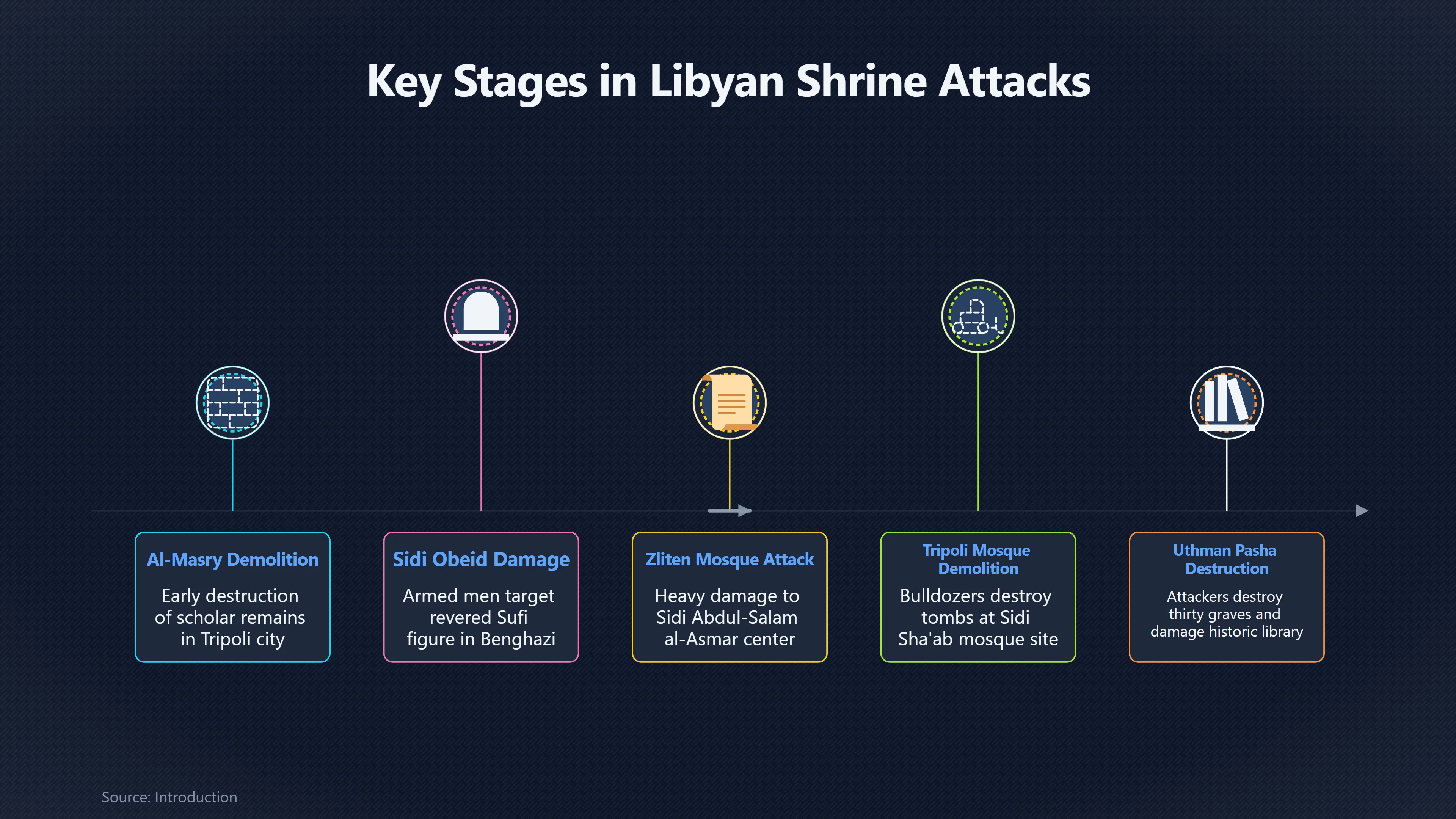
Among the most significant attacks were:
- Al-Masry shrine, Tripoli (October 2011): One of the earliest documented shrine demolitions after the revolution, involving the removal of the remains of respected scholars.
- Sidi Obeid cemetery, Benghazi (January 2012): Armed men damaged the tomb of the revered Sufi figure Sidi Obeid.
- Sidi Abdul-Salam al-Asmar mosque, Zliten (August 2012): One of Libya’s best-known Sufi centres was heavily damaged, and reports indicated that hundreds of historic manuscripts dating back centuries were destroyed.
- Sidi Sha’ab mosque, Tripoli (August 2012): Bulldozers demolished tombs within the mosque compound while security forces reportedly remained nearby without intervening.
- Uthman Pasha mosque, Tripoli (August 2012): Attackers destroyed around thirty graves inside the historic religious complex and damaged its library.[Human Rights Watch]hrw.orgHuman Rights Watch Libya: Stop Attacks on Sufi Sites | Human Rights WatchHuman Rights WatchLibya: Stop Attacks on Sufi Sites | Human Rights WatchAugust 31, 2012…
Other Sufi sites in Misrata, Derna and elsewhere were also attacked. Human Rights Watch documented dozens of assaults on shrines, mosques, libraries and cemeteries over subsequent years, indicating that the violence extended beyond the headline incidents of August 2012.[Human Rights Watch]hrw.orgOpen source on hrw.org.
Why militants described the destruction as “purification”
The attackers generally did not present themselves as opponents of Islam. Instead, they claimed to be defending what they regarded as authentic Islam against corrupt religious practices.
This distinction is essential for understanding the campaign. The dispute centred on competing interpretations within Islam rather than hostility towards religion itself.
The rhetoric commonly rested on several connected ideas:
- Shrines encouraged idolatry. Visiting saints’ tombs was portrayed as directing devotion towards human beings rather than God.
- Historical traditions had become religious innovations. Practices accepted for generations were described as later corruptions with no basis in the earliest Muslim community.
- Physical destruction symbolised spiritual cleansing. Removing shrines was presented as eliminating false religious practices rather than destroying heritage.
- Religious duty outweighed historical preservation. Historic buildings were treated primarily as sites of theological error rather than as cultural monuments.[Human Rights Watch]hrw.orgHuman Rights Watch Libya: Stop Attacks on Sufi Sites | Human Rights WatchHuman Rights WatchLibya: Stop Attacks on Sufi Sites | Human Rights WatchAugust 31, 2012…
This language resembles campaigns against Sufi shrines seen elsewhere in parts of the Muslim world, where militants have portrayed attacks on sacred sites as restoring religious purity. In Libya, however, the campaign unfolded amid revolutionary instability and the rapid expansion of armed militias, allowing ideological convictions to be translated into direct action.

Why the state largely failed to stop the attacks
One of the most striking features of the 2012 attacks was not simply their occurrence but the inability—or unwillingness—of the transitional authorities to prevent them.
Human Rights Watch and contemporary reporting documented several incidents in which security personnel were present while demolitions proceeded. In one widely quoted statement, Interior Minister Fawzi Abdel A’al argued that he would not authorise violent confrontation merely to protect shrines, reportedly saying that destroying the shrines would be preferable to bloodshed between security forces and attackers. Critics argued that this position effectively signalled impunity to the militias responsible.[Human Rights Watch]hrw.orgHuman Rights Watch Libya: Stop Attacks on Sufi Sites | Human Rights WatchHuman Rights WatchLibya: Stop Attacks on Sufi Sites | Human Rights WatchAugust 31, 2012…
The government’s weakness reflected broader post-revolution conditions:
- numerous autonomous armed groups operated outside effective central control;
- police and judicial institutions remained fragile;
- political leaders feared provoking armed confrontations they might lose;
- competing religious authorities disagreed over the legitimacy of shrine practices.[Human Rights Watch]hrw.orgHuman Rights WatchWorld Report 2013: World Report 2013: Libya | Human Rights Watch…
International organisations, including UNESCO and United Nations independent experts, condemned the destruction as attacks on both religious freedom and cultural heritage, arguing that states have a responsibility to protect places of worship regardless of theological disagreements.[Human Rights Watch]hrw.orgHuman Rights Watch Libya: Stop Attacks on Sufi Sites | Human Rights WatchHuman Rights WatchLibya: Stop Attacks on Sufi Sites | Human Rights WatchAugust 31, 2012…
More than a dispute about buildings
Although the attacks focused on physical structures, their wider significance lay in what those structures represented.
For Sufi communities, shrines connected living believers with generations of scholars, teachers and local history. Many also contained manuscripts, libraries and architectural features reflecting centuries of Libyan religious life. Their destruction therefore affected both spiritual practice and historical memory.
For militant groups, by contrast, leaving such monuments standing appeared to legitimise beliefs they regarded as fundamentally un-Islamic. Demolition thus became a public demonstration of ideological authority in newly contested territory.
This made the attacks part of a broader struggle over who could define religious legitimacy in post-Gaddafi Libya. The destruction was therefore simultaneously symbolic, theological and political.
Lasting importance
The attacks on Libya’s Sufi shrines remain one of the clearest examples of how religious ideas can become intertwined with wider periods of political collapse and collective uncertainty. They were not the product of a sudden mass panic or irrational frenzy. Rather, they emerged from a combination of long-standing theological disagreements, weakened state institutions and armed groups capable of enforcing their own interpretation of religious orthodoxy.
Subsequent years saw further attacks on Sufi sites and reports of intimidation directed at Sufi communities, reinforcing concerns that impunity had allowed the campaign to continue beyond its initial wave in 2011–2012.[Human Rights Watch]hrw.orgOpen source on hrw.org.
Within Libya’s wider history of collective belief and social conflict, the shrine destructions illustrate how narratives of religious “purification” can transform inherited differences of interpretation into campaigns against sacred places, with consequences that extend well beyond theology into questions of cultural heritage, minority rights and national identity.
Amazon book picks
Further Reading
Books and field guides related to Why Libya's Sufi Shrines Were Destroyed. Use these as the next step if you want deeper reading beyond the article.

The Return: Fathers, Sons and the Land in Between
Explores Libya's social and political history.
Sufism: A Very Short Introduction
Explains Sufi beliefs and shrine traditions central to the topic.

Libya
First published 2008. Subjects: Revolutions, Libya, history, Libya, politics and government, Libya, economic conditions, History.
Endnotes
1.
Source: hrw.org
Title: Human Rights Watch Libya: Stop Attacks on Sufi Sites | Human Rights Watch
Link:https://www.hrw.org/news/2012/08/31/libya-stop-attacks-sufi-sites
Source snippet
Human Rights WatchLibya: Stop Attacks on Sufi Sites | Human Rights WatchAugust 31, 2012...
Published: August 31, 2012
2.
Source: hrw.org
Link:https://www.hrw.org/world-report/2013/country-chapters/libya
Source snippet
Human Rights WatchWorld Report 2013: World Report 2013: Libya | Human Rights Watch...
3.
Source: hrw.org
Link:https://www.hrw.org/news/2017/12/07/libya-new-wave-attacks-against-sufi-sites
4.
Source: hrw.org
Title: Libya: New Wave of Attacks Against Sufi Sites | Human Rights Watch
Link:https://www.hrw.org/video-photos/photo-essay/2017/12/06/libya-new-wave-attacks-against-sufi-sites
Source snippet
December 6, 2017 — December 6, 2017 Available In * English * العربية LIBYA: NEW WAVE OF ATTACKS AGAINST SUFI SITES Image: 1- Destruction...
Published: December 6, 2017
5.
Source: hrw.org
Title: Libya: Stop Revenge Crimes Against Displaced Persons | Human Rights Watch
Link:https://www.hrw.org/news/2013/03/20/libya-stop-revenge-crimes-against-displaced-persons
6.
Source: hrw.org
Title: يجب وقف الاعتداءات على المواقع الصوفية في ليبيا | Human Rights Watch
Link:https://www.hrw.org/ar/news/2012/08/31/247358
Additional References
7.
Source: cihrs.org
Link:https://cihrs.org/lfjl-and-cihrs-welcome-un-experts-condemnation-of-destruction-of-religious-sites-in-libya/?lang=en
Source snippet
Cairo Institute for Human Rights Studies (CIHRS)...
8.
Source: news.trust.org
Title: 20200316052222 voar7
Link:https://news.trust.org/item/20200316052222-voar7
Source snippet
cultural sites caught in crossfire of Libya civil warMarch 16, 2020 — SUFI CULTURAL SITES CAUGHT IN CROSSFIRE OF LIBYA CIVIL WAR by Layli...
Published: March 16, 2020
9.
Source: youtube.com
Title: Libya’s UNESCO sites endangered amid war
Link:https://www.youtube.com/watch?v=VT8vS3rOtUs
Source snippet
Libyans Fight ISIS & Nature to Try and Save Ancient Greek Ruins of Cyrenaica...
10.
Source: ecoi.net
Link:https://www.ecoi.net/en/document/1419571.html
Source snippet
HRW – Human Rights Watch (Author): “Libya: New Wave of Attacks Against Sufi Sites”, Document #1419571 - ecoi.netDecember 7, 2017 — HRW –...
Published: December 7, 2017
11.
Source: refworld.org
Link:https://www.refworld.org/reference/annualreport/usdos/2014/en/100798
Source snippet
2013 Report on International Religious Freedom - Libya | RefworldJuly 28, 2014 — 2013 REPORT ON INTERNATIONAL RELIGIOUS FREEDOM - LIBYA [...
Published: July 28, 2014
12.
Source: youtube.com
Title: World War II graves smashed in Libya
Link:https://www.youtube.com/watch?v=dY_y_4lF4Oo
Source snippet
Libya's UNESCO sites endangered amid war...
13.
Source: libyanjustice.org
Title: LFJ L Strongly Condemns Recent Attacks of Religious Shrines in Libya
Link:https://www.libyanjustice.org/news/36-lfjl-strongly-condemns-recent-attacks-of-religious-shrines-in-libya
14.
Source: youtube.com
Title: Sufi shrines attacked in Libya
Link:https://www.youtube.com/watch?v=xy7eF_tE01Y
Source snippet
Salafis blamed for Libya mosque destruction...
15.
Source: libyaherald.com
Title: Libya Herald Human Rights Watch Condemns Libya Sufi Shrine Attacks
Link:https://libyaherald.com/2012/09/hrw-adds-voice-to-condemnation-of-sufi-shrine-attacks/
16.
Source: aljazeera.com
Title: Salafis blamed for Libya mosque destruction | News | Al Jazeera
Link:https://www.aljazeera.com/news/2012/8/26/salafis-blamed-for-libya-mosque-destruction
Topic Tree