When Fear Became Proof in Sweden
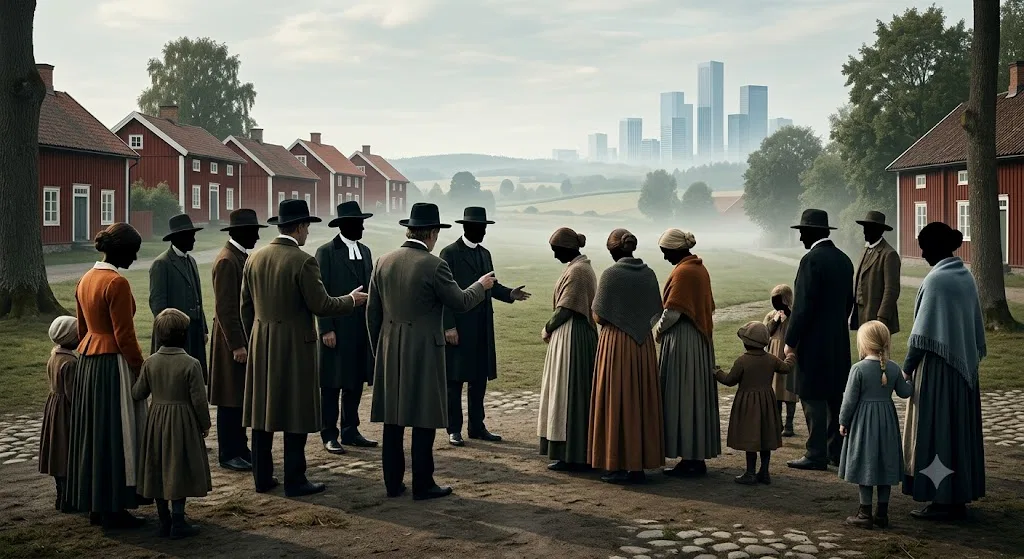
Sweden’s history of collective fear is dominated by one catastrophic episode: the witch persecutions of 1668–76, when stories told largely by children helped send hundreds of people to execution. Later Swedish scares were generally less lethal but followed recognisable patterns.
Page outline Jump by section
Introduction
These cases should not all be called “mass hysteria”. The witch trials were a state-backed persecution built on shared supernatural beliefs. The late twentieth-century satanism scares were moral panics in which genuine concern about vulnerable children became entangled with claims that often lacked reliable evidence. Knutby, by contrast, involved documented crimes and abusive relationships inside a real religious community. Sweden’s experience matters because it shows how rumour becomes dangerous when institutions reward accusation, suppress doubt or mistake an emotionally compelling story for proof.
The witch panic that became a national crisis
Swedish witch prosecutions existed before the late seventeenth century, but they were relatively scattered. The transformation came in 1668, when an accusation in Älvdalen in central Sweden developed into a story about women abducting children at night and carrying them to a witches’ gathering associated with the Devil. Variations of the tale spread through Dalarna and then into other regions, producing the period remembered as the “Great Noise” or “Great Unrest”. Roughly 280 people were executed during these eight years, forming the large majority of Sweden’s estimated witchcraft executions.[si.edu]folklife.si.eduswedish witch trials dark heritageThe first recorded execution occurred in 1550. So, trials were held before The Great…Read more…
The central fear was not simply that neighbours could cast harmful spells. It was that witches were secretly recruiting or kidnapping children into an organised anti-Christian conspiracy. Children described nocturnal journeys, satanic feasts and ritual activities in an imagined location that became highly standardised in testimony. The stories were culturally legible because clergy, magistrates and families already accepted the reality of the Devil, divine punishment and criminal witchcraft.
Once officials treated children as reliable witnesses, the process became self-reinforcing. Accused children heard other children’s accounts, learned which details adults expected and faced pressure to identify supposed abductors. A study of 809 statements made by children in Rättvik in 1670–71 found that age, peer influence and the circulation of shared narrative patterns affected the form of their testimony. The findings do not establish that every child consciously fabricated a story; they show how suggestion and social learning could turn uncertain experiences, dreams or inventions into remarkably similar accusations.[PubMed]pubmed.ncbi.nlm.nih.govChild testimonies during an outbreak of witch hysteriaby RL Sjöberg · 1995 · Cited by 36 — Eight hundred and nine testimonies given…
Authorities amplified the panic in several ways. Special commissions travelled to affected districts, clergy questioned children and courts relaxed earlier caution about testimony from the young. Some witnesses gained attention, food or other rewards. The supposed existence of numerous child victims also created a powerful moral pressure: officials who doubted the claims risked appearing indifferent to a satanic assault on families.[Smithsonian Folklife Center]folklife.si.eduswedish witch trials dark heritageThe first recorded execution occurred in 1550. So, trials were held before The Great…Read more…
Mora and Torsåker
The trials at Mora became one of the best-known early peaks. Dozens were accused, adults were condemned and children were punished for supposedly having attended the witches’ gathering, even when they were described as abducted victims. The combination of punishment and protection reveals the confused logic of the panic: children could be treated simultaneously as innocent prey, spiritual contaminants and legal witnesses.[Hogman Genealogy]hhogman.sewitch trials swedenHogman Genealogyof the Torsåker Witch TrialsThe 1668 trial unleashed the great witch hysteria in Sweden called Stora oväsendet (The Great…
The deadliest single execution occurred at Torsåker in 1675, where 71 people—65 women and six men—were killed after a large local prosecution. The case is frequently described as the largest witch execution in Swedish history. It was not an uncontrolled village lynching. Clergy, courts and a royal commission gave institutional form to rumours and accusations, demonstrating why the episode is better understood as judicial persecution than as a spontaneous crowd frenzy.[Smithsonian Folklife Center]folklife.si.eduswedish witch trials dark heritageThe first recorded execution occurred in 1550. So, trials were held before The Great…Read more…
Gender was crucial but not absolute. Most victims were women, often people whose poverty, reputation, family disputes or position within local tensions made them vulnerable. Men were also accused, especially when implicated by relatives or by the expanding logic of a supposed conspiracy. The persecution drew strength from several pressures at once: religious anxiety, local quarrels, concern for children, official encouragement and the prestige given to dramatic witnesses.

How Stockholm broke the spell
The witch hunt collapsed in Stockholm in 1676, not because belief in witchcraft suddenly disappeared, but because the credibility of its evidence became impossible to defend. Child accusers in the Katarina parish repeated the familiar stories of abduction and satanic gatherings. Some achieved public prominence and were consulted as if they possessed special expertise in identifying witches.
Judges and commissioners gradually became troubled by contradictions. When witnesses were separated, questioned more carefully and asked to reproduce earlier accounts, their stories diverged. Children admitted that accusations had been invented or repeated from others. The proceedings exposed how rewards, attention, peer imitation and leading interrogation had produced an expanding chain of testimony.[Wikipedia]WikipediaWitch trials in SwedenSweden was a country with few witch trials compared to other countries in Europe. In Sweden, about four hundred peo…
The reversal was significant because it came from within the state apparatus. Officials who had once accepted children’s claims began prosecuting false witnesses and ordered the wider persecution to stop. In 1677, clergy were instructed to announce that the danger had ended. This allowed the authorities to close the crisis without demanding that the population abandon the entire supernatural worldview on which it had rested.[Wikipedia]WikipediaWitch trials in SwedenSweden was a country with few witch trials compared to other countries in Europe. In Sweden, about four hundred peo…
The ending illustrates a recurring feature of collective scares: institutions may retreat only when their procedures fail visibly. Abstract scepticism was less decisive than the discovery that witnesses could not repeat their stories consistently. The panic stopped when courts changed the way evidence was tested.
Modern psychological language can illuminate parts of the episode, particularly suggestion, conformity and contagious storytelling. It should not flatten the history, however. The accused were not victims of an unexplained medical outbreak. They were prosecuted under law by authorities who regarded witchcraft as a real offence. “Witch panic”, “judicial persecution” and “collective delusion” therefore describe the case more accurately than a medical label such as mass psychogenic illness.
Satanism scares in a secular society
Sweden’s strong secular reputation did not prevent late twentieth-century fears about satanism. In Scandinavia, occult threats became associated with graveyard vandalism, heavy metal, black clothing, fantasy games and troubled young people. Scholars of Nordic satanism argue that secularisation could make these images more, rather than less, potent: Satan became a flexible symbol for fears about alienated youth, collapsing authority and apparently motiveless violence.[ResearchGate]researchgate.netResearch Gate(PDF) Nordic Satanism and Satanism Scares: The DarkResearchGate(PDF) Nordic Satanism and Satanism Scares: The Dark…December 21, 2009 — 18 Feb 2026 — In the 1980s, Satanism was mainly re…
Tabletop role-playing games were caught in this atmosphere during the 1980s and 1990s. Newspaper discussions sometimes presented imaginary violence, magic or demonic imagery as signs that players might lose contact with reality, become psychologically damaged or progress towards crime and suicide. A study of Swedish newspaper coverage from the period found material suitable for analysis as a moral panic, with games framed less as a varied leisure activity than as a possible threat to young people.[DIVA Portal]diva-portal.orgDIVA PortalHur rollspel beskrevs i svenska dagstidningar 1980-1999by E Back · 2023 · Cited by 1 — The purpose of this study is to examine…
The Swedish controversy was not merely a copy of the American campaign against Dungeons & Dragons. Domestic games, particularly darker horror titles, became prominent targets. Public discussion often collapsed distinctions between fictional play, adolescent provocation, esoteric religion, Satanism and actual criminal behaviour. A disturbing game could therefore be discussed as if it were evidence of a dangerous organisation rather than a commercial work of fiction.
This did not mean that every concern was invented. Some games contained violent or provocative material, and adults could reasonably debate age suitability. Heavy metal scenes also sometimes used deliberately transgressive symbols, while real vandalism and violence occurred in Nordic youth cultures. The panic lay in the unsupported causal leap: the assumption that consuming dark fiction or adopting an alarming style revealed membership of a hidden satanic network or created a direct path to serious crime.
The earlier Scandinavian panic over comic books offers a useful parallel. During the 1950s, critics in Sweden, Denmark and Norway linked comics to poor reading habits, brutality and juvenile delinquency. The controversy drew on wider international arguments but was adapted to Nordic ideas about childhood, education and cultural responsibility. As with later games, a new medium became a convenient explanation for anxieties whose causes were far more complicated.[tidsskriftetbarn.no]tidsskriftetbarn.noOpen source on tidsskriftetbarn.no.

When claims of ritual abuse entered institutions
The most serious modern satanism scare concerned allegations that children were being abused in organised rituals. Internationally, such claims spread during the 1980s and early 1990s through therapy literature, child-protection training, religious campaigning, conferences and highly publicised prosecutions. Researchers have described this as a transnational moral panic: concern about the genuine problem of child sexual abuse became fused with claims of secret multigenerational networks conducting elaborate satanic ceremonies.[Wiley Online Library Compass]compass.onlinelibrary.wiley.comj.1751 9020.2008.00169.xj.1751 9020.2008.00169.x
Sweden’s best-known example was the Södertälje case of the early 1990s. A teenage girl accused family members of sexual abuse and described murders and satanic rituals. The case produced convictions, but later proceedings substantially altered the outcome: the mother was acquitted at retrial and the father’s punishment was reduced. The episode remains important less as proof of an organised satanic conspiracy than as an example of how spectacular allegations could shape investigation and adjudication before their evidential basis had been securely tested.[Wikipedia]WikipediaSödertälje caseSödertälje case
Care is essential here. It would be wrong to infer that disputed ritual claims make ordinary child abuse rare or imaginary. Abuse frequently occurs without satanic organisation, and victims have often been ignored precisely because adults found their accounts inconvenient. The lesson from ritual-abuse panics is narrower: interviewers must avoid suggestion, investigators must separate corroborated acts from expanding narratives and courts must not treat the emotional force of an allegation as independent proof.
There is a striking continuity with the seventeenth-century trials. In both periods, adults feared that children were being secretly taken into an organised world of evil. In both, repeated interviews could create increasingly elaborate accounts. Yet the settings differed profoundly. Early modern judges worked within a legal and religious system that criminalised witchcraft; modern professionals were attempting to recognise real sexual abuse. Historical comparison is useful only when it preserves that distinction.
Knutby: a real abusive community, not merely a scare
The Knutby case is often placed in discussions of Swedish “cults”, but it should not be treated as another unsupported panic. Knutby Filadelfia was a small Pentecostal congregation near Uppsala that developed increasingly distinctive teachings and a tightly controlled leadership culture. Scholars describe it more neutrally as a schismatic new religious movement rooted in Pentecostalism. It was removed from the wider Swedish Pentecostal network in 2004 because its beliefs were judged unorthodox.[Springer]link.springer.comKnutby Filadelfia: A Schismatic New Religious MovementKnutby Filadelfia: A Schismatic New Religious Movement
In January 2004, one congregant was shot dead and another seriously wounded. Sara Svensson, a former nanny in the community, carried out the attacks. Pastor Helge Fossmo was convicted of inciting the murder and attempted murder, while Svensson was committed to psychiatric care. The case attracted extraordinary attention because religious authority, sexual relationships and messages presented as divine commands had been used in the manipulation surrounding the crime.[Ixtheo]ixtheo.deOpen source on ixtheo.de.
Academic interpretations resist the simplest media narrative of a mysterious sect suddenly turning murderous. One analysis emphasises the interaction of weak external oversight, charismatic ministers, insular social relations, unusual theology and the individual psychology and self-interest of those responsible. This approach avoids blaming violence on religion in general while still taking seriously the ways a closed leadership structure can enable coercion.[OUP Academic]academic.oup.comOpen source on oup.com.
Later testimony from former members broadened public understanding beyond the murder itself. Accounts described humiliation, authoritarian discipline, sexualised power and pressure to obey leaders. Research concerning children raised in the congregation has likewise shifted attention towards everyday life inside the community rather than treating Knutby solely as a sensational crime story.[du.diva-portal.org]du.diva-portal.orgOpen source on diva-portal.org.
The word “cult” became common in journalism and popular culture because it condensed the case into an instantly recognisable warning. It can also obscure more than it explains. The useful questions are concrete: How concentrated was authority? Could members question leaders? Were relationships controlled? Were people isolated, threatened or exploited? Did outsiders and parent organisations respond to warning signs? These questions identify coercive mechanisms without assuming that every small or unconventional religion is dangerous.
What Sweden’s cases have in common
Sweden’s major episodes differ in evidence, scale and harm, but several mechanisms recur.
Protection of children becomes an overriding moral demand. During the witch trials, children were supposedly being abducted into the Devil’s service. In the ritual-abuse panic, they were believed to be victims of hidden satanic networks. Because disbelief could look like abandonment, officials had strong incentives to act before evidence was properly tested.
Stories acquire authority through repetition. Children in neighbouring parishes learned a shared witch narrative. Modern ritual-abuse claims travelled through professional networks and media. Repetition made stories feel independently confirmed even when accounts had influenced one another.
Institutions decide whether fear remains rumour or becomes persecution. Gossip alone did not execute accused witches; courts and commissions did. Anxiety about role-playing games had limited consequences unless journalists, politicians or experts treated speculative connections as established fact. In Knutby, failures of internal and external oversight allowed genuine abuse to continue.
Visible outsiders become convenient symbols. Poor or quarrelsome women could be marked as witches. Young people in black clothing, metal fans and gamers could be imagined as recruits to Satanism. Minority religious groups could be discussed through the language of “cult danger” even where there was no evidence of coercion. Moral panic theory is most useful when it asks who is being made into a threatening type and whether the response is proportionate.
Correction usually begins with procedure, not ridicule. The Stockholm witch trials ended when witnesses were separated and their statements tested. Modern child-protection reforms have similarly stressed careful interviewing and independent corroboration. Mocking believers does little to prevent future scares; robust evidence rules do.

Memory, myth and the limits of the label
The Swedish witch trials now form part of a wider reassessment of “dark heritage”. Memorialisation has focused attention on the names and lives of victims rather than on picturesque legends of witches and supernatural adventure. This matters because tourism and popular storytelling can unintentionally reproduce the persecutors’ viewpoint, remembering executed people primarily as magical figures instead of as victims of accusation and state violence.[Smithsonian Folklife Center]folklife.si.eduswedish witch trials dark heritageThe first recorded execution occurred in 1550. So, trials were held before The Great…Read more…
Later retellings also tend to compress complex events into simple tales: gullible villagers, lying children or uniquely evil leaders. The evidence points to systems rather than single causes. Children’s testimony was shaped by adult questioning and peer culture. Courts were influenced by religious assumptions and political pressure. Satanism scares drew energy from real concern about abuse and youth violence, even while making unsupported claims. Knutby involved both individual criminal responsibility and a community structure that normalised obedience.
Sweden therefore offers no single national story of “mass hysteria”. It offers a sequence of more precise warnings. A supernatural belief can become judicial terror when courts abandon safeguards. A legitimate social concern can become a moral panic when symbols replace evidence. An unconventional religion should not be condemned merely for being strange, but documented coercion should not be excused as religious freedom. Across all three settings, the decisive question is the same: what happens when an alarming claim meets an institution with the power to reward it, publicise it or act upon it?
Amazon book picks
Further Reading
Books and field guides related to When Fear Became Proof in Sweden. Use these as the next step if you want deeper reading beyond the article.
Extraordinary Popular Delusions and the Madness of Crowds
Rating: 4.0/5 from 5 Google Books ratings
Connects Swedish events to broader crowd psychology.


Endnotes
1.
Source: Wikipedia
Link:https://en.wikipedia.org/wiki/Witch_trials_in_Sweden
Source snippet
Witch trials in SwedenSweden was a country with few witch trials compared to other countries in Europe. In Sweden, about four hundred peo...
2.
Source: researchgate.net
Title: Research Gate(PDF) Nordic Satanism and Satanism Scares: The Dark
Link:https://www.researchgate.net/publication/240708991_Nordic_Satanism_and_Satanism_Scares_The_Dark_Side_of_the_Secular_Welfare_State
Source snippet
ResearchGate(PDF) Nordic Satanism and Satanism Scares: The Dark...December 21, 2009 — 18 Feb 2026 — In the 1980s, Satanism was mainly re...
Published: December 21, 2009
3.
Source: diva-portal.org
Link:https://www.diva-portal.org/smash/get/diva2%3A492380/FULLTEXT01.pdf
Source snippet
DIVA PortalOf chaos and internal fireby R Andersson · 2012 · Cited by 4 — 'Nordic Satanism and Satanism Scares: The Dark Side of the Secu...
4.
Source: diva-portal.org
Link:https://www.diva-portal.org/smash/record.jsf?pid=diva2%3A1766818
Source snippet
DIVA PortalHur rollspel beskrevs i svenska dagstidningar 1980-1999by E Back · 2023 · Cited by 1 — The purpose of this study is to examine...
5.
Source: tidsskriftetbarn.no
Link:https://tidsskriftetbarn.no/index.php/barn/article/download/4688/7333/46673
6.
Source: compass.onlinelibrary.wiley.com
Title: j.1751 9020.2008.00169.x
Link:https://compass.onlinelibrary.wiley.com/doi/10.1111/j.1751-9020.2008.00169.x
7.
Source: Wikipedia
Title: Södertälje case
Link:https://en.wikipedia.org/wiki/S%C3%B6dert%C3%A4lje_case
8.
Source: link.springer.com
Title: Knutby Filadelfia: A Schismatic New Religious Movement
Link:https://link.springer.com/chapter/10.1007/978-3-319-69614
9.
Source: researchgate.net
Link:https://www.researchgate.net/publication/322502205_Knutby_Filadelfia_A_Schismatic_New_Religious_Movement_Within_the_Pentecostal_Context
10.
Source: ixtheo.de
Link:https://ixtheo.de/Record/1799069869
11.
Source: academic.oup.com
Link:https://academic.oup.com/book/5461/chapter/148352588
12.
Source: du.diva-portal.org
Link:https://du.diva-portal.org/smash/person.jsf?pid=authority-person%3A30983
13.
Source: diva-portal.org
Link:https://www.diva-portal.org/smash/get/diva2%3A1487349/FULLTEXT01.pdf
14.
Source: diva-portal.org
Link:https://www.diva-portal.org/smash/get/diva2%3A1469209/FULLTEXT04.pdf
15.
Source: uu.diva-portal.org
Link:https://uu.diva-portal.org/smash/get/diva2%3A1733992/FULLTEXT01.pdf
16.
Source: norden.diva-portal.org
Link:https://norden.diva-portal.org/smash/get/diva2%3A1534728/FULLTEXT01.pdf
17.
Source: diva-portal.org
Link:https://www.diva-portal.org/smash/get/diva2%3A1460596/FULLTEXT01.pdf
18.
Source: uu.diva-portal.org
Link:https://uu.diva-portal.org/smash/get/diva2%3A1513276/FULLTEXT01.pdf
19.
Source: diva-portal.org
Link:https://www.diva-portal.org/smash/get/diva2%3A1327399/FULLTEXT01.pdf
20.
Source: sh.diva-portal.org
Link:https://sh.diva-portal.org/smash/get/diva2%3A1624077/FULLTEXT05.pdf
21.
Source: diva-portal.org
Link:https://www.diva-portal.org/smash/get/diva2%3A1871731/FULLTEXT01.pdf
22.
Source: diva-portal.org
Link:https://www.diva-portal.org/smash/get/diva2%3A1440300/FULLTEXT01.pdf
23.
Source: diva-portal.org
Link:https://www.diva-portal.org/smash/get/diva2%3A1481733/FULLTEXT01.pdf
24.
Source: Wikipedia
Title: Day care sex abuse hysteria
Link:https://en.wikipedia.org/wiki/Day-care_sex-abuse_hysteria
25.
Source: Wikipedia
Title: Mc Martin preschool trial
Link:https://en.wikipedia.org/wiki/McMartin_preschool_trial
26.
Source: Wikipedia
Title: Mass psychogenic illness
Link:https://en.wikipedia.org/wiki/Mass_psychogenic_illness
27.
Source: Wikipedia
Link:https://en.wikipedia.org/wiki/Contactee
28.
Source: Wikipedia
Title: Nordic aliens
Link:https://en.wikipedia.org/wiki/Nordic_aliens
29.
Source: Wikipedia
Link:https://en.wikipedia.org/wiki/Ra%C3%ABlism
30.
Source: Wikipedia
Title: Aetherius Society
Link:https://en.wikipedia.org/wiki/Aetherius_Society
31.
Source: Wikipedia
Title: Ashtar Sheran
Link:https://en.wikipedia.org/wiki/Ashtar_Sheran
32.
Source: Wikipedia
Title: Satanic panic
Link:https://en.wikipedia.org/wiki/Satanic_panic
33.
Source: Wikipedia
Link:https://en.wikipedia.org/wiki/Ufology
34.
Source: Wikipedia
Title: Seduction of the Innocent
Link:https://en.wikipedia.org/wiki/Seduction_of_the_Innocent
35.
Source: Wikipedia
Title: Åsa Waldau
Link:https://en.wikipedia.org/wiki/%C3%85sa_Waldau
36.
Source: link.springer.com
Link:https://link.springer.com/chapter/10.1007/978-3-030-69882
37.
Source: link.springer.com
Link:https://link.springer.com/book/10.1007/978-3-031-36981-0
38.
Source: researchgate.net
Link:https://www.researchgate.net/publication/313714001_Apocalypse_in_Early_UFO_and_Alien-Based_Religions_Christian_and_Theosophical_Themes
39.
Source: researchgate.net
Link:https://www.researchgate.net/publication/377845513_Paranormal_Sweden_Paranormal_beliefs_and_practices_in_contemporary_Sweden
40.
Source: researchgate.net
Link:https://www.researchgate.net/publication/373916939_Sacred_Values_Politics_and_Moral_Panic_A_Potent_Mix_Biasing_the_Science_behind_Child_Sexual_Abuse_and_Related_Phenomena
41.
Source: history.com
Title: what was satanic panic 1980s
Link:https://www.history.com/articles/what-was-satanic-panic-1980s
42.
Source: folklife.si.edu
Title: swedish witch trials dark heritage
Link:https://folklife.si.edu/magazine/swedish-witch-trials-dark-heritage
Source snippet
The first recorded execution occurred in 1550. So, trials were held before The Great...Read more...
43.
Source: pubmed.ncbi.nlm.nih.gov
Link:https://pubmed.ncbi.nlm.nih.gov/7593397/
Source snippet
Child testimonies during an outbreak of witch hysteriaby RL Sjöberg · 1995 · Cited by 36 — Eight hundred and nine testimonies given...
44.
Source: hhogman.se
Title: witch trials sweden
Link:https://www.hhogman.se/witch-trials-sweden.htm
Source snippet
Hogman Genealogyof the Torsåker Witch TrialsThe 1668 trial unleashed the great witch hysteria in Sweden called Stora oväsendet (The Great...
45.
Source: pmc.ncbi.nlm.nih.gov
Link:https://pmc.ncbi.nlm.nih.gov/articles/PMC9210177/
46.
Source: sciencedirect.com
Title: Moral Panic
Link:https://www.sciencedirect.com/topics/psychology/moral-panic
47.
Source: allthatsinteresting.com
Title: witch trials
Link:https://allthatsinteresting.com/witch-trials/6
Additional References
48.
Source: youtube.com
Title: Sweden’s Witch Trials: Uncovering the Great Noise
Link:https://www.youtube.com/watch?v=JiqkHy2sDZw
Source snippet
Beyond Salem: The Witch Trials in Torsåker, Sweden...
49.
Source: facebook.com
Link:https://www.facebook.com/kathmandupost/posts/mass-hysteria-is-a-misunderstood-psychological-phenomenon-in-which-stress-and-an/1459992042828712/
50.
Source: salemwitchmuseum.com
Link:https://salemwitchmuseum.com/videos/beyond-salem-the-witch-trials-in-torsaker-sweden/
51.
Source: equip.org
Link:https://www.equip.org/articles/descending-masters-a-history-of-the-raelian-movement/
52.
Source: facebook.com
Link:https://www.facebook.com/groups/625436697499583/posts/7266561173387069/
53.
Source: ipl.org
Link:https://www.ipl.org/essay/How-Did-The-Great-Noise-Symbolize-Sweden-494B834A9A6A4D6D
54.
Source: fieldepidemiology.org
Link:https://fieldepidemiology.org/index.php/ajfe/article/download/7807/6435/21437
55.
Source: apothecaries.org
Link:https://www.apothecaries.org/wp-content/uploads/2019/06/Mass-psychogenic-illness-and-how-to-respond.pdf
56.
Source: reddit.com
Link:https://www.reddit.com/r/rpg/comments/duemnq/satanic_panic_for_world_of_darkness/
57.
Source: ebsco.com
Link:https://www.ebsco.com/research-starters/communication-and-mass-media/satanic-panic
Topic Tree
Follow this branch
Related pages 192
- Antigua and Barbuda
- Argentina Belief Scares
- Azerbaijan Belief
- Bahrain Beliefs
- North Korea
- +187 more in sidebar