Within Sudan
How Apocalyptic Belief Built a Sudanese State
Muhammad Ahmad's messianic claim turned religious expectation and anger at foreign rule into a revolution that created a state.
On this page
- Why Muhammad Ahmad's Mahdi claim found an audience
- How victories, preaching and allegiance spread the movement
- Revolution, coercion and the struggle over Mahdist memory
Page outline Jump by section
Introduction
The Mahdist Revolution was one of the most remarkable examples of apocalyptic belief reshaping political history. Between 1881 and 1898, Muhammad Ahmad’s claim to be the long-awaited Mahdi – the divinely guided redeemer expected by many Muslims before the end times – transformed a regional religious movement into a revolutionary state that overthrew Ottoman-Egyptian rule across most of Sudan. Rather than being a simple story of religious enthusiasm, the Mahdiyya shows how millenarian expectations combined with political grievances, economic hardship and anti-imperial resistance to produce a movement that many contemporaries regarded as both spiritually inevitable and politically necessary. Modern historians increasingly argue that neither colonial descriptions of irrational fanaticism nor purely nationalist interpretations fully explain its success. Instead, the Mahdist Revolution demonstrates the extraordinary power of apocalyptic belief when it resonates with widespread experiences of injustice and offers an alternative vision of society.[royalholloway.ac.uk]repository.royalholloway.ac.ukThe Sudan and the Mahdist Revolution of 1881-1885 | openEQUELLA…

Why Muhammad Ahmad’s Mahdi claim found an audience
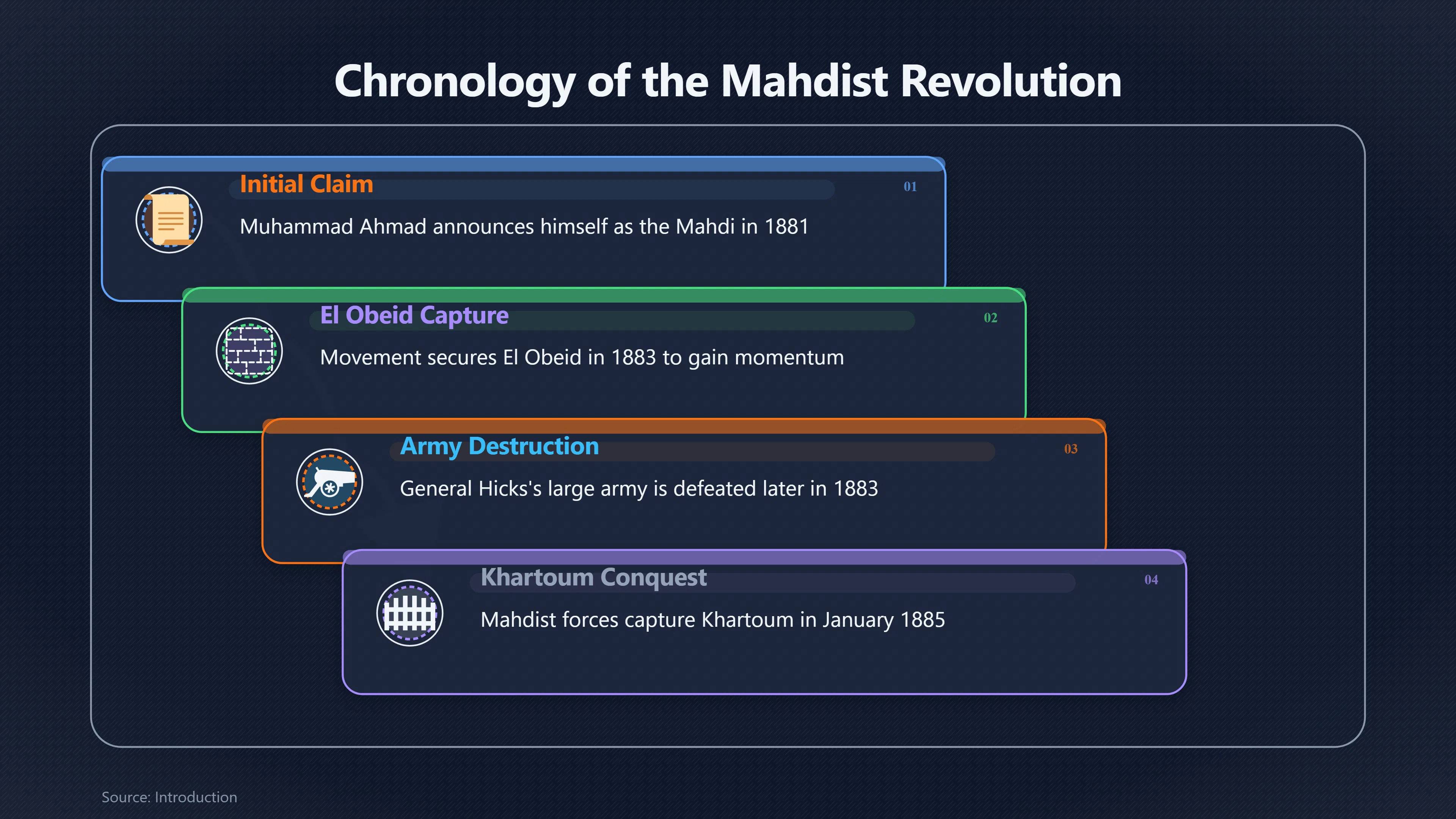
Muhammad Ahmad announced in June 1881 that he was the Mahdi, the messianic figure expected in many Islamic traditions to restore justice before the Day of Judgement. Claims to be the Mahdi had appeared elsewhere in Islamic history, but few attracted such sustained popular support. In Sudan, his message emerged during a period of intense dissatisfaction with Ottoman-Egyptian administration, which had become associated with heavy taxation, forced labour, military conscription, corruption and the growing influence of European powers over Egyptian finances and policy.[repository.royalholloway.ac.uk]repository.royalholloway.ac.ukThe Sudan and the Mahdist Revolution of 1881-1885 | openEQUELLA…
His appeal rested on several reinforcing ideas.
- Religious renewal. Muhammad Ahmad argued that Islam had become corrupted and required purification before God’s final intervention in history.
- Moral justice. His movement promised to replace rulers portrayed as unjust with divinely guided government.
- Liberation from foreign domination. Religious salvation and political independence became inseparable goals.
- Personal obligation. Accepting the Mahdi was presented not as an optional political choice but as a religious duty.
These themes allowed spiritual expectation to reinforce political mobilisation. Joining the movement meant participating simultaneously in a holy struggle and a social revolution. Historians therefore describe the Mahdiyya as both a millenarian movement and an anti-imperial uprising rather than reducing it to either category alone.[cambridge.org]cambridge.orgCambridge University Press & AssessmentMahdist faith and the legitimation of popular revolt in western Sudan | Africa | Cambridge Core…
The movement also benefited from Sudan’s existing religious culture. Networks of scholars, preachers and Sufi communities had long connected towns and rural regions. Although Muhammad Ahmad eventually criticised established religious authorities and sought to supersede existing loyalties, those communication networks helped spread news of his claims and gave ordinary believers familiar ways to discuss religious authority.[repository.royalholloway.ac.uk]repository.royalholloway.ac.ukThe Sudan and the Mahdist Revolution of 1881-1885 | openEQUELLA…
How victories, preaching and allegiance spread the movement
Religious movements rarely expand through doctrine alone. The Mahdiyya spread because belief, military success and social commitment continually reinforced one another.
Muhammad Ahmad sent letters across Sudan calling on rulers, tribal leaders and religious figures to recognise him as the Mahdi. These proclamations invited recipients to declare allegiance before divine judgement overtook those who resisted. Such correspondence created a sense that history itself had entered an extraordinary moment requiring immediate action.[repository.royalholloway.ac.uk]repository.royalholloway.ac.ukThe Sudan and the Mahdist Revolution of 1881-1885 | openEQUELLA…
Military victories then gave these claims enormous credibility. Egyptian expeditions sent to suppress what officials initially regarded as a minor rebellion suffered unexpected defeats. The capture of El Obeid in 1883, followed by the destruction of General William Hicks’s much larger army later that year, convinced many previously sceptical observers that the movement possessed extraordinary momentum. Success itself became evidence that God favoured the Mahdi.[World History]worldhistory.orgMahdist WarWorld HistoryMahdist War: Holy War in Sudan, 1881-99 - World History Encyclopedia…
This produced a powerful feedback loop.
- Victories attracted new followers.
- New followers strengthened the armies.
- Further victories appeared to confirm divine favour.
- Government defeats undermined confidence in established rulers.
For many Sudanese, the movement’s expansion therefore appeared not merely politically successful but spiritually validated.
The Mahdi also reshaped everyday identity. Followers became known as the Ansar (“helpers”), echoing the supporters of the Prophet Muhammad in early Islamic history. Distinctive patched robes symbolised humility and rejection of worldly luxury, while oaths of allegiance bound individuals personally to the Mahdi rather than to previous political or tribal authorities. These visible symbols helped transform scattered supporters into members of a single revolutionary community.[World History]worldhistory.orgMahdist WarWorld HistoryMahdist War: Holy War in Sudan, 1881-99 - World History Encyclopedia…

How apocalyptic belief became a state
The capture of Khartoum in January 1885 represented far more than a military victory. It marked the collapse of Ottoman-Egyptian authority in much of Sudan and the emergence of an independent Mahdist state.
Muhammad Ahmad died only months after the conquest, but the state survived under his successor, the Khalifa Abdallahi ibn Muhammad. The Mahdist government attempted to reorganise administration, taxation, military organisation and religious life according to its understanding of divine guidance. Official correspondence, legal rulings and proclamations reveal a government that viewed itself as implementing sacred authority rather than merely exercising political power.[Docslib]docslib.orgThe Mahdiyya, BibThe Mahdiyya, Bib - DocsLib…
Apocalyptic belief continued to shape governance in several ways.
Religious legitimacy became political legitimacy. Loyalty to the state was closely linked to acceptance of the Mahdi’s authority.
Expectation justified extraordinary change. Existing institutions could be replaced because believers understood themselves to be living in an exceptional era of sacred history.
Expansion remained part of the vision. The movement’s ambitions extended beyond Sudan, reflecting the conviction that the Mahdi’s mission possessed universal significance rather than merely local political aims.[World History]worldhistory.orgMahdist WarWorld HistoryMahdist War: Holy War in Sudan, 1881-99 - World History Encyclopedia…
The result was one of the few nineteenth-century millenarian movements to establish and govern an internationally recognised territorial state for more than a decade.
Revolution, coercion and the struggle over Mahdist memory
The Mahdist Revolution cannot be understood simply as a story of liberation. Like many revolutionary governments, it exercised coercive power after achieving victory.
The Mahdist state fought continuous wars, demanded obedience, suppressed opponents and faced severe economic pressures. Internal rivalries, food shortages, disease and famine caused immense suffering in parts of Sudan. Not everyone accepted Mahdist authority willingly, and regional experiences varied considerably. Modern scholarship therefore rejects idealised portrayals that overlook the hardships experienced under Mahdist rule.[africabib.org]africabib.orgAfricaBib | A Bibliography of the Mahdist State in the Sudan (1881-1898)…
Colonial narratives created a different distortion. British writers often portrayed the Mahdists as irrational fanatics whose religious beliefs explained every military action. The death of General Charles Gordon at Khartoum became central to Victorian imperial memory, encouraging dramatic stories that reduced Sudanese participants to religious extremists rather than political actors with coherent grievances and objectives. Such portrayals helped justify the later Anglo-Egyptian reconquest culminating in the Battle of Omdurman in 1898.[World History]worldhistory.orgMahdist WarWorld HistoryMahdist War: Holy War in Sudan, 1881-99 - World History Encyclopedia…
Recent historians increasingly challenge both extremes. Instead of choosing between “religious fanaticism” and “national liberation,” they emphasise that the Mahdiyya was simultaneously:
- a genuine messianic movement grounded in Islamic expectations;
- a popular revolt against unpopular government;
- an attempt to construct a new religious and political order;
- and eventually a state capable of exercising both reform and coercion.
This more balanced interpretation better explains why the movement inspired extraordinary loyalty while also generating lasting controversy within Sudanese historical memory.[cambridge.org]cambridge.orgCambridge University Press & AssessmentMahdist faith and the legitimation of popular revolt in western Sudan | Africa | Cambridge Core…

Why the Mahdist Revolution still matters
The Mahdist Revolution remains one of history’s clearest demonstrations that apocalyptic belief can become a force for state-building rather than remaining a marginal religious phenomenon. It illustrates that collective belief is most powerful when it speaks to existing political frustrations, social inequalities and moral expectations.
For historians of collective belief, the Mahdiyya is not well described as a case of mass hysteria or irrational delusion. Its followers acted within a coherent religious worldview that interpreted military victories, political oppression and prophetic expectation as mutually reinforcing evidence. Whether or not one accepts the Mahdi’s claims, understanding why so many Sudanese found them convincing requires taking both religious conviction and historical circumstance seriously.
The movement also serves as a reminder that labels such as “cult” obscure more than they explain. The Mahdiyya mobilised tens of thousands of followers, defeated established governments, created durable institutions and reshaped Sudanese politics for generations. Its significance lies not only in its military achievements but in showing how apocalyptic expectations, when aligned with widespread demands for justice and independence, can transform the course of a nation’s history.[worktribe.com]soas-repository.worktribe.comSOAS Repository The Mahdiyya in Sudan and the Problem of HistorySOAS Repository The Mahdiyya in Sudan and the Problem of History
Amazon book picks
Further Reading
Books and field guides related to How Apocalyptic Belief Built a Sudanese State. Use these as the next step if you want deeper reading beyond the article.

The scramble for Africa,
First published 1990. Subjects: History, Colonies, Colonization, Colonización, Kolonisatie.
Endnotes
1.
Source: repository.royalholloway.ac.uk
Link:https://repository.royalholloway.ac.uk/items/4155426b-3f80-47da-b08a-81b48721bc0d/1/
Source snippet
The Sudan and the Mahdist Revolution of 1881-1885 | openEQUELLA...
2.
Source: cambridge.org
Link:https://www.cambridge.org/core/journals/africa/article/abs/mahdist-faith-and-the-legitimation-of-popular-revolt-in-western-sudan/8CDB1AA540539FD2319086C0FB6EF9CC
Source snippet
Cambridge University Press & AssessmentMahdist faith and the legitimation of popular revolt in western Sudan | Africa | Cambridge Core...
3.
Source: docslib.org
Title: The Mahdiyya, Bib
Link:https://docslib.org/doc/3863969/the-mahdiyya-bib
Source snippet
The Mahdiyya, Bib - DocsLib...
4.
Source: africabib.org
Link:https://africabib.org/rec.php?DB=p&RID=21237219X
Source snippet
AfricaBib | A Bibliography of the Mahdist State in the Sudan (1881-1898)...
5.
Source: cambridge.org
Link:https://www.cambridge.org/core/journals/international-journal-of-middle-east-studies/article/abs/mahdism-and-islamism-in-sudan/34C6921740D5D3568EC2BF616EB27540
Source snippet
April 23, 2009 — MAHDISM AND ISLAMISM IN SUDAN Published online by Cambridge University Press: 23 April 2009 Gabriel Warburg Show author...
Published: April 23, 2009
6.
Source: cambridge.org
Link:https://www.cambridge.org/core/journals/international-journal-of-middle-east-studies/article/abs/sudanese-mahdi-frontier-fundmentalist/DD4746B5CB19312F28F49E57C353ABD6
Source snippet
January 29, 2009 — THE SUDANESE MAHDĪ: FRONTIER FUNDMENTALIST Published online by Cambridge University Press: 29 January 2009 John Voll S...
Published: January 29, 2009
7.
Source: africabib.org
Link:https://www.africabib.org/rec.php?RID=21237219X
Source snippet
A Bibliography of the Mahdist State in the Sudan (1881-1898)bibliographic database Image: Line...
8.
Source: youtube.com
Title: The Mahdi
Link:https://www.youtube.com/watch?v=-CVyAhMU7rA
Source snippet
Muhammad Ahmad: Father of the Mahdist State...
9.
Source: soas-repository.worktribe.com
Title: SOAS Repository The Mahdiyya in Sudan and the Problem of History
Link:https://soas-repository.worktribe.com/output/847281/the-mahdiyya-in-sudan-and-the-problem-of-history
10.
Source: worldhistory.org
Title: Mahdist War
Link:https://www.worldhistory.org/Mahdist_War/
Source snippet
World HistoryMahdist War: Holy War in Sudan, 1881-99 - World History Encyclopedia...
11.
Source: sudanembassybj.com
Title: The Mahdiyya
Link:https://www.sudanembassybj.com/The%20Mahdiyya.php
Source snippet
苏丹使馆Sudan EmbassyTHE EMBASSY OF THE REPUBLICE OF THE SUDAN BEIJING The Mahdiyya The Mahdiyya, 1881-98 Discussion of the religious orders...
Additional References
12.
Source: arcjournals.org
Link:https://www.arcjournals.org/international-journal-of-political-science/volume-4-issue-1/4
Source snippet
rnal of Political ScienceInternational Journal of Political Science Volume 4, Issue 1, 2018, Page No: 28-42 doi:dx.doi.org/10.20431/2454...
13.
Source: newlinesmag.com
Link:https://newlinesmag.com/essays/the-sudanese-mahdiyya-when-doomsday-visions-fortified-the-struggle-for-independence/
Source snippet
New Lines MagazineMay 5, 2023 — Essays Sudan 14 min read THE SUDANESE MAHDIYYA: WHEN DOOMSDAY VISIONS FORTIFIED THE STRUGGLE FOR INDEPEND...
Published: May 5, 2023
14.
Source: soas.ac.uk
Link:https://www.soas.ac.uk/about/hengameh-ziai
Source snippet
Jump to: Key information 2. Jump to: Biography 3. Jump to: Research interests 4. Jump to: Publications 5. Jump to: Contact...
15.
Source: youtube.com
Title: The Mahdist War
Link:https://www.youtube.com/watch?v=riwUBGhX1Zg
Source snippet
The Mahdist Revolt | The British Empire | AQA A Level History...
16.
Source: youtube.com
Title: The Mahdist Revolt | The British Empire | AQA A Level History
Link:https://www.youtube.com/watch?v=t1fMz-GINlI
Source snippet
Mahdist War | 3 Minute History...
17.
Source: youtube.com
Title: Mahdist War | 3 Minute History
Link:https://www.youtube.com/watch?v=3f8_NHsd810
Topic Tree