Within Benin
When Benin's Government Declared War on Sorcery
Benin's revolutionary government turned fears of occult enemies into an official struggle over modernity, loyalty and religious authority.
On this page
- Revolutionary ideology and religious suspicion
- How the state defined occult enemies
- Consequences for traditional authorities and believers
Page outline Jump by section
Introduction
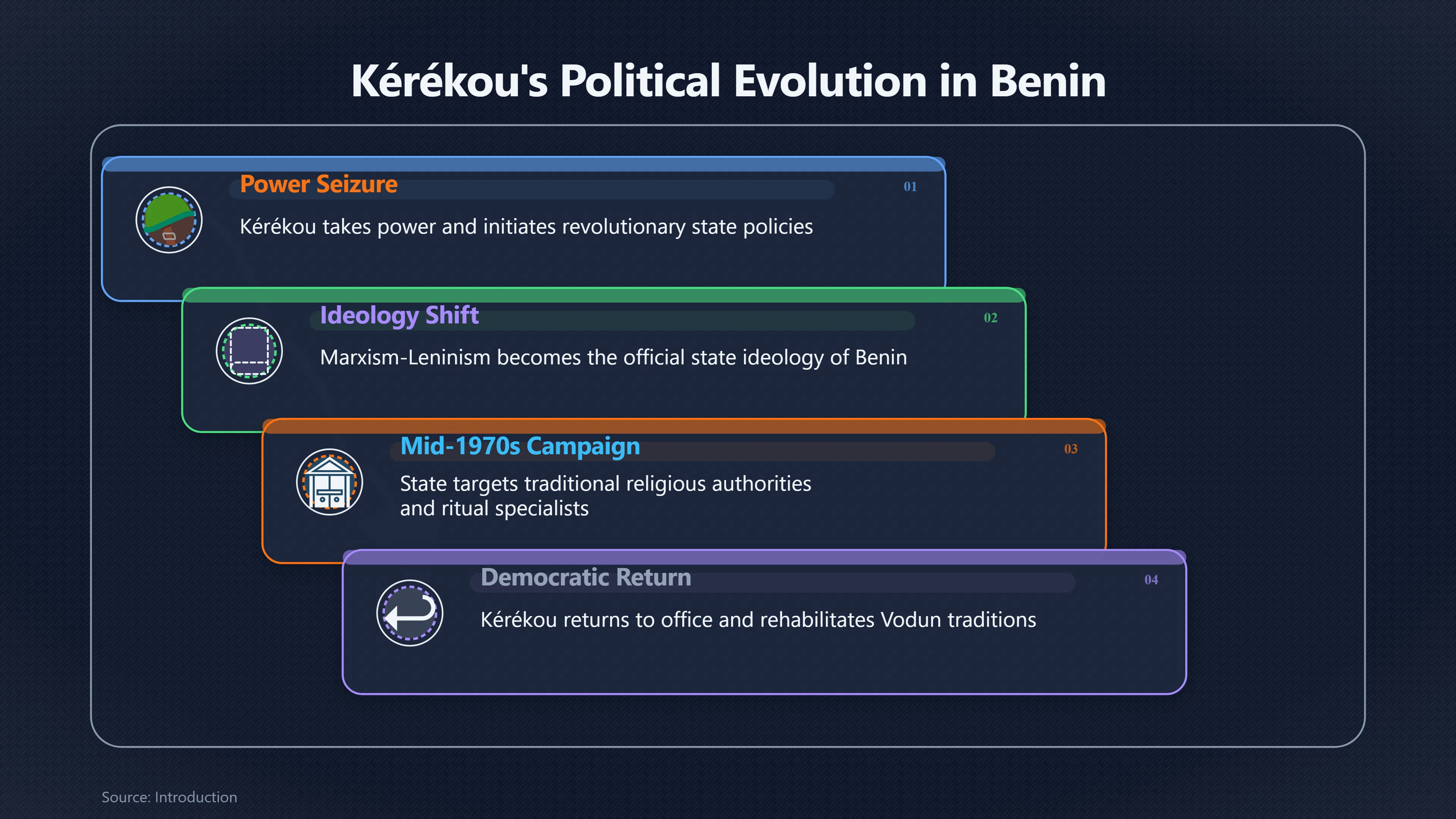
After Mathieu Kérékou seized power in Benin in 1972, his Marxist-Leninist government did more than challenge political opponents. It also sought to weaken religious authorities and beliefs that it regarded as rivals to the revolutionary state. Although often described as a campaign against “sorcery”, the policy was broader: officials condemned many forms of traditional religious practice, accused some priests and healers of exploiting superstition, and portrayed occult belief as an obstacle to socialist modernisation. At the same time, ordinary citizens continued to interpret misfortune, illness and political conflict through ideas about witchcraft and spiritual power, creating a tension between official ideology and everyday belief. Rather than eliminating those beliefs, the campaign revealed how deeply they remained embedded in Beninese society and how difficult it was for a revolutionary government to replace established religious authority.[unige.ch]archive-ouverte.unige.chArchive OuvertePetitioning about the revolutiona… | Archive ouverte UNIGEJanuary 1, 2020…
Revolutionary ideology and religious suspicion
Kérékou’s regime gradually adopted Marxism-Leninism after declaring it the state’s official ideology in 1974. Revolutionary leaders argued that Benin could only modernise by breaking the influence of what they described as feudal, tribal and superstitious institutions. Traditional religious authorities therefore became political as well as spiritual targets.
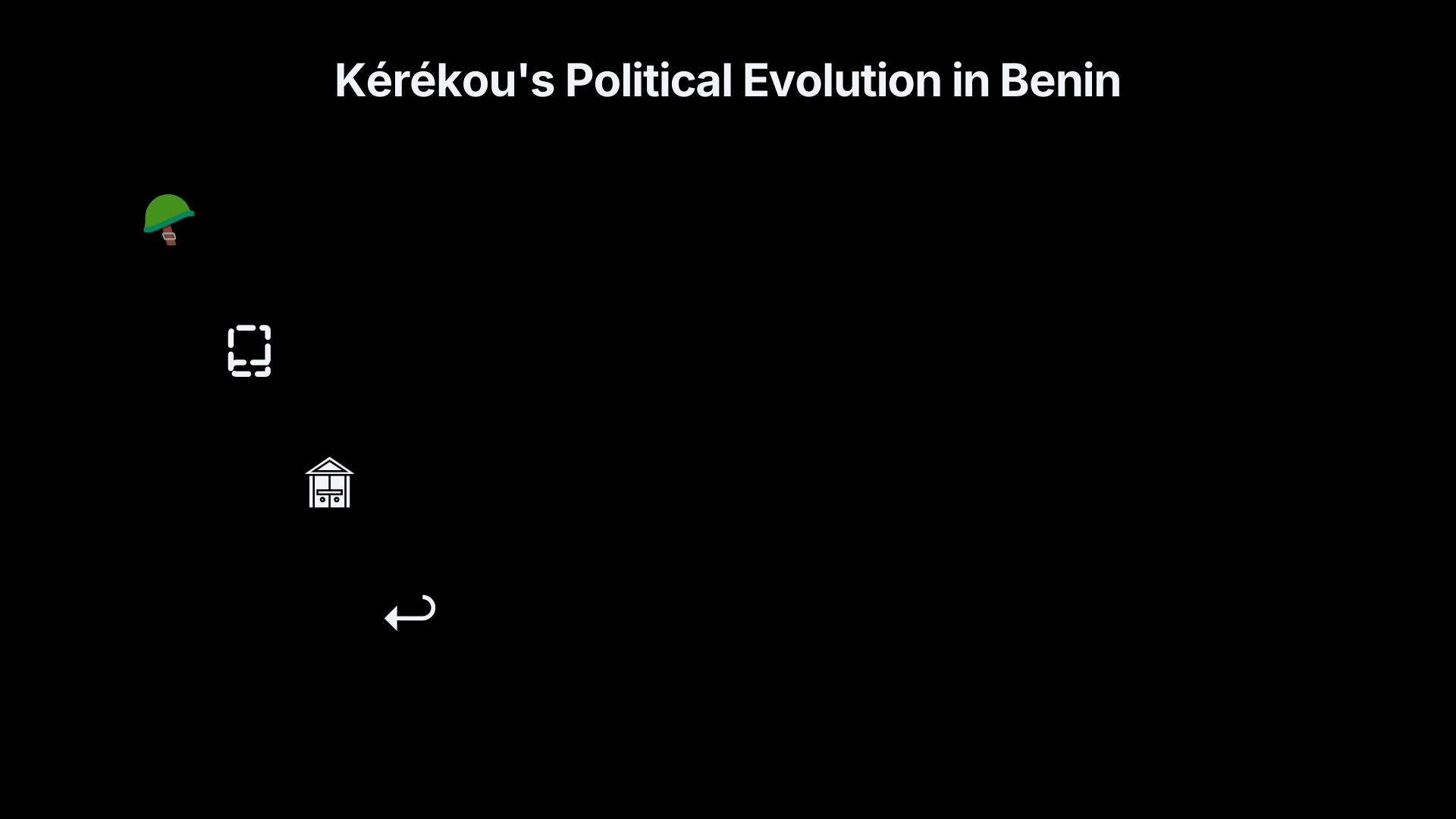
The government did not simply deny the existence of witchcraft or supernatural forces. Instead, it criticised the social authority of those who claimed to identify witches, perform powerful rituals or mediate between communities and unseen forces. Officials argued that such figures diverted loyalty away from the revolutionary state and encouraged explanations for poverty, disease and conflict that contradicted socialist ideas about social change.[wikipedia.org]WikipediaMathieu KérékouMathieu Kérékou
This placed the regime in an awkward position. Marxist theory treated religion as a form of false consciousness, yet many government officials themselves came from communities where belief in spiritual causation remained widespread. As a result, official rhetoric often condemned “sorcery” while everyday political life continued to be shaped by fears of occult attack and expectations that leaders possessed spiritual protection.[Africabib]africabib.orgAfricaBib | Kerekou, God and the Ancestors: Religion and the Conception of Political Power in Benin…
How the state defined occult enemies
The government’s campaign was not directed solely at alleged witches. It targeted a much wider range of people associated with traditional religious authority, including some Vodun priests, shrine custodians, diviners and healers. Revolutionary propaganda frequently grouped these figures together as representatives of backward beliefs that hindered national development.
This approach blurred several distinct ideas:
- Traditional religion, which many Beninese regarded as a legitimate system of worship and community life.
- Witchcraft beliefs, which explained misfortune through hidden human agency.
- Professional ritual specialists, some of whom claimed the ability to detect or counter harmful spiritual forces.
- Political opponents, who could be portrayed as benefiting from superstition or resisting revolutionary reforms.
Historical research into petitions sent directly to Kérékou during the mid-1970s shows that accusations involving sorcery and traditional religion remained common despite official condemnation. Citizens continued asking the state to intervene in disputes involving alleged occult harm, illustrating that revolutionary ideology had not displaced popular understandings of misfortune. Instead, the government became another authority expected to judge conflicts rooted in supernatural belief.[Archive Ouverte]archive-ouverte.unige.chArchive OuvertePetitioning about the revolutiona… | Archive ouverte UNIGEJanuary 1, 2020…
Consequences for traditional authorities and believers
The campaign affected religious leaders in different ways across the country. Some priests were detained or publicly criticised, while shrines and ritual sites lost official protection or were disrupted by redevelopment and administrative reforms. Revolutionary organisations promoted secular political education in place of customary religious authority wherever possible.[AP News]apnews.comFormer dictator Mathieu Kérékou banned Vodún during his Marxist-Leninist regime, viewing it as subversive. However, his defeat in the 199…
Yet suppression proved uneven. Vodun and other indigenous religious traditions were woven into family life, local identity and systems of social trust. Even where public ceremonies were discouraged, religious practice often continued privately or adapted to changing political conditions.
Anthropologists and historians argue that this resilience reflected the practical role these traditions played. They were not simply systems of belief but institutions that mediated disputes, organised festivals, maintained sacred sites and provided explanations during illness, bereavement and uncertainty. Eliminating them required more than banning rituals or denouncing superstition.[Africabib]africabib.orgAfricaBib | Kerekou, God and the Ancestors: Religion and the Conception of Political Power in Benin…
Why the campaign failed to eliminate belief in sorcery
One of the central paradoxes of Kérékou’s rule was that the government attacked occult belief while political rumours increasingly attributed supernatural powers to Kérékou himself.
Popular stories portrayed the president as possessing unusual spiritual protection because he repeatedly survived coup attempts. Rumours circulated that political leaders consulted marabouts or ritual specialists despite official hostility towards traditional religion. These accounts were difficult to verify individually, but together they demonstrate how political authority continued to be interpreted through spiritual language rather than replacing it with purely secular explanations.[africabib.org]africabib.orgAfricaBib | Kerekou, God and the Ancestors: Religion and the Conception of Political Power in Benin…
Later accounts from former advisers and religious leaders suggest that Kérékou himself gradually became more cautious about confronting indigenous religion directly. During his later political career he moved away from revolutionary hostility, eventually recognising the continued importance of Vodun within national life. After returning to office through democratic elections in 1996, his government accepted public celebration of traditional religion and supported institutions representing Vodun practitioners—an extraordinary reversal from the revolutionary period.[AP News]apnews.comFormer dictator Mathieu Kérékou banned Vodún during his Marxist-Leninist regime, viewing it as subversive. However, his defeat in the 199…
Was this a moral panic or a political campaign?
The episode is better understood as a state-led campaign than as a classic mass hysteria.
Unlike episodes in which frightened crowds spontaneously accuse neighbours of witchcraft, the driving force here was the government itself. Revolutionary leaders framed certain religious practices as enemies of national progress and attempted to redefine acceptable belief through official ideology, education and administrative action.
At the same time, the campaign interacted with long-standing popular beliefs about occult danger. Citizens continued bringing disputes involving sorcery to the authorities, while rumours about hidden spiritual power flourished around political leaders. Rather than replacing supernatural explanations, the revolutionary state became another arena in which they were expressed.[Archive Ouverte]archive-ouverte.unige.chArchive OuvertePetitioning about the revolutiona… | Archive ouverte UNIGEJanuary 1, 2020…
Why it remains important
Kérékou’s campaign demonstrates that governments can become active participants in struggles over collective belief rather than merely responding to them. Benin’s revolutionary leadership attempted to redefine religious authority as a political threat, but deeply rooted traditions proved remarkably durable.
For historians of collective fear, the episode illustrates several broader lessons:
- Political modernisation does not automatically weaken beliefs about witchcraft or spiritual causation.
- Campaigns against “superstition” may become campaigns against influential social institutions rather than against beliefs alone.
- Ordinary people often continue interpreting political events through existing religious frameworks even when governments promote secular ideologies.
- Attempts to suppress indigenous religion can strengthen its symbolic importance as a marker of cultural identity.
Within Benin’s wider history of moral panics and collective belief, Kérékou’s campaign stands as an example of a state panic: an official effort to identify occult influence as an obstacle to national transformation, whose long-term legacy was not the disappearance of traditional religion but its eventual public rehabilitation and renewed recognition in democratic Benin.[africabib.org]africabib.orgAfricaBib | Kerekou, God and the Ancestors: Religion and the Conception of Political Power in Benin…
Amazon book picks
Further Reading
Books and field guides related to When Benin's Government Declared War on Sorcery. Use these as the next step if you want deeper reading beyond the article.
African Religions A Very Short Introduction
Explains indigenous belief systems often misunderstood by colonial authorities.

The fate of Africa
Covers post-colonial political transformations including Marxist governments.
In sorcery's shadow
Illustrates enduring belief in spiritual power despite modern politics.

The spirits and the law
Shows how authority, law and spiritual belief interact in West Africa.
Endnotes
1.
Source: africabib.org
Link:https://www.africabib.org/rec.php?RID=20511282X
Source snippet
AfricaBib | Kerekou, God and the Ancestors: Religion and the Conception of Political Power in Benin...
2.
Source: Wikipedia
Title: Mathieu Kérékou
Link:https://en.wikipedia.org/wiki/Mathieu_K%C3%A9r%C3%A9kou
3.
Source: news.trust.org
Title: 20180919085949 ca6en
Link:https://news.trust.org/item/20180919085949-ca6en/
5.
Source: archive-ouverte.unige.ch
Link:https://archive-ouverte.unige.ch/unige%3A152535
Source snippet
Archive OuvertePetitioning about the revolutiona... | Archive ouverte UNIGEJanuary 1, 2020...
Published: January 1, 2020
6.
Source: apnews.com
Link:https://apnews.com/article/df831990ce900c99b927c75e7179e461
Source snippet
Former dictator Mathieu Kérékou banned Vodún during his Marxist-Leninist regime, viewing it as subversive. However, his defeat in the 199...
Additional References
7.
Source: researchgate.net
Link:https://www.researchgate.net/publication/341534600_Petitioning_about_the_Revolutionary_Nation_Social_History_and_Communication_under_the_Early_Kerekou_Regime_in_Benin
Source snippet
Petitioning about the Revolutionary Nation: Social History and Communication under the Early Kérékou Regime in Benin, 1975–1977...
8.
Source: benintoday.com
Link:https://benintoday.com/articles/en/benins-voodoo-from-suppression-to-national-heritage-and-democratic-symbol.html
Source snippet
June 4, 2026 — 4 Jun 2026 BENIN'S VOODOO: FROM SUPPRESSION TO NATIONAL HERITAGE AND DEMOCRATIC SYMBOL Image: Daagbo Hounon Houna II, the...
Published: June 4, 2026
9.
Source: libcom.org
Title: 1989 90 beninese campaign economic justice and democracy
Link:https://libcom.org/article/1989-90-beninese-campaign-economic-justice-and-democracy
Source snippet
1989-90 - Beninese campaign for economic justice and democracy | libcom.orgDecember 23, 2018 — 1989-90 - BENINESE CAMPAIGN FOR ECONOMIC J...
Published: December 23, 2018
10.
Source: cambridge.org
Link:https://www.cambridge.org/core/journals/international-labor-and-working-class-history/article/social-history-of-parastatal-employees-in-southern-benin-19891990-contesting-decline-and-unemployment-during-africas-second-democratization/E30158AF93289F2ED9E736D2D4F146FF
Source snippet
A Social History of Parastatal Employees in Southern Benin, 1989–1990: Contesting Decline and Unemployment During “Africa’s Second Democr...
11.
Source: tandfonline.com
Link:https://www.tandfonline.com/doi/abs/10.1080/00664677.2020.1847038
Source snippet
Alter(native) Magic: Race and the Other in Beninese Witchcraft: Anthropological Forum: Vol 30, No 4December 22, 2020 — Anthropological Fo...
Published: December 22, 2020
12.
Source: youtube.com
Title: Mathieu Kérékou: Benin’s Dictator who became a Democrat
Link:https://www.youtube.com/watch?v=ZBbpq01r2t8
Source snippet
'Witchcraft' and Science in the Republic of Benin with Prof. Doug Falen...
13.
Source: youtube.com
Title: ‘Witchcraft’ and Science in the Republic of Benin with Prof. Doug Falen
Link:https://www.youtube.com/watch?v=d3Y_JS2TWdw
Source snippet
Profile of Lieutenant Colonel Mathieu Kerekou...
14.
Source: africaknowledgeproject.org
Link:https://www.africaknowledgeproject.org/index.php/war/article/view/265
15.
Source: publications.hse.ru
Link:https://publications.hse.ru/en/chapters/395572774
16.
Source: uk.investing.com
Title: les marches americains ont cloture plus haut dow jones en hausse de 184 72690
Link:https://uk.investing.com/news/stock-market-news/les-marches-americains-ont-cloture-plus-haut-dow-jones-en-hausse-de-184-72690
Topic Tree