Within Benin
Why Protection Movements Could Deepen Witchcraft Fear
Travelling anti-witchcraft shrines promised protection but could also turn quarrels, illness and bad luck into evidence of hidden attack.
On this page
- What Tron movements promised
- How suspicion spread through everyday misfortune
- Oaths, oracles and the risks of accusation
Page outline Jump by section
Introduction
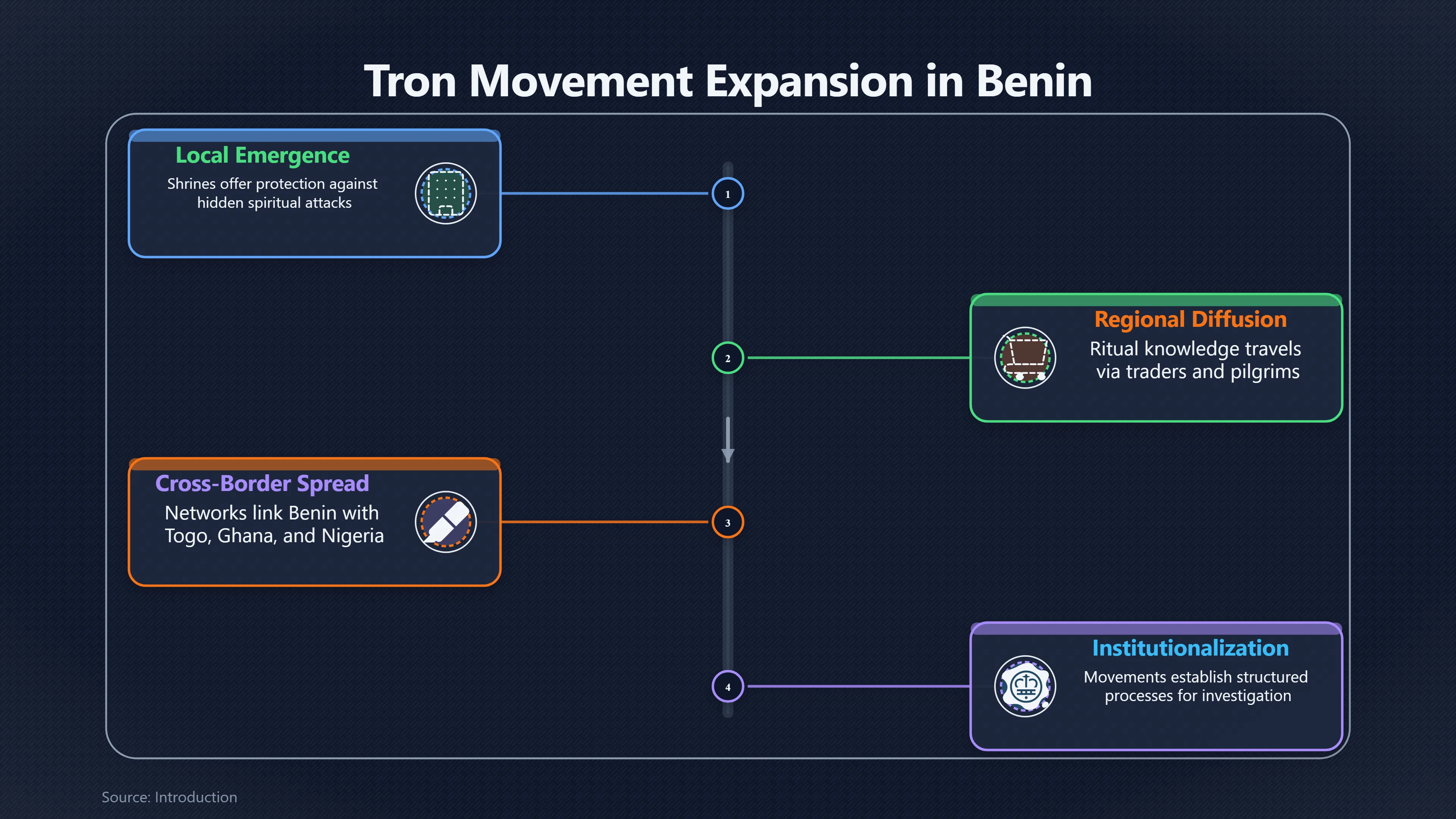
Travelling Tron movements became influential across parts of Benin during the twentieth century because they offered something many communities urgently wanted: protection against hidden spiritual attack. Rather than encouraging witchcraft, Tron shrines presented themselves as a defence against it. Yet the same rituals that promised safety could also intensify suspicion. Illness, infertility, repeated accidents, business failure or unexplained deaths were interpreted as possible signs of occult aggression, and specialists claimed the ability to identify or neutralise those responsible. As Tron networks spread across southern Benin and neighbouring Togo, Ghana and Nigeria through shared ritual traditions and migration, they created new ways of investigating misfortune as well as new opportunities for accusation. Anthropologists therefore describe Tron as a revealing example of how an anti-witchcraft movement can simultaneously reduce fear for some people while deepening it for others.[africabib.org]africabib.orgAfricaBib | On representation and power: portrait of a Vodun leader in present-day Benin…

What Tron movements promised
Tron is best understood as part of a family of anti-witchcraft and protective religious movements rather than as a single organisation. Different shrines and religious leaders varied in their practices, but many claimed the power to expose harmful spiritual forces, protect followers from attacks and restore order after unexplained misfortune. In Benin, Tron became associated with Vodun while also absorbing influences from Christianity, Islam and wider regional religious exchanges. Its expansion reflected the highly connected religious landscape of the Bight of Benin rather than a purely local development.[Africabib]africabib.orgAfricaBib | On representation and power: portrait of a Vodun leader in present-day Benin…
For many followers, joining a Tron shrine was a practical response to uncertainty. Families coping with repeated sickness, failed harvests, infertility or economic setbacks sought rituals that could identify hidden causes and provide protection. Membership often involved purification, ritual obligations and promises to abandon practices considered spiritually dangerous. These commitments offered reassurance that unseen threats could be managed instead of endured passively.[uwpress.wisc.edu]uwpress.wisc.eduAfrican Science | University of Wisconsin PressAfrican Science | University of Wisconsin Press
Anthropologists caution against treating Tron simply as a “witch-finding cult”. Many leaders also acted as healers, mediators and community figures whose authority extended beyond accusations of witchcraft. Their religious role could include blessing households, settling disputes and negotiating relationships between traditional religion, government and civil society.[Africabib]africabib.orgAfricaBib | On representation and power: portrait of a Vodun leader in present-day Benin…
How suspicion spread through everyday misfortune
The central mechanism through which Tron movements could deepen witchcraft fear lay in their interpretation of ordinary misfortune. Events that might otherwise have remained unexplained—or attributed to disease, chance or economic hardship—could instead be linked into a coherent story of deliberate spiritual attack.
This process did not require dramatic evidence. A succession of relatively common problems could be interpreted cumulatively:
- repeated illness within one family;
- unexplained deaths;
- infertility or miscarriages;
- persistent financial failure;
- unusual accidents;
- conflicts between relatives or neighbours.
When these events were understood as signs of hidden aggression, communities often sought ritual specialists capable of identifying the source. The search for protection therefore also became a search for responsibility.[wisc.edu]uwpress.wisc.eduAfrican Science | University of Wisconsin PressAfrican Science | University of Wisconsin Press
Importantly, accusations did not emerge automatically from belief in witchcraft. Many Beninese communities believed occult harm was possible while remaining cautious about naming individuals. The arrival or growing influence of organised anti-witchcraft movements sometimes altered that balance by offering recognised procedures for investigating suspicions. Those procedures could lend greater authority to claims that might otherwise have remained rumours or private anxieties.[Københavns Universitets Forskningsportal]researchprofiles.ku.dkKøbenhavns Universitets ForskningsportalCategorizing the Occult: Vodun, Sorcery and Religious Beliefs In Benin - University of Copenhagen…
Oaths, oracles and the risks of accusation
One reason Tron-related movements spread across national borders was the circulation of ritual specialists and shrine networks linking Benin with neighbouring Togo, Ghana and parts of Nigeria. These regions shared long-standing religious connections that pre-dated modern frontiers.
Within these networks, oaths, divination and oracular judgements were often used to resolve disputes involving suspected witchcraft. Rather than relying on physical evidence in the modern legal sense, communities sought supernatural confirmation about hidden wrongdoing. Refusing an oath or failing a ritual test could itself generate suspicion, even where no independent evidence existed.[Taylor & Francis Online]tandfonline.comTaylor & Francis OnlineOracles, chieftaincies, and witchcraft accusations in south-western Togo: The Journal of Legal Pluralism and Unoff…
Research from neighbouring south-western Togo illustrates that oracles were rarely accepted uncritically. Their verdicts were debated, negotiated and interpreted within local political relationships rather than treated as infallible proof. Chiefs, families and community members frequently reshaped or limited the consequences of an oracle’s decision. This suggests that accusations emerged through social negotiation as much as ritual declaration.[Taylor & Francis Online]tandfonline.comTaylor & Francis OnlineOracles, chieftaincies, and witchcraft accusations in south-western Togo: The Journal of Legal Pluralism and Unoff…
Nevertheless, once an accusation gained ritual legitimacy, it could carry serious consequences. Individuals identified as witches might face social isolation, demands for confession, compulsory cleansing rituals, financial penalties or exclusion from community life. The movement’s promise of protection therefore carried an inherent danger: every successful identification of an occult aggressor reinforced the wider expectation that hidden enemies really were responsible for everyday suffering.[Taylor & Francis Online]tandfonline.comTaylor & Francis OnlineOracles, chieftaincies, and witchcraft accusations in south-western Togo: The Journal of Legal Pluralism and Unoff…
Why Tron crossed borders so successfully
The spread of Tron was helped by cultural and historical connections linking the peoples of southern Benin, Togo, eastern Ghana and western Nigeria. Colonial boundaries divided communities that continued to share languages, markets, family ties and religious traditions.
Travelling priests, pilgrims and traders carried ritual knowledge between shrines, while migrants introduced successful protective practices into new communities. Because the movement addressed universal experiences—illness, jealousy, economic uncertainty and unexplained death—it could be adapted to different local settings without losing its central promise of spiritual protection.[Africabib]africabib.orgAfricaBib | On representation and power: portrait of a Vodun leader in present-day Benin…
This regional circulation also meant ideas about witchcraft evolved through exchange rather than remaining confined within one country’s traditions. Similar anti-witchcraft movements elsewhere in West Africa demonstrate how protective shrines repeatedly emerged in response to changing political, religious and economic conditions while retaining a common concern with identifying occult danger.[Africabib]africabib.orgAfricaBib | Witches, Oracles, and Colonial Law: Evolving Anti-Witchcraft Practices in Ghana, 1927-1932…
Why historians see Tron as a mechanism rather than a panic
Modern scholarship generally avoids describing Tron itself as a case of “mass hysteria”. Instead, researchers analyse it as a social mechanism that shaped how communities interpreted uncertainty.
The movement reduced anxiety for believers by offering rituals of protection and explanation. At the same time, it expanded the range of situations that could be understood as evidence of witchcraft. This created a paradox: efforts to defend communities from occult harm could also increase vigilance for hidden enemies.
That dual role helps explain why Tron remains important in studies of witchcraft suspicion across Benin. It demonstrates that anti-witchcraft movements cannot be understood simply as campaigns against belief. They often reinforced belief in witchcraft while redirecting it through new institutions, ritual authorities and investigative practices. Rather than replacing fear with certainty, they transformed diffuse anxieties into structured processes of accusation, protection and social negotiation.[africabib.org]africabib.orgAfricaBib | On representation and power: portrait of a Vodun leader in present-day Benin…
Amazon book picks
Further Reading
Books and field guides related to Why Protection Movements Could Deepen Witchcraft Fear. Use these as the next step if you want deeper reading beyond the article.
African Religions A Very Short Introduction
Explains indigenous belief systems often misunderstood by colonial authorities.
In sorcery's shadow
Explores anti-witchcraft beliefs and ritual specialists in West Africa.


The spirits and the law
Examines how accusations and spiritual authority spread socially.
Endnotes
1.
Source: africabib.org
Link:https://www.africabib.org/rec.php?RID=374718822
Source snippet
AfricaBib | On representation and power: portrait of a Vodun leader in present-day Benin...
2.
Source: uwpress.wisc.edu
Title: African Science | University of Wisconsin Press
Link:https://uwpress.wisc.edu/Books/A/African-Science2
3.
Source: africabib.org
Link:https://www.africabib.org/rec.php?DB=p&RID=249572265
Source snippet
AfricaBib | Witches, Oracles, and Colonial Law: Evolving Anti-Witchcraft Practices in Ghana, 1927-1932...
4.
Source: africabib.org
Link:https://www.africabib.org/rec.php?RID=185661920
Source snippet
AfricaBib | Exorcising Witchcraft: The Return of the Gods in New Religious Movements on the Jos Plateau and the Benue Regions of...
5.
Source: zgswh.scu.edu.cn
Link:https://zgswh.scu.edu.cn/info/1097/1576.htm
6.
Source: africabib.org
Link:https://www.africabib.org/rec.php?DB=p&RID=185661920
7.
Source: researchprofiles.ku.dk
Link:https://researchprofiles.ku.dk/en/publications/categorizing-the-occult-vodun-sorcery-and-religious-beliefs-in-be
Source snippet
Københavns Universitets ForskningsportalCategorizing the Occult: Vodun, Sorcery and Religious Beliefs In Benin - University of Copenhagen...
8.
Source: tandfonline.com
Link:https://www.tandfonline.com/doi/abs/10.1080/07329113.2013.806842
Source snippet
Taylor & Francis OnlineOracles, chieftaincies, and witchcraft accusations in south-western Togo: The Journal of Legal Pluralism and Unoff...
9.
Source: tandfonline.com
Link:https://www.tandfonline.com/doi/full/10.1080/21681392.2023.2232052
Source snippet
Witchcraft Accusations and the Social Exclusion of the Elderly in Northern Ghana: Understanding How Cultural Di...
10.
Source: researchprofiles.ku.dk
Title: dk Categorizing the Occult: Vodun, Sorcery and Religious Beliefs In Benin
Link:https://researchprofiles.ku.dk/da/publications/categorizing-the-occult-vodun-sorcery-and-religious-beliefs-in-be
11.
Source: tandfonline.com
Link:https://www.tandfonline.com/doi/abs/10.1080/13648470.2011.591201
Additional References
12.
Source: jstage.jst.go.jp
Title: jst.go.jp Demons Listen Too
Link:https://www.jstage.jst.go.jp/article/jjcanth/86/4/86_635/_article/-char/en
Source snippet
Listen TooMarch 31, 2022 — Japanese Journal of Cultural Anthropology Online ISSN: 2424-0516 Print ISSN: 1349-0648 ISSN-L: 1349-0648 Sp...
Published: March 31, 2022
13.
Source: nature.com
Link:https://www.nature.com/nature-index/topics/l4/witchcraft-accusations-and-socio-cultural-dynamics-in-africa
14.
Source: youtube.com
Title: I Found REAL Voodoo in AFRICA (unbelievable)
Link:https://www.youtube.com/watch?v=PovFYQ6TLY4
Source snippet
5 i exposed the mystery behind Africa's most feared and dark religion - Voodoo...
15.
Source: euaa.europa.eu
Link:https://www.euaa.europa.eu/country-guidance-nigeria-2021/29-individuals-accused-witchcraft
Source snippet
Individuals accused of witchcraft | European Union Agency for AsylumOctober 1, 2021 — 2.9. INDIVIDUALS ACCUSED OF WITCHCRAFT Table of con...
Published: October 1, 2021
16.
Source: researchgate.net
Link:https://www.researchgate.net/publication/231979854_Witchcraft_anti-witchcraft_and_trans-regional_ritual_innovation_in_early_colonial_Ghana_Sakrabundi_and_Aberewa
17.
Source: cambridge.org
Link:https://www.cambridge.org/core/journals/african-studies-review/article/abs/antiwitchcraft-shrines-among-the-akan-possession-and-the-gathering-of-knowledge/888D8E3D832F8A47E4186C607072AED3
18.
Source: africaknowledgeproject.org
Link:https://www.africaknowledgeproject.org/index.php/war/article/view/265
19.
Source: researchgate.net
Link:https://www.researchgate.net/publication/271669002_Oracles_chieftaincies_and_witchcraft_accusations_in_south-western_Togo
20.
Source: researchgate.net
Link:https://www.researchgate.net/publication/330145232_Expenditures_on_Malevolent_Magico-Religious_Powers_Empirical_Evidence_from_Benin
21.
Source: gutenberg.org
Link:https://www.gutenberg.org/files/20411/20411-h/20411-h.htm
Topic Tree