Within Estonia
Why Followers Waited for the White Ship
The Maltsvetians joined religious expectation to peasant protest and a practical plan to seek land and freedom in Crimea.
On this page
- Prophet Maltsvet and rural discontent
- The Lasnamae gathering and the promised ship
- Migration to Crimea beyond the failed prophecy
Page outline Jump by section
Introduction
The story of Estonia’s “White Ship” is one of the country’s best-known episodes of collective religious expectation, but it is often simplified into a tale of naïve believers waiting for a miracle that never came. The historical reality is more complex. The followers of the preacher Juhan Leinberg, better known as Prophet Maltsvet, combined spiritual renewal with a practical hope of escaping poverty and unequal rural conditions by settling in Crimea. The famous gathering at Lasnamäe near Tallinn, where hundreds waited for a promised white ship, became an enduring national symbol because it united religious expectation, migration dreams and social protest. The movement was rooted in genuine hardship rather than irrationality alone, and many followers eventually reached Crimea through ordinary migration rather than miraculous rescue.[wikipedia.org]WikipediaJuhan LeinbergJuhan Leinberg

Prophet Maltsvet and rural discontent
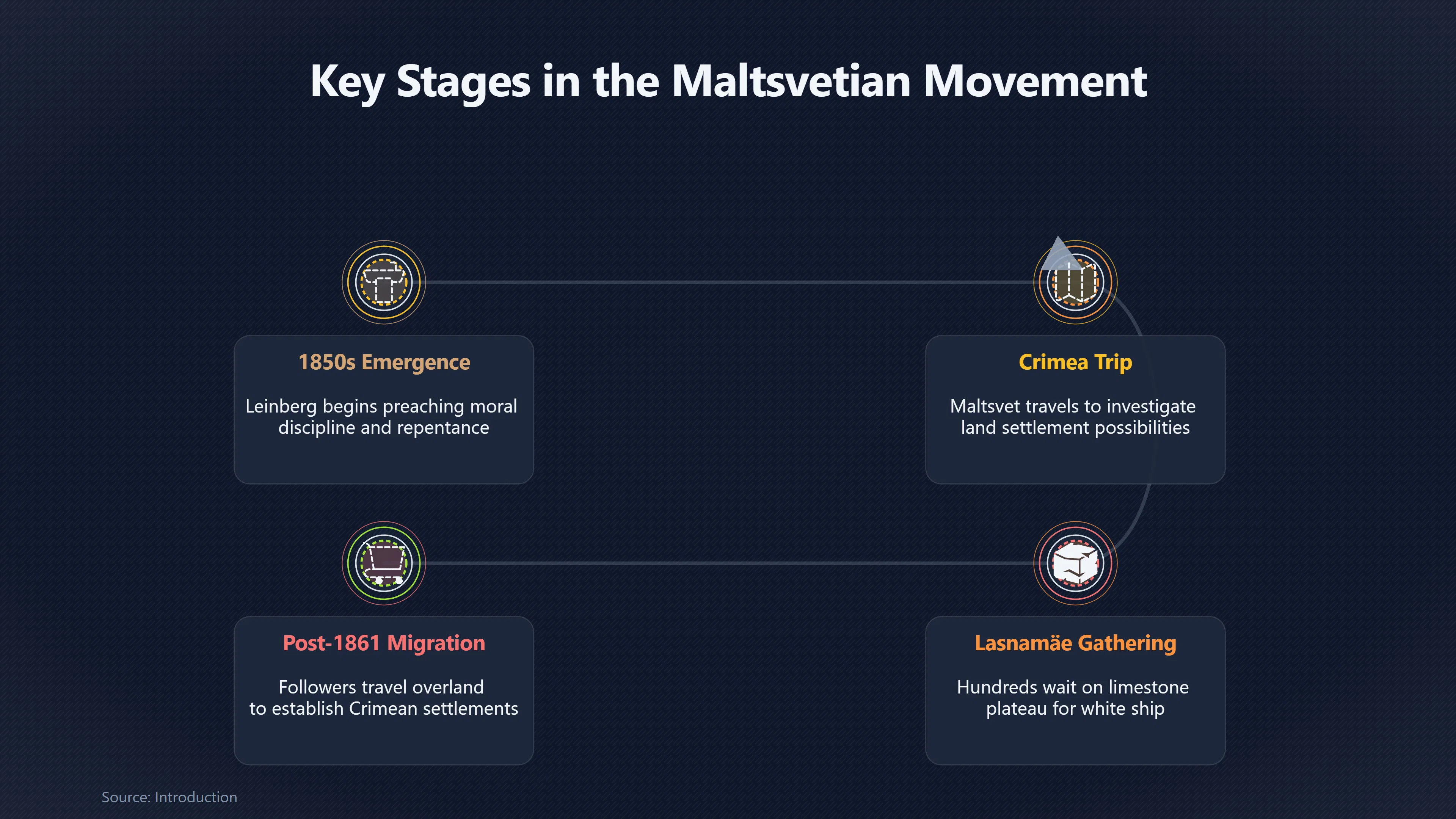
Juhan Leinberg (1812–1885), known to his followers as Prophet Maltsvet, emerged during the 1850s as an independent religious preacher in northern Estonia. His message called for repentance, moral discipline and rejection of material greed. Followers adopted distinctive habits, including simple dress and abstaining from alcohol and tobacco, marking themselves out from both the established Lutheran Church and everyday village society.[Wikipedia]WikipediaJuhan LeinbergJuhan Leinberg
His popularity reflected more than religious enthusiasm. Although serfdom had formally been abolished earlier in the nineteenth century, many Estonian peasants remained economically dependent on Baltic German landlords, with limited opportunities to own land or improve their lives. At the same time, the Russian Empire was encouraging settlement in newly acquired territories such as Crimea after the Crimean War. Stories circulated that fertile land awaited settlers willing to relocate. For many rural families, migration represented not simply spiritual salvation but a realistic chance of becoming independent farmers.[etera.ee]etera.eeTALLIN N UNIVERSITYTALLIN N UNIVERSITY
Maltsvet himself investigated the possibility of settlement, travelling to Crimea in 1861. This practical aspect of the movement is important because it distinguishes the Maltsvetians from many purely apocalyptic religious groups. Their hopes rested on both divine guidance and a concrete destination where they believed a better future might be possible.[Wikipedia]WikipediaJuhan LeinbergJuhan Leinberg
The Lasnamäe gathering and the promised ship
The most famous episode occurred during the spring and early summer of 1861, when several hundred followers assembled on the limestone plateau at Lasnamäe outside Tallinn. They expected the arrival of a white ship that would carry them to their promised destination. The image has become so famous that it often overshadows the wider movement itself.[wikipedia.org]WikipediaJuhan LeinbergJuhan Leinberg
Exactly how the belief in the ship developed remains debated. Later novels and popular retellings often present Maltsvet as explicitly promising a miraculous vessel. However, historians and religious scholars have argued that the famous “White Ship” may have grown through rumour, symbolic language and newspaper reports rather than being a literal prophecy issued by Leinberg himself. Some contemporary traditions also referred to believers expecting a white cloud or another divine means of deliverance. The image became increasingly fixed only through later storytelling.[researchgate.net]researchgate.netResearch Gate History of maltsvet's religion and emigration to the crimeaResearch Gate History of maltsvet's religion and emigration to the crimea
The gathering illustrates how collective expectation develops. Several factors reinforced one another:
- Shared hardship encouraged people to believe that radical change was possible.
- Religious confidence gave authority to Maltsvet’s message of renewal.
- Limited information about migration procedures allowed rumours to flourish.
- Group commitment made waiting together a public demonstration of faith.
- Practical migration plans blurred the boundary between symbolic prophecy and genuine travel arrangements.
Rather than representing a sudden outbreak of irrational behaviour, the waiting at Lasnamäe reflected a community trying to reconcile religious hope with uncertain opportunities for emigration. When the ship failed to appear, disappointment was profound, but the movement did not immediately disappear.[etera.ee]etera.eeTALLIN N UNIVERSITYTALLIN N UNIVERSITY
Migration to Crimea beyond the failed prophecy
The failure of the White Ship did not end the Maltsvetian movement because migration remained possible through ordinary means. During the following years, many followers travelled overland or by conventional transport to Crimea, where Estonian settlements were established alongside other migrant communities within the Russian Empire.[researchgate.net]researchgate.netResearch Gate History of maltsvet's religion and emigration to the crimeaResearch Gate History of maltsvet's religion and emigration to the crimea
Life there was rarely as easy as many had imagined. Settlers faced unfamiliar conditions, difficult journeys and the challenge of creating new farming communities. Nevertheless, some Estonian villages endured for decades, showing that the movement cannot be understood solely as a failed prophecy. Its migration project had lasting demographic and cultural consequences, creating Crimean Estonian communities whose descendants preserved aspects of Estonian language and identity long after the original migration.[ResearchGate]researchgate.netResearch Gate History of maltsvet's religion and emigration to the crimeaResearch Gate History of maltsvet's religion and emigration to the crimea
This practical outcome helps explain why historians are cautious about describing the movement simply as a “cult” or an episode of mass hysteria. Religious expectation undoubtedly shaped decisions, but many participants also made calculated choices based on the prospect of land ownership and greater personal freedom.
Why the White Ship became a national symbol
The White Ship acquired much of its modern meaning through literature rather than through the events alone. Eduard Vilde’s historical novel Prophet Maltsvet, published in the early twentieth century, drew on interviews, letters and memoirs but also reshaped the movement into a powerful literary narrative. Scholars have argued that Vilde interpreted the movement through his own social and political ideas, making the White Ship a symbol of oppression, hope and disappointment rather than a straightforward historical reconstruction.[wikipedia.org]WikipediaJuhan LeinbergJuhan Leinberg
Later writers, including the Finnish author Aino Kallas, further embedded the White Ship in cultural memory. Over time, the phrase “waiting for the White Ship” came to signify hope for rescue that may never arrive. During later crises—including periods of foreign occupation—the symbol was sometimes invoked as a metaphor for national deliverance, extending far beyond its nineteenth-century religious origins.[wikipedia.org]WikipediaJuhan LeinbergJuhan Leinberg
What the episode reveals about collective belief
The Maltsvetian movement demonstrates that collective belief is rarely driven by faith alone. The White Ship story spread because religious conviction intersected with economic hardship, social inequality and genuine opportunities for migration.
Several features distinguish it from classic cases of mass panic:
- The movement centred on hope rather than fear.
- It sought renewal and migration, not confrontation or violence.
- Many expectations had a practical basis, including real discussions about resettlement.
- The most famous miracle—the arrival of the White Ship—became increasingly prominent through later memory and literature rather than through unambiguous contemporary evidence.[researchgate.net]researchgate.netResearch Gate History of maltsvet's religion and emigration to the crimeaResearch Gate History of maltsvet's religion and emigration to the crimea
For Estonia, the White Ship remains culturally important because it captures a recurring historical theme: people living under severe constraints investing extraordinary meaning in the possibility of escape. The image endures not because a miraculous ship ever appeared, but because it expresses the mixture of desperation, faith and determination that shaped one of the country’s most distinctive religious movements.[folklore.ee]folklore.eeKonverents Vilniuses okt. 2006…

Endnotes
1.
Source: Wikipedia
Title: Juhan Leinberg
Link:https://en.wikipedia.org/wiki/Juhan_Leinberg
2.
Source: researchgate.net
Title: Research Gate History of maltsvet’s religion and emigration to the crimea
Link:https://www.researchgate.net/publication/296928524_History_of_maltsvet%27s_religion_and_emigration_to_the_crimea
3.
Source: folklore.ee
Link:https://www.folklore.ee/rl/fo/konve/leedu06/
Source snippet
Konverents Vilniuses okt. 2006...
4.
Source: etera.ee
Title: TALLIN N UNIVERSITY
Link:https://www.etera.ee/api/oai2/download/28491.pdf
5.
Source: Wikipedia
Title: Prohvet Maltsvet
Link:https://de.wikipedia.org/wiki/Prohvet_Maltsvet
6.
Source: kreutzwald.kirmus.ee
Title: Kreutzwaldi sajand / Eesti kultuurilooline veeb
Link:https://kreutzwald.kirmus.ee/et/lisamaterjalid/ajatelje_materjalid?item_id=390&page_start=&table=Events
7.
Source: ceeol.com
Title: CEEO L
Link:https://www.ceeol.com/search/article-detail?id=280699
Source snippet
Article Detail...
8.
Source: zfo-online.de
Title: Microsoft Word
Link:https://www.zfo-online.de/portal/zfo/article/download/9707/9706/9707
Source snippet
03_Aufsatz_Stoecker.docx...
9.
Source: eaa.ee
Title: “The White Ship” by Estonian Painters Association | Eesti Kunstnike Liit
Link:https://www.eaa.ee/ru/node/4289
Source snippet
January 25, 2023 — “THE WHITE SHIP” BY ESTONIAN PAINTERS ASSOCIATION 25.01.2023 The White Ship - DET VITA SKEPPET Estonian Painters Assoc...
Published: January 25, 2023
10.
Source: researchgate.net
Title: (PDF) War of civilizations
Link:https://www.researchgate.net/publication/360454837_War_of_civilizations
11.
Source: zfo-online.de
Link:https://www.zfo-online.de/portal/zfo/article/view/9707
12.
Source: researchgate.net
Title: (PDF) The Last Minutes of Our Earth
Link:https://www.researchgate.net/publication/43337055_The_Last_Minutes_of_Our_Earth
13.
Source: researchgate.net
Title: (PDF) Estonians in the Crimea
Link:https://www.researchgate.net/publication/267194206_Estonians_in_the_Crimea
14.
Source: ceeol.com
Title: CEEO L
Link:https://www.ceeol.com/search/article-detail?id=876472
15.
Source: ceeol.com
Title: CEEO L
Link:https://www.ceeol.com/search/search-result?f=%7B%22SortBy%22%3A2%2C%22SubjectIDs%22%3A%5B322%5D%2C%22Pagination%22%3A%7B%22PageNumber%22%3A1%2C%22PageRows%22%3A20%2C%22TotalRows%22%3A26%7D%2C%22SearchIdentifier%22%3A%22af0a572a-93be-4544-ade5-d8659b029f87%22%7D&page=831
16.
Source: folklore.ee
Link:https://folklore.ee/radar/story.php?area=Kuusalu&id=2051
17.
Source: religion.fandom.com
Title: Juhan Leinberg
Link:https://religion.fandom.com/wiki/Juhan_Leinberg
Additional References
18.
Source: vaimuvara.ee
Title: Eestlaste rännak tõotatud maale prohvet Maltsvetiga
Link:https://vaimuvara.ee/eestlaste-rannak-tootatud-maale-prohvet-maltsvetiga/
Source snippet
April 15, 2022 — EESTLASTE RÄNNAK TÕOTATUD MAALE PROHVET MALTSVETIGA. 1861–1863 toimus esimene suurem eestlaste väljarändamislai...
Published: April 15, 2022
19.
Source: youtube.com
Title: Eino Tamberg
Link:https://www.youtube.com/watch?v=r269fqvNOWY
Source snippet
"Lost" "White Ship" Valge laev (1970) drama / dubbing Soyuzmultfilm...
20.
Source: youtube.com
Title: 8 klass ajalugu video nr 31 Eesti talurahva vabanemine pärisorjusest
Link:https://www.youtube.com/watch?v=iOS0ok3SFPk
Source snippet
klass ajalugu video nr 1 Sissejuhatus muinas- ja vanaaega...
21.
Source: youtube.com
Title: VALGE LAEV
Link:https://www.youtube.com/watch?v=nA-gOzDfkZk
Source snippet
8 klass ajalugu video nr 31 Eesti talurahva vabanemine pärisorjusest...
22.
Source: youtube.com
Link:https://www.youtube.com/watch?v=87_CmlUrt1E
Source snippet
VALGE LAEV - DET VITA SKEPPET 4...
23.
Source: researchportal.helsinki.fi
Link:https://researchportal.helsinki.fi/en/publications/witte-swaen-from-1636-the-discovery-and-archaeological-survey-of-/
24.
Source: keeljakirjandus.ee
Title: Mere kujutamine Mari Saadi romaanis „Lasnamäe lunastaja”
Link:https://www.keeljakirjandus.ee/ee/archives/26076
25.
Source: youtube.com
Title: klass ajalugu video nr 1 Sissejuhatus muinas- ja vanaaega
Link:https://www.youtube.com/watch?v=oeRozwI0NN8
26.
Source: keeljakirjandus.ee
Title: Vilde kui maltsvetluse konstrueerija
Link:https://www.keeljakirjandus.ee/ee/archives/25134
27.
Source: app.thestorygraph.com
Link:https://app.thestorygraph.com/book_reviews/52607601-5120-4036-8bc7-bffb034dba93?sort=oldest
Topic Tree