Within Colombia Belief Panics
How Cartagena's Witch Trials Created Hidden Enemies
Cartagena's witchcraft prosecutions turned African healing traditions and social prejudice into an official system of punishment.
On this page
- Why Cartagena became an inquisitorial centre
- Paula de Eguiluz and coerced confession
- Race, gender and the manufacture of witchcraft
Page outline Jump by section
Introduction
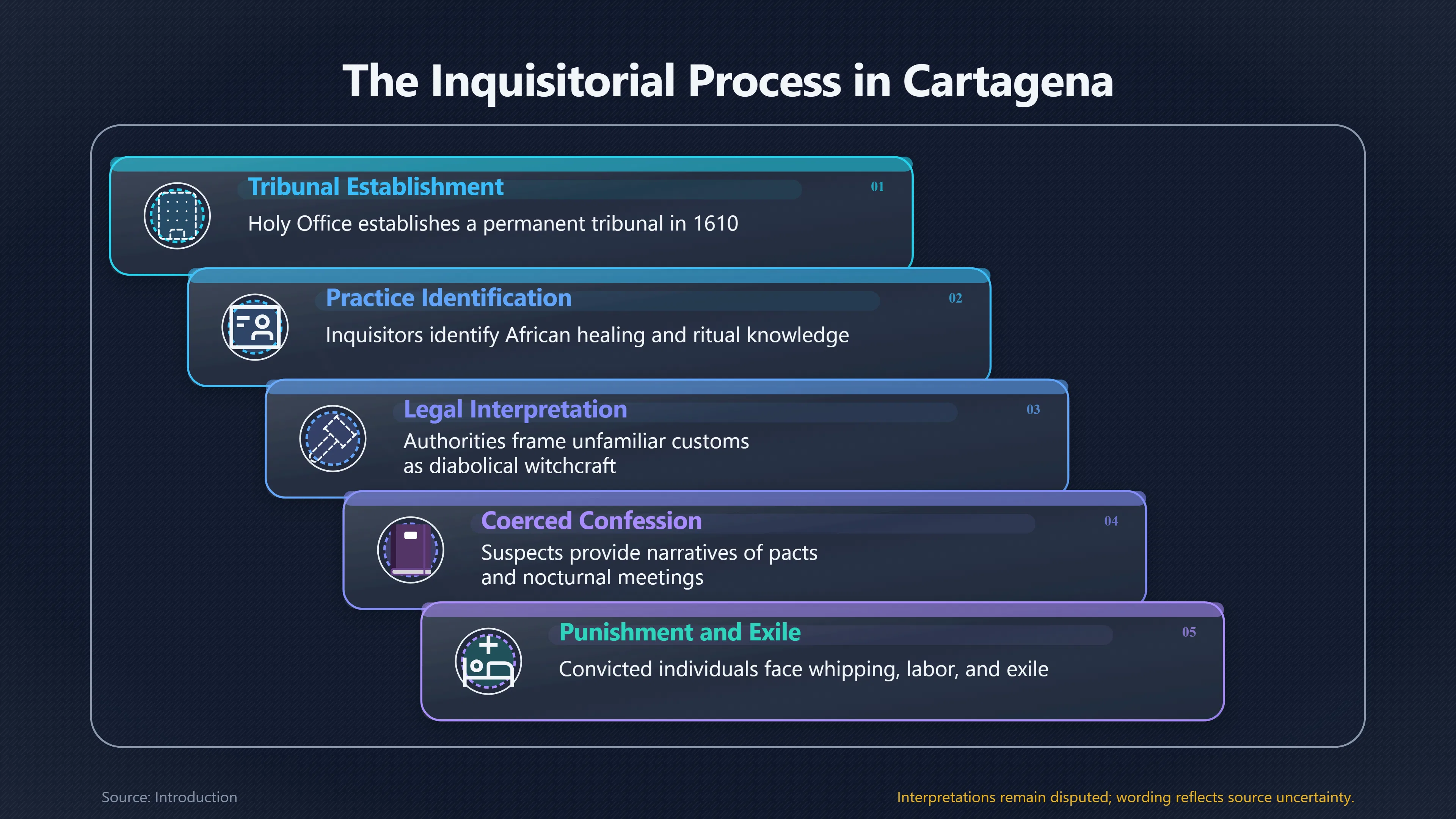
The Cartagena witch trials were not simply a colonial version of the European witch hunts. In the Spanish Caribbean, accusations of witchcraft became closely tied to slavery, race and the policing of African-descended communities. After the Spanish Inquisition established a permanent tribunal in Cartagena in 1610, officials increasingly interpreted African healing, ritual knowledge and spiritual practices through a Christian demonological framework. The result was a legal system that transformed culturally unfamiliar forms of medicine and religious practice into evidence of hidden alliances with the devil. Rather than reflecting a spontaneous outbreak of popular fear, the trials reveal how colonial authorities created “hidden enemies” whose alleged crimes justified surveillance, punishment and social control. Historians today see the Cartagena cases as a striking example of how beliefs about witchcraft could reinforce racial hierarchy and colonial power rather than merely expressing religious anxiety.[edu.co]revistas.unal.edu.coena durante el siglo XVII | Historia y sociedadJuly 1, 2022…

Why Cartagena became an inquisitorial centre
Cartagena de Indias occupied a unique position within Spain’s American empire. As one of the principal ports of the transatlantic slave trade, it brought together Spanish officials, enslaved Africans from many regions, free Black communities, Indigenous peoples and merchants from across the Caribbean. This cultural diversity also meant a wide variety of healing traditions, protective rituals, herbal medicines and religious customs circulated through the city.
When the Holy Office established its tribunal there in 1610, inquisitors encountered practices they often struggled to classify. European Catholic authorities distinguished between ordinary medicine, accepted religious devotion and prohibited magic according to legal and theological rules developed in Iberia. African-derived healing systems, however, frequently combined physical remedies, prayer, ritual objects and spiritual protection in ways unfamiliar to European officials. Instead of understanding these traditions on their own terms, inquisitors increasingly interpreted them through the language of diabolical witchcraft.[Revistas UNAL]revistas.unal.edu.coena durante el siglo XVII | Historia y sociedadJuly 1, 2022…
Unlike many European witch panics, Cartagena did not experience vast village-wide hunts driven by neighbourly accusations alone. Instead, prosecutions were channelled through a permanent judicial institution with established investigative procedures. The tribunal gathered testimony, demanded confessions and fitted diverse local practices into a pre-existing legal model centred on pacts with the devil, secret meetings and supernatural harm. This institutional framework gave colonial authorities considerable power to define what counted as forbidden belief.[Taylor & Francis Online]tandfonline.comOpen source on tandfonline.com.
Paula de Eguiluz and coerced confession
No defendant better illustrates this process than Paula de Eguiluz. Born into slavery in Santo Domingo around the end of the sixteenth century, she later lived in Cuba before being transferred to Cartagena for trial in 1624. She eventually faced three separate inquisitorial prosecutions over the course of her life.[Taylor & Francis Online]tandfonline.comOpen source on tandfonline.com.
Paula was known as a healer whose services included herbal remedies, treatments for illness and rituals connected with relationships and personal fortune. Such work attracted clients from different social backgrounds, demonstrating that African-descended healers occupied an important place in colonial urban life despite official suspicion.[Cambridge University Press & Assessment]cambridge.orgUniversity Press & Assessment Healing and Ritual on the Move (Chapter 2Cambridge University Press & AssessmentHealing and Ritual on the Move (Chapter 2) - Black Catholic Worlds…
The inquisitorial records show how confession itself became a mechanism of control. Defendants were expected to describe crimes in language acceptable to inquisitors: meetings with the devil, nocturnal gatherings, magical flights and renunciation of Christianity. Modern historians argue that these narratives should not be read as straightforward descriptions of actual events. Rather, they often emerged through prolonged questioning within a legal system that already assumed witchcraft existed and required suspects to explain themselves accordingly. As Paula’s testimony evolved across successive trials, she increasingly presented her experiences in forms recognisable to the tribunal, suggesting that confession reflected negotiation and survival as much as personal belief.[tandfonline.com]tandfonline.comOpen source on tandfonline.com.
Her case also demonstrates that inquisitorial punishment extended beyond religious discipline. She was publicly whipped, sentenced to labour in a hospital and exiled from Cuba. Even after serving her sentence, suspicion continued to follow her, making repeated prosecution a feature of colonial social control rather than a single judicial event.[Taylor & Francis Online]tandfonline.comOpen source on tandfonline.com.
Race, gender and the manufacture of witchcraft
Modern scholarship consistently shows that Cartagena’s witchcraft prosecutions followed clear racial and gender patterns.
Among the first fifty years of tribunal activity, researchers have identified 56 individuals tried specifically for witchcraft, 52 of whom were of African descent. Most defendants were women. Although Cartagena itself had a large African-descended population, historians argue that these figures still reveal a pronounced tendency to associate African women with the most serious forms of alleged supernatural crime. European women were more commonly charged with lesser offences categorised as sorcery or superstition rather than full diabolical witchcraft.[University of Texas at Austin]sites.utexas.eduUniversity of Texas at AustinEnchantments and Entanglements: The Life of an Accused Witch in Seventeenth-Century Cartagena - Portal magazine…
This distinction mattered because “witchcraft” carried much heavier theological and legal implications. Inquisitors increasingly portrayed African ritual specialists not simply as people using forbidden charms but as members of organised conspiracies devoted to Satan. Such accusations transformed everyday healing, protective rituals or relationship magic into evidence of collective criminality.[Taylor & Francis Online]tandfonline.comOpen source on tandfonline.com.
Historians therefore argue that race was not merely one characteristic of the accused. It shaped how authorities interpreted identical or similar behaviours. Practices rooted in African medical knowledge became easier to portray as dangerous precisely because they were culturally unfamiliar to colonial elites and associated with enslaved or formerly enslaved populations.[Revistas UNAL]revistas.unal.edu.coena durante el siglo XVII | Historia y sociedadJuly 1, 2022…
Witchcraft accusations also affected property and status
The Cartagena prosecutions did more than punish alleged religious offences. They could reshape neighbourhoods and redistribute wealth.
Recent historical research has examined confiscation records alongside trial documents, showing that women accused of witchcraft often owned modest houses and participated actively in Cartagena’s urban economy. Following convictions, inquisitorial authorities seized and auctioned their property. These confiscations transferred assets away from free Black communities while reinforcing the tribunal’s authority.[Taylor & Francis Online]tandfonline.comOpen source on tandfonline.com.
The neighbourhood known as Los Jagüeyes has become a particularly important case study. Mapping confiscated properties reveals a community of free Afro-descended women whose economic independence and social networks disappeared from the official record after prosecutions. Rather than viewing the trials solely as religious events, historians increasingly interpret them as episodes in which legal, economic and racial power worked together.[Taylor & Francis Online]tandfonline.comOpen source on tandfonline.com.

Why the trials matter today
The Cartagena witch trials are no longer understood primarily as evidence that colonial people were unusually superstitious. Instead, they illustrate how institutions can create convincing narratives about hidden threats by combining genuine cultural differences with legal assumptions and unequal power.
The surviving records certainly contain stories about magic, curses and supernatural harm, but they also preserve traces of African healing traditions, women’s informal medical work and networks of mutual support that existed within a slave society. Reading these documents critically allows historians to recover both the voices shaped by inquisitorial interrogation and the everyday practices that colonial authorities attempted to suppress.[edu.co]revistas.unal.edu.coena durante el siglo XVII | Historia y sociedadJuly 1, 2022…
Within Colombia’s broader history of collective fears and persecutions, Cartagena stands out because the panic was institutional rather than spontaneous. The tribunal did not merely respond to rumours of witchcraft; it helped define who counted as a witch, whose knowledge was treated as dangerous and which communities could be portrayed as secret enemies. That combination of religious belief, racial prejudice and state authority explains why the Cartagena cases remain central to understanding colonial systems of social control as well as the enduring history of Afro-Colombian resilience and cultural survival.[tandfonline.com]tandfonline.comOpen source on tandfonline.com.
Amazon book picks
Further Reading
Books and field guides related to How Cartagena's Witch Trials Created Hidden Enemies. Use these as the next step if you want deeper reading beyond the article.

The Penguin book of witches
Primary sources illuminate witchcraft accusations and beliefs.

Witchcraft: A History in Thirteen Trials
Places Cartagena within the wider history of witch prosecutions.
Open Veins Of Latin America
Explains colonial structures that shaped racial hierarchy.
Endnotes
1.
Source: cambridge.org
Title: University Press & Assessment Healing and Ritual on the Move (Chapter 2)
Link:https://www.cambridge.org/core/books/black-catholic-worlds/healing-and-ritual-on-the-move/524B4EA435169A4DDCFE03D97FF5069C
Source snippet
Cambridge University Press & AssessmentHealing and Ritual on the Move (Chapter 2) - Black Catholic Worlds...
2.
Source: cambridge.org
Title: Cartagena de Indias (Chapter 14)
Link:https://www.cambridge.org/core/books/cambridge-companion-to-the-spanish-inquisition/cartagena-de-indias/12BDECD35FCEFCB1D9AB1F3DF623805B
3.
Source: cambridge.org
Title: Healing and Ritual on the Move (Chapter 2)
Link:https://www.cambridge.org/core/services/aop-cambridge-core/content/view/524B4EA435169A4DDCFE03D97FF5069C/9781009543538c3_81-122.pdf/healing-and-ritual-on-the-move.pdf
4.
Source: revistas.unal.edu.co
Link:https://revistas.unal.edu.co/index.php/hisysoc/article/view/97565
Source snippet
ena durante el siglo XVII | Historia y sociedadJuly 1, 2022...
Published: July 1, 2022
5.
Source: tandfonline.com
Link:https://www.tandfonline.com/doi/full/10.1080/10609164.2021.1912481
6.
Source: sites.utexas.edu
Link:https://sites.utexas.edu/llilas-benson-magazine/2025/08/12/enchantments-and-entanglements-the-life-of-an-accused-witch-in-seventeenth-century-cartagena/
Source snippet
University of Texas at AustinEnchantments and Entanglements: The Life of an Accused Witch in Seventeenth-Century Cartagena - Portal magazine...
7.
Source: socialscienceresearch.org
Link:https://socialscienceresearch.org/index.php/GJHSS/article/view/103634
Source snippet
Social Science ResearchThe Narrativity of an Inquisitorial Process. The First Trial of Faith against Paula de Eguiluz (Cartagena de India...
8.
Source: zaguan.unizar.es
Link:https://zaguan.unizar.es/record/133779
9.
Source: tandfonline.com
Link:https://www.tandfonline.com/doi/abs/10.1080/10609164.2016.1205243
10.
Source: revistas.javeriana.edu.co
Link:https://revistas.javeriana.edu.co/index.php/cualit/article/view/8011
11.
Source: doi.org
Link:https://doi.org/10.2307/jj.34980212.7
Additional References
12.
Source: uma.es
Link:https://www.uma.es/micrositios/sala-de-prensa/noticias/un-libro-de-uma-editorial-revive-la-historia-de-paula-de-eguiluz-una-esclava-acusada-de-brujeria-ante-la-inquisicion/
Source snippet
University of MalagaMay 8, 2026 — UN LIBRO DE UMA EDITORIAL REVIVE LA HISTORIA DE PAULA DE EGUILUZ, UNA ESCLAVA ACUSADA DE BRUJERÍA ANTE...
Published: May 8, 2026
13.
Source: jstor.org
Title: The Inquisition’s Gambit: Making Wealth and Race in Cartagena de Indias | JSTOR
Link:https://www.jstor.org/stable/jj.34980212
Source snippet
The Inquisition's Gambit: Making Wealth and Race in Cartagena de Indias | JSTOR...
14.
Source: degruyterbrill.com
Title: The Inquisition’s Gambit
Link:https://www.degruyterbrill.com/document/isbn/9781512830033/html
Source snippet
October 6, 2026 — Making Wealth and Race in Cartagena de Indias * [Button: Ana Maria Silva Campo ] Sprache: Englisch Veröffentlicht/Copyr...
Published: October 6, 2026
15.
Source: une.es
Title: Novedad Editorial UMA
Link:https://www.une.es/novedad-uma-inquisicion-paula-eguiluz
Source snippet
La Inquisición contra Paula de EguiluzApril 14, 2026 — NOVEDAD EDITORIAL UMA. LA INQUISICIÓN CONTRA PAULA DE EGUILUZ ABRIL, 14, 2026 ESTE...
Published: April 14, 2026
16.
Source: youtube.com
Title: Palace of the Inquisition, a 200-year legacy of colonial horror
Link:https://www.youtube.com/watch?v=ii3s266TDzM
Source snippet
The Harsh Reality After the End of Slavery in Cartagena (AI Reconstruction)...
17.
Source: youtube.com
Title: The Harsh Reality After the End of Slavery in Cartagena (AI Reconstruction)
Link:https://www.youtube.com/watch?v=dPbta8S7Xf0
Source snippet
2024 Dan David Prize Winner Cécile Fromont...
18.
Source: youtube.com
Title: Cartagena, Colombia: A Tour of the Creepy “Torture Museum”
Link:https://www.youtube.com/watch?v=l-x607eC0Sc
Source snippet
Palace of the Inquisition, a 200-year legacy of colonial horror...
19.
Source: youtube.com
Title: The Witch Hunt in Cartagena- History of Cartagena
Link:https://www.youtube.com/watch?v=JtjCL3J6P64
Source snippet
Cartagena, Colombia: A Tour of the Creepy "Torture Museum"...
20.
Source: researchgate.net
Link:https://www.researchgate.net/publication/352820424_Fragile_fortunes_Afrodescendant_women_witchcraft_and_the_remaking_of_urban_Cartagena/download
21.
Source: umaeditorial.uma.es
Link:https://www.umaeditorial.uma.es/libro/la-inquisicion-contra-paula-de-eguiluz_2709/
Topic Tree