Within Algeria
How a Minority Faith Became a Security Scare
Hundreds of Ahmadis faced investigation or prosecution after officials recast peaceful minority worship as a foreign-backed threat.
On this page
- From registration attempt to mass prosecution
- The foreign hand narrative
- Religious freedom and documented harm
Page outline Jump by section
Introduction
The Algerian crackdown on the Ahmadiyya Muslim community between 2016 and 2018 is one of the clearest modern examples of a religious minority becoming the focus of a wider security scare. Rather than presenting Ahmadis simply as an unregistered religious group, senior officials increasingly described them as a foreign-backed movement seeking to undermine Algeria’s religious unity. This transformed what might otherwise have been an administrative dispute over registration into a national-security issue.
The episode is important in the wider history of collective fears in Algeria because it illustrates how official rhetoric about hidden foreign influence can reshape public perceptions of a small religious minority. While Algeria has legitimate concerns about foreign interference and religious extremism, human-rights organisations and legal observers found little evidence that peaceful Ahmadi religious practice justified the scale of investigations and prosecutions that followed. Instead, they argued that conspiracy language blurred the distinction between theological disagreement, regulatory enforcement and genuine security threats.[Amnesty International]amnesty.orgInternational Algeria: Wave of arrests and prosecutions of hundreds of AhmadisAmnesty InternationalAlgeria: Wave of arrests and prosecutions of hundreds of Ahmadis - Amnesty InternationalJune 19, 2017…
From registration attempt to mass prosecution
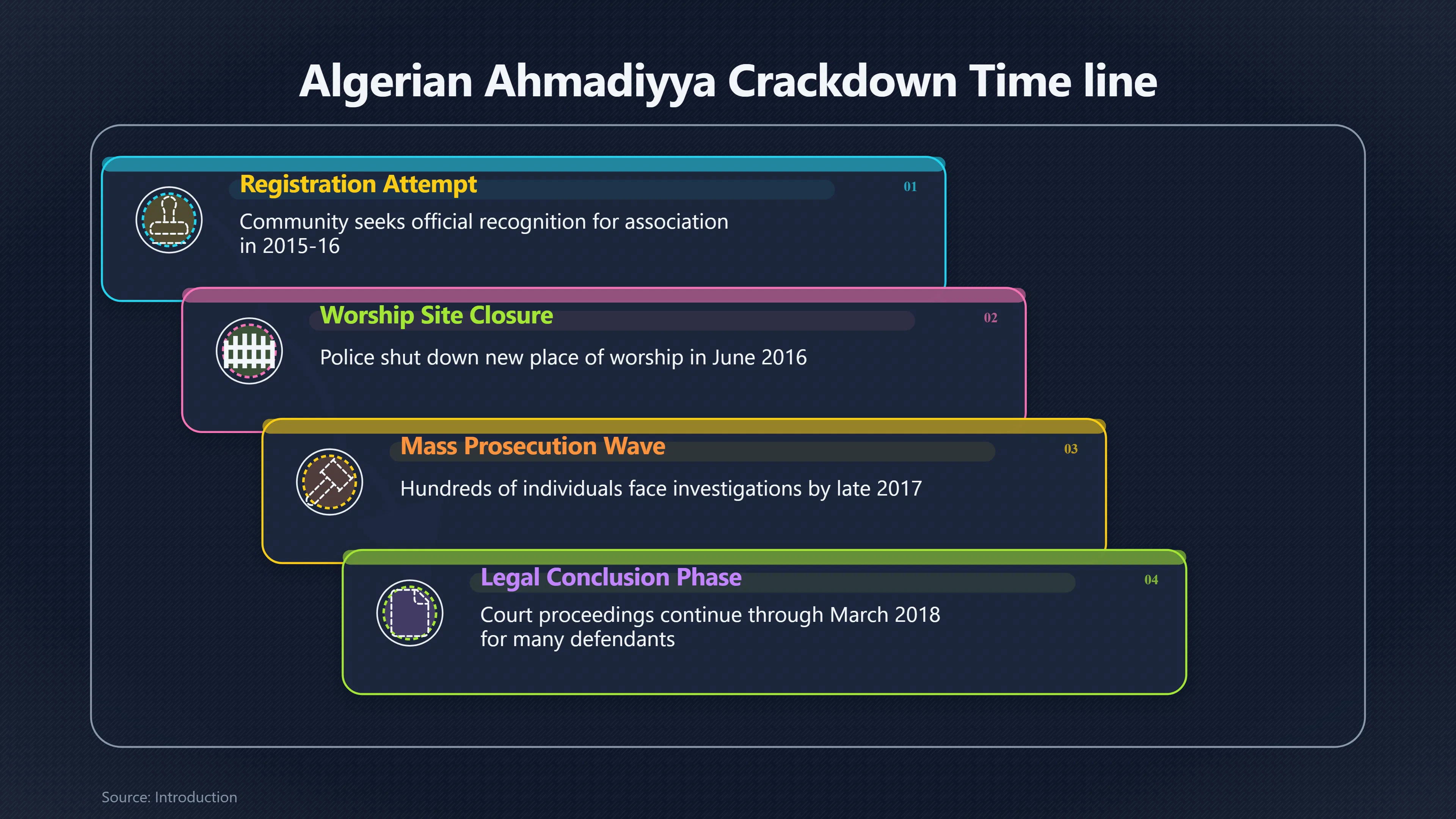
The immediate trigger for the campaign was not violence or public disorder but an effort by Algerian Ahmadis to organise openly.
Members of the community sought official recognition for an association in 2015–16, in accordance with Algeria’s law on associations. The Ministry of the Interior refused registration. Shortly afterwards, in June 2016, police closed a newly constructed Ahmadi place of worship in Larbaa, Blida Province, on the day it was due to open. That action marked the beginning of a nationwide wave of investigations.[Amnesty International]amnesty.orgInternational Algeria: Wave of arrests and prosecutions of hundreds of AhmadisAmnesty InternationalAlgeria: Wave of arrests and prosecutions of hundreds of Ahmadis - Amnesty InternationalJune 19, 2017…
Over the following months, prosecutions spread across multiple provinces. Amnesty International reported that at least 280 Ahmadis had been investigated or prosecuted within roughly a year, while Human Rights Watch documented more than 286 prosecutions by late 2017. Later reporting suggested that over 315 Ahmadis appeared before courts between June 2016 and March 2018. Given that Algeria’s Ahmadi population was estimated at only around 2,000 people, the legal campaign affected a substantial proportion of the community.[amnesty.org]amnesty.orgInternational Algeria: Wave of arrests and prosecutions of hundreds of AhmadisAmnesty InternationalAlgeria: Wave of arrests and prosecutions of hundreds of Ahmadis - Amnesty InternationalJune 19, 2017…
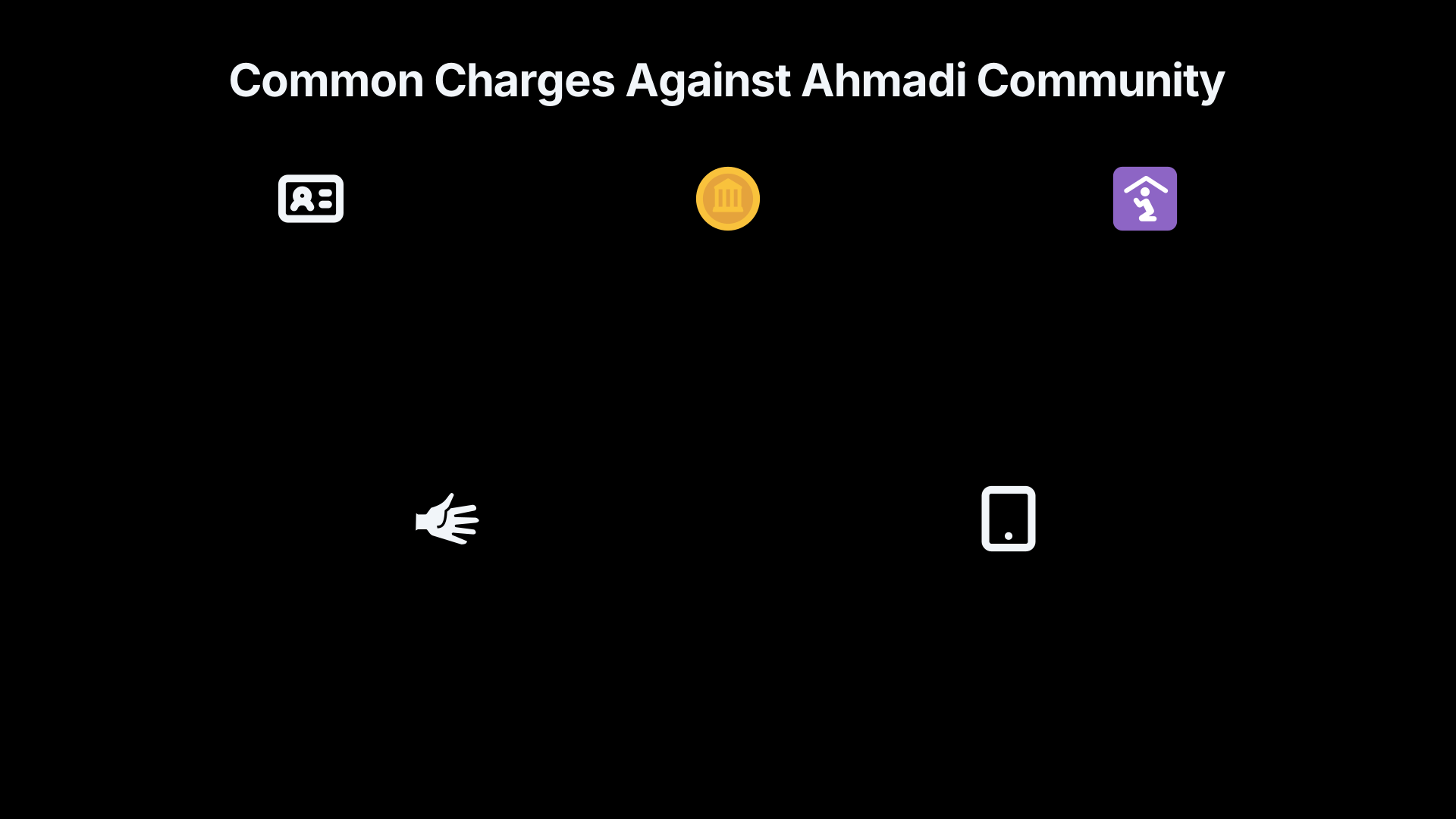
The charges commonly included:
- belonging to an unauthorised association;
- collecting donations without official permission;
- worshipping in unauthorised premises;
- possessing or distributing literature from foreign sources allegedly harmful to national interests;
- “denigrating” Islamic doctrine.
Many defendants received suspended prison sentences or fines, although some were imprisoned for periods of months and a few initially received sentences of several years before appeals.[amnesty.org]amnesty.orgInternational Algeria: Wave of arrests and prosecutions of hundreds of AhmadisAmnesty InternationalAlgeria: Wave of arrests and prosecutions of hundreds of Ahmadis - Amnesty InternationalJune 19, 2017…
The foreign-hand narrative
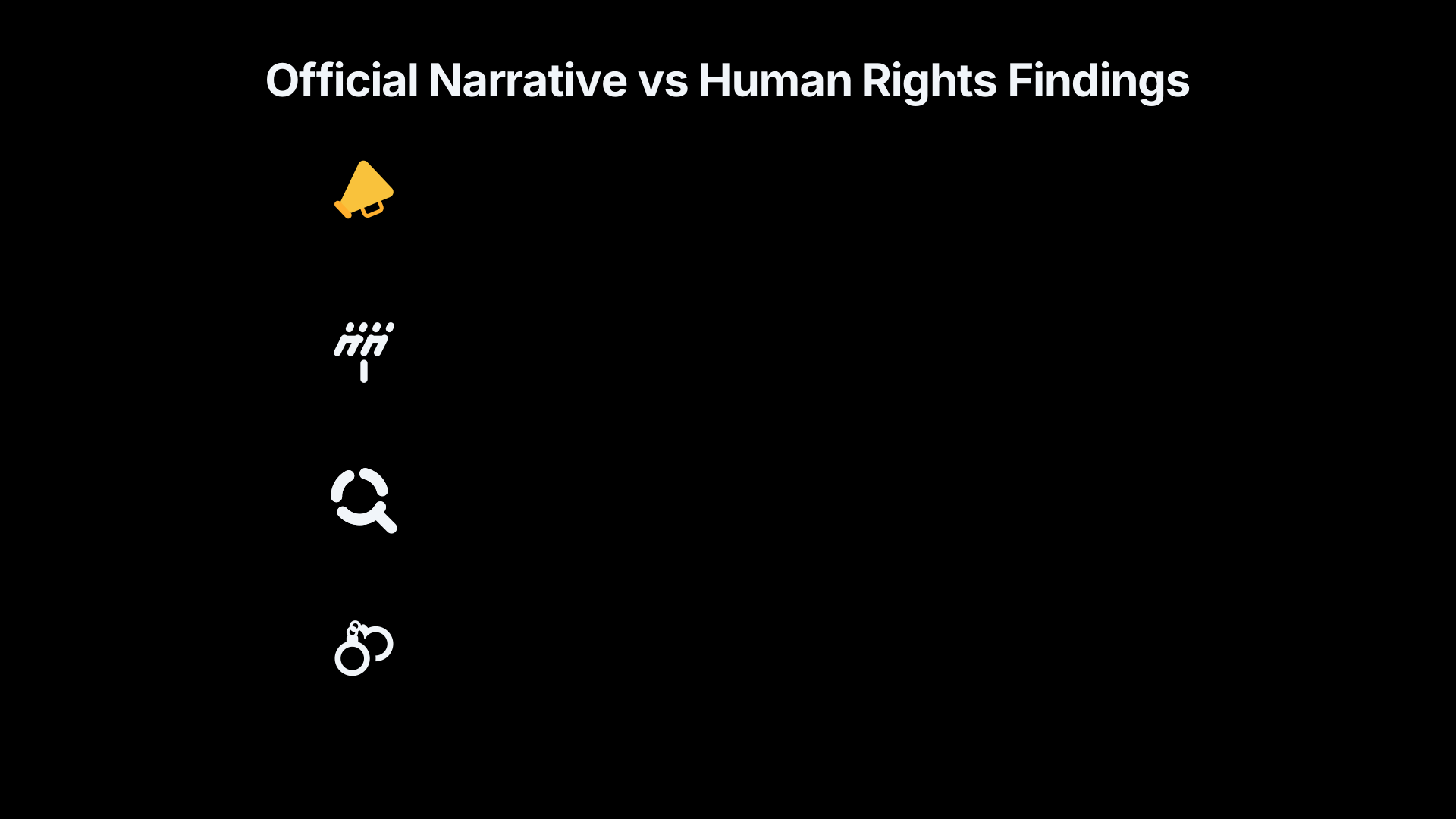
The prosecutions cannot be understood solely as enforcement of administrative law. They were accompanied by repeated public statements portraying Ahmadiyya as part of a broader foreign conspiracy.
In 2016, Minister of Religious Affairs Mohamed Aissa described Ahmadi activity as a “prepared sectarian invasion”. He later declared publicly that Ahmadis were “not Muslim”. In April 2017, Ahmed Ouyahia, then chief of staff to President Abdelaziz Bouteflika, urged Algerians to protect the country from both Shia and Ahmadi groups. Other officials suggested that these movements were linked to foreign agendas seeking to weaken Algeria’s religious cohesion.[Amnesty International]amnesty.orgInternational Algeria: Wave of arrests and prosecutions of hundreds of AhmadisAmnesty InternationalAlgeria: Wave of arrests and prosecutions of hundreds of Ahmadis - Amnesty InternationalJune 19, 2017…
This language reflected a longstanding feature of Algerian political culture. Since independence, governments have often viewed externally connected religious organisations with suspicion, particularly after the civil conflict of the 1990s and amid wider regional instability. Official discourse frequently presents religious unity as a pillar of national security, making foreign-funded or transnational religious movements especially sensitive.
Ahmadiyya’s international structure reinforced these suspicions. The movement, founded in British India in the nineteenth century, has a worldwide leadership and extensive international publishing networks. Prosecutors repeatedly referred to imported literature and overseas organisational links as evidence supporting criminal charges. Human-rights observers noted, however, that possessing foreign religious publications or maintaining contacts with an international faith community is not, by itself, evidence of subversive activity.[Amnesty International]amnesty.orgInternational Algeria: Wave of arrests and prosecutions of hundreds of AhmadisAmnesty InternationalAlgeria: Wave of arrests and prosecutions of hundreds of Ahmadis - Amnesty InternationalJune 19, 2017…
Why the security argument proved persuasive
The official narrative did not emerge in a vacuum. Several wider pressures made claims of foreign religious infiltration more politically credible.
Algeria had spent decades confronting violent Islamist movements and remained highly sensitive to anything perceived as threatening religious stability. The state officially promotes Sunni Islam of the Maliki tradition as an important element of national identity. Unfamiliar religious movements therefore tended to be viewed through the language of national cohesion rather than simply religious diversity.
The campaign also coincided with regional anxiety over sectarian conflicts elsewhere in the Middle East. Public discussion increasingly framed both Shia and Ahmadi communities as imported ideological influences rather than indigenous religious minorities. In this environment, allegations of foreign manipulation required relatively little supporting evidence to gain official traction.
Importantly, the authorities generally did not accuse Ahmadis of planning terrorism. Instead, the implied threat was slower and more diffuse: that foreign-sponsored religious movements might fragment Algerian society, challenge established religious authority and weaken national unity. This distinction helps explain why administrative offences became intertwined with national-security rhetoric.[Amnesty International]amnesty.orgInternational Algeria: Wave of arrests and prosecutions of hundreds of AhmadisAmnesty InternationalAlgeria: Wave of arrests and prosecutions of hundreds of Ahmadis - Amnesty InternationalJune 19, 2017…
Religious freedom and documented harm
Human-rights organisations consistently argued that the prosecutions criminalised peaceful religious practice rather than unlawful conduct.
Amnesty International concluded that many of the cases arose directly from collective worship, possession of religious literature or attempts to organise community life. Human Rights Watch reviewed court documents and reported that judicial reasoning often relied heavily on defendants’ admission that they belonged to the Ahmadi faith or met privately for worship. Lawyers also described prosecutors questioning defendants about their theological beliefs rather than focusing solely on alleged legal violations.[Amnesty International]amnesty.orgInternational Algeria: Wave of arrests and prosecutions of hundreds of AhmadisAmnesty InternationalAlgeria: Wave of arrests and prosecutions of hundreds of Ahmadis - Amnesty InternationalJune 19, 2017…
The president of Algeria’s Ahmadi community, Mohamed Fali, became a particularly prominent defendant. He faced multiple prosecutions and periods of detention while several other members experienced repeated court appearances across different jurisdictions. The cumulative effect was substantial legal uncertainty, financial cost and social pressure on a very small religious minority.[Human Rights Watch]hrw.orgOpen source on hrw.org.
International organisations argued that Algeria’s obligations under international human-rights law protect the right to manifest religion collectively as well as individually. They maintained that administrative rules governing associations and places of worship should not be used selectively against one minority faith.[Amnesty International]amnesty.orgInternational Algeria: Wave of arrests and prosecutions of hundreds of AhmadisAmnesty InternationalAlgeria: Wave of arrests and prosecutions of hundreds of Ahmadis - Amnesty InternationalJune 19, 2017…
A moral panic rather than evidence of organised subversion
Viewed within Algeria’s broader history of collective fears, the Ahmadi crackdown resembles a moral panic more than the exposure of a documented conspiracy.
A moral panic develops when a relatively small group comes to symbolise a much larger perceived threat to society. In this case, official rhetoric portrayed a community numbering only a few thousand people as part of an organised foreign campaign against Algeria’s religious identity. The repeated use of terms such as “sect”, references to foreign influence and warnings about national cohesion encouraged the public to interpret ordinary religious activity through a security lens.
That does not mean every official concern was invented. States commonly regulate religious associations, foreign funding and public assembly, and Algeria’s history of political violence helps explain why authorities remain attentive to external ideological influence. The crucial question is whether the evidence supported treating the Ahmadi community as a significant national-security threat.
Human-rights investigations, court records examined by independent observers and public reporting have not identified evidence that peaceful Ahmadi worship itself constituted organised subversion. Instead, the prosecutions largely rested on administrative offences, theological disagreement and assumptions that international religious connections implied political danger.[amnesty.org]amnesty.orgInternational Algeria: Wave of arrests and prosecutions of hundreds of AhmadisAmnesty InternationalAlgeria: Wave of arrests and prosecutions of hundreds of Ahmadis - Amnesty InternationalJune 19, 2017…
For historians of moral panics and collective fear, the episode illustrates how conspiracy claims can amplify suspicion of an unfamiliar minority without requiring proof of a coordinated hostile campaign. The lasting significance of the crackdown lies less in the size of the Ahmadi community than in the way state security language transformed theological difference into a perceived threat to the nation.
Amazon book picks
Further Reading
Books and field guides related to How a Minority Faith Became a Security Scare. Use these as the next step if you want deeper reading beyond the article.
Orientalism
Useful for understanding how religious and cultural difference becomes politicised.

A Savage War of Peace
Supplies political and historical background for modern security narratives.

The Ahmadiyya Muslims
Directly explains the beliefs and history of the community at the centre of the story.
Endnotes
1.
Source: amnesty.org
Title: International Algeria: Wave of arrests and prosecutions of hundreds of Ahmadis
Link:https://www.amnesty.org/en/latest/press-release/2017/06/algeria-wave-of-arrests-and-prosecutions-of-hundreds-of-ahmadis/
Source snippet
Amnesty InternationalAlgeria: Wave of arrests and prosecutions of hundreds of Ahmadis - Amnesty InternationalJune 19, 2017...
Published: June 19, 2017
2.
Source: amnesty.org
Link:https://www.amnesty.org/en/documents/mde28/7152/2017/en/
Source snippet
Algeria: Human Rights Council adopts Universal Periodic Review outcome on Algeria - Amnesty InternationalSeptember 22, 2017 — 22 Septembe...
Published: September 22, 2017
3.
Source: amnesty.de
Link:https://www.amnesty.de/jahresbericht/2018/algerien
Source snippet
Februar 2018 ALGERIEN 2017/18 Image: Report Cover 17/18 * HINTERGRUND * RECHTE AUF MEINUNGS- UND VERSAMMLUNGSFREIHEIT * RECHT AUF VEREINI...
4.
Source: amnesty.org
Title: Algérie. Vague d’arrestations et de poursuites contre des centaines d’Ahmadis
Link:https://www.amnesty.org/fr/latest/news/2017/06/algeria-wave-of-arrests-and-prosecutions-of-hundreds-of-ahmadis/
5.
Source: hrw.org
Link:https://www.hrw.org/news/2017/09/04/algeria-stop-persecuting-religious-minority
6.
Source: hrw.org
Link:https://www.hrw.org/world-report/2019/country-chapters/algeria
Source snippet
Human Rights WatchWorld Report 2019: Algeria | Human Rights Watch...
7.
Source: hrw.org
Title: Algeria: New Trials Shake Ahmadi Minority | Human Rights Watch
Link:https://www.hrw.org/news/2018/01/22/algeria-new-trials-shake-ahmadi-minority
Source snippet
January 22, 2018 — January 22, 2018 2:00AM EST | News Release Available In * English * العربية * Français * Bahasa Indonesia ALGERIA: NEW...
Published: January 22, 2018
8.
Source: hrw.org
Link:https://www.hrw.org/fr/news/2017/09/04/algerie-les-persecutions-contre-une-minorite-religieuse-doivent-cesser
Source snippet
September 4, 2017 — ALGÉRIE: LES PERSÉCUTIONS CONTRE UNE MINORITÉ RELIGIEUSE DOIVENT CESSER Print Faire un don 4 septembre 2017 12:00AM...
Published: September 4, 2017
9.
Source: hrw.org
Link:https://www.hrw.org/world-report/2017/country-chapters/algeria
10.
Source: hrw.org
Link:https://www.hrw.org/world-report/2018/country-chapters/algeria
Additional References
11.
Source: hrcommittee.org
Link:https://hrcommittee.org/2017/09/04/algeria-stop-persecuting-a-religious-minority/
Source snippet
September 4, 2017 — September 4th, 2017 Algeria, NewsSeptember 4th, 2017 ALGERIA: STOP PERSECUTING A RELIGIOUS MINORITY Image (Beirut) –...
Published: September 4, 2017
12.
Source: youtube.com
Title: USCIRF Conversation: Deteriorating Religious Freedom Conditions in Algeria
Link:https://www.youtube.com/watch?v=eG197aL-LCI
Source snippet
Assessing Freedom of Religion or Belief in Algeria Ahead of the Country's Universal Periodic Review...
13.
Source: youtube.com
Link:https://www.youtube.com/watch?v=T3VFYYmGMgs
Source snippet
Assessing Freedom of Religion or Belief in Algeria - Webinar...
14.
Source: youtube.com
Link:https://www.youtube.com/watch?v=gfnRmLIPpoM
Source snippet
Friday Sermon: Worship, Sadaqat and Istighfar: 24th February 2017...
Published: March 2017
15.
Source: youtube.com
Title: Assessing Freedom of Religion or Belief in Algeria
Link:https://www.youtube.com/watch?v=mWtQWd-330c
Source snippet
Friday Sermon: Extremism and Persecution of Ahmadis: 17th March 2017...
Published: March 2017
16.
Source: youtube.com
Link:https://www.youtube.com/watch?v=EbxM-6A316k
Published: February 2017
17.
Source: refworld.org
Link:https://www.refworld.org/reference/annualreport/amnesty/2017/en/115830
Topic Tree