When Belief, Panic and Power Collide
The Philippines has no single defining episode of “mass hysteria”.
Page outline Jump by section
Introduction
The central lesson is caution. Collective symptoms can be real without having an identifiable toxin or infection. A movement may hold supernatural beliefs without being fraudulent or dangerous. Conversely, religious language can coexist with documented abuse, political power or criminal allegations. Philippine cases are best understood by separating four questions: what participants believed, what verifiable harm occurred, how rumours and institutions amplified events, and who benefited from calling an episode a “cult”, a miracle, possession or madness.
Why belief and crisis so often overlap
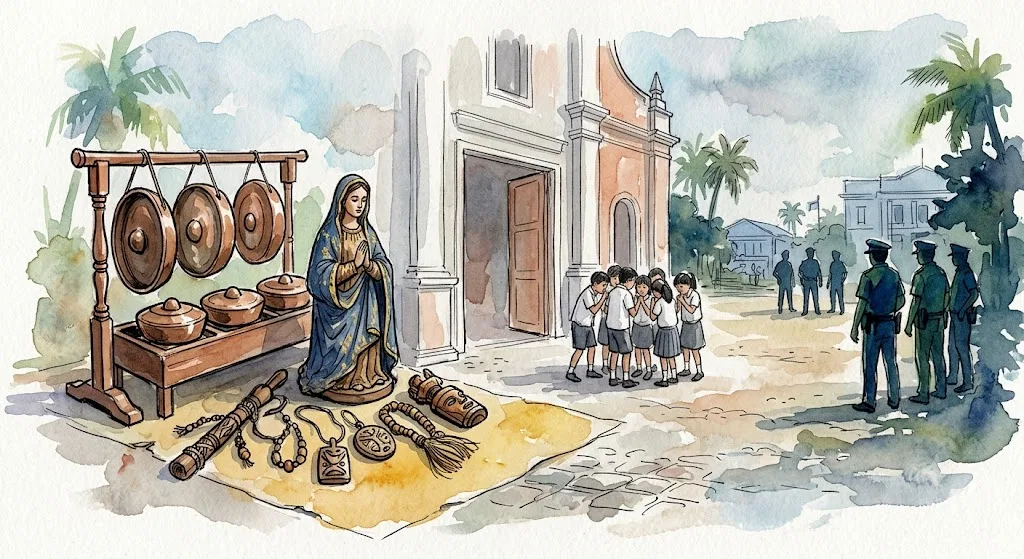
Philippine religious life developed through interaction rather than simple replacement. Indigenous healing, spirit traditions and ritual authority survived alongside Catholicism, Islam and later Protestant and independent churches. Under Spanish rule, colonial authorities frequently interpreted local ritual practices through Christian categories of superstition, sorcery and diabolism. Yet surviving Inquisition records show that folk magic in seventeenth-century Manila was not confined to an isolated indigenous underclass. It circulated through a multi-ethnic port city and was used by Europeans, Africans, Asians and mixed communities for healing, protection, love, divination and revenge. A recent study based on 98 Inquisition cases therefore depicts a busy market in magical services rather than a Philippine equivalent of the large European witch persecutions.[Cambridge University Press & Assessment]cambridge.orgCambridge University Press & AssessmentFolk magic in the Philippines, 1611–39by SJ Mawson · 2023 · Cited by 4 — Based on 98 Inquisition c…
This distinction matters. Accusations of harmful magic could lead to fear, ostracism or violence, but the Philippines did not experience a single, centrally organised witch-hunting panic comparable in scale to early modern Europe. Colonial descriptions also had political uses: branding healers and spirit specialists as superstitious helped missionaries weaken rival forms of authority.
Later religious movements blended biblical prophecy, folk Catholic practice, nationalism, healing and hopes of social transformation. Scholars call many of these movements millenarian, meaning that they expected a sweeping moral or political renewal, sometimes after catastrophe. Such expectations became especially powerful among rural populations facing land inequality, colonial government, debt, war and exclusion from formal politics. They were not necessarily signs of irrationality. They offered a language through which people could imagine justice when ordinary institutions appeared closed to them.[Philippine Social Science Council]pssc.org.phPhilippine Social Science Council
When “fanaticism” concealed political grievance
Rizal-centred and rural renewal movements
After José Rizal’s execution in 1896, some religious communities treated the nationalist writer not merely as a hero but as a spiritual guide, returning redeemer, divine figure or embodiment of sacred power. These Rizal-centred movements were highly diverse. Some were peaceful devotional associations; others became entangled with agrarian protest or resistance to the state.
Older scholarship often grouped them together as “cults” or interpreted them as desperate attempts by disorientated peasants to restore a lost social order. Filipino scholars later criticised this framework for making rural believers appear passive, primitive or detached from politics. Floro Quibuyen argued that analyses of millenarian movements needed to take class conflict, colonial history and the participants’ own political reasoning more seriously. In that reading, prophecy was not simply an escape from material hardship. It could express a coherent demand for dignity, equality and national liberation.[Philippine Social Science Council]pssc.org.phPhilippine Social Science Council
The language used by authorities was consequential. Calling a movement fanatical could make negotiation seem pointless and coercion appear medically or politically necessary. Religious symbolism, unusual clothing or belief in protective objects was then treated as evidence that followers were incapable of rational judgement, even where their grievances concerned land, poverty or government legitimacy.

The Lapiang Malaya killings of 1967
The clearest warning comes from Lapiang Malaya, a religious-political movement led by Valentin de los Santos. In May 1967, hundreds of adherents gathered near Manila intending to demonstrate against President Ferdinand Marcos. Many wore blue uniforms and capes, carried machete-like farm blades and trusted in amulets or spiritual protection. Contemporary coverage portrayed them as an eccentric sect attempting an almost absurd uprising.[Time]time.comThe Philippines: A Bothered ArchipelagoThey were members of an obscure political sect called Lapiang Malaya (Freedom Movement), and t…
The confrontation was not harmless theatre. Heavily armed Philippine Constabulary troops blocked the march, and violence on 21 May left about 30 movement members dead, along with one constabulary officer; hundreds were detained. Exact casualty figures vary slightly among later accounts, which is one reason they should not be repeated with false precision. What is not seriously disputed is the gross imbalance between modern firearms and the demonstrators’ weapons, and the state’s failure to prevent a foreseeable massacre.[Wikipedia]WikipediaLapiang MalayaLapiang Malaya
Belief in supernatural protection may have contributed to the followers’ willingness to confront gunfire. It does not, however, explain the episode by itself. Lapiang Malaya drew support from poor rural communities and combined sacred promises with demands for justice, equality and political change. Describing the victims only as deluded believers turns a political confrontation into a curiosity and obscures the responsibility of armed authorities. The massacre subsequently stimulated Philippine scholarship on popular religion precisely because older explanations based on collective madness seemed inadequate.[Philippine Social Science Council]pssc.org.phPhilippine Social Science Council
Why schools report possession, fainting and seizures
One of the most persistent Philippine scare patterns occurs in schools. Students suddenly faint, shake, cry, hyperventilate, struggle to stand or appear to enter trance-like states. Witnesses may report a spirit, threatening vision or mysterious figure. Rumours spread quickly through classrooms, family messages and local media. Classes are suspended, children are taken to hospital, and clergy, healers, police and health workers may offer competing interpretations.
Doctors commonly use the term mass psychogenic illness, also called mass sociogenic illness, when real symptoms spread through a cohesive group without evidence of a shared physical cause sufficient to explain them. Common symptoms include dizziness, fainting, nausea, headache, shaking and hyperventilation. The term does not mean that sufferers are pretending. Stress, expectation, fear, observation of other distressed people and the body’s own alarm responses can produce genuine and sometimes severe symptoms.[PMC]pmc.ncbi.nlm.nih.govOpen source on nih.gov.
The Bohol school outbreak
In September 2023, a large outbreak occurred during a Catholic service at San Jose National High School in Talibon, Bohol. Early reports said that nearly 200 students fainted or developed seizure-like symptoms; some later reports gave figures above 200. Police accounts indicated that several pupils collapsed first and that fear then spread among an assembly of roughly 2,000 students and staff. Classes were suspended and many pupils were taken for medical assessment.[inquirer.net]cebudailynews.inquirer.netalmost 200 students in bohol possessed by evil spiritsalmost 200 students in bohol possessed by evil spirits
The incident quickly split into rival narratives. Civic authorities and some medical observers described a mass psychogenic episode. Other reports used the language of spirit possession, and a prominent exorcist suggested that evil spirits might have been involved.[Preda Foundation, Inc.]preda.orgOpen source on preda.org.
It is tempting to treat this as a simple contest between science and superstition. The social reality is more complicated. A diagnosis of mass psychogenic illness explains how symptoms may spread, but it does not automatically identify the original trigger or the particular stresses affecting pupils. Likewise, possession language may provide a culturally familiar way to describe loss of control, terror or distress, yet it cannot establish a supernatural cause.
The most responsible immediate response is practical: remove pupils from the frightening setting, check for heat, toxins, infection and other medical dangers, reduce exposure to alarming rumours, provide calm information and offer private psychological support without ridicule. Publicly accusing children of attention-seeking can intensify shame and delay recognition of bullying, academic pressure, trauma or illness.
Similar Philippine school episodes have recurred for years. In 2013, classes at a school in Carigara, Leyte, were suspended after students reportedly screamed, fainted or behaved as though possessed; school officials themselves disagreed over whether spirits, attention-seeking or “mass hysteria” were responsible.[Inquirer.net]newsinfo.inquirer.netschool officials suspend classes over evil spiritsschool officials suspend classes over evil spirits The repetition reflects familiar conditions: tightly connected adolescent groups, stressful institutional settings, rapid rumour transmission and a cultural vocabulary in which spirits and possession remain intelligible explanations.
Miracles can produce devotion without proving a miracle
Collective belief is not always a panic. Apparitions and miracle claims may build communities, pilgrimages and devotional identities without causing widespread disorder. The controversy begins when religious authority, eyewitness testimony and institutional investigation point in different directions.
The best-known Philippine example is the alleged Marian apparition at a Carmelite convent in Lipa, Batangas, in 1948. A young postulant, Teresita Castillo, said that the Virgin Mary appeared to her. Reports of falling petals and other extraordinary signs drew intense public interest, while devotion to Mary under the title associated with the events spread well beyond the convent.[EWTN News]ewtnnews.comEWTN News The curious case of the Lipa Marian apparitionsEWTN News The curious case of the Lipa Marian apparitions
Church authorities investigated and concluded in 1951 that the reported phenomena were not supernatural. Decades later, the local archbishop reopened the question and in 2015 declared the apparitions worthy of belief, but the Vatican overruled that decision and reaffirmed the negative judgement. The original 1951 decree was publicly released in 2024, clarifying the institutional record after decades of confusion and competing claims.[Inquirer.net]newsinfo.inquirer.netvatican publicly releases lipa apparition decree after 72 yearsvatican publicly releases lipa apparition decree after 72 years
The Lipa story is culturally important because it shows that three different claims can coexist:
- people sincerely experienced the devotion as meaningful;
- public enthusiasm and testimony helped the belief spread;
- the Catholic Church did not accept the alleged apparition as supernatural.
Calling the episode either an obvious fraud or a proven miracle goes beyond the evidence. Nor is “mass hysteria” a particularly helpful description. The phenomenon was a durable devotional controversy, shaped by memory, religious authority and national identity, rather than a brief outbreak of contagious illness or terror.
When “cult” allegations concern measurable harm
The word cult is often used as an insult for any unfamiliar or unpopular religion. It can erase differences between eccentric belief, voluntary communal life, charismatic authority and organised abuse. A more useful approach asks about conduct: Are members isolated? Can they leave safely? Are leaders accountable? Are children protected? Is labour coerced? Are marriages forced? Is medical care restricted? Are threats, sexual violence or financial exploitation alleged and supported by testimony or records?
Socorro Bayanihan Services
These questions became urgent in 2023 when former members and Philippine senators made serious allegations against Socorro Bayanihan Services, a community organisation based at Sitio Kapihan in Surigao del Norte. Senate documents framed the inquiry around alleged rape, child sexual abuse, trafficking, forced labour and forced marriage “in the context of cult-like activities”. Witnesses and officials also raised concerns about children leaving school, restricted movement and the power exercised by leader Jey Rence Quilario.[Senate of the Philippines]legacy.senate.gov.phComm on Public Order Jay Rence QuilarioComm on Public Order Jay Rence Quilario
The organisation and its officers disputed major accusations and rejected the cult label. That denial is important because a legislative hearing is not itself a criminal conviction. At the same time, the allegations were not merely complaints about unusual theology. The Department of Justice subsequently filed criminal charges against several members, and environmental authorities cancelled the organisation’s agreement to occupy protected public land after finding violations.[Inquirer.net]newsinfo.inquirer.netdoj files criminal raps vs socorro bayanihan services inc membersdoj files criminal raps vs socorro bayanihan services inc members
Reporting by former-member testimony described an apocalyptic message, intense loyalty to the leader and social separation from outsiders. Such features can help explain how authority was maintained, but the strongest public-interest case rests on specific alleged harms rather than the strangeness of beliefs.[ABC News]abc.net.auABC News Inside Socorro Bayanihan Services Inc, the allegedABC News Inside Socorro Bayanihan Services Inc, the alleged
This is the crucial difference between a moral panic and a legitimate safeguarding investigation. A moral panic magnifies a vaguely defined threat, treats association as guilt and often lacks proportionate evidence. A proper investigation identifies alleged victims, tests statements, protects due process and distinguishes proven acts from rumour.
Media, police and clergy can either calm or amplify fear
Philippine scares often develop through competition between institutions rather than through belief alone. Local journalists need an immediate explanation; schools want order restored; families seek spiritual and medical reassurance; clergy interpret events through religious teaching; officials may want a clear culprit. Each institution can unintentionally harden uncertainty into a dramatic narrative.
Several recurring failures follow:
Premature supernatural certainty. Reporting that children were “possessed” presents an interpretation as a fact and may make further cases more likely by giving frightened pupils a shared script.
Premature psychological certainty. Declaring “mass hysteria” before environmental and medical checks can overlook poisoning, heat illness, infection or individual neurological conditions.
Sensational cult labelling. Describing clothing, prophecy or ritual as proof of dangerousness encourages hostility towards minority religions while distracting attention from verifiable coercion.
Pathologising protest. Lapiang Malaya demonstrates how depicting a movement as collectively deranged can obscure economic grievance and justify overwhelming force.
Confusing belief with evidence. A sincere witness may accurately report an experience while being mistaken about its cause. This applies equally to visions, possession, miracle claims and rumours of secret conspiracies.
Good public communication keeps several possibilities open at first, states what has been medically or legally established, avoids humiliating participants and corrects early claims as evidence changes.

What these episodes reveal about the Philippines
Across these very different cases, collective belief becomes most powerful where ordinary authority is distrusted or inaccessible. Rural millenarian movements flourished where state justice seemed remote. Apparition devotion persisted when local testimony and central church authority diverged. School possession narratives spread where bodily distress, religion and peer contagion could be understood through several competing systems at once. Controversial organisations gained influence through tight communities offering identity, security and salvation.
None of this means Filipinos are unusually prone to superstition or mass irrationality. Comparable episodes occur worldwide. What is distinct is the Philippine historical mixture of colonial Catholicism, indigenous spiritual traditions, social inequality, charismatic politics, natural disaster, migration and strong community networks. These conditions shape the language through which crisis is understood.
The most durable interpretation is therefore neither “people believed something strange” nor “science disproved religion”. Philippine social scares show how belief, hardship, authority and communication interact. Sometimes the result is a temporary outbreak of symptoms. Sometimes it is a devotional tradition. Sometimes it is political protest misread as madness. Sometimes unusual religious claims surround allegations of real abuse. Understanding the difference is the essential work.
Amazon book picks
Further Reading
Books and field guides related to When Belief, Panic and Power Collide. Use these as the next step if you want deeper reading beyond the article.
Noli Me Tangere
First published 1902. Subjects: Economics, Classic Literature, Fiction, Fiction, historical, general, Philippines, fiction.
Pasyon and revolution
First published 1979. Subjects: History, Kasaysayan ng pasiong mahal ni Hesukristong Panginoon natin, Revolutions, Casaysayan nang pasion...
An Anarchy of Families
First published 1993. Subjects: Politics and government, Family, Families, History, Family, asia.
Barangay
First published 1994. Subjects: Ethnology, Civilization, Filipinos, Social life and customs, Bisaya (Philippine people).
Endnotes
1.
Source: cambridge.org
Link:https://www.cambridge.org/core/journals/journal-of-southeast-asian-studies/article/folk-magic-in-the-philippines-161139/16568C1F0C5904E0DAEF4F5A4A418194
Source snippet
Cambridge University Press & AssessmentFolk magic in the Philippines, 1611–39by SJ Mawson · 2023 · Cited by 4 — Based on 98 Inquisition c...
2.
Source: pssc.org.ph
Title: Philippine Social Science Council
Link:https://pssc.org.ph/wp-content/pssc-archives/Aghamtao/1981/06A%20Critique%20of%20Present%20Scholarship%20on%20Rizalist%20Cults%20and%20Millenarian%20Movements%20Towards%20a%20Radic.pdf
3.
Source: time.com
Link:https://time.com/archive/6638133/the-philippines-a-bothered-archipelago/
Source snippet
The Philippines: A Bothered ArchipelagoThey were members of an obscure political sect called Lapiang Malaya (Freedom Movement), and t...
4.
Source: Wikipedia
Title: Lapiang Malaya
Link:https://en.wikipedia.org/wiki/Lapiang_Malaya
5.
Source: opinion.inquirer.net
Link:https://opinion.inquirer.net/48057/tragic-farce-farcical-tragedy
Source snippet
Tragic farce, farcical tragedy | Inquirer Opinion3 Mar 2013 — The way the Lapiang Malaya was forgotten, De los Santos himself was committ...
6.
Source: pmc.ncbi.nlm.nih.gov
Link:https://pmc.ncbi.nlm.nih.gov/articles/PMC4884863/
7.
Source: pmc.ncbi.nlm.nih.gov
Title: PMCMass psychogenic illness and the social network
Link:https://pmc.ncbi.nlm.nih.gov/articles/PMC3536509/
8.
Source: pmc.ncbi.nlm.nih.gov
Title: PMCMass sociogenic illness
Link:https://pmc.ncbi.nlm.nih.gov/articles/PMC543940/
9.
Source: cebudailynews.inquirer.net
Title: almost 200 students in bohol possessed by evil spirits
Link:https://cebudailynews.inquirer.net/527682/almost-200-students-in-bohol-possessed-by-evil-spirits
10.
Source: preda.org
Link:https://www.preda.org/evil-spirit-caused-seizures-in-filipino-students-says-exorcist/
11.
Source: newsinfo.inquirer.net
Title: school officials suspend classes over evil spirits
Link:https://newsinfo.inquirer.net/434371/school-officials-suspend-classes-over-evil-spirits
12.
Source: newsinfo.inquirer.net
Title: vatican publicly releases lipa apparition decree after 72 years
Link:https://newsinfo.inquirer.net/1921245/vatican-publicly-releases-lipa-apparition-decree-after-72-years
13.
Source: newsinfo.inquirer.net
Title: doj files criminal raps vs socorro bayanihan services inc members
Link:https://newsinfo.inquirer.net/1855723/doj-files-criminal-raps-vs-socorro-bayanihan-services-inc-members/
14.
Source: Wikipedia
Title: List of mass panic cases
Link:https://en.wikipedia.org/wiki/List_of_mass_panic_cases
15.
Source: Wikipedia
Link:https://en.wikipedia.org/wiki/Satanism
16.
Source: Wikipedia
Link:https://en.wikipedia.org/wiki/Tadtad
17.
Source: Wikipedia
Title: Rizalist Cult
Link:https://en.wikipedia.org/wiki/Rizalist_Cult
18.
Source: Wikipedia
Link:https://en.wikipedia.org/wiki/Millenarianism
19.
Source: Wikipedia
Title: Mary, Mediatrix of All Grace
Link:https://en.wikipedia.org/wiki/Mary%2C_Mediatrix_of_All_Grace
20.
Source: Wikipedia
Title: Witchcraft in the Philippines
Link:https://en.wikipedia.org/wiki/Witchcraft_in_the_Philippines
21.
Source: Wikipedia
Title: Socorro Bayanihan Services
Link:https://en.wikipedia.org/wiki/Socorro_Bayanihan_Services
22.
Source: opinion.inquirer.net
Title: letter from an ex cult member
Link:https://opinion.inquirer.net/170523/letter-from-an-ex-cult-member
23.
Source: newsinfo.inquirer.net
Title: fainting of 22 girls attributed to evil spirits
Link:https://newsinfo.inquirer.net/825215/fainting-of-22-girls-attributed-to-evil-spirits
24.
Source: history.com
Title: mysterious illnesses mass hysteria
Link:https://www.history.com/articles/mysterious-illnesses-mass-hysteria
25.
Source: philstarlife.com
Title: 426700 over 200 bohol students experience mass hysteria
Link:https://philstarlife.com/news-and-views/426700-over-200-bohol-students-experience-mass-hysteria
26.
Source: ewtnnews.com
Title: EWTN News The curious case of the Lipa Marian apparitions
Link:https://www.ewtnnews.com/world/asia-pacific/the-curious-case-of-the-lipa-marian-apparitions
27.
Source: legacy.senate.gov.ph
Title: Comm on Public Order Jay Rence Quilario
Link:https://legacy.senate.gov.ph/publications/LRS/Quick%20Notes/Comm%20on%20Public%20Order-Jay%20Rence%20Quilario-September%2028%2C%202023.pdf
Published: September 28, 2023
28.
Source: pna.gov.ph
Link:https://www.pna.gov.ph/articles/1210734
29.
Source: gmanetwork.com
Link:https://www.gmanetwork.com/news/topstories/nation/927484/denr-motion-for-reconsideration-on-cancelled-pact-with-socorro-cult-denied/story/
30.
Source: abc.net.au
Title: ABC News Inside Socorro Bayanihan Services Inc, the alleged
Link:https://www.abc.net.au/news/2023-11-04/socorro-bayanihan-services-inc-philippines-doomsday-cult/102923960
31.
Source: legacy.senate.gov.ph
Title: senate.gov.ph Press Release
Link:https://legacy.senate.gov.ph/press_release/2023/1107_delarosa1.asp
32.
Source: legacy.senate.gov.ph
Title: senate.gov.ph Search
Link:https://legacy.senate.gov.ph/search.aspx?order=Write&p=623&q=press+release&r=10&sc=%2F
33.
Source: legacy.senate.gov.ph
Title: Public Order Sept19
Link:https://legacy.senate.gov.ph/19th_congress/ctte_notices/Public%20Order_Sept19.pdf
34.
Source: legacy.senate.gov.ph
Title: senate.gov.ph Press Release
Link:https://legacy.senate.gov.ph/press_release/2024/0806_go2.asp
35.
Source: legacy.senate.gov.ph
Link:https://legacy.senate.gov.ph/lisdata/4423840206%21.pdf
36.
Source: legacy.senate.gov.ph
Title: senate.gov.ph Interview with Senator Risa Hontiveros in DZXL’s
Link:https://legacy.senate.gov.ph/press_release/2024/1017_hontiveros1.asp
37.
Source: pmc.ncbi.nlm.nih.gov
Link:https://pmc.ncbi.nlm.nih.gov/articles/PMC12860665/
38.
Source: pmc.ncbi.nlm.nih.gov
Link:https://pmc.ncbi.nlm.nih.gov/articles/PMC7396040/
39.
Source: pmc.ncbi.nlm.nih.gov
Link:https://pmc.ncbi.nlm.nih.gov/articles/PMC3195398/
40.
Source: pmc.ncbi.nlm.nih.gov
Link:https://pmc.ncbi.nlm.nih.gov/articles/PMC7704439/
41.
Source: pmc.ncbi.nlm.nih.gov
Link:https://pmc.ncbi.nlm.nih.gov/articles/PMC9210177/
42.
Source: pmc.ncbi.nlm.nih.gov
Link:https://pmc.ncbi.nlm.nih.gov/articles/PMC5992694/
43.
Source: pmc.ncbi.nlm.nih.gov
Link:https://pmc.ncbi.nlm.nih.gov/articles/PMC3485077/
44.
Source: pmc.ncbi.nlm.nih.gov
Link:https://pmc.ncbi.nlm.nih.gov/articles/PMC3828262/
45.
Source: sk.sagepub.com
Title: millenarian movements
Link:https://sk.sagepub.com/ency/edvol/globalreligion/chpt/millenarian-movements
46.
Source: doj.gov.ph
Title: news article
Link:https://www.doj.gov.ph/news_article.html?newsid=_dpMHfhwWThlo_GOEFUvSDe4v79nqmnzTHdK9Xg8-3g
47.
Source: gmanetwork.com
Link:https://www.gmanetwork.com/regionaltv/news/109681/26-students-in-cdo-faint-after-alleged-mass-hysteria/story/
Additional References
48.
Source: youtube.com
Link:https://www.youtube.com/watch?v=35dbJF7pTTM
Source snippet
Mass hysteria, hinungdan nga nakuyapan ang 26 estudyante sa Cagayan de Oro City | One Mindanao...
49.
Source: academia.edu
Title: Hegemonic Discourse in Mt
Link:https://www.academia.edu/68743969/And_Woman_will_prevail_over_Man_Symbolic_Sexual_Inversion_and_Counter_Hegemonic_Discourse_in_Mt_Banahaw_The_Case_of_the_Ciudad_Mistica_De_Dios
Source snippet
Banahaw: The Case of...The Lapiang Malaya (Free Party) massacre in 1967 stimulated 2 • scholarly interest on the Philippine millenarian...
50.
Source: youtube.com
Link:https://www.youtube.com/watch?v=7-CoGurroPc
Source snippet
Change in Socorro Bayanihan leadership started abuse claims - gov...
51.
Source: youtube.com
Title: Change in Socorro Bayanihan leadership started abuse claims
Link:https://www.youtube.com/watch?v=1fiodDYx1xY
Source snippet
Alias Jane: Socorro Bayanihan child marriages allowed rape...
52.
Source: youtube.com
Title: Xiao Time: Lapiang Malaya Massacre
Link:https://www.youtube.com/watch?v=7319zt03FJw
Source snippet
Ang unang rebelyon kay Pangulong Marcos | Sinalakay ang malakanyang | Supremo vs Constabulary Story...
53.
Source: ejournals.ph
Link:https://ejournals.ph/article.php?id=5186
Source snippet
Philippine EJournalsThe Negros Millenarian Movementsby EJPL Cleope · 2001 · Cited by 1 — This paper presents the millenarian movements of...
54.
Source: academia.edu
Link:https://www.academia.edu/128064877/Medieval_European_Witchcraft_and_the_Perception_of_Women_in_Select_Philippine_Short_Stories
55.
Source: historysnob.com
Link:https://www.historysnob.com/war-and-historical-events/20-chilling-cases-mass-hysteria-throughout-history
56.
Source: researchgate.net
Link:https://www.researchgate.net/publication/286096122_Flying_over_Manila_Witchcraft_sorcery_hatred_and_greed_in_the_Spanish_colony_of_the_Philippines_in_the_late_16th_century
57.
Source: reddit.com
Link:https://www.reddit.com/r/history/comments/cvtz4y/did_the_spanish_witch_trials_during_the_15th_to/
Topic Tree
Follow this branch
Related pages 192
- Antigua and Barbuda
- Argentina Belief Scares
- Azerbaijan Belief
- Bahrain Beliefs
- North Korea
- +187 more in sidebar