Within Vietnam Belief Scares
Why Prophetic Religions Flourished in Southern Vietnam
Southern Vietnam's great prophetic religions combined healing, apocalypse, community organisation and political power during colonial collapse and war.
On this page
- Colonial disruption, epidemics and the search for security
- How Cao Dai and Hoa Hao turned revelation into institutions
- Faith, armed power and the danger of the cult label
Page outline Jump by section
Introduction
Cao Dai and Hoa Hao emerged in southern Vietnam during one of the country’s most turbulent eras, when French colonial rule, epidemic disease, economic upheaval and war undermined confidence in established authorities. Although they have sometimes been dismissed by outsiders as “cults” or “sects”, such labels obscure what made these movements historically important. They were mass religious communities that combined spiritual teachings with practical organisation, social welfare, healing traditions and, in time, political and military power. Understanding why they flourished helps explain how ordinary people sought security and meaning in a society where governments repeatedly failed to provide either. Their history also illustrates why scholars distinguish durable prophetic religions from temporary episodes of mass hysteria or moral panic.[Cambridge University Press & Assessment]cambridge.orgCambridge University Press & AssessmentMillenarian Machines in South Vietnam | Comparative Studies in Society and History | Cambridge Cor…
Colonial disruption, epidemics and the search for security
Southern Vietnam differed from much of the rest of the country. The Mekong Delta was a frontier region shaped by migration, newly cultivated farmland and weaker traditional institutions than those found in older northern communities. French colonial expansion intensified these conditions by altering land ownership, imposing new administrative structures and widening social inequalities.
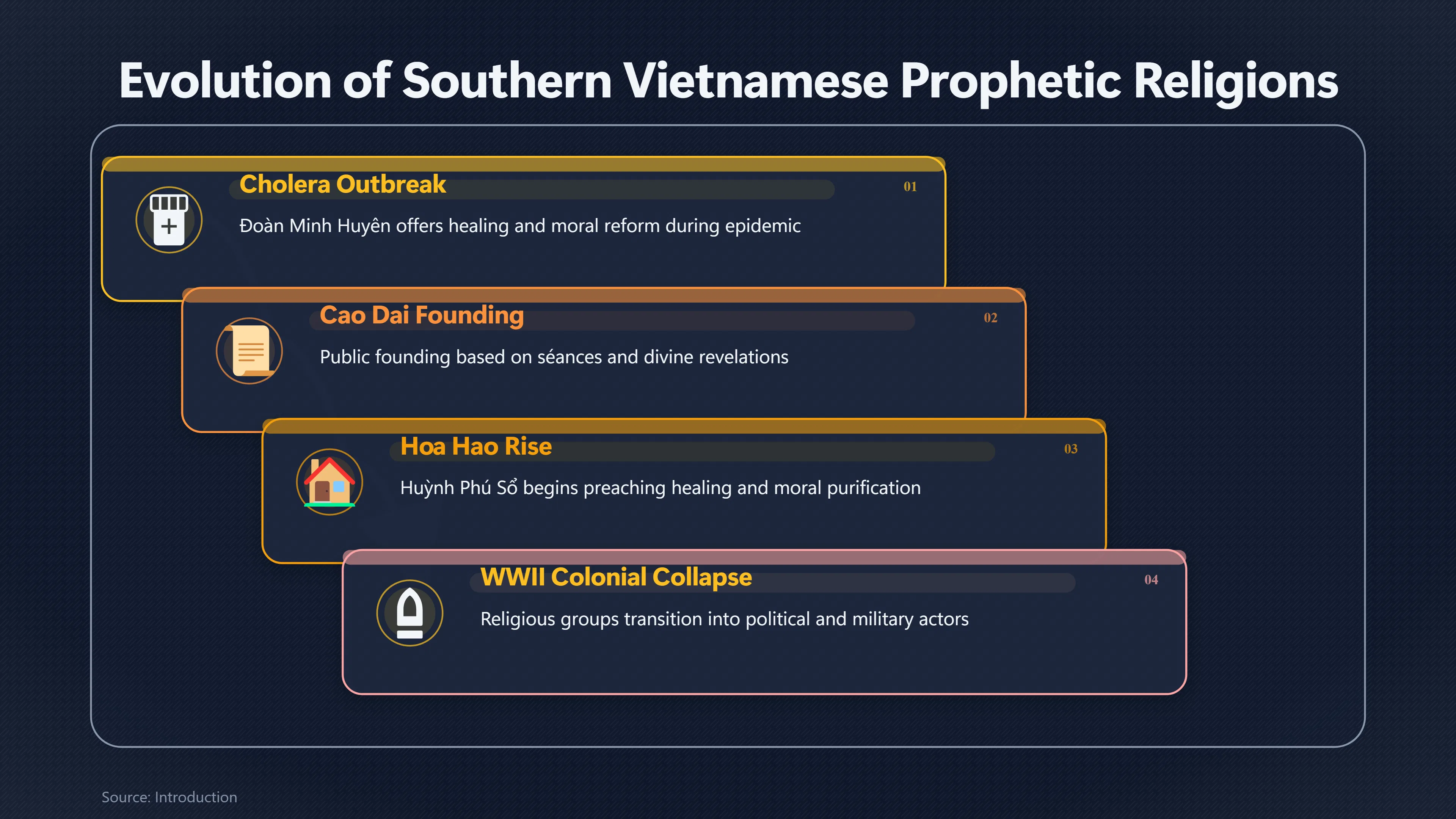
Disease added another layer of uncertainty. Throughout the nineteenth century, cholera and other epidemics repeatedly swept through the delta. In areas where modern medical care was scarce, charismatic healers could gain extraordinary influence. One important predecessor to both Cao Dai and Hoa Hao was the Bửu Sơn Kỳ Hương tradition associated with Đoàn Minh Huyên, who attracted followers during the devastating cholera epidemic of 1849 by offering healing, moral reform and hope that suffering formed part of a larger spiritual transformation. Later prophetic movements inherited this blend of practical healing, ethical renewal and expectation that history was approaching a decisive turning point.[OUP Academic]academic.oup.comOUP AcademicAnticolonialism in Vietnam’s Wild South | Cauldron of Resistance: Ngo Dinh Diem, the United States, and 1950s Southern Vietna…
These movements appealed because they addressed several needs simultaneously:
- They offered explanations for suffering that neither colonial authorities nor traditional elites could provide.
- They promoted strict moral discipline as a response to social breakdown.
- They built communities capable of mutual aid during economic hardship.
- They linked personal salvation with hopes for national renewal.
Rather than separating religion from everyday life, they treated faith as a framework for rebuilding society itself.[Cambridge University Press & Assessment]cambridge.orgCambridge University Press & AssessmentMillenarian Machines in South Vietnam | Comparative Studies in Society and History | Cambridge Cor…
How Cao Dai and Hoa Hao turned revelation into institutions
Although both movements emerged from the same regional environment, they developed in different ways.
Cao Dai: a universal revelation
Founded publicly in 1926, Cao Dai grew from séances in which its founders believed they were receiving divine messages. Its theology brought together elements of Buddhism, Confucian ethics, Taoism, Christianity and Western spiritualism into what followers regarded as a final revelation for a new age. Rather than remaining an informal visionary circle, Cao Dai rapidly developed a sophisticated hierarchy, temples, schools, publications and an administrative structure centred on Tây Ninh.
Its elaborate organisation gave followers more than religious ceremonies. It provided education, charitable work, communal identity and a disciplined institution capable of surviving political turmoil. Scholars therefore describe Cao Dai as an example of successful religious institution-building rather than simply an ecstatic spiritual movement.[Cambridge University Press & Assessment]cambridge.orgCambridge University Press & AssessmentMillenarian Machines in South Vietnam | Comparative Studies in Society and History | Cambridge Cor…
Hoa Hao: simplicity, healing and reform
Hoa Hao Buddhism began in 1939 under the leadership of Huỳnh Phú Sổ, a young preacher from the Mekong Delta. Like earlier prophetic figures, he became known for reported healing abilities while also warning of approaching upheaval and urging moral purification.
In contrast to Cao Dai’s elaborate hierarchy, Hoa Hao emphasised simplicity. It encouraged lay religious practice, reduced ritual complexity and promoted ethical living within ordinary village life. This simplicity made the movement especially attractive among rural farmers who wanted a form of religion closely connected to everyday concerns rather than expensive ceremonial traditions.
Its rapid expansion reflected both spiritual appeal and practical organisation. Local communities became centres of worship, mutual assistance and social discipline, enabling the movement to spread with remarkable speed across the delta.[DOI]doi.orgSage ReferenceSage Reference - Encyclopedia of Global Religion - Hoa Hao…
Why prophecy became political
Neither movement intended to remain purely private. Colonial collapse during the Second World War, Japanese occupation, the August Revolution and the First Indochina War transformed religious organisations into political actors almost by necessity.
As state authority weakened, many villages relied on religious communities for protection, dispute resolution and food distribution. Both Cao Dai and Hoa Hao developed armed forces, negotiated with competing governments and controlled territory at different points. Their leaders often balanced between French authorities, Japanese occupiers, Vietnamese nationalist groups and, later, competing governments in the south.
This political role emerged from local circumstances rather than from theology alone. When governments failed to provide security, religious organisations frequently became the only institutions capable of doing so. Historians therefore argue that these groups should be understood as politico-religious movements rather than merely religious sects. Their military wings reflected the breakdown of state authority as much as religious ambition.[Cambridge University Press & Assessment]cambridge.orgCambridge University Press & AssessmentMillenarian Machines in South Vietnam | Comparative Studies in Society and History | Cambridge Cor…
Faith, armed power and the danger of the “cult” label
The history of Cao Dai and Hoa Hao demonstrates why the word “cult” can mislead when applied without care.
The term has often been used by colonial officials, political opponents and journalists to emphasise unusual beliefs, charismatic founders or military activity. Yet both movements differ in important ways from the stereotype commonly associated with destructive cults.
They developed:
- enduring religious traditions with millions of followers;
- formal institutions that survived the deaths of their founders;
- established places of worship and recognised religious literature;
- community welfare networks alongside religious teaching;
- continuing traditions that remain active in Vietnam and among overseas Vietnamese communities.
Their prophetic expectations also need careful interpretation. Both movements contained beliefs about moral decline and future renewal, but these were embedded within broader ethical programmes encouraging charity, family responsibility and personal discipline rather than constant anticipation of imminent catastrophe. Their longevity itself distinguishes them from many short-lived apocalyptic groups.[Cambridge University Press & Assessment]cambridge.orgCambridge University Press & AssessmentMillenarian Machines in South Vietnam | Comparative Studies in Society and History | Cambridge Cor…
What scholars see instead of collective delusion
Modern historians generally explain the success of Cao Dai and Hoa Hao through social history rather than psychological abnormality.
Several overlapping factors receive particular emphasis:
- Colonial disruption. French conquest weakened existing political structures while creating new inequalities that encouraged alternative forms of authority.[OUP Academic]academic.oup.comOUP AcademicAnticolonialism in Vietnam’s Wild South | Cauldron of Resistance: Ngo Dinh Diem, the United States, and 1950s Southern Vietna…
- Epidemic disease. Healing traditions gained credibility during repeated outbreaks when official medicine reached only a small proportion of the population.[OUP Academic]academic.oup.comOUP AcademicAnticolonialism in Vietnam’s Wild South | Cauldron of Resistance: Ngo Dinh Diem, the United States, and 1950s Southern Vietna…
- Frontier society. The rapidly changing Mekong Delta allowed new organisations to recruit followers more easily than older, more tightly regulated regions.[OUP Academic]academic.oup.comOUP AcademicAnticolonialism in Vietnam’s Wild South | Cauldron of Resistance: Ngo Dinh Diem, the United States, and 1950s Southern Vietna…
- State weakness. Religious institutions often supplied education, welfare and security that governments could not consistently provide.[Cambridge University Press & Assessment]cambridge.orgCambridge University Press & AssessmentMillenarian Machines in South Vietnam | Comparative Studies in Society and History | Cambridge Cor…
From this perspective, belief spread not because large populations succumbed to mass hysteria but because prophetic religion offered practical solutions to genuine crises. The movements’ success reflected institutional effectiveness as well as religious conviction.
Why these movements still matter
Cao Dai and Hoa Hao remain among Vietnam’s most distinctive modern religious traditions. Their origins illuminate how new faiths can emerge during periods of profound uncertainty without fitting simplistic categories such as “cult”, “mass hysteria” or “collective delusion”.
Their story also provides a broader lesson about the relationship between religion and crisis. Colonial conquest, epidemic disease and civil conflict created conditions in which spiritual movements could become providers of healthcare, welfare, identity and political authority simultaneously. Rather than disappearing once stability returned, both traditions established lasting religious communities that continue to shape Vietnamese religious life.
For anyone studying collective belief in Vietnam, they are therefore best understood as examples of prophetic religions responding creatively to upheaval, not as episodes of irrational panic. Their history shows how extraordinary social pressures can produce enduring institutions whose influence extends far beyond the crises that first brought them into being.
Amazon book picks
Further Reading
Books and field guides related to Why Prophetic Religions Flourished in Southern Vietnam. Use these as the next step if you want deeper reading beyond the article.
Imagined communities
First published 1983. Subjects: Nationalism, History, Nationalisme, Nacionalismo, Histoire.

The sacred canopy
First published 1967. Subjects: Religion and sociology, Godsdienstsociologie, Religião, Sociologia (teoria), Sociologie religieuse.
Vietnam, a history
First published 1983. Subjects: History, Vietnam War, 1961-1975, Vietnamese Conflict, 1961-1975, Historia, Histoire.
Protestant Ethic and the Spirit of Capitalism
First published 2008. Subjects: Capitalism, Work ethic.
Endnotes
1.
Source: cambridge.org
Link:https://www.cambridge.org/core/journals/comparative-studies-in-society-and-history/article/millenarian-machines-in-south-vietnam/182005D7B198D0F457ADD6B0B201FEF3
Source snippet
Cambridge University Press & AssessmentMillenarian Machines in South Vietnam | Comparative Studies in Society and History | Cambridge Cor...
2.
Source: academic.oup.com
Link:https://academic.oup.com/cornell-scholarship-online/book/12992/chapter/166167733
Source snippet
OUP AcademicAnticolonialism in Vietnam’s Wild South | Cauldron of Resistance: Ngo Dinh Diem, the United States, and 1950s Southern Vietna...
3.
Source: doi.org
Title: Sage Reference
Link:https://doi.org/10.4135/9781412997898.n320
Source snippet
Sage Reference - Encyclopedia of Global Religion - Hoa Hao...
4.
Source: cambridge.org
Title: Mc Hale Show author d
Link:https://www.cambridge.org/core/books/abs/first-vietnam-war/twilight-of-empire-and-the-strange-birth-of-south-vietnam/4439BE3D1DD677AB084F3CE33772ADE1
Source snippet
The Twilight of Empire and the Strange Birth of South Vietnam (Chapter 10) - The First Vietnam WarAugust 17, 2021 — 10 - THE TWILIGHT OF...
Published: August 17, 2021
5.
Source: cambridge.org
Link:https://www.cambridge.org/core/books/abs/first-vietnam-war/alternative-trajectories-seeing-like-parastates-militias-and-strongmen/8774F68A53D276FAD4D547ED18651904
Source snippet
The First Vietnam WarAugust 17, 2021 — 9 - ALTERNATIVE TRAJECTORIES: SEEING LIKE PARASTATES, MILITIAS, AND STRONGMEN from Part II - Disas...
Published: August 17, 2021
6.
Source: cambridge.org
Link:https://www.cambridge.org/core/journals/journal-of-asian-studies/article/abs/occulting-the-dao-daoist-inner-alchemy-french-spiritism-and-vietnamese-colonial-modernity-in-caodai-translingual-practice/52C9FABC77258831BC8554AD7E19B1BD
Source snippet
l of Asian Studies | Cambridge CoreMarch 16, 2018 — OCCULTING THE DAO: DAOIST INNER ALCHEMY, FRENCH SPIRITISM, AND VIETNAMESE COLONIAL MO...
Published: March 16, 2018
7.
Source: cambridge.org
Link:https://www.cambridge.org/core/journals/comparative-studies-in-society-and-history/article/abs/millenarian-machines-in-south-vietnam/182005D7B198D0F457ADD6B0B201FEF3
Additional References
8.
Source: mdpi.com
Link:https://www.mdpi.com/2077-1444/11/6/280
Source snippet
June 8, 2020 — Background: Open Access Article THE CAO ĐÀI DEATHSCAPE: REIMAGINING DEATH, FUNERALS, AND SALVATION IN CONTEMPORARY VIETNAM...
Published: June 8, 2020
9.
Source: vjol.vista.gov.vn
Link:https://vjol.vista.gov.vn/tcdantochocvatongiaohoc/vi/article/view/135320
10.
Source: youtube.com
Title: Cao Dai, Hoa Hao, Binh Xuyen
Link:https://www.youtube.com/watch?v=OiAEou7BQVQ
Source snippet
Why Do Millions of People in the Mekong Delta Believe in Hoa Hao Buddhism?...
11.
Source: youtube.com
Title: Why Do Millions of People in the Mekong Delta Believe in Hoa Hao Buddhism?
Link:https://www.youtube.com/watch?v=85RnwpqE1VM
Source snippet
The Fate of Four Generals of the Hoa Hao Buddhist Army Before and After 1975...
12.
Source: youtube.com
Title: The Cao Dai Army: Why Did a Religion Have Its Own Military Force?
Link:https://www.youtube.com/watch?v=IUKrtb3_4Sk
Source snippet
Cao Dai, Hoa Hao, Binh Xuyen - How Ngo Dinh Diem Suppressed the Three Separatist Forces...
13.
Source: youtube.com
Link:https://www.youtube.com/watch?v=BVMsKq2wGWQ
Source snippet
History of the Formation of Cao Dai Religion in Tay Ninh...
14.
Source: vjol.info.vn
Link:https://vjol.info.vn/index.php/ncpt-hue/article/view/4270
15.
Source: indochine.uqam.ca
Link:https://indochine.uqam.ca/en/historical-dictionary/604-hoa-ho.html
16.
Source: jstage.jst.go.jp
Link:https://www.jstage.jst.go.jp/article/sea/2015/44/2015_64/_article/-char/en
17.
Source: degruyterbrill.com
Link:https://www.degruyterbrill.com/document/doi/10.4159/harvard.9780674433700.c13/html
Topic Tree