Within Papua New Guinea
How Prophecy Became a Politics of Change
Prophets and reformers joined spiritual renewal to demands for dignity, development, political voice and control over social change.
On this page
- The Vailala movement and ancestral return
- Yali, Paliau and post war reform
- From millenarian hope to electoral influence
Page outline Jump by section
Introduction
The Vailala, Yali and Paliau movements are often grouped together under the old colonial label of “cargo cults”, but comparing them closely shows why many historians and anthropologists now avoid that term. All three emerged during periods of rapid social upheaval in Papua New Guinea and nearby western New Guinea, blending Christian ideas, ancestral belief and hopes for dramatic change. Yet they pursued different goals, developed in different political settings and left very different legacies. Rather than simply waiting for miraculous wealth, each movement tried to explain why colonial society produced such unequal access to power and material prosperity, while proposing its own path towards dignity, renewal and greater local control. Modern scholarship therefore treats them as distinct prophetic and reform movements rather than as examples of collective irrationality.[anthroencyclopedia.com]anthroencyclopedia.comOpen Encyclopedia of AnthropologyCargo cults | Open Encyclopedia of AnthropologyMarch 29, 2018…

The Vailala movement and ancestral return
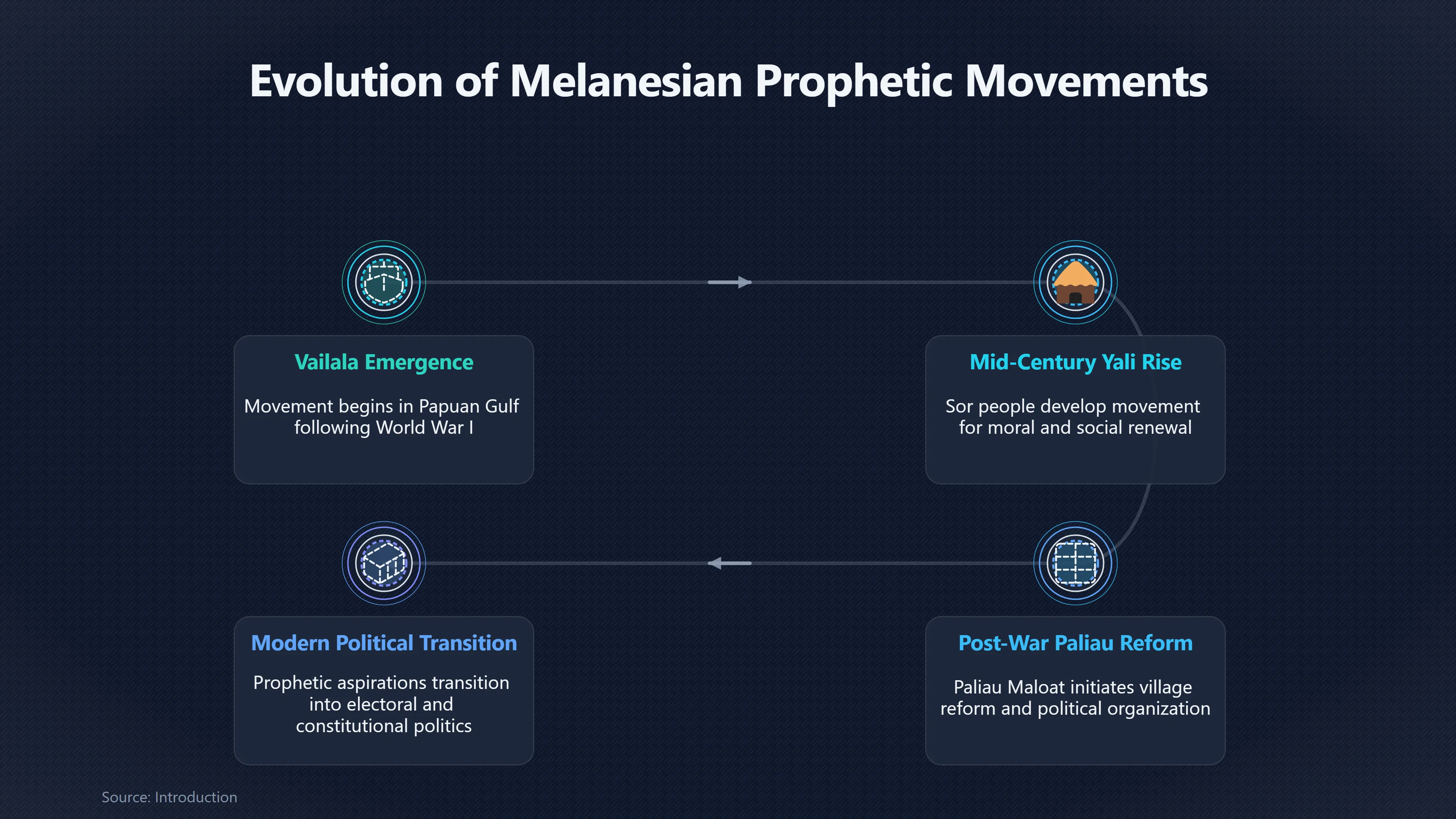
The Vailala movement emerged in the Papuan Gulf around 1919, shortly after the First World War. Colonial officials called it the “Vailala Madness”, a name that reflected their own assumptions more than the beliefs of participants. Government anthropologist F. E. Williams documented reports that followers expected deceased relatives to return aboard a ghostly steamship carrying manufactured goods and inaugurating a transformed social order. Ritual innovations included marching, drilling, ecstatic dancing, glossolalia, imitation of European customs and the abandonment or destruction of some traditional ceremonial objects.[anthroencyclopedia.com]anthroencyclopedia.comOpen Encyclopedia of AnthropologyCargo cults | Open Encyclopedia of AnthropologyMarch 29, 2018…
To colonial administrators these practices appeared bizarre or pathological. More recent interpretations place them in the context of missionisation, plantation labour, expanding colonial administration and growing awareness of European wealth. Communities that had experienced profound disruption sought explanations for why outsiders possessed apparently limitless material resources while local people remained politically subordinate. Expectations of ancestral return therefore expressed both spiritual hope and criticism of colonial inequality.[anthroencyclopedia.com]anthroencyclopedia.comOpen Encyclopedia of AnthropologyCargo cults | Open Encyclopedia of AnthropologyMarch 29, 2018…
The movement itself declined during the 1920s, but it became the best-known early example used by colonial writers when discussing later Melanesian prophetic movements. The misleading phrase “Vailala Madness” also helped shape decades of outside misunderstanding.[Open Encyclopedia of Anthropology]anthroencyclopedia.comOpen Encyclopedia of AnthropologyCargo cults | Open Encyclopedia of AnthropologyMarch 29, 2018…
Yali, Paliau and post-war reform
Although often mentioned alongside Vailala, the Yali and Paliau movements represented different responses to changing colonial societies.
The Yali movement
The Yali movement developed among the Sor people of East Sepik during the middle decades of the twentieth century. It also anticipated the disappearance of colonial domination and the arrival of prosperity associated with ancestors and divine intervention. However, participants themselves objected to outsiders describing the movement as a “cargo cult”, arguing that the label reduced a wider programme of moral renewal and social transformation to a supposed obsession with European goods. Later anthropological work has shown that local interpretations placed far greater emphasis on justice, community renewal and the restoration of indigenous authority than colonial descriptions suggested.[National Library of New Zealand]natlib.govt.nzNational Library of New ZealandThe Yali movement in retrospect: rew… | Items | National Library of New Zealand | National Library of N…
The Yali movement illustrates how colonial language shaped later history. What administrators dismissed as irrational expectation could simultaneously function as political criticism, religious prophecy and an attempt to redefine indigenous identity under colonial rule.[National Library of New Zealand]natlib.govt.nzNational Library of New ZealandThe Yali movement in retrospect: rew… | Items | National Library of New Zealand | National Library of N…
The Paliau movement
The movement founded by Paliau Maloat after the Second World War differed even more clearly from the stereotype of passive expectation. Paliau had served in the colonial police and witnessed dramatic wartime changes before returning to Manus with an ambitious programme of village reform. He encouraged communities to reorganise settlement patterns, improve sanitation, establish councils, cooperate economically, adopt new forms of leadership and prepare for greater political participation. Spiritual expectations remained important, but they were closely connected to practical social reform.[CDAMM]cdamm.orgThe Paliau MovementThe Paliau Movement - CDAMM…
Colonial authorities initially regarded Paliau with suspicion and imprisoned him more than once. Nevertheless, many of the organisational ideas promoted by the movement—including local government, education and community development—anticipated policies that later became part of Papua New Guinea’s transition towards self-government and independence. Rather than disappearing after a brief prophetic episode, the movement evolved into a lasting social and political force within Manus Province.[CDAMM]cdamm.orgThe Paliau MovementThe Paliau Movement - CDAMM…
How the movements compare
The three movements shared several important characteristics.
- All emerged during periods of rapid colonial change, when traditional authority, Christianity, wage labour and new technologies were transforming everyday life.
- All combined spiritual expectations with practical concerns about inequality, authority and access to wealth.
- All were interpreted through colonial assumptions, which frequently portrayed indigenous religious innovation as irrational, deceptive or dangerous.
- All questioned the legitimacy of existing colonial relationships, even when they expressed those criticisms through religious language.[anthroencyclopedia.com]anthroencyclopedia.comOpen Encyclopedia of AnthropologyCargo cults | Open Encyclopedia of AnthropologyMarch 29, 2018…
Their differences are equally significant.
MovementMain emphasisCharacteristic expectationLong-term significanceVailalaSpiritual renewal during early colonial ruleReturn of ancestors bringing a transformed worldBecame the classic colonial example later labelled a “cargo cult”.[Open Encyclopedia of Anthropology]anthroencyclopedia.comOpen Encyclopedia of AnthropologyCargo cults | Open Encyclopedia of AnthropologyMarch 29, 2018… renewal and indigenous authorityEnd of colonial domination alongside supernatural transformationDemonstrated how indigenous participants rejected the colonial “cargo cult” stereotype.[National Library of New Zealand]natlib.govt.nzNational Library of New ZealandThe Yali movement in retrospect: rew… | Items | National Library of New Zealand | National Library of N… reform and political organisationSpiritual renewal linked with practical reconstructionInfluenced local governance and political development well beyond the prophetic phase.[CDAMM]cdamm.orgThe Paliau MovementThe Paliau Movement - CDAMM…
This comparison shows a gradual shift from movements centred primarily on prophetic expectation towards movements that increasingly connected religious hope with organised programmes of social and political change.
From millenarian hope to electoral influence
The post-war decades altered the relationship between prophecy and politics. As opportunities for indigenous political participation expanded, some aspirations that earlier movements had expressed through visions of ancestral return or divine intervention increasingly found expression through village councils, cooperatives, elections and constitutional politics.
The Paliau movement demonstrates this transition most clearly. Rather than disappearing once colonial predictions failed, it adapted to changing political realities and helped cultivate new forms of local leadership. In contrast, Vailala remained largely a historical episode remembered through colonial records, while the Yali movement survives primarily through debates about how outsiders misunderstood indigenous religious movements.[cdamm.org]cdamm.orgThe Paliau MovementThe Paliau Movement - CDAMM…
For historians, these cases challenge the assumption that prophetic movements simply represented irrational expectations of miraculous wealth. Instead, they reveal how religious imagination became a language for discussing justice, sovereignty, economic inequality and the future of indigenous society. The older label “cargo cult” often obscures these broader ambitions by reducing complex social movements to their most dramatic supernatural elements.[anthroencyclopedia.com]anthroencyclopedia.comOpen Encyclopedia of AnthropologyCargo cults | Open Encyclopedia of AnthropologyMarch 29, 2018…
Amazon book picks
Further Reading
Books and field guides related to How Prophecy Became a Politics of Change. Use these as the next step if you want deeper reading beyond the article.
Imagined communities
Useful for understanding political change and collective identity.
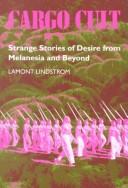

Endnotes
1.
Source: cdamm.org
Title: The Paliau Movement
Link:https://www.cdamm.org/articles/paliau-movement
Source snippet
The Paliau Movement - CDAMM...
2.
Source: Wikipedia
Title: Vailala Madness
Link:https://en.wikipedia.org/wiki/Vailala_Madness
3.
Source: books.openedition.org
Link:https://books.openedition.org/pacific/168?format=embed
4.
Source: Wikipedia
Title: Religion in Papua New Guinea
Link:https://en.wikipedia.org/wiki/Religion_in_Papua_New_Guinea
5.
Source: youtube.com
Title: Cargo Cults w/ Lamont Lindstrom
Link:https://www.youtube.com/watch?v=kcRK4RTUht4
Source snippet
Cargo Cults...
6.
Source: youtube.com
Title: Cargo Cults
Link:https://www.youtube.com/watch?v=i69HiC4PBeI
7.
Source: anthroencyclopedia.com
Link:https://www.anthroencyclopedia.com/entry/cargo-cults
Source snippet
Open Encyclopedia of AnthropologyCargo cults | Open Encyclopedia of AnthropologyMarch 29, 2018...
Published: March 29, 2018
8.
Source: natlib.govt.nz
Link:https://natlib.govt.nz/records/20970814?search%5Bi%5D%5Bsubject%5D=Social+change&search%5Bi%5D%5Bsubject_text%5D=Papua+New+Guineans&search%5Bpath%5D=items
Source snippet
National Library of New ZealandThe Yali movement in retrospect: rew... | Items | National Library of New Zealand | National Library of N...
Additional References
9.
Source: researchgate.net
Link:https://www.researchgate.net/publication/404861540_The_Bloomsbury_Handbook_of_Apocalypticism_and_Millennialism_references_and_notes
10.
Source: youtube.com
Title: How WWII Created a NEW Religion In The Jungle
Link:https://www.youtube.com/watch?v=b0a9mOtf0UU
Source snippet
Cargo Cults w/ Lamont Lindstrom - IndoctriNation Podcast...
11.
Source: cambridge.org
Link:https://www.cambridge.org/core/journals/comparative-studies-in-society-and-history/article/independent-religious-movements-in-three-continents/BF76B16D5BB390ED906DA39E23FEE5A2
12.
Source: researchgate.net
Link:https://www.researchgate.net/publication/354969100_Remembering_Removal_Indigenous_Narratives_of_Colonial_Collecting_Practices_in_the_Gulf_of_Papua_Papua_New_Guinea
13.
Source: youtube.com
Title: Legacy of Sir Paliau Maloat
Link:https://www.youtube.com/watch?v=haBRxHeUn5Y
Source snippet
Cargo Cults: When WWII Supplies Became a Religion...
14.
Source: youtube.com
Title: Cargo Cults: When WWII Supplies Became a Religion
Link:https://www.youtube.com/watch?v=2cPKc-lH4No
Source snippet
How WWII Created a NEW Religion In The Jungle...
15.
Source: scientificamerican.com
Title: 50 Years Ago: Cargo Cults of Melanesia | Scientific American
Link:https://www.scientificamerican.com/article/1959-cargo-cults-melanesia/
16.
Source: thetbs.org
Title: TBSEncyclopedia of Millennialism and Mlllennial Movements
Link:https://www.thetbs.org/study-materials/wp-content/uploads/2023/03/Encyclopedia-of-Millennialism-and-Millennial-Movements-by-Richard-Landes-z-lib.org_.pdf
17.
Source: onlinelibrary.wiley.com
Title: j.1834 4461.2000.tb03071.x
Link:https://onlinelibrary.wiley.com/doi/abs/10.1002/j.1834-4461.2000.tb03071.x
18.
Source: ora.ox.ac.uk
Title: ORAA TEXT I NITS CONTEXT
Link:https://ora.ox.ac.uk/objects/uuid%3A430c7971-2227-45b1-b847-c7508de6bebf/files/rmg74qn404
Topic Tree