Within Andorra Witch Trials
Who Really Drove Andorra's Witch Persecutions?
Local secular judges, not the Spanish Inquisition, ordered the known executions and gave village rumours legal force.
On this page
- The Tribunal de Corts and local criminal justice
- Why secular courts could be harsher than inquisitors
- Torture, confession and self reinforcing accusations
Page outline Jump by section
Introduction
One of the biggest misconceptions about Andorra’s witch persecutions is that they were driven by the Spanish Inquisition. The surviving evidence points in a different direction. Most known witchcraft prosecutions in Andorra were investigated, tried and sentenced by the country’s own secular justice system, above all the Tribunal de Corts. Those local courts transformed village suspicions into criminal cases, authorised torture, accepted confessions that reinforced existing fears, and imposed the executions that made the persecutions deadly. Understanding who exercised judicial power is essential because it explains why accusations spread as they did and why Andorra followed a pattern seen across much of the Pyrenean region, where civil courts often proved more aggressive than church inquisitors in prosecuting alleged witches.[diariandorra.ad]diariandorra.adDiari Andorra.ad Assenyalades, torturades, executadesAssenyalades, torturades, executadesMarch 6, 2019…
The Tribunal de Corts and local criminal justice
The Tribunal de Corts was the highest ordinary court in medieval and early modern Andorra. Created to administer both civil and criminal justice, it exercised broad authority on behalf of the co-princes and their representatives. Its archives preserve one of the richest surviving collections of judicial records from the Pyrenees, including many of the witchcraft proceedings that allow historians to reconstruct Andorra’s persecutions.[Govern d’Andorra]govern.add’Andorra Arxiu del Tribunal de CortsGovern d’AndorraArxiu del Tribunal de Corts - Govern d’Andorra…
Rather than treating witchcraft as a purely religious offence, the Tribunal de Corts prosecuted it as a criminal threat to the community. Alleged witches were accused of causing illness, livestock deaths, crop damage, destructive storms and unexplained deaths through supernatural means. Once neighbours brought these suspicions before the court, judges sought evidence in the same way they investigated other serious crimes—through witness testimony, interrogation and confession. The result was that rumours circulating within villages acquired legal authority.[Terra de Bruixes]terradebruixes.cultura.adTerra de Bruixes Andorra, Terra de BruixesTerra de Bruixes Andorra, Terra de Bruixes
This judicial structure helps explain why accusations could become self-sustaining. Local judges were deeply embedded in the same small communities where allegations originated. They were not distant investigators arriving from outside but officials responding to fears already circulating among neighbours.
Why secular courts could be harsher than inquisitors
Modern popular culture often portrays the Spanish Inquisition as the main engine of European witch hunting. In much of the western Mediterranean, however, historians have shown that the opposite was frequently true.
The Spanish Inquisition generally treated many witchcraft accusations with increasing scepticism from the early seventeenth century onwards. Inquisitors often demanded stronger evidence, questioned confessions extracted under torture, and were reluctant to impose executions based solely on claims of supernatural activity. Its concern was primarily religious heresy rather than every local accusation of harmful magic.[Patrimoni Cultural]patrimoni.gencat.catPatrimoni CulturalThey were talked about… and theyApril 22, 2021…
Andorra largely escaped this moderating influence because most prosecutions never reached inquisitorial jurisdiction. Instead, they remained in the hands of the Tribunal de Corts and other secular authorities. Robert Pastor’s research, supported and expanded by later work from Pau Castell, concludes that the known executions were ordered by the Andorran courts rather than by the Inquisition.[Bondia]bondia.adRobert Pastor, historiador: “Les quinze dones executades per bruixeria les va condemnar Corts” | BondiaApril 20, 2023…
This pattern reflects a wider trend across parts of Europe. Civil courts often regarded witchcraft as an exceptional crime capable of threatening the entire community. Because judges believed the danger was real and immediate, they were often willing to relax normal evidential standards. In practice this made local criminal courts more likely to pursue aggressive investigations than ecclesiastical tribunals.[Patrimoni Cultural]patrimoni.gencat.catPatrimoni CulturalThey were talked about… and theyApril 22, 2021…
The Andorran evidence therefore challenges a persistent historical myth. The people most responsible for turning fear into executions were not outside religious officials but Andorra’s own secular legal institutions.
Torture, confession and self-reinforcing accusations
The surviving records show how the judicial process itself intensified persecution.
Interrogations frequently relied on torture or the threat of torture. Once subjected to extreme pressure, many defendants confessed to impossible acts that reflected contemporary beliefs rather than verifiable events. Confessions described meetings with the devil, attendance at witches’ gatherings and agreements to perform supernatural harm. Such statements should not be read as reliable evidence of real practices; historians instead treat them as products of coercive interrogation combined with shared cultural expectations.[DiariAndorra.ad]diariandorra.adDiari Andorra.ad Assenyalades, torturades, executadesAssenyalades, torturades, executadesMarch 6, 2019…
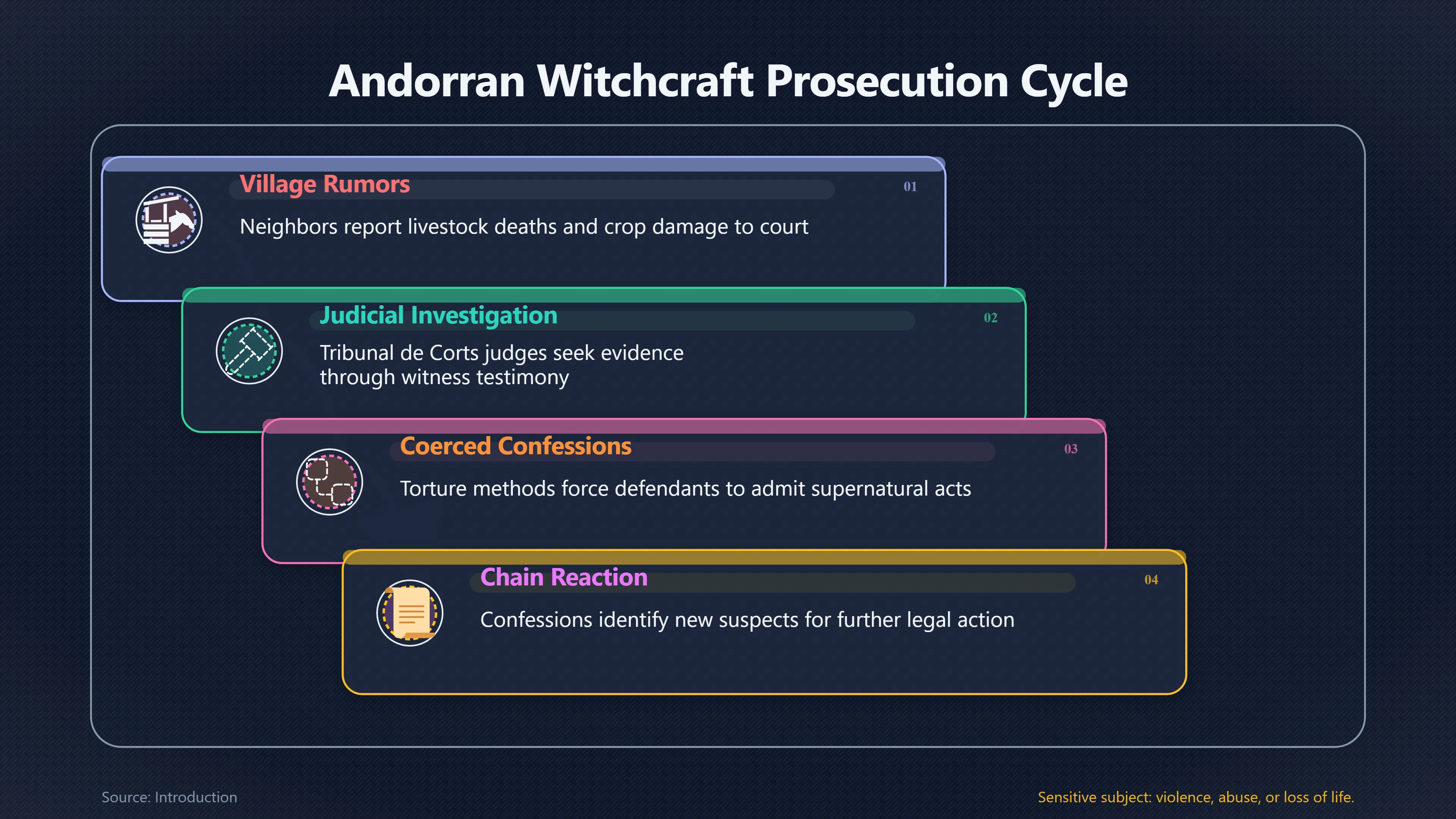
The problem did not end with a confession. Judges commonly demanded that accused witches identify accomplices. Each new name generated further arrests, further interrogations and further confessions, creating a chain reaction in which accusations appeared to confirm one another. The legal process therefore amplified local fears instead of testing them independently.
Research into Andorran records also reveals that torture methods were not merely theoretical. Contemporary descriptions refer to practices intended to force admissions of guilt, including suspension by the thumbs using cords, illustrating the physical coercion behind many recorded confessions.[Bondia]bondia.adTornen les bruixes (de Robert Pastor) | BondiaTornen les bruixes (de Robert Pastor) | BondiaFebruary 13, 2023…
Because the courts accepted these confessions as meaningful evidence, rumours acquired an appearance of judicial certainty even though they had originated in fear, neighbourhood conflict or unexplained misfortune.
Why the courts believed village rumours
The Tribunal de Corts did not invent beliefs about witchcraft. Those ideas already existed within Andorran society. What the court did was convert local suspicion into legally recognised criminal cases.
Many accusations followed a familiar pattern. A quarrel between neighbours was followed by illness, livestock losses or bad weather. Witnesses then interpreted ordinary misfortune through the widely accepted belief that witches could inflict supernatural harm. Multiple neighbours repeating similar suspicions gave judges confidence that a genuine crime had occurred, even though modern standards would regard such evidence as entirely circumstantial.[Terra de Bruixes]terradebruixes.cultura.adTerra de Bruixes Andorra, Terra de BruixesTerra de Bruixes Andorra, Terra de Bruixes
This interaction between community belief and judicial procedure created a powerful feedback loop:
- Local rumours produced formal accusations.
- Judges investigated those accusations as genuine crimes.
- Torture generated confessions.
- Confessions identified additional suspects.
- New prosecutions appeared to confirm that witches truly existed.
The courts therefore became active participants in sustaining persecution rather than neutral arbiters evaluating evidence.
What this reveals about Andorra’s witch persecutions
Focusing on the Tribunal de Corts changes the way Andorra’s witch trials are understood. The central story is not one of an external religious institution imposing persecution on an unwilling population. Instead, it is a case of local governance, local justice and local belief reinforcing one another.
The surviving judicial archive shows that ordinary criminal courts gave legal force to community fears. Their willingness to prosecute witchcraft as a real offence, rely on coerced confessions and treat accusations as mutually reinforcing transformed neighbourly suspicion into capital punishment. This places Andorra within the broader pattern of Pyrenean and Catalan witch hunting, where secular authorities frequently proved the driving force behind persecution, while the Inquisition often played a smaller—or even comparatively restrained—role.[govern.ad]govern.adGovern d’AndorraS’amplia el fons documental sobre la cacera de bruixes a l’Arxiu Nacional amb una tesi doctoral de l’historiador Pau Cast…
Amazon book picks
Further Reading
Books and field guides related to Who Really Drove Andorra's Witch Persecutions?. Use these as the next step if you want deeper reading beyond the article.
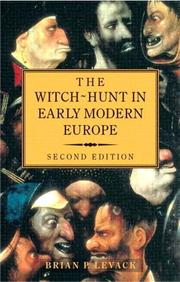
The witch-hunt in early modern Europe
Strong coverage of courts, law and prosecution processes.
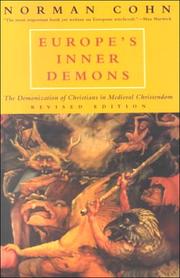
Europe's inner demons
Explains the judicial and ideological foundations of witch trials.

Endnotes
1.
Source: diariandorra.ad
Title: Diari Andorra.ad Assenyalades, torturades, executades
Link:https://www.diariandorra.ad/cultura/190306/assenyalades-torturades-executades_44763.html
Source snippet
Assenyalades, torturades, executadesMarch 6, 2019...
Published: March 6, 2019
2.
Source: govern.ad
Link:https://www.govern.ad/ca/w/s-amplia-el-fons-documental-sobre-la-cacera-de-bruixes-a-l-arxiu-nacional-amb-una-tesi-doctoral-de-l-historiador-pau-castell-1
Source snippet
Govern d’AndorraS’amplia el fons documental sobre la cacera de bruixes a l’Arxiu Nacional amb una tesi doctoral de l’historiador Pau Cast...
3.
Source: govern.ad
Title: d’Andorra Arxiu del Tribunal de Corts
Link:https://www.govern.ad/ca/l/4671510
Source snippet
Govern d’AndorraArxiu del Tribunal de Corts - Govern d’Andorra...
4.
Source: bondia.ad
Link:https://www.bondia.ad/cultura/robert-pastor-historiador-les-quinze-dones-executades-per-bruixeria-les-va-condemnar-corts
Source snippet
Robert Pastor, historiador: “Les quinze dones executades per bruixeria les va condemnar Corts” | BondiaApril 20, 2023...
Published: April 20, 2023
5.
Source: bondia.ad
Title: Tornen les bruixes (de Robert Pastor) | Bondia
Link:https://www.bondia.ad/cultura/tornen-les-bruixes-de-robert-pastor
Source snippet
Tornen les bruixes (de Robert Pastor) | BondiaFebruary 13, 2023...
Published: February 13, 2023
6.
Source: bondia.ad
Title: Una llàsti
Link:https://www.bondia.ad/cultura/pau-castell-historiador-el-pirineu-es-a-la-zona-zero-del-bressol-de-la-cacera-de-bruixes
7.
Source: diariandorra.ad
Link:https://www.diariandorra.ad/opinio/la-tribuna/211114/bruixes_93533.html
Source snippet
November 14, 2021 — [Input: Cerca...] Cerca La Tribuna La tribuna Image: Robert Pastor Robert Pastor BRUIXES Creat: 14.11.2021 | 06:00 Ac...
Published: November 14, 2021
8.
Source: govern.ad
Title: “La peça del mes”
Link:https://www.govern.ad/ca/tematiques/cultura-i-esports/arxiu-nacional/publicacions/la-peca-del-mes/2018
Source snippet
Govern d’Andorra[BUTTON: AGOST 2018 - SENTÈNCIA DEL PROCÉS PER BRUIXERIA CONTRA L’ANTÒNIA MARTINA DEL TARTER ] SENTÈNCIA DEL PROCÉS PER B...
9.
Source: terradebruixes.cultura.ad
Title: Terra de Bruixes Andorra, Terra de Bruixes
Link:https://terradebruixes.cultura.ad/
10.
Source: patrimoni.gencat.cat
Link:https://patrimoni.gencat.cat/sites/default/files/hd-images-zip/descarregues/llibreBRUIXES_eng_final.pdf
Source snippet
Patrimoni CulturalThey were talked about... and theyApril 22, 2021...
Published: April 22, 2021
11.
Source: historia.ad
Title: terra de bruixes atles 5
Link:https://www.historia.ad/terra-de-bruixes-atles-5/
Source snippet
Terra de bruixes – Atles 5 – Relat històric d'Andorra, tota la història d'AndorraAndorra, Terra de Bruixes Atles Els precedents (c.1420-1...
Additional References
12.
Source: rtva.ad
Title: cacera bruixes andorra descobert documents llocs
Link:https://www.rtva.ad/noticies/cultura/cacera-bruixes-andorra-descobert-documents-llocs
Source snippet
La cacera de bruixes a Andorra al descobert amb documents, llocs i els noms dels implicats | RTVAMarch 5, 2019 — Image: andorradifusio_rt...
Published: March 5, 2019
13.
Source: youtube.com
Title: A History of Witchcraft and Magic in Europe Part 5: Medieval Christianity
Link:https://www.youtube.com/watch?v=AafuN-KAg2c
Source snippet
The Witch-Hunt in Early Modern Europe: A Discussion with Brian Levack...
14.
Source: youtube.com
Title: The Witch-Hunt in Early Modern Europe: A Discussion with Brian Levack
Link:https://www.youtube.com/watch?v=eSvFMkcO2d4
Source snippet
Secrets of the Basque Witch Hunt with Jan Machielsen...
15.
Source: youtube.com
Title: What REALLY happened to women accused of witchcraft?
Link:https://www.youtube.com/watch?v=DDP5j7B4yXs
Source snippet
A History of Witchcraft and Magic in Europe Part 5: Medieval Christianity...
16.
Source: youtube.com
Title: Secrets of the Basque Witch Hunt with Jan Machielsen
Link:https://www.youtube.com/watch?v=389wgCchHMY
Source snippet
Navigating the Intersection of Law, Religion, and the Supernatural...
17.
Source: elperiodic.ad
Title: ANDORRA LA VE
Link:https://elperiodic.ad/cultura/traure-lo-fetge-per-lo-cul/
Source snippet
«...traure lo fetge per lo cul...» - El Periòdic d'AndorraJune 24, 2013 — * Cultura * Publicat: 24 juny, 2013 - 01:06 CEST «…TRAURE LO FE...
Published: June 24, 2013
18.
Source: youtube.com
Title: Navigating the Intersection of Law, Religion, and the Supernatural
Link:https://www.youtube.com/watch?v=ikhhTOQmMHY
Topic Tree