Within Equatorial Guinea
What Can We Really Know About Ritual Killing Claims?
Claims of ritual murder mixed documented crimes with opposition reports, censorship and public suspicion of hidden violence among the powerful.
On this page
- Documented criminal cases and reported allegations
- How censorship makes rumours hard to test
- Why stories of elite sacrifice remain powerful
Page outline Jump by section
Introduction
Claims of ritual killing in Equatorial Guinea occupy an unusually difficult place between documented crime, political accusation and persistent rumour. There is evidence that individual murders described as ritual killings have occurred and have been prosecuted. At the same time, opposition figures, exiles and foreign observers have periodically alleged that members of the political elite were linked to hidden violence or occult practices, while the government has denied such claims. Because Equatorial Guinea has one of Africa’s most tightly controlled media environments, many dramatic allegations cannot be independently verified. That uncertainty has become part of the story itself: when reliable reporting is restricted, frightening rumours can flourish alongside genuine criminal cases.
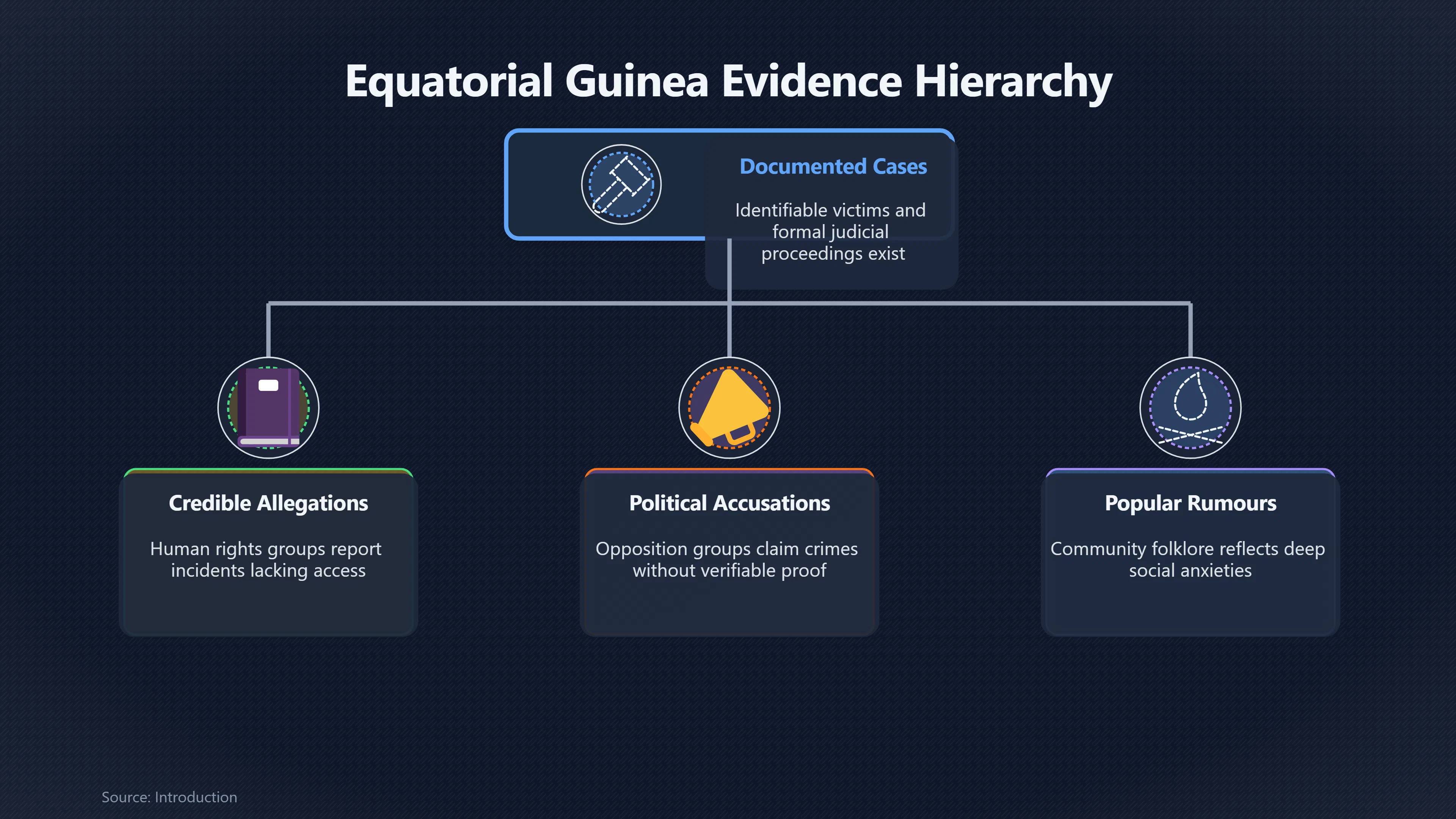
Understanding these claims therefore requires separating three different categories: documented criminal prosecutions, allegations that remain unproven, and broader social beliefs about hidden power and sacrifice. Blurring those categories creates a misleading picture of both the country and the evidence.
Which ritual-killing cases are actually documented?
There is credible evidence that courts in Equatorial Guinea have prosecuted people accused of ritual murder. One well-documented example is the 1997 case of Matias Evung, who was sentenced to death after conviction for a ritual killing in Bata. Amnesty International’s concern in that case focused on the death sentence rather than disputing that the prosecution involved a ritual-murder charge.[Amnesty International]amnesty.orgInternational Equatorial Guinea: Death penalty: Matias EvungAmnesty InternationalEquatorial Guinea: Death penalty: Matias Evung - Amnesty InternationalOctober 5, 1997…
Cases such as this demonstrate that ritual killing is not merely a fictional theme imported from outside the country. Across parts of Central Africa, including neighbouring states, police investigations have occasionally uncovered murders in which body parts were allegedly removed for ritual purposes or in pursuit of wealth, influence or supernatural protection. These crimes are distinct from accusations of witchcraft against living individuals; they concern homicide investigated through the criminal justice system rather than communal suspicion alone.
However, publicly available documentation is remarkably sparse. Court records are difficult to obtain, domestic journalism is heavily constrained, and many reports rely on brief official announcements rather than detailed investigation. As a result, it is often impossible to establish how many reported ritual-killing cases resulted in reliable convictions, how evidence was assessed, or whether political pressures influenced particular prosecutions.
Why are elite ritual-killing allegations so difficult to verify?
The most sensational stories concern alleged involvement by powerful political figures in ritual sacrifice or occult violence. These stories circulate widely among opposition communities, in exile media and through informal networks. Yet the available evidence rarely allows firm conclusions.
Several features of Equatorial Guinea make independent verification unusually difficult:[freedomhouse.org]freedomhouse.orgEquatorial Guinea: Country Profile | Freedom HouseSupport Freedom House. [Button: Donate] Expanding Freedom and Democracy Image: EquatorialGuinea_hero_map Image: Flag of Equatorial Guinea…
- Independent newspapers and broadcasters have long faced censorship and political pressure.
- Journalists risk harassment, detention or intimidation for investigating politically sensitive subjects.
- Courts lack full independence, limiting confidence in both official denials and official prosecutions.
- International reporters have only intermittent access to the country.
Human rights reporting consistently describes severe restrictions on freedom of expression and extensive state control over information. Recent reports continue to identify censorship, intimidation of journalists and weak judicial independence as structural problems.[ecoi.net]ecoi.netUSDOS – US Department of State (Author): “2024 Country Reports on Human Rights Practices: Equatorial Guinea”, Document #2128494 - ecoi.ne…
This means that two opposite errors are both possible. Genuine crimes may remain hidden because investigators cannot work freely. Equally, dramatic accusations against political elites may circulate for years without sufficient evidence to establish whether they are true.
How censorship changes the way rumours spread
In societies with a vigorous independent press, extraordinary claims are more likely to encounter competing investigations, official records and public scrutiny. In Equatorial Guinea those mechanisms are much weaker.
Instead, information often travels through:
- family and community networks;
- political exile organisations;
- diaspora media;
- social media;
- foreign human-rights reporting.[ecoi.net]ecoi.netUSDOS – US Department of State (Author): “2024 Country Reports on Human Rights Practices: Equatorial Guinea”, Document #2128494 - ecoi.ne…
Each source may contain valuable information, but each also has limitations. Exile groups sometimes possess eyewitness testimony unavailable inside the country, yet they may also repeat allegations that cannot be independently checked. Official government statements may include genuine criminal information while omitting politically inconvenient facts.
This creates what researchers sometimes call an “information vacuum”: people know that important events may be concealed, making rumours seem more plausible even when direct evidence is lacking. The absence of trustworthy public information therefore becomes a force that sustains belief rather than resolving uncertainty.
US State Department reporting over several years has repeatedly described extensive censorship, self-censorship by journalists and fear of reprisals for criticising senior officials, conditions that make independent verification exceptionally difficult.[U.S. Department of State]2021-2025.state.govU.S. Department of State Equatorial GuineaU.S. Department of StateEquatorial Guinea - United States Department of State…
Why stories of elite sacrifice remain persuasive
Rumours about powerful people using ritual violence for wealth or political success appear in many Central African societies, not only Equatorial Guinea. They draw strength from several overlapping ideas.
First, traditional beliefs in hidden supernatural power have not disappeared with urbanisation or Christianity. Many people continue to distinguish between accepted religious practice and secret harmful acts carried out for personal gain.
Second, extreme inequality encourages speculation about hidden sources of wealth. Equatorial Guinea became one of Africa’s largest oil producers, yet much of the population continued to experience poverty while enormous fortunes accumulated around the ruling elite. In such circumstances, rumours that extraordinary wealth has extraordinary causes can become socially compelling, even without direct evidence.[Freedom House]freedomhouse.orgfreedom worldFreedom HouseEquatorial Guinea: Freedom in the World 2025 Country Report | Freedom House…
Third, authoritarian politics naturally encourages suspicion. When citizens cannot openly question leaders or investigate allegations, unofficial explanations often fill the gap. Stories of hidden sacrifice become symbolic expressions of broader beliefs that power is maintained through secret and immoral means.
Importantly, symbolic truth and factual truth are not the same thing. A rumour may express widespread distrust without accurately describing real events.
Separating evidence from political fear
Readers should distinguish four levels of evidence when encountering ritual-killing claims about Equatorial Guinea.
Documented criminal cases. These involve identifiable victims, police investigations, prosecutions or judicial proceedings, even if reporting remains incomplete.
Credible but unverified allegations. Human-rights organisations, diplomats or multiple independent witnesses may report incidents that cannot be conclusively confirmed because investigators lack access.
Political accusations. Opposition groups and government critics sometimes allege ritual crimes by officials without producing independently verifiable evidence.
Popular rumours and folklore. Stories passed through communities or social media may reflect genuine anxieties but should not be treated as established historical fact.
Keeping these categories separate is especially important in Equatorial Guinea because the country’s political environment makes both official narratives and unofficial rumours difficult to evaluate.
What can we really know?
The strongest evidence supports three conclusions.
First, ritual killing has existed as a recognised category of criminal accusation in Equatorial Guinea, and at least some prosecutions are well documented.[Amnesty International]amnesty.orgInternational Equatorial Guinea: Death penalty: Matias EvungAmnesty InternationalEquatorial Guinea: Death penalty: Matias Evung - Amnesty InternationalOctober 5, 1997…
Second, the country’s restrictions on media freedom and independent investigation make it unusually hard to determine the truth behind many politically sensitive allegations. Multiple international human-rights assessments describe censorship, intimidation of journalists and weak institutional accountability as persistent features of public life.[ecoi.net]ecoi.netUSDOS – US Department of State (Author): “2024 Country Reports on Human Rights Practices: Equatorial Guinea”, Document #2128494 - ecoi.ne…
Third, rumours linking hidden violence to political power remain influential not because they have all been proven, but because they develop within a society where reliable information is scarce, public trust is limited and extraordinary claims are often difficult to either confirm or conclusively disprove. The result is a landscape in which genuine crimes, political suspicion and collective fear continually reinforce one another, making careful verification essential before treating any individual allegation as historical fact.
Amazon book picks
Further Reading
Books and field guides related to What Can We Really Know About Ritual Killing Claims?. Use these as the next step if you want deeper reading beyond the article.

The state of Africa
First published 2005. Subjects: History, Politics and government, Africa, history, Africa, politics and government.
The fate of Africa
First published 2004. Subjects: Politics and government, Social conditions, Economic conditions, Politique et gouvernement, Conditions so...
Persuasions and performances
First published 1986. Subjects: Ethnology, Philosophy, Rites and ceremonies, Social life and customs, Symbolism.
Witchcraft, Oracles and Magic Among the Azande
Helps interpret accusations involving hidden violence and belief.
Endnotes
1.
Source: amnesty.org
Title: International Equatorial Guinea: Death penalty: Matias Evung
Link:https://www.amnesty.org/en/documents/afr24/006/1997/en/
Source snippet
Amnesty InternationalEquatorial Guinea: Death penalty: Matias Evung - Amnesty InternationalOctober 5, 1997...
Published: October 5, 1997
2.
Source: ecoi.net
Link:https://www.ecoi.net/en/document/2128494.html
Source snippet
USDOS – US Department of State (Author): “2024 Country Reports on Human Rights Practices: Equatorial Guinea”, Document #2128494 - ecoi.ne...
3.
Source: 2021-2025.state.gov
Title: U.S. Department of State Equatorial Guinea
Link:https://2021-2025.state.gov/reports/2020-country-reports-on-human-rights-practices/equatorial-guinea/
Source snippet
U.S. Department of StateEquatorial Guinea - United States Department of State...
4.
Source: ecoi.net
Link:https://www.ecoi.net/en/document/2107684.html
Source snippet
USDOS – US Department of State (Author): “2023 Country Report on Human Rights Practices: Equatorial Guinea”, Document #2107684 - ecoi.net...
5.
Source: amnesty.org
Title: International Human rights in Equatorial Guinea Amnesty International
Link:https://www.amnesty.org/en/location/africa/west-and-central-africa/equatorial-guinea/
Source snippet
Amnesty InternationalHuman rights in Equatorial Guinea Amnesty International...
6.
Source: ecoi.net
Link:https://www.ecoi.net/en/document/2064771.html
7.
Source: ecoi.net
Link:https://www.ecoi.net/de/dokument/2064771.html
8.
Source: amnesty.org
Link:https://www.amnesty.org/en/latest/news/2019/08/equatorial-guinea-years-of-repression-and-rule-of-fear-2/
9.
Source: ecoi.net
Link:https://www.ecoi.net/en/document/2004150.html
10.
Source: amnesty.org
Title: Equatorial Guinea: A parody of a trial in order to crush the opposition
Link:https://www.amnesty.org/en/documents/afr24/014/2002/en/
11.
Source: 2021-2025.state.gov
Title: f0ee6052b7 2
Link:https://2021-2025.state.gov/report/custom/f0ee6052b7-2/
12.
Source: freedomhouse.org
Title: freedom world
Link:https://freedomhouse.org/country/equatorial-guinea/freedom-world/2025
Source snippet
Freedom HouseEquatorial Guinea: Freedom in the World 2025 Country Report | Freedom House...
13.
Source: hrw.org
Title: Vast oil revenues fund lav
Link:https://www.hrw.org/africa/equatorial-guinea
Source snippet
Equatorial Guinea | Country Page | World | Human Rights WatchJuly 6, 2026 — EQUATORIAL GUINEA Corruption, poverty, and repression continu...
Published: July 6, 2026
14.
Source: freedomhouse.org
Title: Equatorial Guinea: Country Profile | Freedom House
Link:https://freedomhouse.org/country/equatorial-guinea
Source snippet
Support Freedom House. [Button: Donate] Expanding Freedom and Democracy Image: EquatorialGuinea_hero_map Image: Flag of Equatorial Guinea...
15.
Source: ritualkillinginafrica.org
Title: Equatorial Guinea | Ritual Killing In Africa
Link:https://www.ritualkillinginafrica.org/category/equatorial-guinea/
16.
Source: freedomhouse.org
Title: freedom world
Link:https://freedomhouse.org/country/equatorial-guinea/freedom-world/2023
17.
Source: freedomhouse.org
Title: freedom world
Link:https://freedomhouse.org/country/equatorial-guinea/freedom-world/2024
Additional References
18.
Source: youtube.com
Link:https://www.youtube.com/watch?v=9Hvb4EO9QhI
Source snippet
Equatorial Guinea: An Example of How Corruption Can Destroy a Nation...
19.
Source: youtube.com
Title: Obiang’s Kleptocracy in Equatorial Guinea
Link:https://www.youtube.com/watch?v=SOfVBhP-PVA
Source snippet
Pope in Equatorial Guinea: Moral authority role risks being 'whitewashed & used to legitimise power'...
20.
Source: youtube.com
Title: A Rare Glimpse into Kangaroo Court in Equatorial Guinea
Link:https://www.youtube.com/watch?v=i13-n-IAlIM
Source snippet
Obiang's Kleptocracy in Equatorial Guinea...
21.
Source: encyclopedia.com
Link:https://www.encyclopedia.com/humanities/encyclopedias-almanacs-transcripts-and-maps/equatorial-guineans
22.
Source: youtube.com
Title: Equatorial Guinea: The North Korea of Africa
Link:https://www.youtube.com/watch?v=6IBLU8CNmgQ
Source snippet
A Rare Glimpse into Kangaroo Court in Equatorial Guinea...
23.
Source: amnesty.org.uk
Title: equatorial guinea new report shows trial alleged mercenary coup plotters unfair
Link:https://www.amnesty.org.uk/knowledge-hub/all-resources/equatorial-guinea-new-report-shows-trial-alleged-mercenary-coup-plotters-unfair/
24.
Source: hrw.org
Title: Equatorial Guinea: Rights Lawyer Faces Bogus Charges | Human Rights Watch
Link:https://www.hrw.org/news/2019/02/15/equatorial-guinea-rights-lawyer-faces-bogus-charges
25.
Source: amnesty.org.uk
Title: equatorial guinea president nguemas gruesome 40 years human rights abuses
Link:https://www.amnesty.org.uk/knowledge-hub/all-resources/equatorial-guinea-president-nguemas-gruesome-40-years-human-rights-abuses/
26.
Source: academicjournals.org
Title: African Journal of Political Science and International Relations
Link:https://academicjournals.org/journal/AJPSIR/article-full-text/0157F9467035
27.
Source: amnesty.org.uk
Title: equatorial guinea torture and heavy sentences mark unfair trial
Link:https://www.amnesty.org.uk/knowledge-hub/all-resources/equatorial-guinea-torture-and-heavy-sentences-mark-unfair-trial/
Topic Tree