Within American Panics
When Suspicion Became Proof of Disloyalty
Real espionage fears expanded into sweeping accusations that treated dissent, association and silence as signs of hidden subversion.
On this page
- The first and second Red Scares
- Mc Carthyism and guilt by association
- Real threats, exaggerated claims and lasting harm
Page outline Jump by section
Introduction
The Red Scares were two periods in twentieth-century American history when fear of revolutionary politics expanded far beyond genuine security concerns into a broader politics of suspicion. Real threats existed: anarchists carried out bombings after the First World War, and Soviet intelligence successfully recruited spies during the early Cold War. Yet these realities often became the starting point for much wider campaigns in which political dissent, trade union activism, civil-rights advocacy, artistic expression or even past acquaintances could be treated as evidence of hidden disloyalty. The result was a climate in which accusation frequently carried more weight than proof, and where the fear of being labelled “un-American” encouraged conformity across government, education, entertainment and public life. The Red Scares remain one of the clearest examples of how democratic societies can respond to genuine dangers with measures that exceed the evidence and weaken civil liberties.[HISTORY]history.comred scareRed Scare: Definition, Cold War & Facts | HISTORYJune 1, 2010…
The first and second Red Scares
Although often discussed together, the two Red Scares emerged from different historical circumstances.
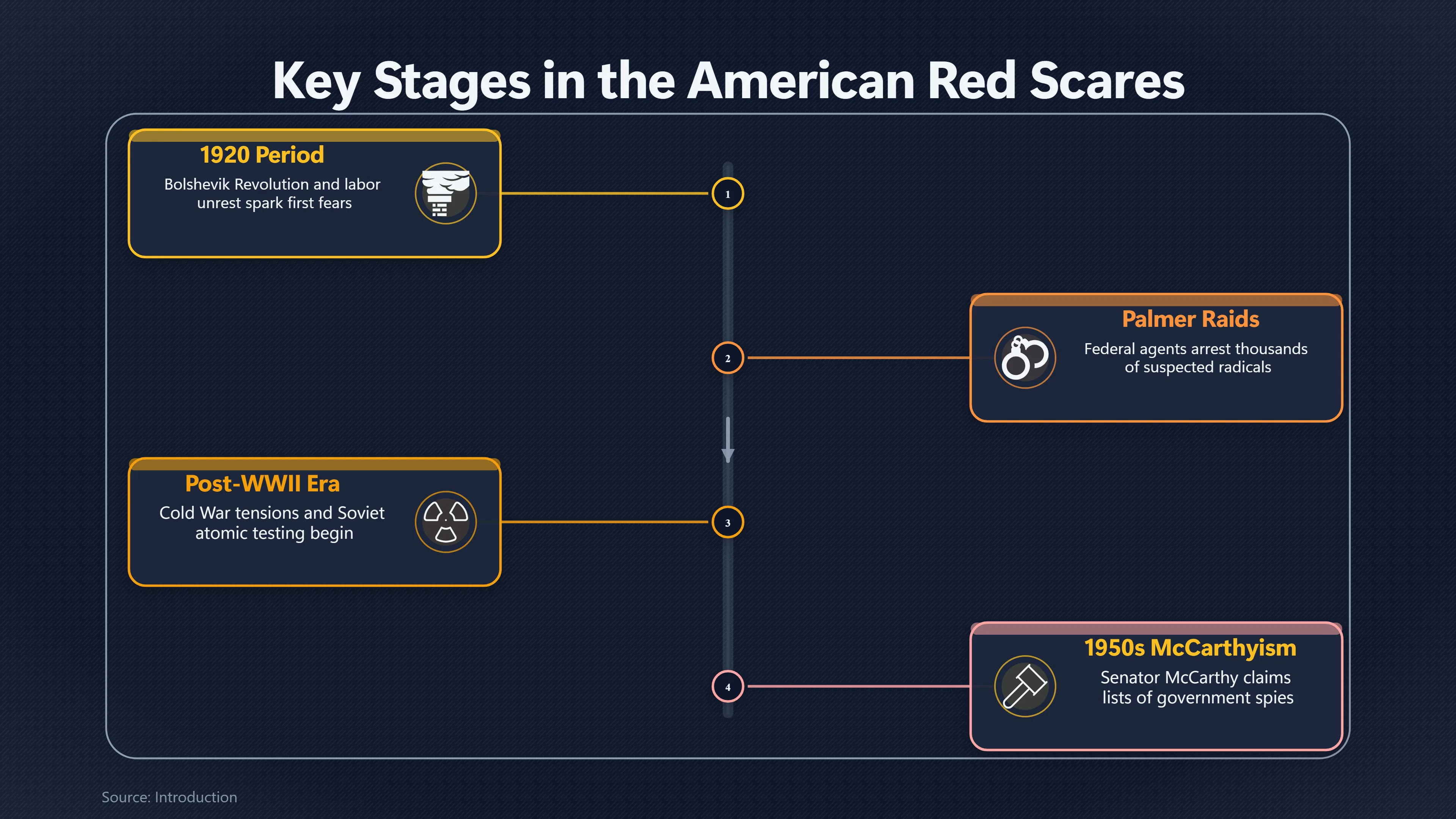
The First Red Scare developed between 1917 and 1920. The Bolshevik Revolution in Russia, widespread labour unrest, inflation after the First World War and a series of anarchist bombings convinced many Americans that a revolutionary uprising might be imminent. Newspapers frequently portrayed strikes and immigration from eastern and southern Europe as parts of a single international conspiracy, even when no such connection existed. Fear spread rapidly because several genuine acts of political violence occurred alongside rumours of much larger conspiracies.[HISTORY]history.comred scareRed Scare: Definition, Cold War & Facts | HISTORYJune 1, 2010…
Attorney General A. Mitchell Palmer became the public face of this response. Under his direction, federal agents and local police conducted the Palmer Raids, arresting thousands of suspected radicals. Many detainees were held without proper legal procedures, questioned without lawyers and, in some cases, deported despite little evidence that they had committed crimes. Later reviews found that most of those swept up had no involvement in violent plots. As courts and public opinion reacted against these abuses, the first Red Scare gradually subsided.[HISTORY]history.compalmer raids red scare tacticsWhat Were the Palmer Raids and What Tactics Did They Use? | HISTORYJanuary 22, 2026…
The Second Red Scare unfolded after the Second World War. Unlike the earlier episode, it occurred during the Cold War, when the United States faced a powerful geopolitical rival in the Soviet Union. Communist governments expanded across Eastern Europe and Asia, the Soviet Union tested an atomic bomb in 1949, and several genuine espionage cases—including those involving Klaus Fuchs, Julius and Ethel Rosenberg, and members of the Cambridge spy network in Britain—demonstrated that Soviet intelligence had successfully penetrated Western institutions. These events gave anti-Communist fears a factual foundation even as many political leaders exaggerated their scale and domestic implications.[HISTORY]history.comred scareRed Scare: Definition, Cold War & Facts | HISTORYJune 1, 2010…
When suspicion became proof of disloyalty
The defining feature of the Red Scares was not simply fear of communism but a new standard of evidence. Instead of proving that someone had committed espionage or sabotage, investigators increasingly treated indirect signs as sufficient grounds for suspicion.
These signs included:
- Membership in organisations later alleged to have Communist influence.
- Signing petitions alongside left-wing campaigners.
- Refusing to identify friends or colleagues before investigative committees.
- Attending political meetings years earlier.
- Invoking constitutional protections, particularly the Fifth Amendment, which many critics interpreted as an admission of guilt.
This approach transformed ordinary political association into potential evidence of conspiracy. The burden often shifted onto the accused to prove their loyalty rather than requiring investigators to demonstrate wrongdoing. Historians frequently describe this as guilt by association, one of McCarthyism’s defining characteristics.[The Free Speech Center]firstamendment.mtsu.eduOpen source on mtsu.edu.
The language of hidden enemies also made the alleged threat appear limitless. If Communists were assumed to operate secretly, then the absence of evidence could itself be interpreted as evidence of an especially successful conspiracy. This circular reasoning made accusations difficult to disprove.
McCarthyism and guilt by association
Although anti-Communist investigations predated him, Senator Joseph McCarthy became the era’s most recognisable figure after claiming in 1950 that he possessed lists of Communists inside the federal government. His allegations changed repeatedly and often lacked supporting evidence, yet they received enormous publicity because they appeared during a period of heightened Cold War anxiety.[HISTORY]history.comred scareRed Scare: Definition, Cold War & Facts | HISTORYJune 1, 2010…
McCarthy himself chaired Senate investigations, while the House Un-American Activities Committee (HUAC), established before his rise, pursued separate inquiries into alleged Communist influence in government, universities and especially the entertainment industry. Public hearings were often designed as much for political theatre as for fact-finding. Witnesses were pressed to identify colleagues, creating pressure to cooperate even when direct evidence was weak.[The Library of Congress]loc.govThe Library of Congress Red ScareThe Library of CongressRed Scare - Pointing Their Pens: Herblock and Fellow Cartoonists Confront the Issues | Exhibitions - Library of Co…
Hollywood became one of the most famous battlegrounds. Writers, directors and actors who refused to testify or answer questions about political beliefs were imprisoned for contempt of Congress or placed on industry blacklists. Some continued working under pseudonyms, while others saw careers collapse despite never being convicted of espionage or any related offence. The blacklist also encouraged studios to avoid hiring anyone considered politically controversial, extending punishment beyond formal legal proceedings.[The Library of Congress]loc.govThe Library of Congress Red ScareThe Library of CongressRed Scare - Pointing Their Pens: Herblock and Fellow Cartoonists Confront the Issues | Exhibitions - Library of Co…
Government employees faced similar pressures. President Harry Truman’s 1947 Federal Employee Loyalty Program introduced background investigations intended to identify security risks. Although relatively few employees were found to have engaged in espionage, many careers were damaged through suspicion, anonymous accusations or concerns about personal associations rather than proven misconduct. Civil-liberties organisations argued that these loyalty programmes weakened freedom of belief and association.[American Civil Liberties Union]aclu.orgAmerican Civil Liberties UnionACLU History: Rooting Out 'Subversives:' Paranoia and Patriotism in the McCarthy Era | American Civil Liber…
Real threats, exaggerated claims and lasting harm
Modern historians generally reject the simple claim that the Red Scares were either entirely justified or entirely imaginary. Both periods combined legitimate security concerns with disproportionate political responses.
Evidence released after the Cold War, including material from the Venona decrypts and Soviet archives, confirmed that Soviet intelligence had indeed operated extensive espionage networks inside the United States during and after the Second World War. Communist Party members occasionally assisted these efforts, although the relationship between party membership and espionage was far from automatic. Genuine espionage therefore cannot be dismissed as a myth.[The Free Speech Center]firstamendment.mtsu.eduOpen source on mtsu.edu.
At the same time, these genuine cases did not justify the much broader assumption that teachers, trade unionists, scientists, artists or civil-rights activists formed part of a coordinated conspiracy. The overwhelming majority of those investigated were never charged with espionage or violent offences. Careers were disrupted through blacklists, dismissals and public accusations that relied more on political beliefs or personal connections than demonstrable criminal acts.[American Civil Liberties Union]aclu.orgAmerican Civil Liberties UnionACLU History: Rooting Out 'Subversives:' Paranoia and Patriotism in the McCarthy Era | American Civil Liber…
The experience also encouraged self-censorship. Universities avoided controversial speakers, publishers became cautious about politically sensitive works, and individuals often concealed lawful beliefs or associations to protect employment. Fear therefore influenced behaviour even when formal punishment never occurred.

Why the politics of suspicion spread so easily
Several social pressures reinforced one another during both Red Scares.
First, international crises created genuine uncertainty. Revolutionary upheaval after 1917 and Cold War rivalry after 1945 encouraged people to interpret domestic disagreements through the lens of global ideological conflict.
Second, the media amplified dramatic accusations more readily than careful investigations. Headlines announcing hidden conspiracies attracted greater attention than later corrections or acquittals.
Third, political incentives rewarded those who appeared uncompromising. Public officials could demonstrate patriotism by demanding tougher investigations, while questioning those investigations risked being portrayed as sympathy for the enemy.
Finally, suspicion became socially contagious. Once colleagues, neighbours or institutions began distancing themselves from accused individuals, others often followed to avoid attracting suspicion themselves. This dynamic made the politics of accusation self-reinforcing, even when evidence remained weak.
Why the Red Scares still matter
The Red Scares continue to shape American political language. Terms such as McCarthyism, blacklisting, loyalty tests and guilt by association have become shorthand for situations in which suspicion substitutes for evidence or where disagreement is treated as proof of hidden allegiance.
Historians also view these episodes as cautionary examples of how democracies respond under pressure. The central lesson is not that security threats are always imaginary; the United States did face real acts of political violence and genuine Soviet espionage. Rather, the Red Scares illustrate how fear can expand beyond documented dangers until entire categories of people become suspect because of their opinions, friendships or past associations.
For that reason, the Red Scares occupy an important place within the broader history of American moral panics and collective fears. They demonstrate how societies can mistake ideological difference for covert conspiracy, allowing extraordinary measures to appear reasonable during moments of uncertainty before later generations judge them as excessive.[mtsu.edu]firstamendment.mtsu.eduOpen source on mtsu.edu.
Amazon book picks
Further Reading
Books and field guides related to When Suspicion Became Proof of Disloyalty. Use these as the next step if you want deeper reading beyond the article.


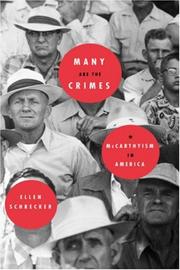
The paranoid style in American politics
Examines recurring patterns of conspiracy thinking.
Endnotes
1.
Source: history.com
Title: red scare
Link:https://www.history.com/articles/red-scare
Source snippet
Red Scare: Definition, Cold War & Facts | HISTORYJune 1, 2010...
Published: June 1, 2010
2.
Source: history.com
Title: Palmer Raids
Link:https://www.history.com/articles/palmer-raids
Source snippet
Palmer Raids - Definition, Purpose & 1920s | HISTORY...
3.
Source: history.com
Title: palmer raids red scare tactics
Link:https://www.history.com/articles/palmer-raids-red-scare-tactics
Source snippet
What Were the Palmer Raids and What Tactics Did They Use? | HISTORYJanuary 22, 2026...
Published: January 22, 2026
4.
Source: archives.gov
Title: Guide to House Records: Chapter 14 | National Archives
Link:https://www.archives.gov/legislative/guide/house/chapter-14.html
5.
Source: congress.gov
Title: ional Record | Congress.gov | Library of Congress
Link:https://www.congress.gov/congressional-record/volume-143/issue-123/extensions-of-remarks-section/article/E1767-2
6.
Source: youtube.com
Title: Cold War at Home: Mc Carthyism and the Red Scare
Link:https://www.youtube.com/watch?v=2mzYLf4YET4
Source snippet
History Brief: The Red Scare in the 1920s...
7.
Source: youtube.com
Link:https://www.youtube.com/watch?v=OdbClUYYaOU
Source snippet
The Cold War: McCarthyism and the Red Scare - Episode 19...
8.
Source: firstamendment.mtsu.edu
Link:https://firstamendment.mtsu.edu/article/mccarthyism/
9.
Source: aclu.org
Link:https://www.aclu.org/documents/aclu-history-rooting-out-subversives-paranoia-and-patriotism-mccarthy-era
Source snippet
American Civil Liberties UnionACLU History: Rooting Out 'Subversives:' Paranoia and Patriotism in the McCarthy Era | American Civil Liber...
10.
Source: loc.gov
Title: The Library of Congress Red Scare
Link:https://www.loc.gov/exhibits/pointing-their-pens-editorial-cartoons/red-scare.html
Source snippet
The Library of CongressRed Scare - Pointing Their Pens: Herblock and Fellow Cartoonists Confront the Issues | Exhibitions - Library of Co...
11.
Source: aclu.org
Link:https://www.aclu.org/news/lgbtq-rights/trump-administration-playbook-takes-tactics-from-lavender-scare-of-the-cold-war
Source snippet
June 9, 2026 — TRUMP ADMINISTRATION PLAYBOOK TAKES TACTICS FROM LAVENDER SCARE OF THE COLD WAR A McCarthy-era effort to report LGBTQ peop...
Published: June 9, 2026
12.
Source: guides.loc.gov
Link:https://guides.loc.gov/anarchism-and-radical-movements/huac
Source snippet
Un-American Activities Committee - Anarchism and Radical Movements: A Rare Materials Guide - Research Guides at Library of CongressJanuar...
13.
Source: firstamendment.mtsu.edu
Title: a mitchell palmer
Link:https://firstamendment.mtsu.edu/article/a-mitchell-palmer/
Source snippet
Mitchell Palmer | The First Amendment EncyclopediaAugust 10, 2023 — A. MITCHELL PALMER Written by, published on August 10, 2023 last upd...
Published: August 10, 2023
14.
Source: aclu.org
Title: The ACLU’s Fifth Column? | American Civil Liberties Union
Link:https://www.aclu.org/news/civil-liberties/the-aclus-fifth-column
15.
Source: encyclopedia.1914-1918-online.net
Title: red scare
Link:https://encyclopedia.1914-1918-online.net/article/red-scare/
16.
Source: historynewsnetwork.org
Title: The Myth of Mc Carthyism — History News Network
Link:https://www.historynewsnetwork.org/blog/10898
17.
Source: loc.gov
Title: A Climate of Fear
Link:https://www.loc.gov/exhibits/hope-for-america/a-climate-of-fear.html
18.
Source: loc.gov
Link:https://www.loc.gov/exhibits/herblocks-history/fire.html
19.
Source: trumanlibrary.gov
Link:https://www.trumanlibrary.gov/education/presidential-inquiries/house-un-american-activities-committee
20.
Source: osti.gov
Link:https://www.osti.gov/opennet/manhattan-project-history/Events/1945-present/venona.htm
21.
Source: loc.gov
Link:https://www.loc.gov/resource/llserialsetce.11501_00_00-002-0378-0000/?sp=2&st=grid
22.
Source: loc.gov
Link:https://www.loc.gov/resource/llserialsetce.11501_00_00-002-0378-0000/?sp=3&st=gallery
23.
Source: loc.gov
Link:https://www.loc.gov/item/47032542/
Additional References
24.
Source: visitthecapitol.gov
Link:https://www.visitthecapitol.gov/artifact/house-un-american-activities-committee-preparing-question-actor-gary-cooper-witness
25.
Source: billofrightsinstitute.org
Link:https://billofrightsinstitute.org/essays/the-postwar-red-scare/
26.
Source: youtube.com
Title: Red Scare & Palmer Raids Explained
Link:https://www.youtube.com/watch?v=cflAZfjY-2Y
Source snippet
Cold War at Home: McCarthyism and the Red Scare...
27.
Source: youtube.com
Link:https://www.youtube.com/watch?v=wxQ63VR1_GE
Source snippet
Red Scare & Palmer Raids Explained...
28.
Source: youtube.com
Title: The Cold War: Mc Carthyism and the Red Scare
Link:https://www.youtube.com/watch?v=EDuhoXWWd5s
29.
Source: fbi.gov
Title: world war cold war
Link:https://www.fbi.gov/history/history-of-the-fbi/world-war-cold-war
30.
Source: academic.oup.com
Link:https://academic.oup.com/edited-volume/61644/chapter-abstract/539843385
31.
Source: academic.oup.com
Link:https://academic.oup.com/edited-volume/61644/chapter-abstract/539843385?login=true
32.
Source: academic.oup.com
Link:https://academic.oup.com/edited-volume/61644/chapter-abstract/539901966
Topic Tree