Within Algeria
Why Colonial Algeria Feared Hidden Religious Revolt
French officials treated religious networks as possible channels of rebellion, turning uncertainty into surveillance and recurring conspiracy fears.
On this page
- Religious networks and real resistance
- How officials classified dangerous belief
- Rumour, race and colonial double standards
Page outline Jump by section
Introduction
French colonial rule in Algeria did not simply treat religion as a matter of personal belief. From the conquest in 1830 onwards, many officials came to regard Islamic religious networks as potential political organisations capable of organising rebellion across vast distances. This suspicion was not entirely invented: respected religious leaders, Sufi brotherhoods and local scholars sometimes did play important roles in resistance to colonial expansion. Yet the colonial administration often extended that reality into a much broader fear that ordinary religious gatherings, travelling teachers or pilgrimage links might conceal secret conspiracies.

The result was a distinctive form of colonial security thinking in which uncertainty itself became suspicious. Religious authority was mapped, classified and monitored, while rumours of hidden revolts repeatedly shaped official policy. Historians argue that this mindset influenced not only French rule but also later Algerian approaches to security, intelligence and the relationship between religion and political mobilisation.[cnrseditions.fr]cnrseditions.frCNRS Editions Algérie colonialeCNRS EditionsAlgérie coloniale - musulmans et chrétiens: le contrôle de l'Etat (1830-1914) - CNRS EditionsFebruary 12, 2015…
Religious networks and real resistance
French fears did not emerge in a vacuum. During the nineteenth century, conquest met determined resistance from many parts of Algeria. Religious figures could provide legitimacy, communication and social trust in communities where colonial authority remained weak.
Sufi brotherhoods, local religious teachers and respected holy families were particularly significant because they possessed networks that crossed tribal and regional boundaries. These connections could carry messages, mobilise supporters and help sustain resistance movements. From the colonial perspective, such networks resembled political organisations even when their primary functions were religious or educational.
This overlap between religion and resistance encouraged French administrators to interpret many forms of Islamic organisation through a military lens. Instead of distinguishing clearly between ordinary religious life and organised rebellion, officials increasingly assumed that the same institutions could rapidly become centres of insurrection. The result was continual surveillance of mosques, schools, religious endowments and influential scholars.[CNRS Editions]cnrseditions.frCNRS Editions Algérie colonialeCNRS EditionsAlgérie coloniale - musulmans et chrétiens: le contrôle de l'Etat (1830-1914) - CNRS EditionsFebruary 12, 2015…
How officials classified dangerous belief
Colonial administrators attempted to separate what they considered “acceptable” Islam from forms they believed threatened French authority. Rather than viewing Islam as a single religious tradition, they created administrative categories intended to distinguish loyal religious figures from potentially subversive ones.
The military’s Bureaux arabes, established during the conquest, became central to this effort. Their officers gathered intelligence, studied local customs, identified influential religious leaders and advised military commanders. Although presented as a means of understanding Algerian society, the bureaux also functioned as an extensive intelligence system designed to detect signs of resistance before rebellion emerged.[Wikipedia]WikipediaBureaux arabesBureaux arabes
This process reflected a wider colonial ambition to make religion legible to the state. Officials sought to identify who possessed influence, how authority was transmitted and which relationships might become politically dangerous. Modern historians describe this as part of the colonial “invention” or administrative construction of a regulated Muslim religious sphere under state supervision rather than simply recognising an existing religious hierarchy.[CNRS Editions]cnrseditions.frCNRS Editions Algérie colonialeCNRS EditionsAlgérie coloniale - musulmans et chrétiens: le contrôle de l'Etat (1830-1914) - CNRS EditionsFebruary 12, 2015…
Why conspiracy fears spread so easily
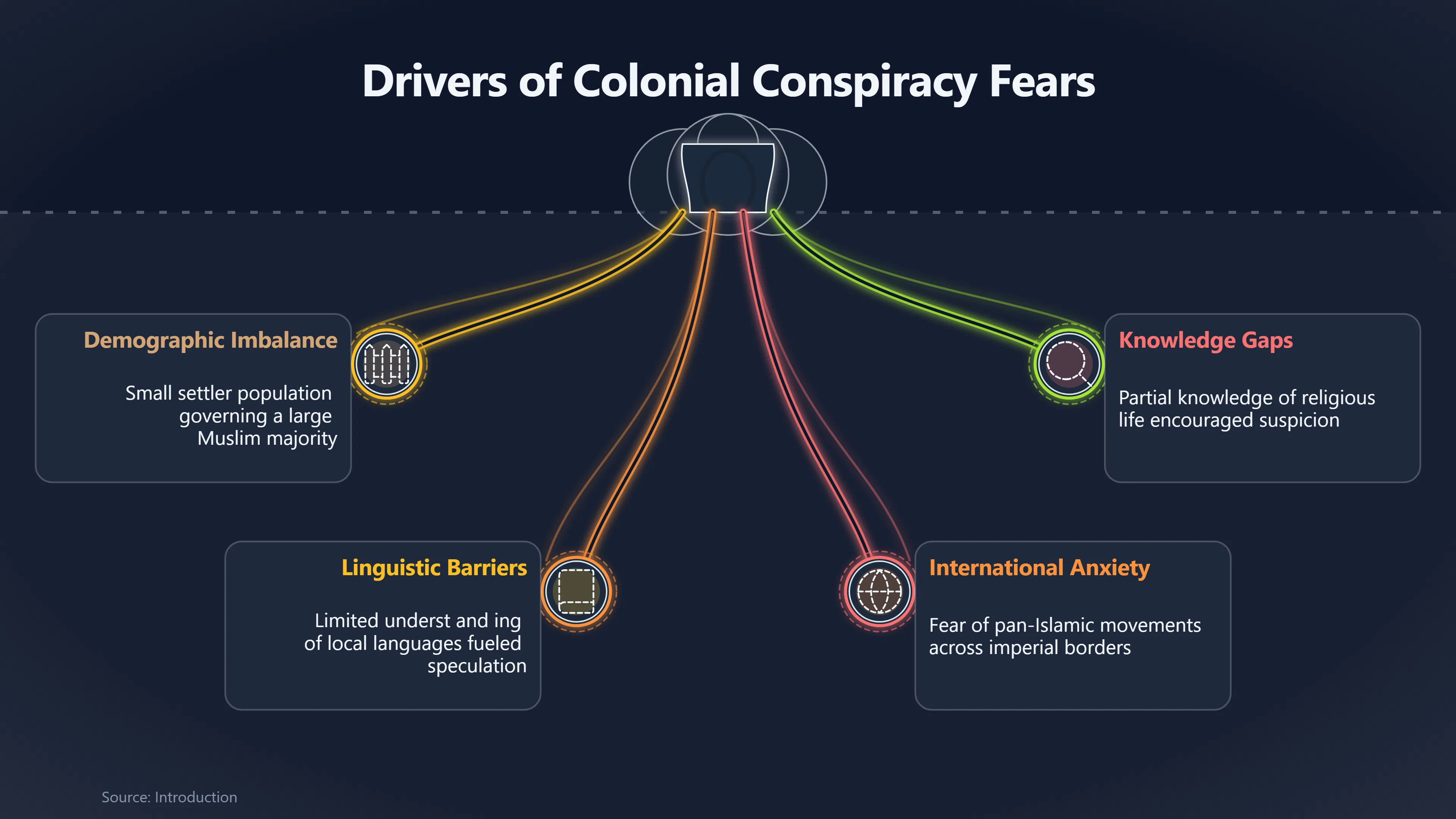
Colonial Algeria produced repeated rumours that hidden religious organisations were coordinating widespread revolt. Several factors made these fears persuasive to European administrators.
First, French rule rested on a relatively small settler population governing a much larger Muslim majority. Officials therefore worried constantly about surprise uprisings.
Secondly, many European administrators possessed only partial knowledge of local languages and religious life. Limited understanding encouraged speculation about secret meetings, coded messages and concealed chains of authority.
Finally, international developments heightened official anxiety. During the late nineteenth century, European governments increasingly discussed the possibility of pan-Islamic political movements linking Muslims across imperial borders. In Algeria, local religious activity could therefore be interpreted as evidence of a much larger international conspiracy, even when concrete proof remained weak.[CNRS Editions]cnrseditions.frCNRS Editions Algérie colonialeCNRS EditionsAlgérie coloniale - musulmans et chrétiens: le contrôle de l'Etat (1830-1914) - CNRS EditionsFebruary 12, 2015…

The Margueritte revolt and colonial interpretations
One revealing example came with the 1901 uprising at Margueritte. During the attack, some European settlers were compelled to recite the Islamic declaration of faith and adopt North African clothing. Several settlers who resisted were killed.
French officials interpreted these actions primarily as evidence of religious fanaticism. Investigators concentrated on whether the revolt’s leaders belonged to Sufi brotherhoods or wider pan-Islamic conspiracies, treating the religious symbolism as proof that hidden Islamic organisations had orchestrated the violence.
More recent historical research reaches a more complex conclusion. Jennifer Sessions argues that colonial investigators focused so heavily on supposed religious conspiracy that they overlooked the local social meanings of the forced conversion ritual and the everyday colonial relationships that shaped the uprising. Rather than demonstrating a vast secret religious network, the episode reflected both political resistance and the symbolic reversal of colonial power within a specific local context. Institut d’Études Avancées de Paris[paris-iea.fr]paris-iea.frInstitut d'Études Avancées de ParisMaking Settlers Muslim: Religion, Resistance and Everday Life in Nineteenth-Century French Algeria - I…
Rumour, race and colonial double standards
French officials frequently portrayed Algerian Muslims as especially vulnerable to rumour, superstition or religious excitement. Colonial writing often suggested that indigenous society was naturally prone to irrational collective behaviour.
Yet colonial society displayed its own recurrent panics. European settlers repeatedly feared hidden plots, coordinated massacres and invisible religious conspiracies. These anxieties often spread despite limited evidence and encouraged broader surveillance measures.
The double standard is striking. Rumours circulating among Algerians were often cited as proof of cultural backwardness, whereas rumours circulating among colonial authorities tended to be treated as prudent security concerns. Historians argue that this imbalance helped legitimise exceptional policing powers and justified close monitoring of religious institutions.[CNRS Editions]cnrseditions.frCNRS Editions Algérie colonialeCNRS EditionsAlgérie coloniale - musulmans et chrétiens: le contrôle de l'Etat (1830-1914) - CNRS EditionsFebruary 12, 2015…
Lasting influence on Algerian security thinking
The colonial state’s assumption that religious influence could rapidly become political rebellion survived well beyond the nineteenth century. French administrators developed extensive systems for recording religious authority, supervising clerics and distinguishing between supposedly loyal and dangerous forms of Islam.
Independent Algeria inherited institutions, archives and administrative habits shaped by this long history. Although the political context changed dramatically after independence, the idea that religious organisations might also function as political mobilisation networks remained influential in later security thinking.
For historians, this makes colonial Algeria an important example of how collective fear can become embedded within government itself. The central issue was not simply whether rebellion existed—it often did—but how uncertainty encouraged officials to interpret ordinary religious authority through the persistent expectation of hidden conspiracy. That expectation expanded surveillance, reshaped relations between state and religion, and left an institutional legacy extending far beyond the colonial period.[cnrseditions.fr]cnrseditions.frCNRS Editions Algérie colonialeCNRS EditionsAlgérie coloniale - musulmans et chrétiens: le contrôle de l'Etat (1830-1914) - CNRS EditionsFebruary 12, 2015…
Amazon book picks
Further Reading
Books and field guides related to Why Colonial Algeria Feared Hidden Religious Revolt. Use these as the next step if you want deeper reading beyond the article.

Muslim Saints and Mystics
Helps explain religious networks viewed suspiciously by colonial authorities.
The Wretched of the Earth
Explores colonial violence, resistance and political mobilisation.
Endnotes
1.
Source: cnrseditions.fr
Title: CNRS Editions Algérie coloniale
Link:https://www.cnrseditions.fr/catalogue/histoire/algerie-coloniale/
Source snippet
CNRS EditionsAlgérie coloniale - musulmans et chrétiens: le contrôle de l'Etat (1830-1914) - CNRS EditionsFebruary 12, 2015...
Published: February 12, 2015
2.
Source: Wikipedia
Title: Bureaux arabes
Link:https://en.wikipedia.org/wiki/Bureaux_arabes
3.
Source: paris-iea.fr
Link:https://www.paris-iea.fr/en/fellows/making-settlers-muslim-religion-resistance-and-everday-life-in-nineteenth-century-french-algeria-2
Source snippet
Institut d'Études Avancées de ParisMaking Settlers Muslim: Religion, Resistance and Everday Life in Nineteenth-Century French Algeria - I...
4.
Source: paris-iea.fr
Link:https://www.paris-iea.fr/fr/les-publications/making-settlers-muslim-religion-resistance-and-everday-life-in-nineteenth-century-french-algeria
Additional References
5.
Source: academic.oup.com
Link:https://academic.oup.com/fh/article-abstract/33/2/259/5424975
Source snippet
OUP AcademicMaking Settlers Muslim: Religion, Resistance and Everday Life in Nineteenth-Century French Algeria | French History | Oxford...
6.
Source: asjp.cerist.dz
Link:https://asjp.cerist.dz/en/article/227586
Source snippet
Arab offices and French settlement policy in Algeria Constantine province as a modelJune 24, 2023 — مجلة طبنـــة للدراسات العلمية الأكادي...
Published: June 24, 2023
7.
Source: researchportal.helsinki.fi
Link:https://researchportal.helsinki.fi/en/publications/nonsense-and-the-senses-french-sources-of-knowledge-in-colonial-a/
Source snippet
and the Senses: French Sources of Knowledge in Colonial Algeria, 1846–1871 - University of Helsinki Research PortalJune 9, 2023 — NONSENS...
Published: June 9, 2023
8.
Source: asjp.cerist.dz
Link:https://asjp.cerist.dz/en/article/143936
Source snippet
g of French Colonialism in Southern Algeria during the Nineteenth Century...
9.
Source: academic.oup.com
Title: Charon had set
Link:https://academic.oup.com/book/45521/chapter/396007150
Source snippet
and Caesar: Missionaries and Militaires in Colonial Algeria | Sacred Rivals: Catholic Missions and the Making of Islam in Nineteenth-Cent...
10.
Source: youtube.com
Title: How France Took So Much of Africa (Ep 1)
Link:https://www.youtube.com/watch?v=sgWtth7BajY
Source snippet
French conquest of Algeria 1830 - History of French victory Pacification of Algeria...
11.
Source: youtube.com
Title: The Sufi Muslim Warrior Who Protected Christians
Link:https://www.youtube.com/watch?v=zqjgPr3zlBE
Source snippet
Emir Abdelkader: The Algerian warrior whom his enemies came to respect...
12.
Source: asjp.cerist.dz
Link:https://asjp.cerist.dz/en/article/296190
Source snippet
RELIGIOUS ISSUE IN ALGERIA THROUGH THE DOMINANCE OF THE DIRECTORATE OF CIVIL AFFAIRS DURING THE COLONIAL PERIOD (1830/1947)June 10, 2026...
Published: June 10, 2026
13.
Source: carnegieendowment.org
Link:https://carnegieendowment.org/research/2021/06/islamic-institutions-in-arab-states-mapping-the-dynamics-of-control-co-option-and-contention?center=china
14.
Source: cambridge.org
Link:https://www.cambridge.org/core/journals/journal-of-african-history/article/abs/murids-surveillance-and-collaboration/959E4726C2FA19894D1C9B2FB10E9409
Topic Tree