When Fear and Faith Spread Across Nicaragua
Nicaragua’s clearest contribution to the history of contagious belief is not a classic witch trial or a single notorious “cult”. It is a more complicated set of episodes in which bodily distress, supernatural explanation, religious vision and political fear overlap.
Page outline Jump by section
Introduction
A second important episode is the reported Marian apparition at Cuapa in 1980. It began as one man’s religious experience but became a nationally significant story during revolutionary upheaval and approaching civil war. Church approval, anti-Marxist interpretations and Sandinista suspicion turned a local miracle claim into a struggle over who could define Nicaragua’s moral future. In more recent years, government portrayals of priests as terrorists, coup plotters and agents of evil have shown the same underlying mechanism in a different form: collective danger is attached to a religious enemy, then used to justify extraordinary control.[uoregon.edu]scholarsbank.uoregon.eduScholars' BanklScholars' BankSeptember 23, 2008 — by AM LE CHEVALLIER · 2006 — The novel Bernardo and the Virgin by Latino writer Silvio Sirias retells…
Grisi siknis: when distress moves through a community
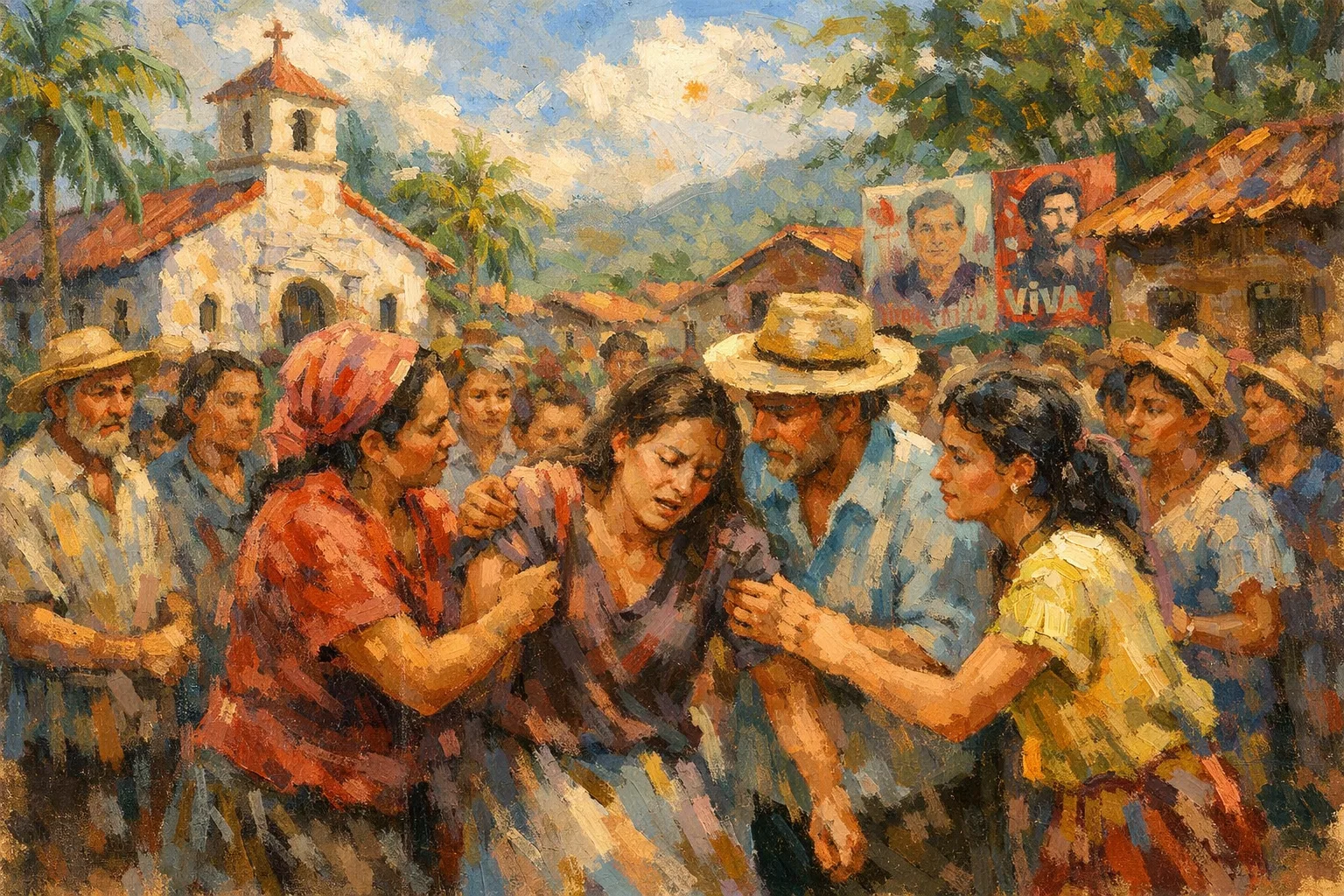
Grisi siknis is often translated as “crazy sickness”, although that phrase can sound dismissive in English. It occurs principally among the Miskitu people of Nicaragua and Honduras and has been recorded by anthropologists for decades. A typical episode begins with anxiety, headache, dizziness, weakness or fear. The affected person may then fall, enter an altered state, run away, struggle against unseen attackers or later remember little of what happened. During some outbreaks, one sufferer appears to identify or “name” the next person who will be affected, helping to create a strong local sense that the condition is contagious.[springer.com]link.springer.comLink Grisi Siknis in Miskito Culture | Springer Nature LinkSpringer LinkGrisi Siknis in Miskito Culture | Springer Nature LinkJuly 14, 1985 — by PA Dennis · Cited by 44 — Grisi Siknis in Miskito C…
The symptoms are real, sometimes dangerous and not adequately described as play-acting. People may injure themselves while running, resist restraint or experience prolonged periods of fear and exhaustion. Reports have sometimes added lurid details about superhuman strength, strange objects being vomited or sexual encounters with spirits. Some of these descriptions come from individual testimonies or journalistic retellings and should not be treated as universal features of the illness. The more consistent pattern is one of intense embodied distress interpreted through locally meaningful ideas about spirits, witchcraft, envy and interpersonal attack.[pitt.edu]d-scholarship.pitt.eduOpen source on pitt.edu.
Outbreaks have periodically attracted national and foreign attention. In late 2003, journalists reported that a Miskitu settlement was struggling with an extensive cluster of cases. Further episodes were reported around Puerto Cabezas, Siuna and nearby communities in 2009, including attacks among students. Contemporary accounts linked the outbreaks with poverty, insecurity and the disruption left by Hurricane Felix in 2007, although no single trigger was established.[theguardian.com]theguardian.comThe Guardian Nicaragua village in grip of madness | World newsThe Guardian Nicaragua village in grip of madness | World news
Why calling it “mass hysteria” is not enough
From a psychiatric perspective, grisi siknis resembles mass psychogenic illness: symptoms spread through a socially connected group without a single infectious, toxic or neurological agent explaining the pattern. Fear, observation, expectation and emotional contagion may influence who becomes ill and how symptoms develop. This comparison is useful because it acknowledges that psychological and social processes can produce genuine physical suffering.[nih.gov]pmc.ncbi.nlm.nih.govOpen source on nih.gov.
Yet the older expression “mass hysteria” carries heavy baggage. It has historically been used to belittle women, indigenous people and patients whose symptoms medicine could not easily explain. It can also suggest that an entire community is irrational, when the evidence points instead to individuals expressing distress through a culturally recognised pattern. Grisi siknis does not simply spread because people are credulous. It spreads within a shared system that tells sufferers what an attack looks like, why it has happened and which healers or rituals may stop it.
Anthropological interpretation therefore treats the condition as a cultural idiom of distress: a socially intelligible way in which suffering becomes visible. Earlier research connected attacks with the difficult transition from adolescence to adulthood, especially for girls negotiating expectations around sexuality, marriage, respectability and obedience. More recent work places greater emphasis on gender-based violence, economic marginalisation, political abandonment and structural inequality in eastern Nicaragua. These explanations need not exclude one another. A recognised illness form can provide a language for several kinds of pressure at once.[springer.com]link.springer.comLink Grisi Siknis in Miskito Culture | Springer Nature LinkSpringer LinkGrisi Siknis in Miskito Culture | Springer Nature LinkJuly 14, 1985 — by PA Dennis · Cited by 44 — Grisi Siknis in Miskito C…
This perspective also explains why a purely biomedical response may fail. Families may understand an attack as the work of a sorcerer or spirit and seek treatment from a traditional healer. A clinician who simply declares that nothing physical is wrong risks increasing fear or appearing to deny the sufferer’s experience. Conversely, accepting every accusation of supernatural attack as literal can intensify suspicion and expose alleged sorcerers to hostility. The most careful response combines medical investigation, protection from injury, psychological support and respect for local healing practices without endorsing blame or persecution.
Cuapa: a miracle claim inside a revolution
In 1980, Bernardo Martínez, a church sacristan in the rural community of Cuapa, said that he first saw an unusual light around a statue of the Virgin Mary and later experienced a series of apparitions. According to accounts accepted within the local Catholic tradition, the figure urged prayer, reconciliation and personal responsibility for peace. The reported appearances occurred shortly after the Sandinista revolution had overthrown the Somoza dictatorship and while Nicaragua was moving towards a prolonged conflict between the new government and the US-backed Contra forces.[Mary Pages]marypages.comour lady of cuapa also known as our lady of nicaragua enour lady of cuapa also known as our lady of nicaragua en
The timing made a purely devotional interpretation almost impossible. One reported instruction concerned destroying books considered sinful or hostile to God. In Nicaragua’s polarised climate, many Catholics understood this as a warning against Marxist literature. Sandinista supporters, in turn, suspected that the apparition story was being used as religious propaganda against the revolution. Hostile descriptions of the vision as a “Virgin of the Contras” reflected the fear that sacred authority was being recruited into a political struggle.[Wikipedia]WikipediaSan Francisco de CuapaSan Francisco de Cuapa
The local bishop issued a favourable judgement in November 1982, permitting Catholic devotion associated with the reported appearances. That decision distinguishes Cuapa from an uncontrolled miracle panic in which rumours multiply without institutional restraint. The Church did not merely observe a popular craze from outside; it investigated the claim, endorsed its devotional value and helped preserve it as part of Nicaraguan Catholic memory. At the same time, ecclesiastical approval establishes a religious judgement, not scientific proof that a supernatural being physically appeared.[Mary Pages]marypages.comour lady of cuapa also known as our lady of nicaragua enour lady of cuapa also known as our lady of nicaragua en
Cuapa became culturally important because its central message could be read in different ways. Believers heard a call to prayer, conversion and peacemaking. Anti-Sandinista Catholics could interpret warnings about godless books and national suffering as condemnation of revolutionary ideology. Government sympathisers could see an attempt to weaken a new political order by presenting it as spiritually dangerous. The apparition therefore functioned as both a devotional event and a contested national symbol.
It would be misleading to call the Cuapa following a cult. Martínez did not establish an isolated authoritarian community, demand personal obedience or create a separate church. The movement remained within institutional Catholicism and centred on pilgrimage and Marian devotion. “Apparition movement”, “devotional movement” or “miracle claim” are more accurate descriptions. The episode belongs in the history of collective belief not because its followers were unusually irrational, but because a private vision acquired public force through war, media, church authority and political interpretation.
Religion and the manufacture of political enemies
Nicaragua’s modern history shows that panic language does not arise only from crowds or marginal religious groups. States can manufacture their own threatening categories. During the 2018 uprising, Catholic churches and clergy sometimes sheltered injured demonstrators, documented violence or helped mediate talks between the government and opposition. The protests had begun over social-security reforms but widened after lethal repression into a broader challenge to President Daniel Ortega’s rule. United Nations investigators documented hundreds of deaths, thousands of injuries and extensive arbitrary detention.[OHCHR]ohchr.orgHumanRightsViolationsNicaraguaApr Aug2018 ENHuman rights violations and abuses18 Aug 2018 — “The violence and repression seen in Nicaragua since demonstrations began in April a…
As relations deteriorated, Ortega and Vice-President Rosario Murillo increasingly described critical priests as coup plotters, terrorists, killers or agents of evil. A United Nations group of experts concluded that such language formed part of escalating repression against the Catholic Church and could encourage violence by transforming religious critics into existential enemies of the nation. Clergy were subsequently arrested, prosecuted, expelled or forced into exile, while public processions and religious organisations faced growing restrictions.[OHCHR]ohchr.orgA/HRC/55/27 Advance unedited versionby JM Simon · 2024 — Since April 2018, the Catholic Church has been increasingly repressed.13 Au…
This was not a conventional moral panic in which frightened citizens spontaneously demanded action against a supposed hidden menace. It was closer to state-directed threat construction. Officials took genuine political conflict and presented a broad religious institution as part of a unified terrorist or foreign conspiracy. That framing blurred distinctions between armed conspiracy, peaceful criticism, humanitarian assistance and ordinary worship.
The effects were concrete. Surveillance around churches, restrictions on sermons, arrests, expulsions and the cancellation of religious organisations reduced civic space and encouraged self-censorship. Reports published in 2025 and 2026 indicated that the pressure had continued, including monitoring of services and targeting of Catholic, evangelical and indigenous Moravian communities.[USCIRF]uscirf.govRepression of Religious Freedom in Latin America'sRepression of Religious Freedom in Latin America's
This history also complicates easy assumptions about Nicaragua’s religious politics. In the 1980s, some Sandinistas feared that Catholic miracle stories and conservative clergy were mobilising counter-revolution. Decades later, an Ortega-led government portrayed much of the Church as a counter-revolutionary conspiracy. In both periods, religion became a screen onto which fears of foreign control, social disorder and national betrayal were projected.
What the evidence does not support
Nicaragua is sometimes forced into familiar international templates: Latin American witch hunts, secretive jungle cults, mass possession epidemics or apocalyptic sects. The available evidence does not justify presenting the country as the scene of a large, well-documented historical witch panic comparable with early modern Europe or colonial Salem. Nor is there strong evidence for a single nationally dominant satanic panic matching those experienced in the United States and Britain during the 1980s and 1990s.
Belief in sorcery, spirits, possession and miraculous intervention certainly exists, but belief alone is not a panic. A panic requires something more: rapid social amplification, a clearly identified danger, pressure for exceptional action, and usually some mismatch between the claims being circulated and the evidence supporting them. That distinction matters because supernatural explanations may coexist with real violence, poverty, illness or political repression.
Grisi siknis, for example, should not be reduced to a story of villagers mistakenly believing in witches. The attacks are genuine experiences of distress, while supernatural narratives help organise and communicate them. Cuapa should not be reduced either to divine fact or cynical propaganda. It is possible to document what Martínez reported, what Church authorities decided and how political groups interpreted the story without claiming to settle its supernatural truth.
Similarly, the government’s attacks on clergy cannot be dismissed as imaginary simply because officials used conspiratorial language. Nicaragua experienced a real political conflict, and some religious leaders openly opposed state violence. The panic mechanism lay in treating diverse critics as members of one demonic, terrorist or foreign-controlled plot and then using that category to justify repression.
Why these episodes spread
Although Nicaragua’s cases differ, several recurring conditions help explain why emotionally powerful beliefs become collective realities.
Severe uncertainty is central. Grisi siknis outbreaks have appeared in communities facing poverty, disaster, gendered insecurity and limited access to trusted healthcare. Cuapa emerged during revolutionary transformation and approaching war. Anti-clerical conspiracy rhetoric intensified during a national political crisis. When ordinary explanations seem inadequate, stories of spirits, miracles or hidden plots make uncertainty easier to interpret.
Existing cultural scripts shape the form that fear takes. Miskitu sufferers do not simply display undifferentiated stress; attacks follow recognisable expectations about running, spirits, sorcery and contagion. Catholic Nicaragua already possessed a rich tradition of Marian devotion, allowing one man’s reported visions to become legible as a national religious event. Sandinista history provided later officials with a ready language of counter-revolution, imperial interference and betrayal.
Trusted intermediaries give claims authority. Traditional healers, relatives and earlier sufferers influence understandings of grisi siknis. Bishops and priests helped establish Cuapa as an approved devotion. Presidents, police and state media amplified allegations against the Church. The social position of the messenger can matter as much as the original claim.
Repetition turns interpretation into evidence. When several students experience similar attacks, observers see proof of contagion. When pilgrims repeat an apparition narrative, its details stabilise and acquire historical weight. When officials repeatedly call priests terrorists, the allegation may begin to seem self-evident to supporters even without evidence of a coordinated clerical conspiracy.
How Nicaragua’s cases should be understood
The most useful lesson is that collective belief is rarely separate from material conditions. Grisi siknis is simultaneously bodily illness, emotional communication, cultural performance and a possible response to structural harm. Cuapa is simultaneously religious devotion, personal testimony, institutional judgement and political symbol. The campaign against critical churches is simultaneously propaganda, moral classification and coercive state policy.
These categories should therefore remain distinct:
- Mass psychogenic illness describes the spread of real symptoms through psychological and social processes.
- Cultural idiom of distress emphasises that suffering takes forms recognised within a particular society.
- Miracle or apparition movement describes collective devotion built around a claimed supernatural event.
- Moral panic involves an exaggerated or simplified public threat attached to a person or group.
- Political demonisation occurs when authorities portray opponents as fundamentally evil, conspiratorial or outside the legitimate community.
- Persecution refers to the concrete punishments that may follow, including violence, detention, expulsion or suppression of worship.
Using the right term protects both accuracy and people. It prevents patients from being mocked as hysterical, believers from being casually branded cult members, indigenous explanations from being treated as primitive curiosities, and state repression from being disguised as a mere clash of opinions.

Nicaragua’s lasting place in the history of contagious belief
Nicaragua’s most revealing cases are not stories in which an entire population suddenly lost its reason. They show how people make danger understandable when life is already unstable. A frightened young woman’s body, a sacristan’s vision and a government’s accusation against priests belong to very different moral worlds, yet each becomes socially powerful through shared expectations, trusted authorities and repeated narratives.
Grisi siknis remains especially significant because it challenges the boundary between mind, body and culture. It demonstrates that symptoms can spread socially without being invented, and that an effective explanation must take both clinical evidence and indigenous meaning seriously. Cuapa shows how a miracle account can become inseparable from revolution, war and national identity. The post-2018 campaign against religious opponents shows the darker reverse: those in power can cultivate collective fear deliberately and turn symbolic accusations into punishment.
Taken together, these episodes make Nicaragua an important case for understanding why “mass hysteria” is often too blunt a phrase. The deeper history concerns embodied distress, contested miracles, political mythmaking and the struggle to decide whose interpretation of fear will become reality.
Amazon book picks
Further Reading
Books and field guides related to When Fear and Faith Spread Across Nicaragua. Use these as the next step if you want deeper reading beyond the article.
Blood of Brothers
First published 1991. Subjects: History, Politics and government, Nicaragua, history, New York Times reviewed.

The spirits and the law
First published 2011. Subjects: Religion, Religion and law, Nationalism, Vodou, History.
Endnotes
1.
Source: link.springer.com
Title: Link Grisi Siknis in Miskito Culture | Springer Nature Link
Link:https://link.springer.com/chapter/10.1007/978
Source snippet
Springer LinkGrisi Siknis in Miskito Culture | Springer Nature LinkJuly 14, 1985 — by PA Dennis · Cited by 44 — Grisi Siknis in Miskito C...
Published: July 14, 1985
2.
Source: camjol.info
Link:https://camjol.info/index.php/WANI/user/setLocale/en?source=%2Findex.php%2FWANI%2Farticle%2Fview%2F19777%3FarticlesBySimilarityPage%3D20
Source snippet
Grisi siknis among the Miskitos | Wani1 Oct 1999 — Grisi siknis is an illness syndrome which occurs only among the Miskitu people o...
3.
Source: ohchr.org
Link:https://www.ohchr.org/sites/default/files/A_HRC_55_27_AdvanceUneditedVersion1_0.pdf
Source snippet
A/HRC/55/27 Advance unedited versionby JM Simon · 2024 — Since April 2018, the Catholic Church has been increasingly repressed.13 Au...
Published: April 2018
4.
Source: ohchr.org
Title: HumanRightsViolationsNicaraguaApr Aug2018 EN
Link:https://www.ohchr.org/Documents/Countries/NI/HumanRightsViolationsNicaraguaApr_Aug2018_EN.pdf
Source snippet
Human rights violations and abuses18 Aug 2018 — “The violence and repression seen in Nicaragua since demonstrations began in April a...
5.
Source: d-scholarship.pitt.edu
Link:https://d-scholarship.pitt.edu/concern/etds/dd97255f-7b87-4b38-af24-1ecd72eb515d
6.
Source: pmc.ncbi.nlm.nih.gov
Link:https://pmc.ncbi.nlm.nih.gov/articles/PMC7396040/
7.
Source: Wikipedia
Title: Mass psychogenic illness
Link:https://en.wikipedia.org/wiki/Mass_psychogenic_illness
8.
Source: researchgate.net
Link:https://www.researchgate.net/publication/361621865_Grisi_Siknis_A_cultural_idiom_of_gender-based_violence_and_structural_inequalities_in_eastern_Nicaragua
9.
Source: Wikipedia
Title: San Francisco de Cuapa
Link:https://en.wikipedia.org/wiki/San_Francisco_de_Cuapa
10.
Source: Wikipedia
Title: List of Marian apparitions
Link:https://en.wikipedia.org/wiki/List_of_Marian_apparitions
11.
Source: ohchr.org
Title: A HRC 46 21 Advance Edited Version
Link:https://www.ohchr.org/en/HRBodies/HRC/RegularSessions/Session46/Documents/A_HRC_46_21_AdvanceEditedVersion.pdf
12.
Source: ohchr.org
Title: a hrc 58 26 auv en
Link:https://www.ohchr.org/sites/default/files/documents/hrbodies/hrcouncil/grhe-nicaragua/a-hrc-58-26-auv-en.pdf
13.
Source: uscirf.gov
Title: Repression of Religious Freedom in Latin America’s
Link:https://www.uscirf.gov/sites/default/files/2025-11/2025%20Issue%20Update%20Patterns%20of%20Religious%20Repression%20in%20Latin%20America.pdf
14.
Source: uscirf.gov
Title: 2025 USCIRF Annual Report
Link:https://www.uscirf.gov/sites/default/files/2025-03/2025%20USCIRF%20Annual%20Report.pdf
15.
Source: uscirf.gov
Title: USCIRF 2026 AR 3326 NEW
Link:https://www.uscirf.gov/sites/default/files/2026-03/USCIRF_2026_AR_3326_NEW.pdf
16.
Source: 2021-2025.state.gov
Link:https://2021-2025.state.gov/reports/2023-report-on-international-religious-freedom/nicaragua/
17.
Source: Wikipedia
Title: Tanganyika laughter epidemic
Link:https://en.wikipedia.org/wiki/Tanganyika_laughter_epidemic
18.
Source: Wikipedia
Title: List of mass panic cases
Link:https://en.wikipedia.org/wiki/List_of_mass_panic_cases
19.
Source: Wikipedia
Title: Moral panic
Link:https://en.wikipedia.org/wiki/Moral_panic
20.
Source: Wikipedia
Title: Satanic panic
Link:https://en.wikipedia.org/wiki/Satanic_panic
21.
Source: Wikipedia
Title: Marian apparition
Link:https://en.wikipedia.org/wiki/Marian_apparition
22.
Source: Wikipedia
Link:https://en.wikipedia.org/wiki/Millenarianism
23.
Source: Wikipedia
Title: Grisi siknis
Link:https://en.wikipedia.org/wiki/Grisi_siknis
24.
Source: uscirf.gov
Link:https://www.uscirf.gov/countries/nicaragua
25.
Source: uscirf.gov
Title: Ryan Berg Testimony
Link:https://www.uscirf.gov/sites/default/files/Ryan%20Berg%20Testimony.pdf
26.
Source: uscirf.gov
Title: hearing forb violations against christians abroad
Link:https://www.uscirf.gov/events/hearing-forb-violations-against-christians-abroad
27.
Source: uscirf.gov
Link:https://www.uscirf.gov/countries/russia
28.
Source: uscirf.gov
Title: religious freedom and rule law syria
Link:https://www.uscirf.gov/news-room/releases-statements/religious-freedom-and-rule-law-syria
29.
Source: uscirf.gov
Link:https://www.uscirf.gov/countries/algeria
30.
Source: uscirf.gov
Link:https://www.uscirf.gov/sites/default/files/2026%20Nicaragua%20Country%20Update.pdf
31.
Source: uscirf.gov
Title: 2026 recommendations
Link:https://www.uscirf.gov/countries/2026-recommendations
32.
Source: researchgate.net
Link:https://www.researchgate.net/publication/292145151_Deconstructing_a_Modern_Witch_Hunt_Satanic_Cults_Ritual_Abuse_and_Moral_Panic
33.
Source: researchgate.net
Link:https://www.researchgate.net/publication/268694182_Outbreak_of_Mass_Psychogenic_Illness_at_a_High_School_Amhara_Region_Ethiopia_April_2010
34.
Source: researchgate.net
Title: 372420937 Mass Psychogenic Illness Editorial
Link:https://www.researchgate.net/publication/372420937_Mass_Psychogenic_Illness_Editorial
35.
Source: ohchr.org
Title: a hrc 58 crp 8 en
Link:https://www.ohchr.org/sites/default/files/documents/hrbodies/hrcouncil/sessions-regular/session58/a-hrc-58-crp-8-en.pdf
36.
Source: spcommreports.ohchr.org
Link:https://spcommreports.ohchr.org/TmSearch/Mandates?m=31
37.
Source: ohchr.org
Title: a hrc 55 2 aev
Link:https://www.ohchr.org/sites/default/files/documents/hrbodies/hrcouncil/sessions-regular/session55/advance-versions/a-hrc-55-2-aev.pdf
38.
Source: spcommreports.ohchr.org
Link:https://spcommreports.ohchr.org/TmSearch/Mandates?m=46
39.
Source: spcommreports.ohchr.org
Link:https://spcommreports.ohchr.org/TmSearch/Mandates?m=25
40.
Source: ohchr.org
Title: a hrc 54 2 aev
Link:https://www.ohchr.org/sites/default/files/documents/hrbodies/hrcouncil/sessions-regular/session54/advance-versions/a-hrc-54-2-aev.pdf
41.
Source: history.com
Title: what was satanic panic 1980s
Link:https://www.history.com/articles/what-was-satanic-panic-1980s
42.
Source: history.com
Title: salem witch trials hysteria factors
Link:https://www.history.com/articles/salem-witch-trials-hysteria-factors
43.
Source: revistas.bicu.edu.ni
Link:https://revistas.bicu.edu.ni/index.php/wani/article/view/501?articlesBySimilarityPage=5
44.
Source: journals.sagepub.com
Link:https://journals.sagepub.com/doi/abs/10.1177/13634615221098310
Source snippet
Sage JournalsGrisi Siknis: A cultural idiom of gender-based violence and...by MD Venegas · 2022 · Cited by 5 — For the Miskitu of Nicara...
45.
Source: scholarsbank.uoregon.edu
Title: Scholars’ Bankl
Link:https://scholarsbank.uoregon.edu/bitstreams/f7b90fb1-76a5-43d8-a747-0970ce1f7ddb/download
Source snippet
Scholars' BankSeptember 23, 2008 — by AM LE CHEVALLIER · 2006 — The novel Bernardo and the Virgin by Latino writer Silvio Sirias retells...
Published: September 23, 2008
46.
Source: pubmed.ncbi.nlm.nih.gov
Link:https://pubmed.ncbi.nlm.nih.gov/35765241/
Source snippet
It is characterized by numerous psychosomatic symptoms, including headache, fear...Read more...
47.
Source: theguardian.com
Title: The Guardian Nicaragua village in grip of madness | World news
Link:https://www.theguardian.com/world/2003/dec/17/1
48.
Source: americasquarterly.org
Title: daily focus nicaraguas supernatural epidemic
Link:https://americasquarterly.org/blog/daily-focus-nicaraguas-supernatural-epidemic/
49.
Source: marypages.com
Title: our lady of cuapa also known as our lady of nicaragua en
Link:https://www.marypages.com/our-lady-of-cuapa-also-known-as-our-lady-of-nicaragua-en.html
50.
Source: pmc.ncbi.nlm.nih.gov
Link:https://pmc.ncbi.nlm.nih.gov/articles/PMC11023688/
51.
Source: pmc.ncbi.nlm.nih.gov
Link:https://pmc.ncbi.nlm.nih.gov/articles/PMC3536509/
52.
Source: pubmed.ncbi.nlm.nih.gov
Link:https://pubmed.ncbi.nlm.nih.gov/9443001/
53.
Source: pmc.ncbi.nlm.nih.gov
Link:https://pmc.ncbi.nlm.nih.gov/articles/PMC10106894/
54.
Source: divinemysteries.info
Link:https://www.divinemysteries.info/tag/nicaragua/
55.
Source: theguardian.com
Title: was ripon school gripped by mass psychogenic illness
Link:https://www.theguardian.com/science/2015/nov/14/was-ripon-school-gripped-by-mass-psychogenic-illness
56.
Source: theguardian.com
Title: carol morley the falling mass hysteria is a powerful group activity
Link:https://www.theguardian.com/film/2015/mar/29/carol-morley-the-falling-mass-hysteria-is-a-powerful-group-activity
57.
Source: theguardian.com
Title: chatgpt driving rise in reports of satanic organised ritual abuse uk experts say
Link:https://www.theguardian.com/technology/2026/mar/08/chatgpt-driving-rise-in-reports-of-satanic-organised-ritual-abuse-uk-experts-say
58.
Source: ssoar.info
Link:https://www.ssoar.info/ssoar/handle/document/85315
Additional References
59.
Source: govinfo.gov
Link:https://www.govinfo.gov/content/pkg/CPRT-108JPRT20429/html/CPRT-108JPRT20429.htm
60.
Source: youtube.com
Title: ‘Grisi Siknis’ illness grips indigenous Nicaraguan communities
Link:https://www.youtube.com/watch?v=7i-vbei4D4Q
Source snippet
One of the IMPORTANT marian apparition: Our Lady of Cuapa...
61.
Source: youtube.com
Title: Grisi Siknis: Demonic Possession or Mind-Alteration?
Link:https://www.youtube.com/watch?v=4Ni2pU4S_To
Source snippet
'Grisi Siknis' illness grips indigenous Nicaraguan communities...
62.
Source: youtube.com
Title: One of the IMPORTANT marian apparition: Our Lady of Cuapa
Link:https://www.youtube.com/watch?v=Z8Lob3b4SMg
Source snippet
The Warning According to Our Lady of Cuapa...
63.
Source: marubeni.com
Link:https://www.marubeni.com/en/research/potomac/backnumber/19.html
64.
Source: historysnob.com
Link:https://www.historysnob.com/war-and-historical-events/20-famous-examples-of-moral-panic
65.
Source: apnews.com
Link:https://apnews.com/article/e345c96c0ca5118dc05b3880cb33cc7e
66.
Source: bibliovault.com
Link:https://bibliovault.com/BV.titles.epl?tquery=Apparitions%2520and%2520miracles
67.
Source: unhcr.org
Link:https://www.unhcr.org/uk/media/breaking-spell-responding-witchcraft-accusations-against-children-bussien-dovidio-graziani
68.
Source: academia.edu
Link:https://www.academia.edu/38880452/Debney_Ben_2020_The_Oldest_Trick_in_the_Book_Panic_driven_Scapegoating_in_History_and_Recurring_Patterns_of_Persecution_Springer_Nature_Singapore
Topic Tree
Follow this branch
Related pages 192
- Antigua and Barbuda
- Argentina Belief Scares
- Azerbaijan Belief
- Bahrain Beliefs
- North Korea
- +187 more in sidebar