Within Bulgaria Beliefs
Why Did Deunov's White Brotherhood Endure?
Peter Deunov's White Brotherhood joined Christian mysticism, disciplined communal practice and a national vision of spiritual transformation.
On this page
- Deunov's teachings and spiritual programme
- Paneurhythmy and communal life
- Conflict, survival and contested labels
Page outline Jump by section
Introduction
Peter Deunov (1864–1944), also known by the spiritual name Beinsa Douno, founded one of Bulgaria’s most distinctive religious movements of the twentieth century: the White Brotherhood, or Universal White Brotherhood. Rather than encouraging withdrawal from society or predicting an imminent apocalypse, Deunov promoted a programme of moral renewal centred on Christian spirituality, personal discipline, communal life, music, education and harmony with nature. His movement became controversial because it challenged established religious authority, attracted thousands of followers outside the structures of the Bulgarian Orthodox Church, and developed its own schools, rituals and spiritual vocabulary. Although opponents often described it as a dangerous sect, historians generally view it as a Christian-inspired esoteric movement whose survival reflects wider debates over religious freedom, national identity and spiritual alternatives in modern Bulgaria. It endured despite church condemnation, communist repression and changing political systems, making it one of the country’s most enduring spiritual traditions.[wikipedia.org]WikipediaPeter DeunovPeter Deunov

Why did Deunov’s White Brotherhood emerge?
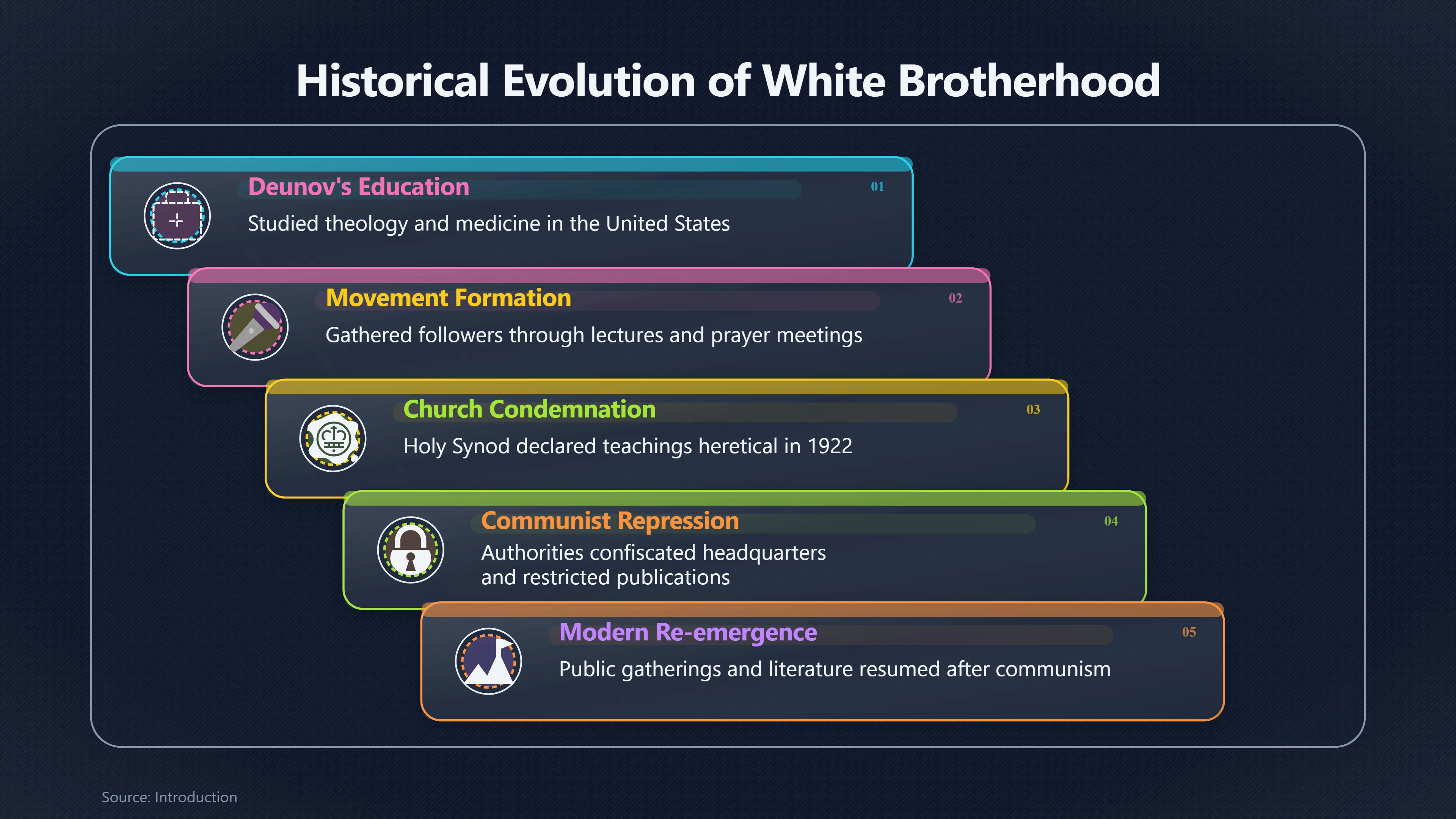
The White Brotherhood arose during a period of rapid change. Bulgaria had recently achieved independence from Ottoman rule, urbanisation was accelerating, and many educated Bulgarians were searching for new ways to combine Christianity, science, education and modern spirituality. Deunov, the son of an Orthodox priest, studied theology and medicine in the United States before returning to Bulgaria in the 1890s. His experiences exposed him to Protestant thought and wider currents of Western esotericism while leaving him convinced that spiritual renewal, rather than political ideology alone, was essential for the nation’s future.[Encyclopedia.com]encyclopedia.comdeunov peter konstantinovDeunov, Peter Konstantinov (1864-1944) | Encyclopedia.com…
Beginning around 1900, Deunov gradually gathered followers through lectures, prayer meetings and annual gatherings. Rather than establishing a conventional church, he envisioned what he called a spiritual school. His movement combined biblical teachings with ideas about personal transformation, moral self-improvement, music, healthy living and humanity’s spiritual evolution. He rejected rigid denominational boundaries, presenting Christ primarily as a universal spiritual principle rather than the exclusive possession of any institution.[uhb.no]uhb.noBiography of the Master Beïnça Douno (Peter DeunovBiography of the Master Beïnça Douno (Peter Deunov
Unlike many movements later labelled “cults”, the White Brotherhood did not revolve around isolation from wider society or complete obedience to organisational structures. In fact, Deunov resisted formal institutionalisation and discouraged dependence on legal statutes or bureaucratic organisation, believing spiritual life should be guided by conscience rather than administrative rules.[Wikipedia]WikipediaPeter DeunovPeter Deunov
Deunov’s teachings and spiritual programme
Deunov’s teachings drew on Christianity while incorporating ideas commonly associated with modern esoteric spirituality. His lectures, eventually numbering several thousand, covered religion, ethics, education, music, health, philosophy and humanity’s future spiritual development. Much of this material survives because followers carefully transcribed his talks in shorthand.[ispan.waw.pl]ispan.waw.plOctober 1, 2017…
Several themes consistently defined his programme:
- Spiritual transformation through daily practice rather than dramatic conversion experiences.
- Love as the central divine principle, extending beyond personal relationships to social and international life.
- Harmony between humanity and nature, expressed through outdoor gatherings and seasonal rituals.
- Personal moral discipline, including moderation, honesty, self-control and service to others.
- Music and movement as spiritual education, not merely artistic expression.
- Universal brotherhood, stressing cooperation between peoples and religions instead of sectarian rivalry.[fbu.org]fbu.orgFraternité Blanche Universelle In BulgariaFraternité Blanche UniverselleIn Bulgaria - Fraternité Blanche Universelle…
Although Deunov spoke of humanity entering a new spiritual era, historians distinguish these ideas from classic millenarian movements that predict imminent catastrophe or the end of the world. His emphasis lay on gradual moral evolution rather than violent apocalyptic expectation.[Encyclopedia.com]encyclopedia.comdeunov peter konstantinovDeunov, Peter Konstantinov (1864-1944) | Encyclopedia.com…
Paneurhythmy and communal life
Perhaps the White Brotherhood’s most recognisable practice is Paneurhythmy, a coordinated series of musical exercises performed outdoors in large circles. Developed during the 1920s and 1930s, it combines composed music, carefully choreographed movements and symbolic gestures intended to cultivate harmony between body, mind, community and nature.[Wikipedia]WikipediaOpen source on wikipedia.org.
For participants, Paneurhythmy functions as both physical exercise and spiritual discipline. Rather than ecstatic worship or trance, the movements are deliberately measured and synchronised. Practitioners typically perform them during spring and summer mornings, especially in natural settings. The annual gathering near the Seven Rila Lakes has become the movement’s best-known public event, attracting participants from Bulgaria and abroad.[Wikipedia]WikipediaOpen source on wikipedia.org.
Community life also centred on the Izgrev (“Sunrise”) settlement established outside Sofia in the late 1920s. Followers gathered there for lectures, music, prayer and study, creating a distinctive spiritual neighbourhood rather than an isolated commune. The settlement became the organisational heart of the movement until the communist period.[Wikipedia]WikipediaPeter DeunovPeter Deunov
These practices help explain the movement’s longevity. Shared music, repeated rituals, outdoor gatherings and educational activities created durable social bonds that survived even when public organisation became impossible.
Why did the Orthodox Church oppose the movement?
Relations between the White Brotherhood and the Bulgarian Orthodox Church deteriorated steadily as the movement expanded.
Church leaders objected that Deunov claimed spiritual authority outside Orthodox structures while introducing teachings influenced by esoteric traditions and unconventional biblical interpretation. The movement’s growing popularity also meant that many people sought spiritual guidance independently of parish life.[Encyclopedia.com]encyclopedia.comdeunov peter konstantinovDeunov, Peter Konstantinov (1864-1944) | Encyclopedia.com…
In 1922 the Holy Synod declared that Deunov had effectively separated himself from the Orthodox Church and described his teachings as heretical. This condemnation became one of the defining moments in the movement’s history.[Wikipedia]WikipediaPeter DeunovPeter Deunov
From a historical perspective, this conflict should not simply be understood as proof that the White Brotherhood was a dangerous organisation. Rather, it reflected competing understandings of religious authority. The Orthodox hierarchy defended doctrinal continuity and ecclesiastical order, while Deunov presented himself as a teacher of spiritual renewal whose message transcended denominational boundaries. Religious historians therefore treat the dispute as an institutional conflict rather than evidence that the movement fitted modern stereotypes of destructive cults.[ResearchGate]researchgate.netResearch Gate(PDF) Шапкалова, С., Ж. Назърска. Петър Дънов и Бялото братствоResearch Gate(PDF) Шапкалова, С., Ж. Назърска. Петър Дънов и Бялото братство

Survival under communism
Deunov died in December 1944, just as Bulgaria entered the communist era. His death removed the movement’s charismatic founder at the very moment when independent religious organisations faced increasing pressure.[In Your Pocket]inyourpocket.comIn Your Pocket Bulgarian Spiritual leaders: Peter DeunovIn Your Pocket Bulgarian Spiritual leaders: Peter Deunov
Communist authorities viewed independent religious communities with suspicion. The White Brotherhood’s headquarters and publishing facilities were confiscated, publications were restricted, and public activities became increasingly difficult. Although the movement briefly obtained legal recognition after Deunov’s death, later campaigns against religious organisations forced many activities underground. Meetings continued privately, and followers preserved lectures, music and ritual practices despite official hostility.[Encyclopedia.com]encyclopedia.comdeunov peter konstantinovDeunov, Peter Konstantinov (1864-1944) | Encyclopedia.com…
This period illustrates an important distinction within Bulgaria’s history of collective belief. The White Brotherhood was not suppressed because of a public panic over alleged crimes or dramatic incidents. Instead, it became another victim of a political system determined to control independent religious life.

Why has the movement endured?
Following the end of communist rule, the White Brotherhood re-emerged publicly. Its literature was republished, gatherings resumed openly, and Paneurhythmy again became visible in parks and mountain landscapes. Today the movement continues both in Bulgaria and internationally, with annual ceremonies at the Seven Rila Lakes remaining its most recognisable public expression.[In Your Pocket]inyourpocket.comIn Your Pocket Bulgarian Spiritual leaders: Peter DeunovIn Your Pocket Bulgarian Spiritual leaders: Peter Deunov
Several factors explain its resilience:
- It preserved an extensive written record of Deunov’s teachings.
- Rituals such as Paneurhythmy created a strong shared identity without requiring isolation from wider society.
- Its emphasis on health, music, ecology and peaceful living appealed to later generations interested in alternative spirituality.
- It adapted to changing political conditions while retaining its central practices.[wikipedia.org]WikipediaOpen source on wikipedia.org.
The movement has also spread beyond Bulgaria through disciples such as Omraam Mikhaël Aïvanhov, who established related spiritual communities in France and influenced broader currents of European esoteric Christianity.[uhb.no]uhb.noOpen source on uhb.no.
Contested labels and historical interpretation
The White Brotherhood is frequently described as a “cult” in journalistic or polemical writing, particularly in discussions of new religious movements. That label, however, remains contested.
Sociologists of religion generally prefer more descriptive terms such as new religious movement, esoteric Christian movement, or spiritual school, because the word “cult” often carries assumptions about coercion, manipulation or abuse that require specific evidence rather than theological disagreement alone. The Bulgarian Orthodox Church condemned the movement as heretical, while communist authorities regarded it as politically undesirable, but these institutional judgments are distinct from modern scholarly classification.[researchgate.net]researchgate.netResearch Gate(PDF) Шапкалова, С., Ж. Назърска. Петър Дънов и Бялото братствоResearch Gate(PDF) Шапкалова, С., Ж. Назърска. Петър Дънов и Бялото братство
The movement has not been free from criticism. Researchers have examined Deunov’s cosmology, some controversial statements about race and spiritual evolution, and the highly charismatic role he occupied within the community. These issues remain subjects of scholarly discussion and should be assessed within the historical context of early twentieth-century esoteric thought rather than detached from it.[RadioFreeEurope/RadioLiberty]rferl.orgRadio Free Europe/Radio Liberty With Bulgaria's White BrotherhoodRadio Free Europe/Radio Liberty With Bulgaria's White Brotherhood
Within Bulgaria’s wider history of collective belief, the White Brotherhood therefore occupies a distinctive position. It was neither a brief moral panic nor an episode of mass psychogenic illness. Instead, it represents a durable spiritual renewal movement whose history reveals recurring tensions between charismatic religious innovation, established religious authority and state power. Its endurance demonstrates that contested religious movements can become lasting elements of national cultural history rather than temporary social scares.
Amazon book picks
Further Reading
Books and field guides related to Why Did Deunov's White Brotherhood Endure?. Use these as the next step if you want deeper reading beyond the article.

Autobiography of a Yogi
Appeals to readers interested in twentieth-century spiritual movements.
The Varieties of Religious Experience
Framework for understanding spiritual movements.

Endnotes
1.
Source: Wikipedia
Title: Peter Deunov
Link:https://en.wikipedia.org/wiki/Peter_Deunov
2.
Source: encyclopedia.com
Title: deunov peter konstantinov 1864 1944
Link:https://www.encyclopedia.com/science/encyclopedias-almanacs-transcripts-and-maps/deunov-peter-konstantinov
Source snippet
Deunov, Peter Konstantinov (1864-1944) | Encyclopedia.com...
3.
Source: researchgate.net
Title: Research Gate(PDF) Шапкалова, С., Ж. Назърска. Петър Дънов и Бялото братство
Link:https://www.researchgate.net/publication/377334689Sapkalova_S_Z_Nazrska_Petr_Dnov_i_Baloto_bratstvo-kulturno_nasledstvo_i_duhovni_prostranstva_Sofia_Za_bukvite-_O_pismeneh_2021
4.
Source: uhb.no
Title: Biography of the Master Beïnça Douno (Peter Deunov)
Link:https://www.uhb.no/en/history/biography-of-the-master-beinca-douno-peter-deunov
5.
Source: ispan.waw.pl
Link:https://ispan.waw.pl/ireteslaw/bitstream/handle/20.500.12528/83/G_Szwat-Gylybowa_-_Bogomilism_The_Afterlife_of_the_Bulgarian_Heresy.pdf?isAllowed=y&sequence=1
Source snippet
October 1, 2017...
Published: October 1, 2017
6.
Source: Wikipedia
Link:https://en.wikipedia.org/wiki/Paneurhythmy
7.
Source: encyclopedia.com
Title: White Brotherhood | Encyclopedia.com
Link:https://www.encyclopedia.com/science/encyclopedias-almanacs-transcripts-and-maps/white-brotherhood
Source snippet
June 23, 2026 — WHITE BROTHERHOOD views 1,575,295 updated WHITE BROTHERHOOD The White Brotherhood, a Bulgarian occult order with roots in...
Published: June 23, 2026
8.
Source: uhb.no
Link:https://uhb.no/en/history
9.
Source: researchgate.net
Link:https://www.researchgate.net/publication/323660473Constructing_New_Spirituality_in_Modernity-_the_Case_of_the_White_Brotherhood_in_Bulgaria
10.
Source: paneurhythmy.org
Link:https://paneurhythmy.org/sunmes.php
11.
Source: youtube.com
Title: Universal Brotherhood
Link:https://www.youtube.com/watch?v=9iKf0nuWYmU
Source snippet
Hundreds Dance in Bulgaria to Welcome the 'Divine New Year' | AQ1F...
12.
Source: youtube.com
Title: The White Brotherhood
Link:https://www.youtube.com/watch?v=iJ6qoL2zuUY
Source snippet
A River of Love: The Sacred Life and Silent Work for Humanity of a True Master | Cherry Frizzell...
13.
Source: fbu.org
Title: Fraternité Blanche Universelle In Bulgaria
Link:https://www.fbu.org/en/oma-in-bulgaria/
Source snippet
Fraternité Blanche UniverselleIn Bulgaria - Fraternité Blanche Universelle...
14.
Source: rferl.org
Title: Radio Free Europe/Radio Liberty With Bulgaria’s White Brotherhood
Link:https://www.rferl.org/a/bulgaria-white-brotherhood-ceremony-rila-paneurhythmy/32562654.html
15.
Source: inyourpocket.com
Title: In Your Pocket Bulgarian Spiritual leaders: Peter Deunov
Link:https://www.inyourpocket.com/bulgaria/articles/bulgarian-spiritual-leaders-peter-deunov
16.
Source: rferl.org
Title: With Bulgaria’s White Brotherhood
Link:https://www.rferl.org/amp/bulgaria-white-brotherhood-ceremony-rila-paneurhythmy/32562654.html
Additional References
17.
Source: cesnur.org
Title: Slavic Messianism in Southeast Europe: Pet?r D?nov and the White Brotherhood
Link:https://www.cesnur.org/2010/to-heinzel.htm
18.
Source: youtube.com
Link:https://www.youtube.com/watch?v=rOtFFIHJCYc
19.
Source: youtube.com
Title: Hundreds Dance in Bulgaria to Welcome the ‘Divine New Year’ | AQ1F
Link:https://www.youtube.com/watch?v=_EYN-oDYLA0
Source snippet
The Master Beinsa Douno (Bulgaria)...
20.
Source: investorbulgaria.com
Title: The White Brotherhood in Bulgaria: Origins, Beliefs, and Practices
Link:https://investorbulgaria.com/the-white-brotherhood-in-bulgaria-origins-beliefs-and-practices/
21.
Source: old-news.bnr.bg
Title: bg Peter Deunov’s paneurhythmy is a philosophy and a dance of joy
Link:https://old-news.bnr.bg/en/post/101742116/peter-deunovs-paneurhythmy-is-a-philosophy-and-a-dance-of-joy
22.
Source: heartscenter.org
Link:https://www.heartscenter.org/TeachingsBlogs/AngelsandAscendedMasters/MessengersNowAscended/TheMasterPeterDeunov-BeinsaDuono/tabid/1182/Default.aspx
23.
Source: margaretevandenbrink.nl
Title: index uk
Link:https://www.margaretevandenbrink.nl/index_uk.php?m=m80&p=301
Topic Tree