Within El Salvador
Why Miracle Stories Endure in El Salvador
Stories of volcanic deliverance and Marian appearances show how Salvadoran communities used sacred narratives to make catastrophe and insecurity meaningful.
On this page
- Our Lady of Peace and the volcano
- How communal memory turns survival into miracle
- Apparition claims and the problem of evidence
Page outline Jump by section
Introduction
Miracle stories in El Salvador are less about spectacular supernatural spectacles than about how communities have understood survival in the face of danger. The country’s best-known traditions centre on the belief that the Virgin Mary, honoured as Our Lady of Peace, protected the city of San Miguel during a major volcanic eruption in the eighteenth century. Alongside this are more localised reports of Marian apparitions and other claims of divine intervention, most of which remain matters of personal faith rather than historically verifiable events.
For historians and social scientists, these traditions are valuable not because they prove or disprove miracles, but because they reveal how communities respond to catastrophe, uncertainty and collective trauma. They show how shared religious narratives can strengthen solidarity, shape local identity and provide meaning after experiences that might otherwise seem random or overwhelming.
Our Lady of Peace and the volcano
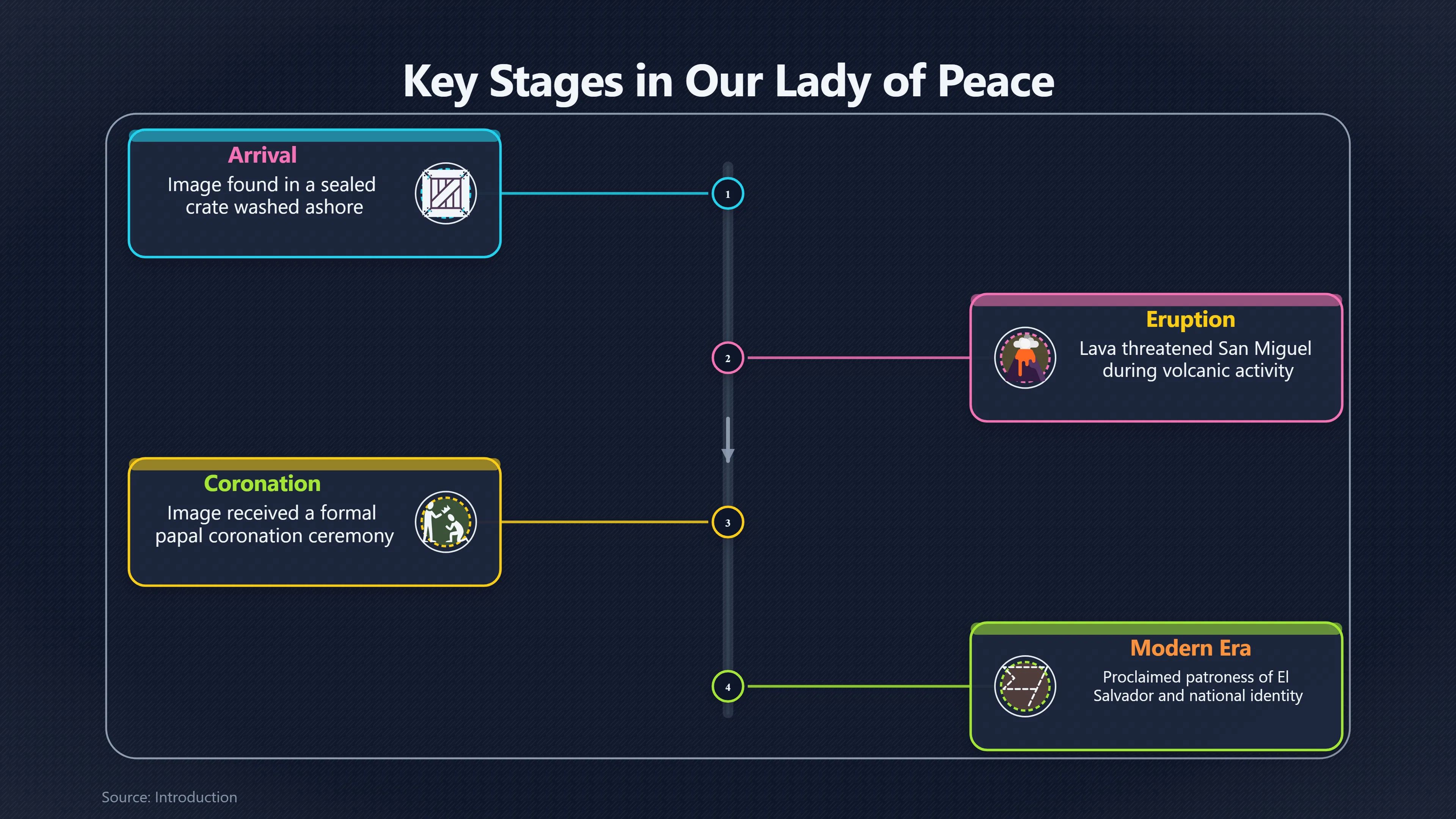
| The central miracle tradition in El Salvador concerns the eruption of the Chaparrastique (San Miguel) volcano on 21 September 1787. According to long-standing Catholic tradition, lava threatened the city of San Miguel until residents carried the image of Our Lady of Peace to the entrance of the parish church and prayed for protection. The lava was said to change direction, sparing the town, while clouds above the volcano formed the shape of a palm branch, later adopted as a symbol carried by the statue. The Catholic Diocese of San Miguel continues to commemorate this event annually as El Milagro Patente (“The Evident Miracle”). Diócesis de San Miguel | Sitio Oficial+2Diócesis de San Miguel | Sitio Oficial[diocesisdesanmiguelsv.org]diocesisdesanmiguelsv.orgSeptember 17, 2025… |
The miracle narrative is intertwined with the history of the statue itself. Tradition holds that the image arrived mysteriously in a sealed crate washed ashore in 1682. According to the story, attempts to open the crate failed until it reached San Miguel, where it was discovered to contain an image of the Virgin and Child. The unexpected arrival and the later volcanic miracle became linked in local memory, reinforcing the statue’s role as a symbol of divine protection and national peace.[mariedenazareth.com]mariedenazareth.comEncyclopédie Mariale – SalvadorEncyclopédie Mariale – Salvador
The devotion grew steadily over the following centuries. The image received a papal coronation in 1921 and was later proclaimed patroness of El Salvador, making the miracle tradition part of both local religious life and national identity. Annual processions, pilgrimages and feast days continue to commemorate the story.[mariedenazareth.com]mariedenazareth.comEncyclopédie Mariale – SalvadorEncyclopédie Mariale – Salvador
How communal memory turns survival into miracle
Whether the lava literally changed direction because of divine intervention is a question that history cannot answer. Modern volcanology explains that lava flows naturally alter course depending on topography, changing vents and variations in eruptive activity. Without detailed contemporary geological observations, it is impossible to reconstruct precisely what happened in September 1787.
The historical importance of the story therefore lies elsewhere. The eruption was a frightening communal experience, and the account of miraculous protection offered an explanation that united survivors around a shared act of prayer rather than chance. Instead of remembering only destruction, later generations remembered rescue.
This process is common in societies exposed to repeated natural hazards. Religious narratives can:
- transform survival into a meaningful collective memory;
- strengthen local identity through annual commemorations;
- encourage solidarity during future emergencies; and
- connect dangerous landscapes with sacred protection rather than only fear.
In El Salvador, where earthquakes, volcanic eruptions and later civil conflict repeatedly disrupted ordinary life, stories of supernatural protection helped communities interpret uncertainty through familiar religious symbols rather than purely natural causes. The miracle tradition therefore functions as a form of cultural memory as much as a claim about physical events.
Apparition claims and the problem of evidence
Compared with countries such as Mexico, Portugal or France, El Salvador has relatively few widely recognised Marian apparition traditions. Local reports have occasionally emerged in different regions, often attracting pilgrims or devotional gatherings for a time, but none has achieved the international prominence of Lourdes, Fátima or Guadalupe.
The evidence for these reports is usually limited. Most rely on eyewitness testimony, local oral tradition or devotional literature rather than independent contemporary documentation. Historians therefore distinguish carefully between:
- A reported apparition, meaning that individuals sincerely claimed to experience a supernatural vision.
- An officially recognised apparition, which requires lengthy ecclesiastical investigation and remains uncommon.
- A popular local devotion, where belief spreads within a community without formal Church recognition.
The Catholic Church itself applies cautious standards when evaluating alleged apparitions. Most reported visions worldwide receive no formal recognition, and Catholics are generally not required to believe private revelations even when Church authorities judge them worthy of devotion.[Google Sites]sites.google.comSites Mary APParitionsGoogle SitesMary APParitions - Our Lady of Peace…
For researchers, this distinction matters because sincere testimony alone cannot establish supernatural causation. At the same time, the absence of scientific proof does not prevent such experiences from becoming socially significant.
Why these stories endure
Miracle traditions persist because they answer questions that historical evidence alone cannot resolve. Survivors naturally ask why one town escaped destruction while another suffered, or why some people lived through disasters that killed others. Religious narratives provide emotionally satisfying answers rooted in providence, communal prayer and hope.
These stories also reinforce social bonds. Annual commemorations of the 1787 volcanic miracle are not merely recollections of an historical event but public rituals that renew local identity across generations. Participants remember both the danger and the belief that the community was preserved through faith.
Importantly, belief in miraculous protection has generally coexisted with practical responses to disaster rather than replacing them. Modern Salvadorans live with scientific monitoring of active volcanoes while many also participate in religious processions asking for protection. The two frameworks often operate alongside one another instead of being viewed as mutually exclusive.
What historians conclude
Most historians neither attempt to prove nor dismiss the miracle of Our Lady of Peace. Instead, they ask what the tradition reveals about Salvadoran society.
Several broad conclusions emerge:
- The 1787 volcanic miracle is best understood as a deeply rooted religious tradition anchored in a real volcanic disaster.
- Contemporary evidence confirms that an eruption threatened San Miguel, but it cannot independently verify miraculous intervention.
- The enduring importance of the story comes from communal memory, ritual and identity rather than scientific demonstration.
- Local apparition reports remain part of Salvadoran devotional culture, yet most lack the documentary evidence or ecclesiastical recognition needed to move beyond personal or regional belief.
Seen in this way, miracle stories occupy a distinctive place in El Salvador’s history of collective belief. Rather than producing widespread panic or persecution, they have generally served as narratives of protection, resilience and hope, helping communities make sense of living in a landscape shaped by both natural hazards and historical uncertainty.


Endnotes
1.
Source: diocesisdesanmiguelsv.org
Link:https://diocesisdesanmiguelsv.org/238-anos-del-milagro-patente/
Source snippet
September 17, 2025...
Published: September 17, 2025
2.
Source: diocesisdesanmiguelsv.org
Link:https://diocesisdesanmiguelsv.org/reina-de-la-paz-patrona-de-el-salvador/
3.
Source: diocesisdesanmiguelsv.org
Link:https://diocesisdesanmiguelsv.org/232-anos-del-milagro-patente/
4.
Source: mariedenazareth.com
Title: Encyclopédie Mariale – Salvador
Link:https://www.mariedenazareth.com/encyclopedie-mariale/la-vierge-marie-remplit-le-monde-sanctuaires-marials/ameriques/salvador
5.
Source: sites.google.com
Title: Sites Mary APParitions
Link:https://sites.google.com/a/udayton.edu/maryapparitions/el-salvador/our-lady-of-peace
Source snippet
Google SitesMary APParitions - Our Lady of Peace...
Additional References
6.
Source: youtube.com
Title: Christianity in the New World: Spanish & Portuguese Missions in the Americas
Link:https://www.youtube.com/watch?v=Z6VpY1D5tJ8
Source snippet
The Secret Hidden Above This Colonial Town | Panchimalco, El Salvador...
7.
Source: youtube.com
Link:https://www.youtube.com/watch?v=nQ23QHVDgDM
Source snippet
Nahuatl Pipil Dance in Nahuizalco, El Salvador...
8.
Source: youtube.com
Title: The Secret Hidden Above This Colonial Town | Panchimalco, El Salvador
Link:https://www.youtube.com/watch?v=5Y0XooIl26Q
Source snippet
Election info changes quickly. Verify responses with official sources...
9.
Source: youtube.com
Title: The Nahuat of El Salvador & Central American Lenca
Link:https://www.youtube.com/watch?v=-kBuZZkxCjo
Source snippet
Christianity in the New World: Spanish & Portuguese Missions in the Americas...
10.
Source: youtube.com
Title: Nahuatl Pipil Dance in Nahuizalco, El Salvador
Link:https://www.youtube.com/watch?v=nRS2jLLSfow
Source snippet
The Nahuat of El Salvador & Central American Lenca...
Topic Tree