Within Kenya
When Did Religion Become a Colonial Threat?
Dini ya Msambwa shows how colonial authorities could treat religious independence as evidence of political rebellion.
On this page
- Elijah Masinde and the movement's beliefs
- Why colonial officials feared religious independence
- How the label of cult can conceal political conflict
Page outline Jump by section
Introduction
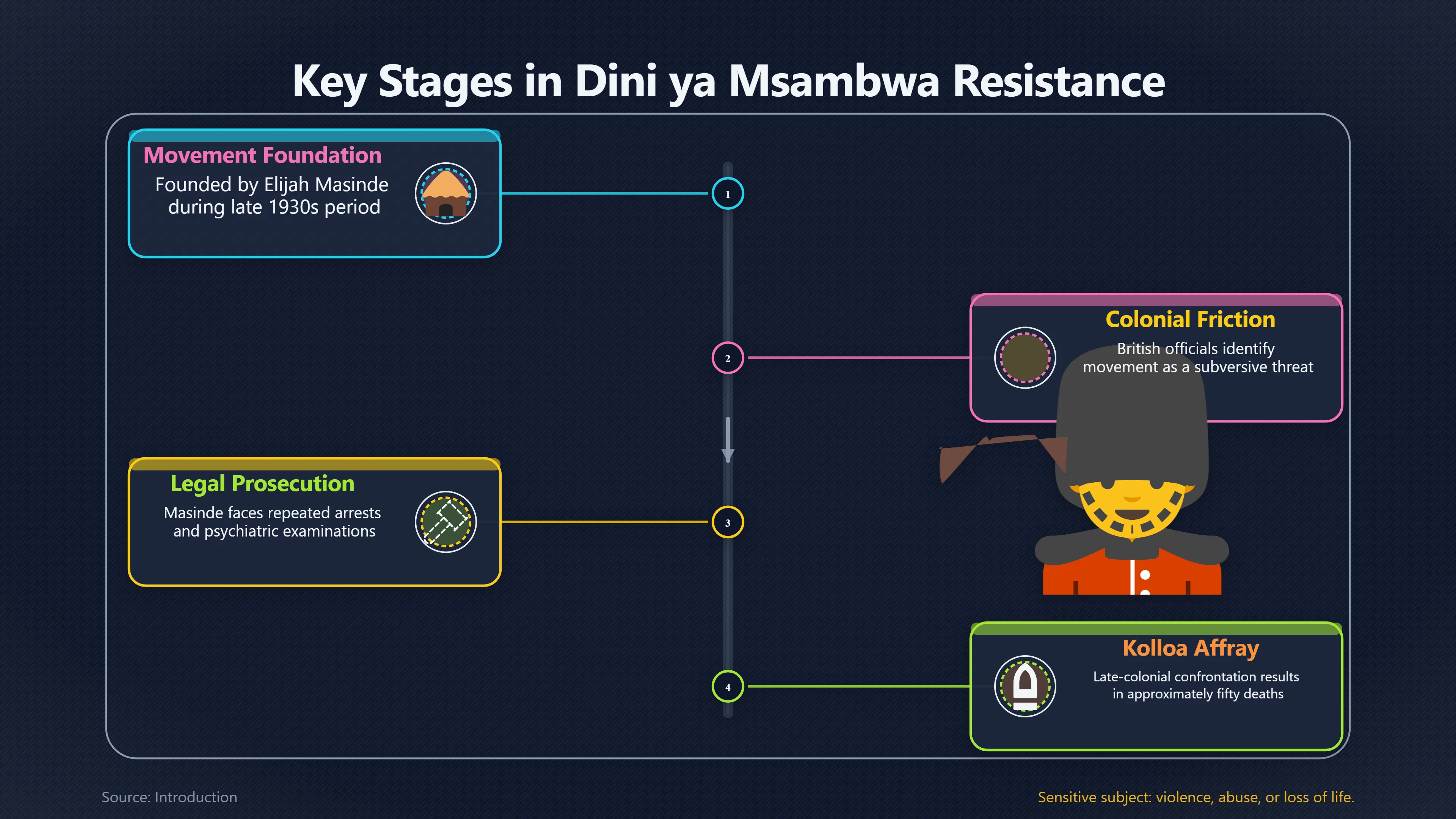
Dini ya Msambwa is one of the clearest examples from colonial Kenya of how an independent religious movement could be treated as a political threat. Founded by the Bukusu prophet Elijah Masinde during the late 1930s and early 1940s, it combined indigenous religious traditions, selective use of biblical ideas and outspoken criticism of British colonial rule. To colonial officials, these features made the movement appear dangerously subversive. To many followers, however, it represented a defence of African culture, political autonomy and spiritual authority against foreign domination. Modern historians increasingly argue that understanding Dini ya Msambwa requires looking beyond labels such as “cult” or “fanatical sect” and recognising how colonial governments often blurred the boundaries between religious dissent and political rebellion.[Cambridge University Press & Assessment]cambridge.orgCambridge University Press & AssessmentProsecuting a Prophet: Justice, Psychiatry, and Rebellion in Colonial Kenya | African Studies Revi…
When did religion become a colonial threat?
British rule in Kenya depended not only on military and administrative power but also on missionary Christianity and systems of indirect government. Religious movements that rejected missionary authority therefore challenged more than theology. They questioned the legitimacy of colonial rule itself.
Dini ya Msambwa emerged among the Bukusu people of western Kenya during a period of rapid social disruption. Land alienation, labour demands, taxation and missionary influence were reshaping everyday life. Elijah Masinde argued that African communities should reject foreign domination, preserve ancestral customs and recover forms of religious authority that predated colonial rule. His message was spiritual, but it was also unmistakably political because it encouraged people to resist institutions closely associated with colonial power.[ajess.kibu.ac.ke]ajess.kibu.ac.kea history of dini ya musambwa in bungoma county kenyaA History of Dini Ya Musambwa in Bungoma County, Kenya: 1940-2017 - Kibabii University African Journal of Education and Social Sciences…
Colonial officials interpreted this combination as evidence that religion was providing an organisational framework for resistance. Instead of treating Dini ya Msambwa as simply another African-initiated church, administrators increasingly described it as a dangerous movement requiring surveillance, arrests and restrictions.[Cambridge University Press & Assessment]cambridge.orgCambridge University Press & AssessmentProsecuting a Prophet: Justice, Psychiatry, and Rebellion in Colonial Kenya | African Studies Revi…
Elijah Masinde and the movement’s beliefs
Elijah Masinde, born around 1910 in present-day Bungoma County, had early contact with Christian missions before breaking with them. His conflict with missionaries reflected wider disagreements over religious authority, African customs and the role of European culture in everyday life. According to both historical research and contemporary accounts, Masinde objected to the rejection of practices such as respect for ancestors and criticised the assumption that European customs were inherently superior.[ajess.kibu.ac.ke]ajess.kibu.ac.kea history of dini ya musambwa in bungoma county kenyaA History of Dini Ya Musambwa in Bungoma County, Kenya: 1940-2017 - Kibabii University African Journal of Education and Social Sciences…
Dini ya Msambwa was neither a simple return to pre-colonial religion nor a conventional Christian denomination. Instead, it blended several elements:
- belief in a supreme creator while rejecting exclusive dependence on the Bible;
- continued respect for ancestors and indigenous ritual practices;
- pilgrimage and sacrifice at sacred places such as Mount Elgon;
- rejection of missionary claims that African religious traditions were inherently pagan or inferior;
- calls for moral reform, communal solidarity and resistance to colonial domination.[ajess.kibu.ac.ke]ajess.kibu.ac.kea history of dini ya musambwa in bungoma county kenyaA History of Dini Ya Musambwa in Bungoma County, Kenya: 1940-2017 - Kibabii University African Journal of Education and Social Sciences…
This mixture made the movement difficult for colonial officials to classify. It was not entirely outside Christianity, yet it refused missionary control. It was religious, but it also criticised taxation, recruitment for wartime service and the erosion of elder authority. That ambiguity increased official suspicion.[ajess.kibu.ac.ke]ajess.kibu.ac.kea history of dini ya musambwa in bungoma county kenyaA History of Dini Ya Musambwa in Bungoma County, Kenya: 1940-2017 - Kibabii University African Journal of Education and Social Sciences…
Why colonial officials feared religious independence
The British administration worried less about unusual beliefs than about what those beliefs enabled.
Masinde urged followers to reject aspects of colonial authority, including participation in institutions seen as serving European interests. His preaching encouraged cultural independence and questioned the legitimacy of colonial administration. Officials feared that religious gatherings could become centres for political mobilisation beyond government control.[kibu.ac.ke]ajess.kibu.ac.kea history of dini ya musambwa in bungoma county kenyaA History of Dini Ya Musambwa in Bungoma County, Kenya: 1940-2017 - Kibabii University African Journal of Education and Social Sciences…
As a result, Masinde experienced repeated arrests, detention and psychiatric examination. Colonial authorities increasingly portrayed him as mentally unstable or suffering from “religious mania”, language that modern historians argue served political as well as medical purposes. Psychiatric diagnoses became another means of delegitimising anti-colonial leadership by redefining political opposition as personal pathology rather than legitimate dissent.[cambridge.org]cambridge.orgCambridge University Press & AssessmentProsecuting a Prophet: Justice, Psychiatry, and Rebellion in Colonial Kenya | African Studies Revi…
Julie MacArthur’s study of Masinde’s 1948 deportation proceedings shows that the courtroom became a struggle over competing interpretations. Prosecutors attempted to present Masinde as an irrational fanatic, while Masinde defended himself as a prophet speaking for his people against injustice. Rather than simply determining guilt, the trial exposed conflicting ideas about law, religion and political legitimacy.[Cambridge University Press & Assessment]cambridge.orgCambridge University Press & AssessmentProsecuting a Prophet: Justice, Psychiatry, and Rebellion in Colonial Kenya | African Studies Revi…

How the label of “cult” concealed political conflict
Descriptions of Dini ya Msambwa changed depending on who was speaking.[youtube.com]youtube.comDini Ya MsambwaElijah Masinde Wanameme is a Man who Wrote a Letter to God Over Brutality…
Colonial reports commonly portrayed the movement as fanatical, primitive or dangerously irrational. Such language justified surveillance, detention and restrictions on assembly. Modern scholarship, however, places the movement within a much broader pattern of African independent religious movements that emerged across colonial Africa in response to dispossession, missionary expansion and cultural disruption.[cambridge.org]cambridge.orgCambridge University Press & AssessmentProsecuting a Prophet: Justice, Psychiatry, and Rebellion in Colonial Kenya | African Studies Revi…
This does not mean Dini ya Msambwa was simply a political party disguised as a religion. Religion itself supplied its moral authority, symbols and organisational structure. But reducing it to a “cult” obscures several important realities:
- followers were defending indigenous religious practices rather than merely rejecting Christianity;
- many grievances concerned land, governance and colonial inequality;
- spiritual leadership provided an alternative source of legitimacy outside colonial institutions;
- official descriptions often reflected political priorities as much as objective observation.[kibu.ac.ke]ajess.kibu.ac.kea history of dini ya musambwa in bungoma county kenyaA History of Dini Ya Musambwa in Bungoma County, Kenya: 1940-2017 - Kibabii University African Journal of Education and Social Sciences…
The movement therefore illustrates how the word “cult” can sometimes function less as a neutral description than as a political judgement applied to religious groups that challenge established authority.
Violence, repression and historical memory
The relationship between Dini ya Msambwa and colonial violence did not end with Masinde’s prosecutions.
Research into the so-called Kolloa (or Kolowa) Affray reconstructs a late-colonial confrontation between police and members of the movement that reportedly resulted in around fifty deaths. Later religious traditions connected to Dini ya Msambwa transformed these events into narratives of martyrdom and sacrifice, showing how episodes of state violence became integrated into religious memory rather than disappearing from public consciousness.[PhilPapers]philpapers.orgPhil Papers Zebulon Dingley, The Transfiguration of Lukas PkechZebulon Dingley, The Transfiguration of Lukas Pkech - PhilPapersAugust 17, 2020…
The movement also continued after Kenyan independence, although with reduced influence. Masinde remained a controversial figure until his death in 1987, remembered variously as a nationalist hero, religious reformer, prophet or dangerous agitator depending on the political and religious perspective of those describing him.[ajess.kibu.ac.ke]ajess.kibu.ac.kea history of dini ya musambwa in bungoma county kenyaA History of Dini Ya Musambwa in Bungoma County, Kenya: 1940-2017 - Kibabii University African Journal of Education and Social Sciences…
Why Dini ya Msambwa still matters
Dini ya Msambwa occupies an important place in Kenya’s history because it complicates simple distinctions between religion and politics.
Its story reminds readers that colonial governments often interpreted independent African religious authority as evidence of political rebellion. Historians now place Masinde alongside other African prophetic leaders whose movements challenged colonial power through a combination of spiritual teaching, cultural revival and political resistance rather than through conventional party politics alone.[cambridge.org]cambridge.orgCambridge University Press & AssessmentProsecuting a Prophet: Justice, Psychiatry, and Rebellion in Colonial Kenya | African Studies Revi…
The movement also offers a useful caution for understanding later debates about “dangerous religions” in Kenya. Some groups have indeed committed coercive abuse or violence, while others have been labelled dangerous largely because they rejected established authority or dominant religious institutions. Dini ya Msambwa demonstrates why those cases should be distinguished carefully. Whether a movement deserves concern depends less on unfamiliar beliefs than on its behaviour: whether it uses coercion, permits members to leave freely, incites violence or violates fundamental rights. That distinction remains central to understanding both Kenya’s colonial past and its continuing debates about religion, authority and public fear.

Amazon book picks
Further Reading
Books and field guides related to When Did Religion Become a Colonial Threat?. Use these as the next step if you want deeper reading beyond the article.
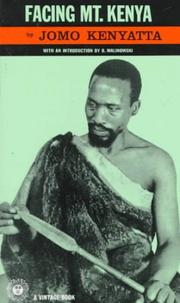
African religions and philosophy
Provides essential background for indigenous religious movements like Dini ya Msambwa.
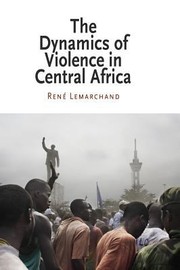
The dynamics of violence in central Africa
First published 2008. Subjects: Politics and government, Geopolitics, Ethnic relations, Economic conditions, Genocide.
Endnotes
1.
Source: cambridge.org
Link:https://www.cambridge.org/core/journals/african-studies-review/article/abs/prosecuting-a-prophet-justice-psychiatry-and-rebellion-in-colonial-kenya/2A28FE69036EF721F91431AADE61D8DD
Source snippet
Cambridge University Press & AssessmentProsecuting a Prophet: Justice, Psychiatry, and Rebellion in Colonial Kenya | African Studies Revi...
2.
Source: ajess.kibu.ac.ke
Title: a history of dini ya musambwa in bungoma county kenya 1940 2017
Link:https://ajess.kibu.ac.ke/a-history-of-dini-ya-musambwa-in-bungoma-county-kenya-1940-2017/
Source snippet
A History of Dini Ya Musambwa in Bungoma County, Kenya: 1940-2017 - Kibabii University African Journal of Education and Social Sciences...
3.
Source: africabib.org
Link:https://www.africabib.org/rec.php?RID=302295321
4.
Source: philpapers.org
Title: Phil Papers Zebulon Dingley, The Transfiguration of Lukas Pkech
Link:https://philpapers.org/rec/DINTTO-4
Source snippet
Zebulon Dingley, The Transfiguration of Lukas Pkech - PhilPapersAugust 17, 2020...
Published: August 17, 2020
5.
Source: cambridge.org
Link:https://www.cambridge.org/core/journals/historical-journal/article/abs/black-mischief-crime-protest-and-resistance-in-colonial-kenya/9AEC5D9711677E3F565D540C3A5064C3
6.
Source: cambridge.org
Link:https://www.cambridge.org/core/journals/journal-of-african-history/article/resurrecting-the-african-independent-pentecostal-church-land-education-and-the-politics-of-reconciliation-during-kenyas-decolonisation-195269/5180E5AC17068A07F5DE90943B67AC47
7.
Source: cambridge.org
Link:https://www.cambridge.org/core/journals/british-journal-of-political-science/article/abs/bureaucracy-and-incumbent-violence-colonial-administration-and-the-origins-of-the-mau-mau-emergency-in-kenya/71BFD4B561ED9840461578F6E59B3BA9
8.
Source: africabib.org
Link:https://www.africabib.org/rec.php?RID=187453462
9.
Source: youtube.com
Title: Dini Ya Msambwa
Link:https://www.youtube.com/watch?v=CkrPZUFMen4
Source snippet
Elijah Masinde Wanameme is a Man who Wrote a Letter to God Over Brutality...
10.
Source: erepository.uonbi.ac.ke
Title: Masika David Neville Ph.D
Link:https://erepository.uonbi.ac.ke/bitstream/handle/11295/164823/Masika%20David%20Neville-%20Ph.D.pdf?isAllowed=y&sequence=1
Source snippet
UoN eRepositoryTHE POLITICAL ECONOMY OF WARS IN MOUNT ELGON, 1968-2008...
11.
Source: erepository.uonbi.ac.ke
Link:https://erepository.uonbi.ac.ke/server/api/core/bitstreams/66b438d9-8d06-471c-a3ac-a96e44a7d327/content
Source snippet
UoN eRepositoryThe Political Economy of Wars in Mount Elgon, 1968-2008...
12.
Source: aegis-eu.org
Title: View Abstracte825
Link:https://www.aegis-eu.org/archive/ecas2007/ViewAbstracte825.html?PaperID=596
Source snippet
AEGISAEGIS ECAS 2007 - View abstract...
Additional References
13.
Source: pdcnet.org
Title: The Transfiguration of Lukas Pkech: Dini ya Msambwa and the “Kolloa Affray”
Link:https://www.pdcnet.org/collection-anonymous/pdf2image?file_type=pdf&pdfname=jrv_2020_0999_7_26_74.pdf
Source snippet
The Transfiguration of Lukas Pkech: Dini ya Msambwa and the “Kolloa Affray” - Zebulon Dingley - Journal of Religion and Violence (P...
14.
Source: youtube.com
Title: My Culture: How does Dini ya Msambwa bury their dead?
Link:https://www.youtube.com/watch?v=27aOE32UmWw
Source snippet
This video provides an in-depth look at the life of Elijah Masinde, exploring how his spiritual leadership of the Dini ya Msambwa movemen...
15.
Source: youtube.com
Title: Elijah Masinde Wanameme is a Man who Wrote a Letter to God Over Brutality
Link:https://www.youtube.com/watch?v=ZrB0Pgsvo2A
Source snippet
Man who wanted British Colonialists to leave and Africans worship their own God...
16.
Source: youtube.com
Title: Man who wanted British Colonialists to leave and Africans worship their own God
Link:https://www.youtube.com/watch?v=vaZ12awEwi4
Source snippet
My Culture: The 37th Anniversary of Elijah Masinde...
17.
Source: youtube.com
Title: My Culture: The 37th Anniversary of Elijah Masinde
Link:https://www.youtube.com/watch?v=omZf_19L01c
Source snippet
My Culture: How does Dini ya Msambwa bury their dead?...
18.
Source: cyrho.com
Title: Mahone 2006 colonial rebellion
Link:https://cyrho.com/data/Mahone%202006%20colonial%20rebellion.pdf
Source snippet
Journal of African History, 47 (2006), pp. 241–58...
19.
Source: jstor.org
Link:https://www.jstor.org/stable/j.ctt22727nc
20.
Source: researchgate.net
Link:https://www.researchgate.net/publication/342532014_Prosecuting_a_Prophet_Justice_Psychiatry_and_Rebellion_in_Colonial_Kenya
21.
Source: researchgate.net
Link:https://www.researchgate.net/publication/343232426_The_Transfiguration_of_Lukas_Pkech_in_advance_Dini_ya_Msambwa_and_the_Kolloa_Affray
22.
Source: ir-library.ku.ac.ke
Link:https://ir-library.ku.ac.ke/items/8838c752-afac-4f59-8be0-6f4dd6a24179
Topic Tree