Within Niger
Why Did Cartoon Protests Turn Deadly in Niger?
Anger over a French cartoon spread into deadly violence against churches, businesses and French-linked targets across Niger.
On this page
- What happened in Zinder and Niamey
- Why local Christian targets became symbols
- How religion, politics and foreign influence converged
Page outline Jump by section
Introduction
In January 2015, protests in Niger over new Charlie Hebdo cartoons of the Prophet Muhammad escalated into the country’s deadliest episode of religiously charged mob violence in recent decades. What began as demonstrations after Friday prayers rapidly turned into attacks on churches, Christian homes, schools, bars and businesses associated with France or the West. By the time order was restored, at least ten people had been killed, dozens of churches had been destroyed or damaged, and thousands of Christians had fled for safety.[Sage Journals]journals.sagepub.comSage JournalsThe “Protests against Charlie Hebdo” in Niger: A Background Analysis - Jannik Schritt, 2015April 1, 2015…

Although the violence was triggered by outrage over the French magazine and President Mahamadou Issoufou’s participation in the Paris unity march following the terrorist attack on Charlie Hebdo, researchers argue that the riots cannot be understood simply as spontaneous religious anger. Long-standing political rivalries, economic exclusion, youth mobilisation, anti-French sentiment and local power struggles all shaped why protests became exceptionally violent in Niger while remaining largely peaceful in many other Muslim-majority countries.[Sage Journals]journals.sagepub.comSage JournalsThe “Protests against Charlie Hebdo” in Niger: A Background Analysis - Jannik Schritt, 2015April 1, 2015…
What happened in Zinder and Niamey?
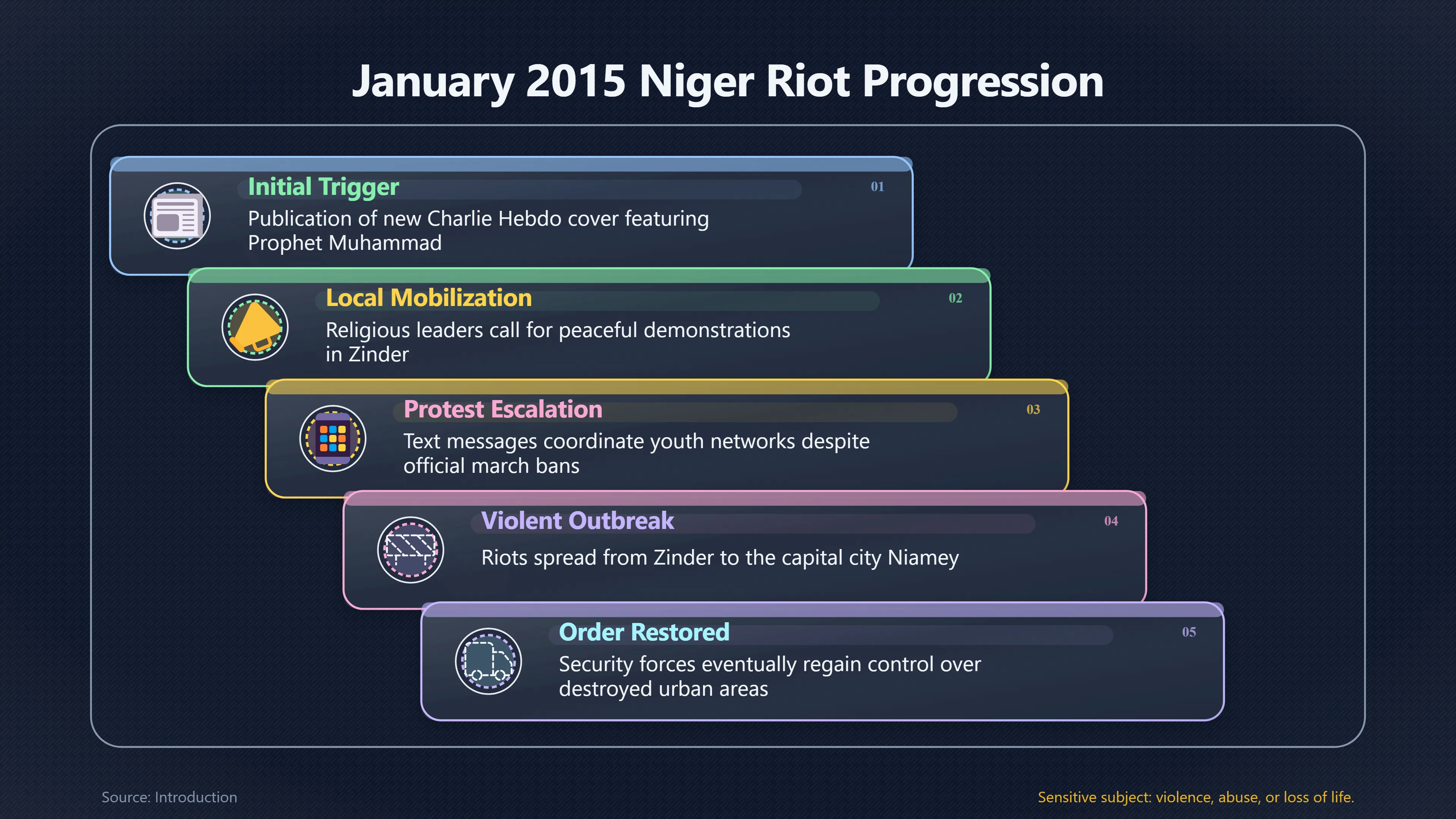
The immediate trigger was the publication of another Charlie Hebdo cover featuring the Prophet Muhammad shortly after the magazine’s offices had been attacked by Islamist gunmen in Paris on 7 January 2015. Across parts of the Muslim world, many regarded the new cover as a fresh insult to Islam.
In Niger, religious leaders in Zinder initially called for peaceful demonstrations after Friday prayers on 16 January. Local authorities prohibited the march, but mobilisation continued through text messages and informal youth networks. Demonstrators gathered anyway, and the situation deteriorated rapidly. Barricades were erected, clashes with police followed, and groups began attacking selected buildings rather than engaging in indiscriminate rioting.[Sage Journals]journals.sagepub.comSage JournalsThe “Protests against Charlie Hebdo” in Niger: A Background Analysis - Jannik Schritt, 2015April 1, 2015…
Violence first engulfed Zinder before spreading the following day to the capital, Niamey. Protesters set fire to churches, Christian schools, orphanages and businesses. French-linked institutions, hotels and bars serving alcohol were also targeted. Security forces eventually restored control, but only after widespread destruction. Official figures recorded at least ten deaths, while many more people were injured. Tens of churches were burned or vandalised, and thousands of Christians sought refuge in military camps or with Muslim neighbours who protected them.[Sage Journals]journals.sagepub.comSage JournalsThe “Protests against Charlie Hebdo” in Niger: A Background Analysis - Jannik Schritt, 2015April 1, 2015…
Why did local Christian targets become symbols?
One of the striking features of the violence is that most victims had no connection to Charlie Hebdo. Niger’s Christian population forms only a small minority, and local Christians were not responsible for the French publication that sparked the protests.
Instead, churches became symbolic stand-ins for several overlapping ideas:
- Christianity was associated, however inaccurately, with France and Europe.
- French institutions represented Niger’s former colonial power.
- Churches were visible, accessible targets during fast-moving urban unrest.
- Christian-owned schools, charities and businesses were perceived by some protesters as extensions of Western influence.
Researchers stress that this symbolic logic should not be confused with widespread hostility between ordinary Muslims and Christians. Before and after the riots, Niger generally maintained a reputation for comparatively peaceful everyday coexistence between religious communities. During the violence, numerous Muslim families reportedly sheltered Christian neighbours from attack, demonstrating that the riots did not reflect the behaviour or attitudes of the wider Muslim population.[Sage Journals]journals.sagepub.comSage JournalsThe “Protests against Charlie Hebdo” in Niger: A Background Analysis - Jannik Schritt, 2015April 1, 2015…
How religion, politics and foreign influence converged
The protests occurred against a much broader political backdrop than the cartoons alone.
President Mahamadou Issoufou had travelled to Paris to join the international solidarity march following the terrorist attack on Charlie Hebdo. For many protesters, his appearance alongside French and Western leaders became a powerful political symbol. Circulating text messages criticised him for appearing to support people perceived to have insulted Islam, helping transform international events into a domestic political grievance.[Sage Journals]journals.sagepub.comSage JournalsThe “Protests against Charlie Hebdo” in Niger: A Background Analysis - Jannik Schritt, 2015April 1, 2015…
At the same time, anti-French rhetoric already had deep roots in Niger. France remained influential through military cooperation, uranium mining and economic ties, making it an easy focus for resentment among those who viewed the country as exercising continued post-colonial influence. The cartoons therefore became intertwined with broader narratives about foreign domination rather than remaining solely a dispute over religious imagery.[Sage Journals]journals.sagepub.comSage JournalsThe “Protests against Charlie Hebdo” in Niger: A Background Analysis - Jannik Schritt, 2015April 1, 2015…
Political competition also mattered. Zinder had become an opposition stronghold after national political realignments earlier in the decade. Scholars describe repeated episodes of urban unrest in the city in which local grievances were channelled through whatever issue happened to be most emotionally powerful at the time. In this interpretation, the Charlie Hebdo controversy functioned as a catalyst rather than the sole cause.[Sage Journals]journals.sagepub.comSage JournalsThe “Protests against Charlie Hebdo” in Niger: A Background Analysis - Jannik Schritt, 2015April 1, 2015…
Why did violence spread so quickly?
Researchers identify several interacting factors.
Young unemployed men played a central role in the unrest. Niger has one of the world’s youngest populations, with widespread unemployment and limited economic opportunities. Such conditions made organised mobilisation easier, especially in neighbourhoods already accustomed to protest and confrontation with authorities.[Sage Journals]journals.sagepub.comSage JournalsThe “Protests against Charlie Hebdo” in Niger: A Background Analysis - Jannik Schritt, 2015April 1, 2015…
Communication also mattered. Before the demonstrations, text messages circulated calling on Muslims to protest both the cartoons and President Issoufou’s participation in the Paris march. These messages helped create a shared narrative and coordinated mobilisation despite the official ban on demonstrations.[Sage Journals]journals.sagepub.comSage JournalsThe “Protests against Charlie Hebdo” in Niger: A Background Analysis - Jannik Schritt, 2015April 1, 2015…
The riots themselves displayed recognisable patterns rather than random crowd behaviour. Protesters built burning roadblocks, confronted police and attacked selected symbolic targets including churches, bars and Western-linked businesses. This organised character has led scholars to reject explanations based solely on emotional contagion or spontaneous mass hysteria.[Sage Journals]journals.sagepub.comSage JournalsThe “Protests against Charlie Hebdo” in Niger: A Background Analysis - Jannik Schritt, 2015April 1, 2015…

Was this an example of mass hysteria?
Not in the usual sense.
Unlike classic cases of mass psychogenic illness or rumour panics, the Niger violence involved identifiable political actors, organised mobilisation, clear symbolic targets and concrete grievances. Collective emotion certainly played an important role, but historians and social scientists generally interpret the riots as an episode of political and religious mobilisation shaped by existing social tensions rather than irrational collective delusion.[Sage Journals]journals.sagepub.comSage JournalsThe “Protests against Charlie Hebdo” in Niger: A Background Analysis - Jannik Schritt, 2015April 1, 2015…
The event nevertheless belongs in the broader history of collective fear because international images and narratives rapidly transformed into local perceptions of threat. For some participants, the cartoons became evidence of a wider assault on Islam, while churches and Christian institutions came to represent that perceived attack despite having no involvement in the French publication.
Lasting significance
The January 2015 riots remain one of Niger’s clearest examples of how global events can interact with local politics to produce deadly collective violence.
They exposed the risks created when international religious controversies intersect with domestic political competition, youth frustration and anti-colonial sentiment. They also demonstrated the dangers of reducing complex episodes to simple explanations about religious extremism alone. The strongest scholarly interpretations instead present the violence as the product of several reinforcing forces: symbolic outrage over the cartoons, local political conflict, socio-economic exclusion, regional identities and the mobilisation of marginalised young men.[Sage Journals]journals.sagepub.comSage JournalsThe “Protests against Charlie Hebdo” in Niger: A Background Analysis - Jannik Schritt, 2015April 1, 2015…
For Niger’s history of collective fear and moral mobilisation, the riots illustrate that episodes often described as “religious violence” are frequently driven by a wider combination of political symbolism, economic pressures and struggles over national identity. Understanding those wider dynamics helps explain why similar protests elsewhere remained relatively peaceful while Niger experienced one of the most destructive outcomes.[Sage Journals]journals.sagepub.comSage JournalsThe “Protests against Charlie Hebdo” in Niger: A Background Analysis - Jannik Schritt, 2015April 1, 2015…
Amazon book picks
Further Reading
Books and field guides related to Why Did Cartoon Protests Turn Deadly in Niger?. Use these as the next step if you want deeper reading beyond the article.
The Looming Tower
Provides essential background for understanding religious protest, extremism and political violence.

What Is Islam?
Helps explain the diversity of Muslim responses to religious controversy.

Africa: A Biography of the Continent
Explains regional historical and political conditions shaping Niger.
Islam
First published 1988. Subjects: Islam, Doctrines, Doctrinas, Islam and state, Islam and politics.
Endnotes
1.
Source: journals.sagepub.com
Link:https://journals.sagepub.com/doi/10.1177/000203971505000104
Source snippet
Sage JournalsThe “Protests against Charlie Hebdo” in Niger: A Background Analysis - Jannik Schritt, 2015April 1, 2015...
Published: April 1, 2015
2.
Source: journals.sagepub.com
Link:https://journals.sagepub.com/doi/full/10.1177/000203971505000104
Additional References
3.
Source: cambridge.org
Link:https://www.cambridge.org/core/journals/journal-of-modern-african-studies/article/abs/disordering-politics-urban-riots-and-the-sociopolitical-configuration-of-contemporary-niger/6584D48C9A33087D452310436BF3ED5B
Source snippet
Cambridge CoreJanuary 20, 2020 — DIS/ORDERING POLITICS: URBAN RIOTS AND THE SOCIO-POLITICAL CONFIGURATION OF CONTEMPORARY NIGER Published...
Published: January 20, 2020
4.
Source: research-information.bris.ac.uk
Title: bris.ac.uk After >Charlie>: the unravelling of the French republican response
Link:https://research-information.bris.ac.uk/en/publications/after-icharliei-the-unravelling-of-the-french-republican-response/
Source snippet
>Charlie>: the unravelling of the French republican response - University of BristolJanuary 31, 2018 — AFTER CHARLIE: THE UNRAVELLING OF...
Published: January 31, 2018
5.
Source: kclpure.kcl.ac.uk
Title: kcl.ac.uk Terrorism and the banlieues: The Charlie Hebdo attacks in context
Link:https://kclpure.kcl.ac.uk/portal/en/publications/terrorism-and-the-banlieues-the-charlie-hebdo-attacks-in-context/
Source snippet
and the banlieues: The Charlie Hebdo attacks in context - King's College LondonMay 18, 2017 — TERRORISM AND THE BANLIEUES: THE CHARLIE HE...
Published: May 18, 2017
6.
Source: youtube.com
Link:https://www.youtube.com/watch?v=KQGHvvgcIjs
Source snippet
This France 24 news report is highly relevant as it captures the immediate aftermath of the protests and shows the direct impact on the m...
7.
Source: rips-irsp.com
Title: Who were the « Charlie » in the Streets?
Link:https://rips-irsp.com/articles/irsp.63
Source snippet
A Socio-Political Approach of the January 11 Rallies [Qui étaient Les “Charlie” dans la rue? Approche Socio-Politique des Rassemblements...
8.
Source: youtube.com
Title: Christians find their churches devastated after anti-Charlie Hebdo demonstration
Link:https://www.youtube.com/watch?v=48_iGKOx9Z8
Source snippet
Christians gather at re-purposed church on the outskirts of Niamey...
9.
Source: youtube.com
Title: Christians gather at re-purposed church on the outskirts of Niamey
Link:https://www.youtube.com/watch?v=oija8bR8sc0
Source snippet
Six months after Charlie Hebdo riots, Franco-Nigerien cultural centre still in ruins...
10.
Source: youtube.com
Title: Protests Against Charlie Hebdo Turn Deadly
Link:https://www.youtube.com/watch?v=C_zB96FlU0o
Source snippet
Christians find their churches devastated after anti-Charlie Hebdo demonstration...
11.
Source: ecoi.net
Link:https://www.ecoi.net/en/document/1269019.html
Source snippet
USDOS – US Department of State (Author): “2015 Report on International Religious Freedom - Niger”, Document #1269019 - ecoi.netAugust 10...
12.
Source: academic.oup.com
Link:https://academic.oup.com/book/33618
Source snippet
Turns and Critical Junctures: Debating Citizenship after the Charlie Hebdo Attacks | Oxford AcademicJune 18, 2020 — Konstantinos Elefther...
Published: June 18, 2020
Topic Tree