Within Azerbaijan Belief
Why Azerbaijan's Healing Shrines Still Draw Believers
Azerbaijan's healing shrines show how stories of protection and cure can spread without becoming a sudden mass panic.
On this page
- Rituals at Graves, Trees and Sacred Sites
- How Stories of Healing Travel Through Families
- Faith, Hope and the Limits of Medical Claims
Page outline Jump by section
Introduction
Across Azerbaijan, people continue to visit sacred shrines in search of healing, protection, fertility, relief from anxiety and help during difficult moments in life. These places—often centred on the grave of a revered religious figure, an ancient tree, a spring or a rock—demonstrate how powerful religious reputations can spread without producing a sudden moral panic or mass hysteria. Instead, their influence grows gradually through family traditions, local testimony and repeated acts of pilgrimage.
For understanding collective belief in Azerbaijan, healing shrines are important because they illustrate a slow, cumulative process of reputation-building. Stories of answered prayers encourage further visits, while rituals performed over generations reinforce the idea that particular places possess special spiritual power. Historians and anthropologists generally interpret these practices as expressions of lived religion rather than evidence of irrational mass behaviour, noting that many shrines remained significant even during periods when official religious life was heavily restricted.[cambridge.org]cambridge.orgCambridge University Press & AssessmentShrines and Sovereigns: Life, Death, and Religion in Rural Azerbaijan | Comparative Studies in Soc…
Rituals at Graves, Trees and Sacred Sites
Azerbaijan’s sacred places vary enormously in appearance. Some are substantial mausoleums associated with respected Islamic scholars or saints, while others consist of a solitary tree, a cave, a spring or a modest grave marked by ribbons and offerings. Their authority usually rests not on formal religious institutions but on local memory and long-standing custom.
Visitors commonly perform simple rituals rather than elaborate ceremonies. These may include:
- Offering prayers for health or recovery.
- Lighting candles where local custom permits.
- Tying pieces of cloth or ribbon to nearby trees as symbols of a request or vow.
- Washing with water from a sacred spring.
- Walking through a shrine according to established local rules.
- Making charitable donations or sharing food after prayers are answered.
Many shrines have acquired specialised reputations. One may be associated with children’s health, another with infertility, another with protection during travel or relief from chronic illness. The important point is that these reputations usually develop through accumulated local stories rather than through official declarations.
Researchers also note that these sacred places preserve layers of religious history. Islamic devotion often exists alongside much older traditions connected with sacred trees, water, fire or unusual natural features, producing a form of popular religion that reflects centuries of cultural continuity rather than a single religious movement.[researchgate.net]researchgate.netResearch Gate(PDF) Belief in Sacred Places in the Worldview of AzerbaijanisResearch Gate(PDF) Belief in Sacred Places in the Worldview of Azerbaijanis
How Stories of Healing Travel Through Families
Unlike miracle scares or apparition panics that spread rapidly through newspapers or social media, Azerbaijan’s healing shrines typically gain their reputation through personal trust networks.
A familiar pattern appears repeatedly in ethnographic studies:
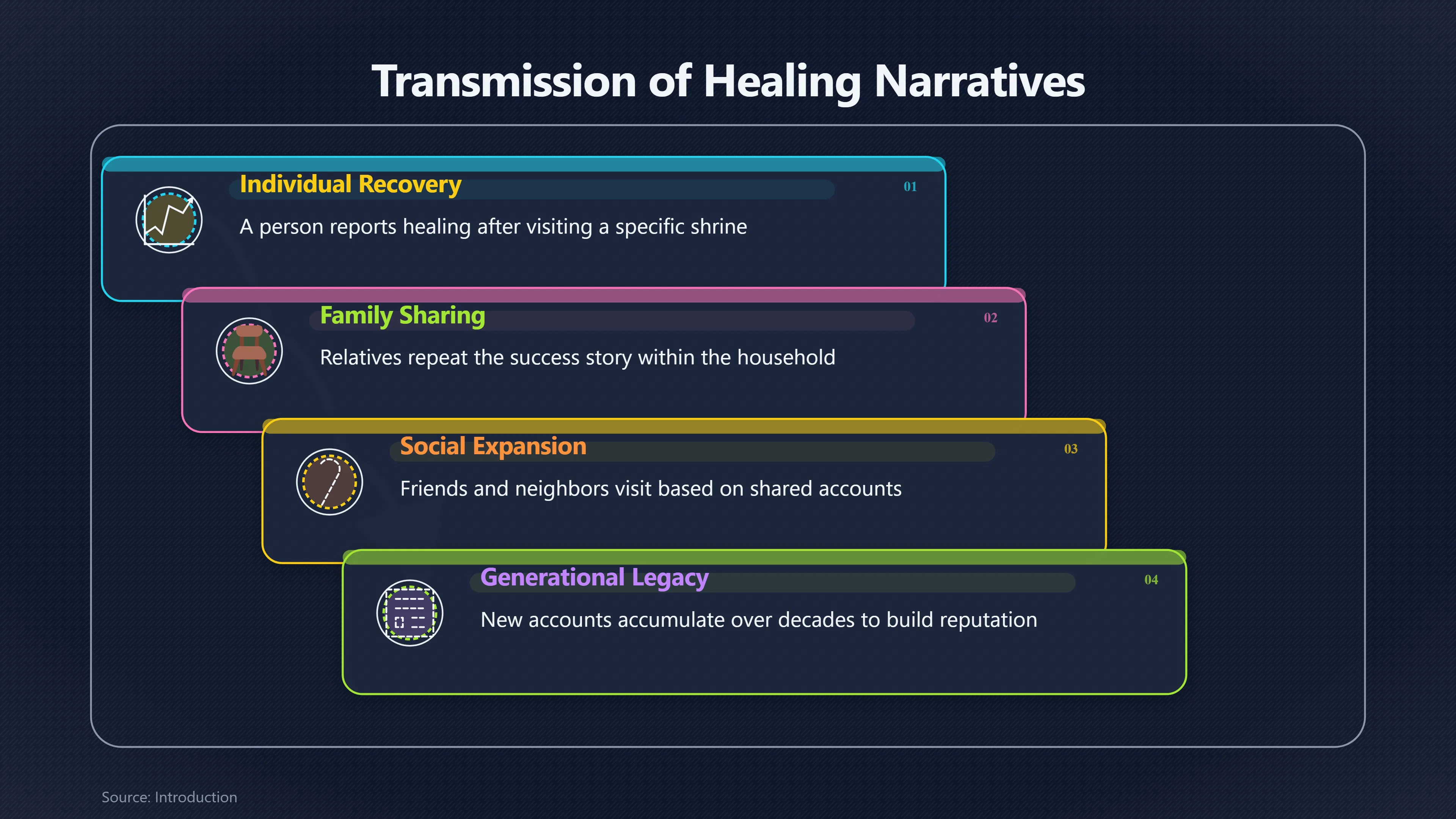
- Someone reports recovering after visiting a shrine.
- Relatives repeat the story within the family.
- Friends visit with similar hopes.
- New accounts accumulate over years or decades.
- The shrine becomes known well beyond its original village.
Because these accounts usually concern individual experiences rather than dramatic public events, belief spreads gradually. A reputation may take generations to establish.
Anthropologists describe this process as a form of collective memory. Even when individual healing claims cannot be medically verified, the stories themselves become socially meaningful. Families remember that a grandmother conceived after visiting a shrine, that a child recovered following a pilgrimage or that prayers appeared to coincide with recovery from illness. These narratives become part of local identity and encourage continued pilgrimage.[ResearchGate]researchgate.netResearch Gate(PDF) Belief in Sacred Places in the Worldview of AzerbaijanisResearch Gate(PDF) Belief in Sacred Places in the Worldview of Azerbaijanis
Why Soviet Campaigns Failed to Erase Sacred Reputation
The Soviet authorities regarded pilgrimage to shrines as superstition and attempted to replace religious explanations with scientific atheism. Mosques and religious institutions faced restrictions, while pilgrimage customs were criticised as remnants of an outdated past.
Yet many shrines survived because they depended less on formal clergy than on ordinary communities. Even where religious buildings were closed, people could continue visiting a tree, spring or isolated grave. Sacred places therefore became informal centres of religious continuity.
Bruce Grant’s research argues that throughout the former Soviet world, shrines often remained among the last active expressions of religious life because they were embedded in local landscapes and family practice rather than institutional structures. Recent Azerbaijani ethnographic research similarly concludes that sacred places functioned as repositories of cultural memory during periods of official repression before experiencing renewed visibility after independence.[Cambridge University Press & Assessment]cambridge.orgCambridge University Press & AssessmentShrines and Sovereigns: Life, Death, and Religion in Rural Azerbaijan | Comparative Studies in Soc…
Faith, Hope and the Limits of Medical Claims
Healing stories should not be confused with scientific evidence that a shrine cures disease. Most reported recoveries remain personal testimonies rather than medically documented case studies.
This distinction matters for understanding why these traditions differ from episodes of mass delusion or public panic.
Several mechanisms can operate simultaneously:
- Individuals may experience genuine psychological comfort through prayer and pilgrimage.
- Reduced stress and increased hope may improve wellbeing for some people.
- Illnesses sometimes improve naturally regardless of treatment.
- Families may remember successful visits more readily than unsuccessful ones.
- Spiritual meaning may remain valuable even when physical recovery does not occur.
Researchers therefore treat healing traditions primarily as cultural and religious practices rather than as verified medical interventions. The persistence of pilgrimage does not necessarily depend upon demonstrable cures; it often reflects the human search for hope, meaning and community during periods of illness or uncertainty.[ResearchGate]researchgate.netResearch Gate(PDF) Belief in Sacred Places in the Worldview of AzerbaijanisResearch Gate(PDF) Belief in Sacred Places in the Worldview of Azerbaijanis
Why Healing Shrines Matter in Azerbaijan’s History of Collective Belief
Healing shrines occupy a distinctive place within Azerbaijan’s wider history of contested belief. They show that influential religious ideas need not spread through fear, coercion or sudden waves of collective excitement.
Instead, sacred reputation grows through repeated personal encounters, trusted testimony and enduring family traditions. This makes healing shrines a useful contrast with moral panics or mass psychogenic illness. Rather than producing widespread alarm, they encourage pilgrimage, remembrance and acts of hope centred on particular places.
For historians and scholars of religion, these sites demonstrate how popular belief can survive political upheaval, ideological campaigns and social change. Their continuing popularity reflects not a single dramatic miracle but the cumulative force of countless small stories passed from one generation to the next, allowing sacred landscapes to remain part of Azerbaijan’s cultural and religious life.[cambridge.org]cambridge.orgCambridge University Press & AssessmentShrines and Sovereigns: Life, Death, and Religion in Rural Azerbaijan | Comparative Studies in Soc…
Amazon book picks
Further Reading
Books and field guides related to Why Azerbaijan's Healing Shrines Still Draw Believers. Use these as the next step if you want deeper reading beyond the article.

The Varieties of Religious Experience
Examines religious experience, healing and personal belief.


The anthropology of religion, magic, and witchcraft
Frames healing shrines as lived religious practice.

Endnotes
1.
Source: cambridge.org
Link:https://www.cambridge.org/core/journals/comparative-studies-in-society-and-history/article/abs/shrines-and-sovereigns-life-death-and-religion-in-rural-azerbaijan/B6F0E04567FD4F4848E71E5324D8232E
Source snippet
Cambridge University Press & AssessmentShrines and Sovereigns: Life, Death, and Religion in Rural Azerbaijan | Comparative Studies in Soc...
2.
Source: researchgate.net
Title: Research Gate(PDF) Belief in Sacred Places in the Worldview of Azerbaijanis
Link:https://www.researchgate.net/publication/396822144_Belief_in_Sacred_Places_in_the_Worldview_ofAzerbaijanis
3.
Source: researchgate.net
Title: 370985341 AGAC PIRLRININ SFAVERICI XUSUSIYYTLRI
Link:https://www.researchgate.net/publication/370985341_AGAC_PIRLRININ_SFAVERICI_XUSUSIYYTLRI
4.
Source: researchgate.net
Title: (PDF) Religious Views in Modern Azerbaijan
Link:https://www.researchgate.net/publication/310428226_Religious_Views_in_Modern_Azerbaijan
5.
Source: researchgate.net
Title: Shrines and Sovereigns: Life, Death, and Religion in Rural Azerbaijan
Link:https://www.researchgate.net/publication/259410972_Shrines_and_Sovereigns_Life_Death_and_Religion_in_Rural_Azerbaijan
6.
Source: azerbaijan.travel
Link:https://azerbaijan.travel/miraculous-ashabi-kahf-shrinee
7.
Source: azerbaijan.travel
Link:https://azerbaijan.travel/tarixin-mirasi-diri-baba-turbesi
8.
Source: azerbaijan.az
Title: History of religions
Link:https://azerbaijan.az/en/related-information/213
Additional References
9.
Source: dergipark.org.tr
Title: İnancın Merkezinde Türbeler: Azerbaycan Halk İnancının Astara’daki Görünümü
Link:https://dergipark.org.tr/tr/pub/atdd/article/1790924
Source snippet
Akademik Tarih ve Düşünce DergisiJanuary 3, 2026 — İNANCIN MERKEZINDE TÜRBELER: AZERBAYCAN HALK İNANCININ ASTARA’DAKI GÖRÜNÜMÜ Cilt: 12 S...
Published: January 3, 2026
10.
Source: biblioteka.by
Title: Бакинский бескостный святой мусульманское паломничество в секулярном городе
Link:https://biblioteka.by/m/articles/view/%D0%91%D0%B0%D0%BA%D0%B8%D0%BD%D1%81%D0%BA%D0%B8%D0%B9-%D0%B1%D0%B5%D1%81%D0%BA%D0%BE%D1%81%D1%82%D0%BD%D1%8B%D0%B9-%D1%81%D0%B2%D1%8F%D1%82%D0%BE%D0%B9-%D0%BC%D1%83%D1%81%D1%83%D0%BB%D1%8C%D0%BC%D0%B0%D0%BD%D1%81%D0%BA%D0%BE%D0%B5-%D0%BF%D0%B0%D0%BB%D0%BE%D0%BC%D0%BD%D0%B8%D1%87%D0%B5%D1%81%D1%82%D0%B2%D0%BE-%D0%B2-%D1%81%D0%B5%D0%BA%D1%83%D0%BB%D1%8F%D1%80%D0%BD%D0%BE%D0%BC-%D0%B3%D0%BE%D1%80%D0%BE%D0%B4%D0%B5
Source snippet
Бакинский "бескостный" святой: мусульманское паломничество в секулярном городеJanuary 10, 2025 — Бакинский "бескостный" святой: мусульман...
Published: January 10, 2025
11.
Source: library.kg
Title: Baku’s “Boneless” Saint: Muslim Pilgrimage in a Secular City
Link:https://library.kg/m/articles/view/Baku-s-Boneless-Saint-Muslim-Pilgrimage-in-a-Secular-City
Source snippet
January 14, 2025 — Baku's "Boneless" Saint: Muslim Pilgrimage in a Secular City Текст статьи · Комментарии [Button: Регистрация ] [Button...
Published: January 14, 2025
12.
Source: bibiheybet.com
Title: bibiheybat holy shrine
Link:https://www.bibiheybet.com/en/article/bibiheybat-holy-shrine
Source snippet
Bibiheybət ZiyarətgahıMarch 6, 2026 — BIBIHEYBAT HOLY SHRINE March 6, 2026 Located just 4–5 kilometers southwest of Baku, along the sceni...
Published: March 6, 2026
13.
Source: youtube.com
Link:https://www.youtube.com/watch?v=yDRD1rA9tvI
Source snippet
Azerbaijan. The sacred mount Beşbarmaq. Travels on two wheels...
14.
Source: chaikhana.media
Title: The healing powers of Azerbaijan’s shrines | Chai Khana
Link:https://chaikhana.media/en/stories/722/
Source snippet
The healing powers of Azerbaijan’s shrines | Chai Khana...
15.
Source: youtube.com
Title: HIKING to HOLY CAVE
Link:https://www.youtube.com/watch?v=PBzIJl8KUBM
Source snippet
Travelog 224: Baku, Azerbaijan | Bibi-Heybat Mosque, Ancient Oil Wells & Gobustan Mud Volcanoes...
16.
Source: dergipark.anas.az
Link:https://dergipark.anas.az/index.php/phas/article/view/4156
17.
Source: medanthro.ru
Link:https://medanthro.ru/?lang=en&page_id=1183
18.
Source: bibiheybet.com
Link:https://www.bibiheybet.com/en/pilgrimage/pir-hasan-shrine
Topic Tree