Within Costa Rica Panics
Why Did Theosophy Alarm Catholic Costa Rica?
Theosophy became a public threat when Catholic leaders feared losing control over education, morality and modern spiritual life.
On this page
- Who joined the Theosophical Society
- Church attacks, excommunication and arson
- Modernity, education and religious competition
Page outline Jump by section
Introduction
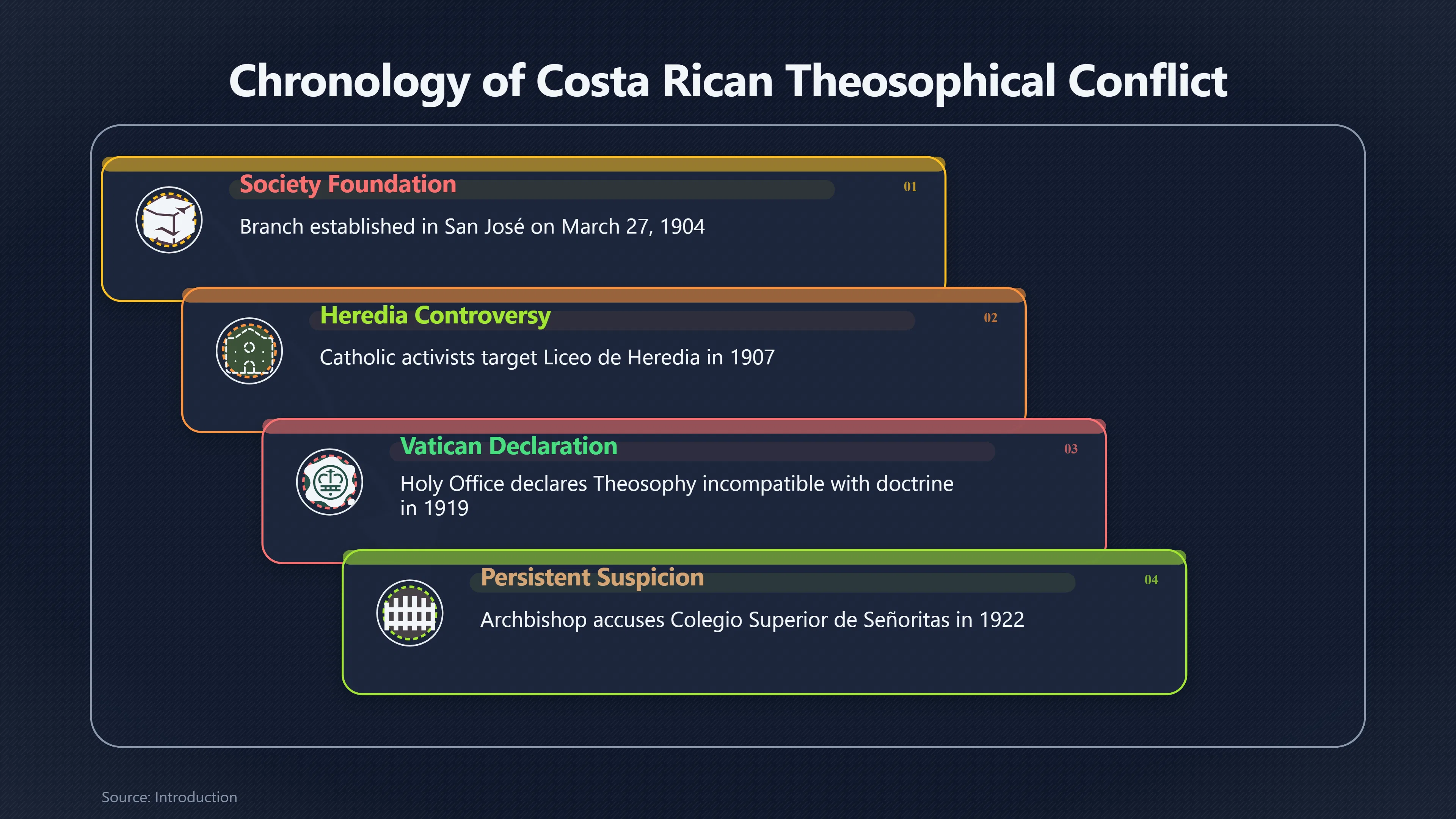
Theosophy became one of the most contentious religious controversies in twentieth-century Costa Rica not because it attracted huge numbers of followers, but because it won support from influential teachers, writers, artists and politicians at a time when the Catholic Church expected to shape the country’s moral and educational life. Founded in San José in 1904, the Costa Rican branch of the Theosophical Society promoted comparative religion, spiritual inquiry and intellectual openness. Church leaders regarded these ideas as a direct challenge to Catholic authority, especially when leading Theosophists occupied prominent positions in education. The resulting conflict developed into one of Costa Rica’s most significant religious culture wars, combining newspaper campaigns, public demonstrations, excommunications, book burnings, accusations of heresy and even attacks on property. Rather than representing a panic over an isolated sect, the dispute revealed deeper struggles over modernity, science, education and who should define acceptable belief in an overwhelmingly Catholic nation.[wikipedia.org]WikipediaTheosophical Society in Costa RicaTheosophical Society in Costa Rica
Why did Theosophy alarm Catholic Costa Rica?
Theosophy emerged internationally in the late nineteenth century as a movement encouraging the comparative study of religions, philosophy and science while exploring spiritual ideas such as reincarnation and hidden wisdom traditions. Its Costa Rican branch, established on 27 March 1904 by the Spanish artist Tomás Povedano and other intellectuals, was the first in Central America. From the beginning it attracted members from the country’s educated elite rather than functioning as a mass religious movement.[Wikipedia]WikipediaTheosophical Society in Costa RicaTheosophical Society in Costa Rica
Its rapid growth worried Catholic leaders for several reasons. First, Theosophy argued that no single religion possessed the whole truth, undermining Catholic claims to exclusive spiritual authority. Second, many leading Theosophists were also educators who promoted scientific ideas, educational reform and greater intellectual freedom. Finally, the movement overlapped socially with Freemasonry, another organisation long criticised by the Catholic hierarchy. Together these developments appeared to many church leaders as part of a wider secular challenge to traditional religious authority.[wikipedia.org]WikipediaFreemasonry in Costa RicaFreemasonry in Costa Rica
The controversy therefore became much larger than disagreement over esoteric beliefs. It evolved into a debate over whether Costa Rica would remain culturally defined by Catholicism or embrace a more pluralistic intellectual environment.
Who joined the Theosophical Society?
The significance of Costa Rican Theosophy came less from its membership size than from the influence of its members.
Among the best-known figures were:
- Tomás Povedano, the Spanish painter who helped establish the movement.[Roberto Brenes Mesén]WikipediaRoberto Brenes Mesén esén, poet, philosopher and influential educational reformer. * **Omar Dengo, one of Costa Rica’s leading educators.[theosophy.world]theosophy.worldWorld Costa Rica, Theosophy in | Theosophy WorldCosta Rica, Theosophy in | Theosophy World… * Julio Acosta García, who later became President of Costa Rica.[theosophy.world]theosophy.worldWorld Costa Rica, Theosophy in | Theosophy WorldCosta Rica, Theosophy in | Theosophy World…
- María Fernández Le Cappellain, writer and former First Lady.
- Eunice Odio, the celebrated poet, who joined in a later generation.[Wikipedia]WikipediaTheosophical Society in Costa RicaTheosophical Society in Costa Rica
Because these figures occupied positions in schools, universities, government and the arts, critics feared that Theosophy exercised influence far beyond its formal membership. Supporters, by contrast, viewed it as part of a broader intellectual awakening that encouraged scientific thinking, artistic experimentation and international engagement.
The movement also attracted women active in educational and feminist circles. Recent historical research argues that Theosophy provided some educated Costa Rican women with alternative intellectual networks outside exclusively Catholic organisations, although many feminists remained practising Catholics and the relationship between reform movements and religion was more complex than later stereotypes suggest.[SciELO Costa Rica]scielo.sa.crCosta RicaTeósofas, masonas y feministas (Costa Rica, 1890-1923)…
Church attacks, excommunication and arson
The fiercest confrontations centred on education.
In 1907, Roberto Brenes Mesén, then director of the Liceo de Heredia, became the focus of a major campaign organised by Catholic activists and supported by clergy. Parents were encouraged to withdraw their children because the school taught Darwinian evolution and refused to introduce formal Catholic religious instruction. Brenes Mesén’s opponents portrayed him not merely as an educational reformer but as a dangerous Theosophist undermining Christian civilisation.[Revistas UCR]archivo.revistas.ucr.ac.crRevistas UCR06_rehmlac.vol13.n1-mjquesada_lariasSeptember 15, 2020…
The conflict quickly spread beyond the classroom.
Public meetings, newspaper exchanges and sermons denounced Theosophy as spiritually dangerous. The Church imposed ecclesiastical sanctions, including excommunications in parts of the dispute, while public demonstrations featured the burning of books regarded as impious. According to historian Iván Molina Jiménez, the intensity of the confrontation briefly made it appear as though Costa Rica had returned to the bitter church-state conflicts of the nineteenth century.[Repositorio DSpace]obregon.cihac.fcs.ucr.ac.crRepositorio DSpaceLa ciudad de los monos: Roberto Brenes Mesén, los católicos heredianos y el conflicto cultural de 1907 en Costa Rica…
Violence remained limited compared with religious conflicts elsewhere in Latin America, but hostility sometimes extended to attacks on buildings associated with Theosophists. Historians describe episodes of arson and vandalism as evidence that religious rhetoric occasionally spilled into direct action, even though Costa Rica avoided prolonged sectarian violence.[Wikipedia]WikipediaTheosophical Society in Costa RicaTheosophical Society in Costa Rica
These incidents are better understood as part of a moral and political struggle than as evidence that Theosophy itself promoted extremism. The movement became the object of organised campaigns portraying it as a threat to religion, family life and national identity.
Modernity, education and religious competition
The controversy reflected wider international tensions within Catholicism during the early twentieth century.
Across Europe and Latin America, Catholic authorities were confronting liberalism, scientific modernisation, Freemasonry and new religious movements. The Vatican itself eventually declared participation in the Theosophical Society incompatible with Catholic doctrine in 1919, reinforcing positions already taken by local bishops in countries such as Costa Rica.[Cambridge University Press & Assessment]cambridge.orgCambridge University Press & AssessmentDe Theosophismo: The Vatican’s Response to the Theosophical Society in the Documents of the Holy O…
Costa Rica provided an especially revealing case because many leading reformers combined interests in education, literature, science and comparative religion. Questions about evolution, secular education and freedom of conscience therefore became inseparable from arguments about Theosophy.
The 1907 dispute did not end the conflict. In 1922, Archbishop Rafael Otón Castro Jiménez accused the director of the Colegio Superior de Señoritas, Esther de Mézerville, of allowing Theosophical doctrines to influence education. Rumours circulated that she was using her position to spread esoteric beliefs, showing that suspicion of Theosophical influence persisted well after the original Heredia controversy.[SciELO Costa Rica]scielo.sa.crCosta RicaTeósofas, masonas y feministas (Costa Rica, 1890-1923)…
These recurring disputes reveal how educational institutions became symbolic battlegrounds. The central question was not whether students would formally become Theosophists, but whether schools should remain under Catholic moral authority or become spaces where science, comparative religion and secular intellectual inquiry could flourish.
Was this a cult scare or a religious culture war?
Calling the controversy a “cult panic” oversimplifies what happened.
The Theosophical Society was an organised international movement with published doctrines, public meetings and identifiable leaders. It was not a secret conspiracy, nor is there evidence that it engaged in the kinds of coercive practices commonly associated with destructive high-control groups.
Instead, historians generally interpret the episode as a religious culture war driven by competing visions of national identity. Catholic authorities genuinely believed that Theosophy endangered souls and weakened the Church’s cultural role. Theosophists argued that they were expanding intellectual freedom rather than attacking Christianity. Each side therefore understood itself as defending civilisation against a dangerous opponent.[sa.cr]scielo.sa.crCosta RicaTeósofas, masonas y feministas (Costa Rica, 1890-1923)…
This distinction matters because the controversy demonstrates how moral panics can emerge around recognised religious minorities without requiring fabricated conspiracies or mass delusions. The perceived threat arose from the movement’s visibility among respected public figures and from fears that educational reform would permanently shift Costa Rican society away from Catholic dominance.

Why the controversy still matters
Today, Costa Rica’s Theosophical Society survives as a small spiritual organisation, while the country itself has become far more religiously diverse than it was in 1904. The early conflict nevertheless remains important because it illustrates how debates over education, science and religious freedom can become emotionally charged when they are linked to questions of national identity.[Wikipedia]WikipediaTheosophical Society in Costa RicaTheosophical Society in Costa Rica
The episode also provides an important historical counterpoint to later Costa Rican moral panics involving hippies, heavy-metal fans and other perceived outsiders. In each case, anxieties about social change were concentrated onto a visible minority portrayed as threatening the nation’s moral foundations. The Theosophy controversy was one of the earliest and most influential examples of this pattern, showing how disputes over belief can become proxies for much broader struggles over culture, authority and modernity.[Repositorio DSpace]obregon.cihac.fcs.ucr.ac.crRepositorio DSpaceLa ciudad de los monos: Roberto Brenes Mesén, los católicos heredianos y el conflicto cultural de 1907 en Costa Rica…
Amazon book picks
Further Reading
Books and field guides related to Why Did Theosophy Alarm Catholic Costa Rica?. Use these as the next step if you want deeper reading beyond the article.
The Varieties of Religious Experience
Provides broader perspective on new religious movements.


Endnotes
1.
Source: Wikipedia
Title: Theosophical Society in Costa Rica
Link:https://en.wikipedia.org/wiki/Theosophical_Society_in_Costa_Rica
2.
Source: theosophy.world
Title: World Costa Rica, Theosophy in | Theosophy World
Link:https://www.theosophy.world/encyclopedia/costa-rica-theosophy
Source snippet
Costa Rica, Theosophy in | Theosophy World...
3.
Source: Wikipedia
Title: Freemasonry in Costa Rica
Link:https://en.wikipedia.org/wiki/Freemasonry_in_Costa_Rica
4.
Source: Wikipedia
Title: Roberto Brenes Mesén
Link:https://en.wikipedia.org/wiki/Roberto_Brenes_Mes%C3%A9n
5.
Source: cambridge.org
Link:https://www.cambridge.org/core/journals/church-history/article/de-theosophismo-the-vaticans-response-to-the-theosophical-society-in-the-documents-of-the-holy-office-19151919/0285D16F33FFEC2E59638501113F9FC3
Source snippet
Cambridge University Press & AssessmentDe Theosophismo: The Vatican’s Response to the Theosophical Society in the Documents of the Holy O...
6.
Source: theosophical.org
Link:https://www.theosophical.org/about/theosophy
7.
Source: theosophy.org
Title: theosophica lmovement
Link:https://www.theosophy.org/Other%20or%20Uncertain/History%20of%20the%20Theosophical%20Movement%20%281875-1950%29/theosophica%20lmovement.htm
8.
Source: obregon.cihac.fcs.ucr.ac.cr
Link:https://obregon.cihac.fcs.ucr.ac.cr/items/279b01a0-8869-4576-b105-27c1e06ea68f
Source snippet
Repositorio DSpaceLa ciudad de los monos: Roberto Brenes Mesén, los católicos heredianos y el conflicto cultural de 1907 en Costa Rica...
9.
Source: scielo.sa.cr
Link:https://www.scielo.sa.cr/scielo.php?pid=S1659-42232021000100069&script=sci_arttext
Source snippet
Costa RicaTeósofas, masonas y feministas (Costa Rica, 1890-1923)...
10.
Source: archivo.revistas.ucr.ac.cr
Title: Revistas UCR06_rehmlac.vol13.n1-mjquesada_larias
Link:https://archivo.revistas.ucr.ac.cr/index.php/rehmlac/article/download/44216/45386?inline=1
Source snippet
September 15, 2020...
Published: September 15, 2020
11.
Source: scielo.sa.cr
Link:https://www.scielo.sa.cr/scielo.php?pid=S1659-42232023000200114&script=sci_arttext
12.
Source: archivo.revistas.ucr.ac.cr
Link:https://archivo.revistas.ucr.ac.cr/index.php/rehmlac/article/download/55352/58464?inline=1
13.
Source: archivo.revistas.ucr.ac.cr
Link:https://archivo.revistas.ucr.ac.cr/index.php/rehmlac/article/download/43530/45392?inline=1
14.
Source: archivo.revistas.ucr.ac.cr
Link:https://archivo.revistas.ucr.ac.cr/index.php/rehmlac/article/download/37636/38509?inline=1
15.
Source: obregon.cihac.fcs.ucr.ac.cr
Link:https://obregon.cihac.fcs.ucr.ac.cr/items/279b01a0-8869-4576-b105-27c1e06ea68f/full
16.
Source: scielo.sa.cr
Link:https://www.scielo.sa.cr/scielo.php?pid=S1659-42232019000200123&script=sci_arttext
17.
Source: scielo.sa.cr
Link:https://www.scielo.sa.cr/scielo.php?pid=S1659-42232019000200123&script=sci_abstract
Additional References
18.
Source: theohistory.org
Title: Of the many individuals of importance
Link:https://theohistory.org/issue-archive/volume-xviii/
Source snippet
Volume XVIII – Theosophical HistoryJune 20, 2026 — However interesting this is, it is the esoteric subset of the second version of nation...
Published: June 20, 2026
19.
Source: theohistory.org
Title: Volume X – Theosophical History
Link:https://theohistory.org/issue-archive/volume-x/
Source snippet
1-12, Theosophical History Occasional Papers Vol. 1-8, and all THC publications. Later issues of Theosophical History and the Occa...
20.
Source: youtube.com
Title: The Theosophical Society in America: An Illustrated History
Link:https://www.youtube.com/watch?v=bueOQUDN5Jo
Source snippet
The Dawning of the Theosophical Age with Michael Gomes...
21.
Source: youtube.com
Title: The Dawning of the Theosophical Age with Michael Gomes
Link:https://www.youtube.com/watch?v=XAoD1gIVE-w
Source snippet
Annie Besant: An Unlikely Rebel | Historical Documentary...
22.
Source: theosociety.org
Link:https://www.theosociety.org/pasadena/ts/tshist.htm
23.
Source: theosophicalsociety.org.uk
Link:https://theosophicalsociety.org.uk/theosophy
24.
Source: biblioteca-repositorio.clacso.edu.ar
Link:https://biblioteca-repositorio.clacso.edu.ar/handle/CLACSO/213425
25.
Source: bitterwinter.org
Link:https://bitterwinter.org/tomas-povedano-and-maria-fernandez-theosophy-krishnamurti-and-the-arts-in-costa-rica/
26.
Source: researchgate.net
Title: 366529047 Teosofas masonas y feministas Costa Rica 1890 1923
Link:https://www.researchgate.net/publication/366529047_Teosofas_masonas_y_feministas_Costa_Rica
27.
Source: youtube.com
Title: Annie Besant: An Unlikely Rebel | Historical Documentary
Link:https://www.youtube.com/watch?v=7CfUE4O8dho
Source snippet
Quakers in Costa Rica...
Topic Tree