Within Liechtenstein Panics
The Escape That Broke the Witch Trial System
Maria Eberle escaped Vaduz Castle, challenged her sentence and helped bring local abuses before imperial authorities.
On this page
- Arrest, torture and death sentence
- Escape from Vaduz Castle
- Appeal, exoneration and uncertain aftermath
Page outline Jump by section
Introduction
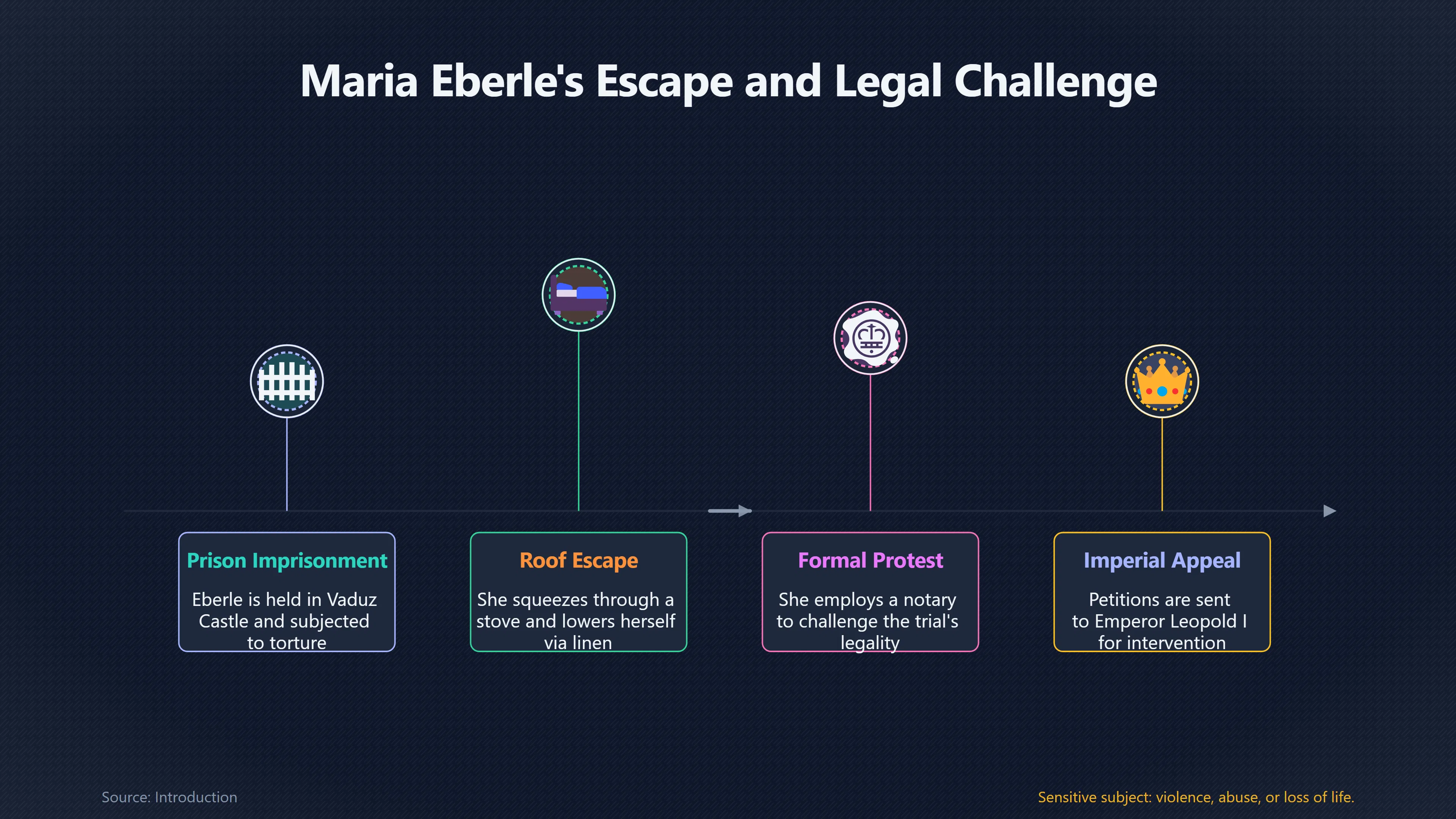
Maria Eberle’s story is the best-documented individual case from the final wave of witch trials in the territory that later became Liechtenstein. Arrested in 1680, tortured in Vaduz Castle and condemned to death, she accomplished a remarkable escape that transformed her from a victim into a challenger of the legal system that had condemned her. Instead of simply fleeing, Eberle formally protested the legality of her trial, appealed to the Holy Roman Emperor, and helped trigger the imperial investigation that ultimately brought the prosecutions to an end. Her surviving case is therefore important not only because it reveals how the trials operated, but because it provides rare evidence of how they were successfully challenged.[historisches-lexikon.li]historisches-lexikon.liLiechtenstein Lexicon Eberle (Eberlin), Maria – Historisches LexikonLiechtenstein LexiconEberle (Eberlin), Maria – Historisches LexikonDecember 31, 2011…
Arrest, torture and death sentence
Maria Eberle, also recorded as Maria Eberlin, lived in the village of Planken with her husband Thomas Lampert. By the time she was arrested on 19 November 1680, her family had already suffered heavily from earlier witch persecutions. Both her grandfather and an aunt had previously been executed after being accused of witchcraft, leaving the family under long-standing suspicion. Historians regard this family history as one example of how accusations could become self-perpetuating, with later generations inheriting a dangerous reputation.[Liechtenstein Lexicon]historisches-lexikon.liLiechtenstein Lexicon Eberle (Eberlin), Maria – Historisches LexikonLiechtenstein LexiconEberle (Eberlin), Maria – Historisches LexikonDecember 31, 2011…
Several witnesses accused Eberle of witchcraft during the final prosecution campaign in the County of Vaduz. Like many other defendants in seventeenth-century witch trials, she was imprisoned in Vaduz Castle and subjected to torture. Under interrogation she confessed to acts of witchcraft, a confession extracted under coercion rather than freely given. A legal opinion then endorsed her execution, and she was sentenced to death.[Liechtenstein Lexicon]historisches-lexikon.liLiechtenstein Lexicon Eberle (Eberlin), Maria – Historisches LexikonLiechtenstein LexiconEberle (Eberlin), Maria – Historisches LexikonDecember 31, 2011…
Her experience illustrates the mechanisms that sustained the trials. Torture produced confessions, confessions appeared to validate existing beliefs, and judicial procedures that would normally protect defendants were largely abandoned once witchcraft was treated as an exceptional crime. Eberle’s case survives in unusually detailed records, making it one of the clearest windows into how these prosecutions operated in practice.[news.historisches-lexikon.li]news.historisches-lexikon.liMaria Eberle und das Ende der Hexenverfolgungen:: news für e HFLMaria Eberle und das Ende der Hexenverfolgungen:: news für e HFL
Escape from Vaduz Castle
Rather than awaiting execution, Maria Eberle carried out one of the most extraordinary prison escapes associated with the European witch trials.
Contemporary accounts describe her squeezing through the opening of a stove, making her way into the castle roof space, removing roof tiles and lowering herself outside the castle walls using knotted bed linen. She then escaped to the nearby town of Feldkirch, beyond the immediate reach of the Vaduz authorities.[news.historisches-lexikon.li]news.historisches-lexikon.liMaria Eberle und das Ende der Hexenverfolgungen:: news für e HFLMaria Eberle und das Ende der Hexenverfolgungen:: news für e HFL
The escape mattered because Eberle did not disappear into hiding. Instead, from Feldkirch she employed a notary to send a formal protest to the Landvogt (governor) of Vaduz, challenging the legality of the proceedings against her. This was a crucial shift. Rather than arguing that witchcraft itself was impossible, she attacked the way the authorities had conducted the trial. That distinction made it possible for higher authorities to intervene on legal rather than theological grounds.[Liechtenstein Lexicon]historisches-lexikon.liLiechtenstein Lexicon Eberle (Eberlin), Maria – Historisches LexikonLiechtenstein LexiconEberle (Eberlin), Maria – Historisches LexikonDecember 31, 2011…
Historians regard this protest as the first concrete step that began dismantling the final wave of witch prosecutions in Vaduz and Schellenberg.[Liechtenstein Lexicon]historisches-lexikon.liLiechtenstein Lexicon Eberle (Eberlin), Maria – Historisches LexikonLiechtenstein LexiconEberle (Eberlin), Maria – Historisches LexikonDecember 31, 2011…
Appeal, exoneration and uncertain aftermath
Eberle’s legal challenge quickly expanded beyond her individual case. Together with four other refugees from the prosecutions and the parish priest Valentin von Kriss of Triesen, she sent petitions to Emperor Leopold I requesting imperial intervention. Their complaints alleged serious procedural abuses in the conduct of the trials.[news.historisches-lexikon.li]news.historisches-lexikon.liMaria Eberle und das Ende der Hexenverfolgungen:: news für e HFLMaria Eberle und das Ende der Hexenverfolgungen:: news für e HFL
The emperor responded by ordering the prosecutions to cease in 1681 and appointing an imperial commission to investigate. The commission referred the surviving court records to the University of Salzburg, where the jurist Johann Baptist Moser produced a lengthy legal opinion in 1682. Applying ordinary legal standards to each case, he concluded that the trials of 1679 and 1680 had been conducted unlawfully. Imperial intervention eventually led to the invalidation of the convictions, the withdrawal of criminal jurisdiction from the local ruler and the effective end of organised witch trials in the county.[Liechtenstein Lexicon]historisches-lexikon.liLiechtenstein Lexicon Moser, Johann Baptist – Historisches LexikonLiechtenstein LexiconMoser, Johann Baptist – Historisches LexikonDecember 31, 2011…
Maria Eberle herself returned to the County of Vaduz as early as 1681. Her death sentence was lifted, and the authorities were ordered to restore property confiscated during her prosecution, including a substantial sum of 234 gulden and 30 kreuzer. Even so, the surviving records suggest that returning to ordinary life proved difficult. She initially left her house in Planken empty, stayed with relatives in neighbouring Schellenberg and was reportedly expelled twice from the county by armed soldiers before disappearing from the historical record.[Liechtenstein Lexicon]historisches-lexikon.liLiechtenstein Lexicon Eberle (Eberlin), Maria – Historisches LexikonLiechtenstein LexiconEberle (Eberlin), Maria – Historisches LexikonDecember 31, 2011…
Why Maria Eberle’s case remains so important
Maria Eberle occupies a distinctive place in the history of witch persecutions because her surviving records document every major stage of the collapse of the system:
- she experienced arrest, torture and a death sentence;
- she escaped from imprisonment rather than accepting execution;
- she challenged the legality of her own prosecution through formal legal channels;
- her appeal became one of the principal triggers for imperial intervention;
- her sentence was overturned, and confiscated property was ordered to be returned.[historisches-lexikon.li]historisches-lexikon.liLiechtenstein Lexicon Eberle (Eberlin), Maria – Historisches LexikonLiechtenstein LexiconEberle (Eberlin), Maria – Historisches LexikonDecember 31, 2011…
For historians, her case demonstrates that the end of the Vaduz witch trials was not simply the result of changing beliefs about witchcraft. It also depended on determined individuals who exposed procedural abuses, sympathetic clergy and lawyers willing to pursue appeals, and imperial authorities prepared to insist that local courts obey established legal standards. The surviving documentation makes Maria Eberle’s experience the clearest personal narrative from Liechtenstein’s final witch-trial wave and one of the strongest pieces of evidence for how a persecution built on fear and coerced confessions was finally brought under scrutiny.[historisches-lexikon.li]historisches-lexikon.liLiechtenstein Lexicon Eberle (Eberlin), Maria – Historisches LexikonLiechtenstein LexiconEberle (Eberlin), Maria – Historisches LexikonDecember 31, 2011…
Amazon book picks
Further Reading
Books and field guides related to The Escape That Broke the Witch-Trial System. Use these as the next step if you want deeper reading beyond the article.
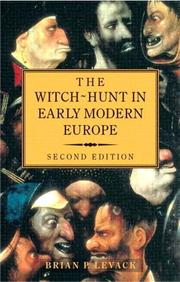
The witch-hunt in early modern Europe
Explains the legal framework surrounding cases like Maria Eberle's.

Endnotes
1.
Source: historisches-lexikon.li
Title: Liechtenstein Lexicon Eberle (Eberlin), Maria – Historisches Lexikon
Link:https://historisches-lexikon.li/Eberle_%28Eberlin%29%2C_Maria
Source snippet
Liechtenstein LexiconEberle (Eberlin), Maria – Historisches LexikonDecember 31, 2011...
Published: December 31, 2011
2.
Source: news.historisches-lexikon.li
Title: Maria Eberle und das Ende der Hexenverfolgungen:: news für e HFL
Link:https://news.historisches-lexikon.li/maria-eberle-und-das-ende-der-hexenverfolgungen
3.
Source: historisches-lexikon.li
Title: Liechtenstein Lexicon Hexenverfolgung – Historisches Lexikon
Link:https://historisches-lexikon.li/Hexenverfolgung
4.
Source: historisches-lexikon.li
Title: Liechtenstein Lexicon Moser, Johann Baptist – Historisches Lexikon
Link:https://historisches-lexikon.li/Moser%2C_Johann_Baptist
Source snippet
Liechtenstein LexiconMoser, Johann Baptist – Historisches LexikonDecember 31, 2011...
Published: December 31, 2011
5.
Source: news.historisches-lexikon.li
Title: 300 jahre fuerstentum liechtenstein
Link:https://news.historisches-lexikon.li/300-jahre-fuerstentum-liechtenstein
6.
Source: historisches-lexikon.li
Title: Köberle (Köberlin, Köberl), Johann Christoph – Historisches Lexikon
Link:https://historisches-lexikon.li/K%C3%B6berle_%28K%C3%B6berlin%2C_K%C3%B6berl%29%2C_Johann_Christoph
7.
Source: historisches-lexikon.li
Title: Schaan – Historisches Lexikon
Link:https://historisches-lexikon.li/Schaan
8.
Source: historisches-lexikon.li
Title: Vaduz (Gemeinde) – Historisches Lexikon
Link:https://historisches-lexikon.li/Vaduz_%28Gemeinde%29
9.
Source: historisches-lexikon.li
Title: Kaiserliche Administration – Historisches Lexikon
Link:https://historisches-lexikon.li/Kaiserliche_Administration
10.
Source: historisches-lexikon.li
Title: Walser, Andreas Josef – Historisches Lexikon
Link:https://historisches-lexikon.li/Walser%2C_Andreas_Josef
11.
Source: vaduz.li
Title: schloss vaduz
Link:https://www.vaduz.li/en/living-environment/living-building/listed-buildings/schloss-vaduz
Additional References
12.
Source: liechtenstein-institut.li
Link:https://liechtenstein-institut.li/publikationen/goop-cornelius-2024-maria-eberle-und-das-ende-der-hexenverfolgungen-gastbeitrag-liezeit-nr-124-13-april-2024
Source snippet
Gastbeitrag. Lie:Zeit Nr. 124, 13. April 2024.:: Liechtenstein-Institut. Forschung und Lehre.April 13, 2024 — GOOP, CORNELIUS (2024): MA...
Published: april 2024
13.
Source: theguardian.com
Link:https://www.theguardian.com/us-news/2023/may/30/connecticut-witch-trials-exonerations
Source snippet
[Input] Beth Caruso, co-founder of the Connecticut Witch Trial Exoneration Project. Photograph: Jessica Hill/AP V...
14.
Source: lie-zeit.li
Title: Hexenverfolgungen in Liechtenstein – lie:zeit online
Link:https://www.lie-zeit.li/2023/03/hexenverfolgungen-in-liechtenstein/
Source snippet
März 2023 Bild, das auf die Hexenprozesse hinweist ALS HEXENVERFOLGUNG BEZEICHNET MAN DAS AUFSPÜREN, FESTNEHMEN, FOLTERN UND BESTRAFEN, I...
15.
Source: academic.oup.com
Link:https://academic.oup.com/book/44700/chapter-abstract/378812867
Source snippet
in Defence of Mediate Subjects: The Smallest Territories, c.1500–1780 | Intervention and State Sovereignty in Central Europe, 1500-1780 |...
16.
Source: youtube.com
Title: Europe’s Witch Trials: Context for Salem Part 1
Link:https://www.youtube.com/watch?v=oY–nodAvU8
Source snippet
The Secret History of Witches | Witch Trials and Fear in History...
17.
Source: academic.oup.com
Link:https://academic.oup.com/book/44700/chapter/378812867
Source snippet
in Defence of Mediate Subjects: The Smallest Territories, c.1500–1780 | Intervention and State Sovereignty in Central Europe, 1500-1780 |...
18.
Source: e-archiv.li
Link:https://www.e-archiv.li/textDetail.aspx?backurl=auto&eID=8&etID=46110
19.
Source: liechtenstein-institut.li
Link:https://liechtenstein-institut.li/en/research-projects/die-kaiserliche-administration-der-reichsgrafschaft-vaduz-und-der-reichsherrschaft-schellenberg-1684-16991712
20.
Source: liechtenstein-institut.li
Link:https://liechtenstein-institut.li/forschungsprojekte/die-kaiserliche-administration-der-reichsgrafschaft-vaduz-und-der-reichsherrschaft-schellenberg-1684-16991712
21.
Source: revistas.unal.edu.co
Link:https://revistas.unal.edu.co/index.php/peju/article/view/36716
Topic Tree