Within Oman
Were Oman's Possession Rituals Hysteria or Healing?
Omani possession ceremonies organise distress through music, ritual questioning and collective support rather than simple crowd delusion.
On this page
- How possession is recognised and treated
- What ceremonies provide for sufferers and families
- Medical risks, stigma and cultural interpretation
Page outline Jump by section
Introduction
In parts of Oman, spirit possession has long been understood not simply as a frightening supernatural event but as a culturally recognised explanation for distress that could be addressed through communal healing. The best-documented example is the Zar tradition, in which music, rhythmic movement, ritual questioning and the support of relatives and neighbours help organise emotional suffering into a shared social experience rather than an isolated personal crisis. Researchers who have studied Zar in Oman argue that these ceremonies are better understood as a culturally meaningful response to distress than as evidence of mass hysteria or collective delusion. Instead of asking whether spirits objectively exist, anthropologists and psychiatrists have examined what these rituals accomplish for participants, families and communities.[Sultan Qaboos University]squ.elsevierpure.comSultan Qaboos University Zar: Group distress and healingSultan Qaboos UniversityZar: Group distress and healing - Sultan Qaboos University House of Expertise…
This distinction is important when considering Oman within the wider history of collective belief. Possession ceremonies involve shared expectations and dramatic public performances, but they generally function as recognised forms of care rather than contagious episodes of panic. Their significance lies less in proving supernatural claims than in revealing how a society explains suffering, mobilises support and negotiates the boundary between traditional healing and modern medicine.[Sultan Qaboos University]squ.elsevierpure.comSultan Qaboos University Zar: Group distress and healingSultan Qaboos UniversityZar: Group distress and healing - Sultan Qaboos University House of Expertise…
Were Oman’s Possession Rituals Hysteria or Healing?
Modern readers sometimes assume that dramatic possession ceremonies must represent irrational crowd behaviour. The available evidence from Oman suggests a more complicated picture.
Researchers at Sultan Qaboos University describe Zar as a system that combines religious ideas, social expectations and ritual performance into a recognised method of responding to particular forms of distress. Rather than spreading through uncontrolled emotional contagion, ceremonies usually occur within established social settings, led by experienced practitioners and attended by relatives or community members who understand the ritual’s purpose.[Sultan Qaboos University]squ.elsevierpure.comSultan Qaboos University Zar: Group distress and healingSultan Qaboos UniversityZar: Group distress and healing - Sultan Qaboos University House of Expertise…
Anthropologists and cultural psychiatrists therefore distinguish Zar from classic mass psychogenic illness. In a mass psychogenic episode, symptoms spread unexpectedly through a group without an adequate physical cause. Zar ceremonies, by contrast, are intentional, structured and culturally meaningful events in which participants expect ritual healing rather than panic. The shared beliefs certainly influence experience, but they do so within an organised therapeutic framework rather than through uncontrolled collective fear.[Sultan Qaboos University]squ.elsevierpure.comSultan Qaboos University Zar: Group distress and healingSultan Qaboos UniversityZar: Group distress and healing - Sultan Qaboos University House of Expertise…
How Possession Is Recognised and Treated
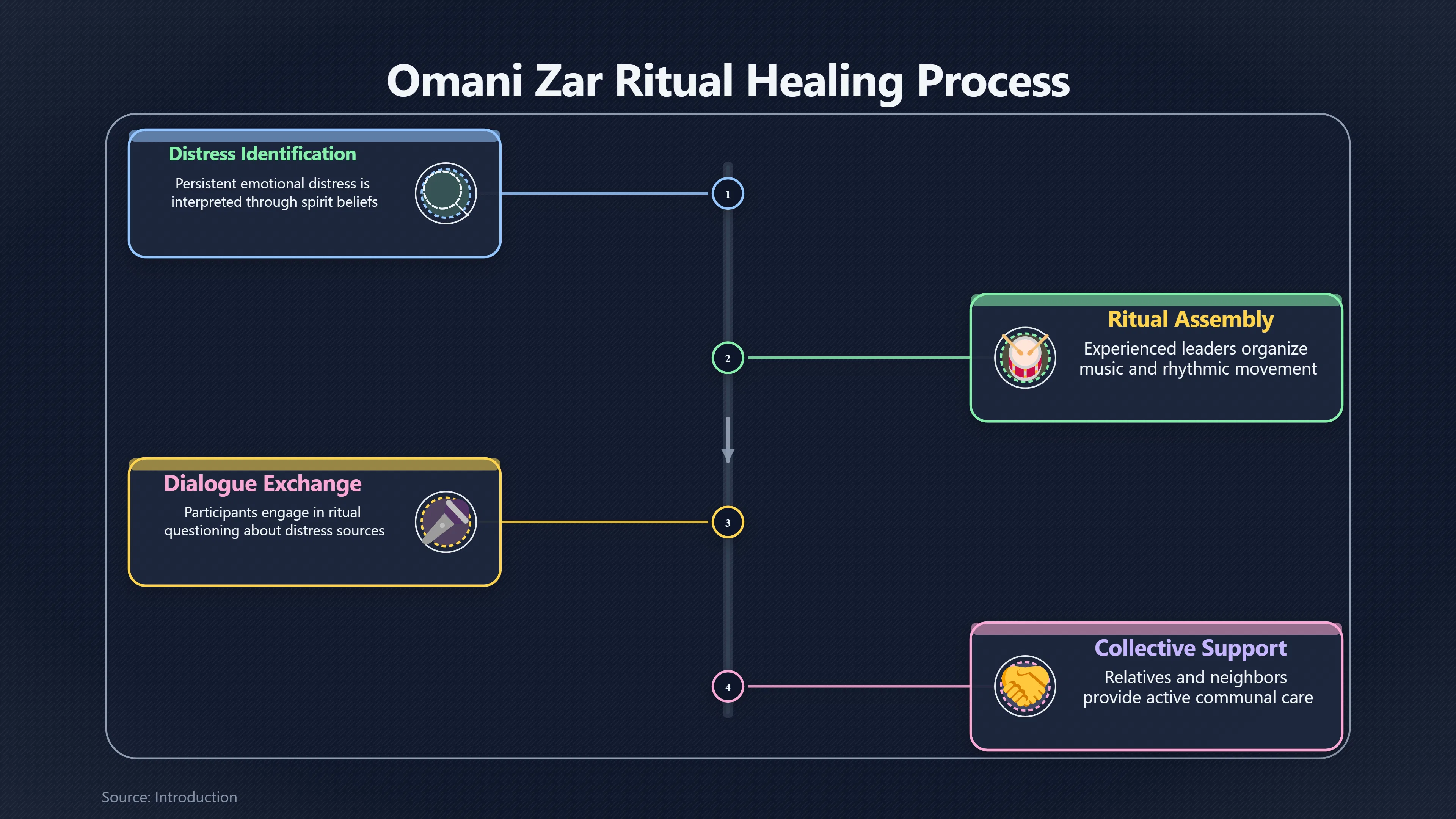
Within communities where possession beliefs are accepted, persistent emotional distress, unusual behaviour or unexplained physical complaints may be interpreted as signs that a spirit is involved. This interpretation does not necessarily replace every other explanation, but it provides a culturally familiar framework for understanding suffering.
Treatment focuses less on driving out an enemy than on restoring balance between the affected individual, the spirit world as understood by participants, and the wider community. Researchers describe ceremonies involving:
- repetitive music and drumming;
- rhythmic movement or dancing;
- ritual dialogue about the source of distress;
- participation by experienced ritual leaders;
- active involvement from relatives and neighbours.
These elements encourage emotional expression in ways that may be difficult in ordinary daily life. Rather than suffering alone, the individual becomes the centre of collective attention and care.[Sultan Qaboos University]squ.elsevierpure.comSultan Qaboos University Zar: Group distress and healingSultan Qaboos UniversityZar: Group distress and healing - Sultan Qaboos University House of Expertise…
Researchers have proposed several mechanisms that may help explain why participants often report improvement without assuming that all participants share identical supernatural beliefs. The ritual creates a socially accepted opportunity to express distress, reduces isolation, provides symbolic explanations for difficult experiences and mobilises practical support from family members.[Sultan Qaboos University]squ.elsevierpure.comSultan Qaboos University Zar: Group distress and healingSultan Qaboos UniversityZar: Group distress and healing - Sultan Qaboos University House of Expertise…
What the Ceremonies Provide for Sufferers and Families
The healing value identified by researchers is not limited to the individual participant.
A socially acceptable language for distress
In highly community-oriented societies, openly describing psychological suffering may be difficult or carry social stigma. Framing distress through possession can externalise the problem. Instead of viewing someone as personally weak or morally failing, relatives may understand the condition as something happening to them rather than something they deliberately chose.[EMRO Dashboards]applications.emro.who.intEMRO DashboardseditorialOman Medical Journal [2017], Vol. 32, NoApril 15, 2026…
Collective responsibility
Unlike many modern clinical encounters, Zar ceremonies involve the wider social network. Family members witness the ritual, offer practical assistance and acknowledge the sufferer’s experience. This collective participation reinforces the idea that recovery is a shared responsibility rather than an individual burden. Researchers note that such communal involvement fits well with Oman’s traditionally collectivist social structure.[EMRO Dashboards]applications.emro.who.intEMRO DashboardseditorialOman Medical Journal [2017], Vol. 32, NoApril 15, 2026…
Emotional release
Music, repetitive rhythm and ritual performance provide structured opportunities for emotional expression that everyday social norms may discourage. Cultural psychiatrists have suggested that this can help participants process tension, grief or conflict in a socially legitimate way. Although experiences vary greatly between individuals, the ceremony itself creates a recognised setting for emotional release rather than random emotional contagion.[Sultan Qaboos University]squ.elsevierpure.comSultan Qaboos University Zar: Group distress and healingSultan Qaboos UniversityZar: Group distress and healing - Sultan Qaboos University House of Expertise…
Medical Risks, Stigma and Cultural Interpretation
Understanding the social value of possession rituals does not mean treating them as complete substitutes for medical care.
Psychiatrists working in Oman have noted that many people experiencing mental illness first seek help from traditional healers because symptoms are commonly interpreted through beliefs about spirits, the evil eye or other external influences. This may provide culturally meaningful support, but it can also delay assessment for conditions such as depression, psychosis, epilepsy or neurological disorders that benefit from clinical treatment.[PMC]pmc.ncbi.nlm.nih.govPMCPsychiatry in the Sultanate of OmanPMCPsychiatry in the Sultanate of Oman
At the same time, researchers caution against dismissing traditional healing as mere superstition. Simply labelling possession beliefs as irrational risks overlooking the genuine psychological and social functions these ceremonies perform. The challenge for modern healthcare is therefore not to caricature traditional practices but to recognise when culturally respected rituals coexist with, or should be complemented by, evidence-based medical care.[Sultan Qaboos University]squ.elsevierpure.comSultan Qaboos University Zar: Group distress and healingSultan Qaboos UniversityZar: Group distress and healing - Sultan Qaboos University House of Expertise…
Many Omani mental-health specialists have argued for culturally sensitive practice rather than confrontation. Patients may trust clinicians more when professionals acknowledge the patient’s own explanatory beliefs while also investigating possible psychiatric or medical conditions.[PMC]pmc.ncbi.nlm.nih.govPMCPsychiatry in the Sultanate of OmanPMCPsychiatry in the Sultanate of Oman
Why These Rituals Matter in Oman’s History of Collective Belief
Spirit possession ceremonies occupy an unusual place within Oman’s history of collective belief because they demonstrate that shared supernatural ideas do not automatically produce moral panic or mass hysteria.
Instead, they show how collective beliefs can organise care. The same shared assumptions that outsiders might interpret as evidence of irrationality can also provide sufferers with recognition, social acceptance and access to community support. For this reason, scholars increasingly describe Omani possession rituals through the lenses of medical anthropology and cultural psychiatry rather than as examples of crowd delusion.[Sultan Qaboos University]squ.elsevierpure.comSultan Qaboos University Zar: Group distress and healingSultan Qaboos UniversityZar: Group distress and healing - Sultan Qaboos University House of Expertise…
Within the broader history of unusual beliefs in Oman—including folklore about spirits, stories associated with places such as Bahla and modern rumours spread through social media—possession healing stands apart because its primary purpose is therapeutic. Its enduring significance lies not in whether spirits can be proven to exist, but in how communities have used shared ritual, music and social solidarity to interpret suffering and promote recovery.[Sultan Qaboos University]squ.elsevierpure.comSultan Qaboos University Zar: Group distress and healingSultan Qaboos UniversityZar: Group distress and healing - Sultan Qaboos University House of Expertise…
Amazon book picks
Further Reading
Books and field guides related to Were Oman's Possession Rituals Hysteria or Healing?. Use these as the next step if you want deeper reading beyond the article.

The Spirit Catches You and You Fall Down
Shows how healing beliefs and medical systems interact.
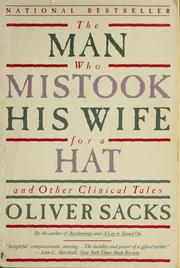
The Man Who Mistook His Wife for a Hat
Explores neurological experiences that challenge everyday assumptions.

The anthropology of religion, magic, and witchcraft
Provides anthropological frameworks for possession and healing rituals.
Endnotes
1.
Source: pmc.ncbi.nlm.nih.gov
Title: PMCPsychiatry in the Sultanate of Oman
Link:https://pmc.ncbi.nlm.nih.gov/articles/PMC6734705/
2.
Source: applications.emro.who.int
Title: EMRO Dashboardseditorial
Link:https://applications.emro.who.int/imemrf/Oman_Med_J/Oman_Med_J_2017_32_2_83_85.pdf
Source snippet
Oman Medical Journal [2017], Vol. 32, NoApril 15, 2026...
Published: April 15, 2026
3.
Source: squ.elsevierpure.com
Title: Sultan Qaboos University Zar: Group distress and healing
Link:https://squ.elsevierpure.com/en/publications/zar-group-distress-and-healing/
Source snippet
Sultan Qaboos UniversityZar: Group distress and healing - Sultan Qaboos University House of Expertise...
4.
Source: pmc.ncbi.nlm.nih.gov
Link:https://pmc.ncbi.nlm.nih.gov/articles/PMC6889563/
5.
Source: pubmed.ncbi.nlm.nih.gov
Link:https://pubmed.ncbi.nlm.nih.gov/31791283/
6.
Source: pmc.ncbi.nlm.nih.gov
Link:https://pmc.ncbi.nlm.nih.gov/articles/PMC2803848/
7.
Source: squ.elsevierpure.com
Title: zar group distress and healing
Link:https://squ.elsevierpure.com/ar/publications/zar-group-distress-and-healing/
Additional References
8.
Source: frontiersin.org
Link:https://www.frontiersin.org/journals/sociology/articles/10.3389/fsoc.2026.1814421/full
Source snippet
May 14, 2026 — While anthropologists and folklorists have differed in naming this form of traditional healing—using terms such as al-.tib...
Published: May 14, 2026
9.
Source: journals.sagepub.com
Link:https://journals.sagepub.com/doi/10.1177/1354067X251315739
Source snippet
sagepub.comZâr: Cultural beliefs, symptoms, and healing ritual anthropological study of a cultural mental disorder - Fatemeh Saki, 2025Ja...
10.
Source: researchgate.net
Title: Commentators on spirit possession such as Zar have provided
Link:https://www.researchgate.net/publication/388299171_Zar_Cultural_beliefs_symptoms_and_healing_ritual_anthropological_study_of_a_cultural_mental_disorder
Source snippet
Zâr: Cultural beliefs, symptoms, and healing ritual anthropological study of a cultural mental disorder | Request PDFJanuary 1, 2025 — Th...
Published: January 1, 2025
11.
Source: tandfonline.com
Link:https://www.tandfonline.com/doi/abs/10.1080/13674670124303
12.
Source: ora.ox.ac.uk
Link:https://ora.ox.ac.uk/objects/uuid%3A8f8345cd-80ae-43b3-a2d9-82fdbf5c4b01
13.
Source: cambridge.org
Title: Psychiatry in the sultanate of Oman | BJPsych International | Cambridge Core
Link:https://www.cambridge.org/core/journals/bjpsych-international/article/psychiatry-in-the-sultanate-of-oman/7AC68C6B56FBFF74BAE4D8F55737EA75
14.
Source: youtube.com
Title: ZAR RITUAL (Cairo, Egypt)
Link:https://www.youtube.com/watch?v=H1p1H-8DxSA
Source snippet
Zar from the island of Qeshm in the Persian Gulf...
15.
Source: dohainstitute.org
Title: Frankincense’s Ritual Uses in Oman: An Anthropological Study
Link:https://www.dohainstitute.org/en/ResearchAndStudies/Pages/frankincense-in-the-sultanate-of-oman-an-anthropological-study.aspx
16.
Source: researchgate.net
Title: Communities of healing practice on al-Batinah coast of Oman
Link:https://www.researchgate.net/publication/287306632_Communities_of_healing_practice_on_al-Batinah_coast_of_Oman
17.
Source: researchgate.net
Title: Research Gate(PDF) Zar: Group distress and healing
Link:https://www.researchgate.net/publication/240531666_Zar_Group_distress_and_healing
Topic Tree