Within Kuwait
Why Possession Beliefs Still Shape Everyday Healing
Possession traditions in Kuwait sit between healing, family custom, performance and religious dispute rather than fitting a simple cult narrative.
On this page
- Ritual healing, music and performance
- Why supernatural explanations can feel persuasive
- Consent, medical care and the risk of coercion
Page outline Jump by section
Introduction
Beliefs about spirit possession continue to shape everyday healing for some people in Kuwait, but they do not fit neatly into stories about cults or mass hysteria. Instead, they sit at the intersection of religion, family life, folk custom and healthcare. For some Kuwaitis, unexplained illness, sudden behavioural change or persistent family problems may be understood through ideas about spiritual influence, the evil eye or sorcery. Others—including many religious scholars, doctors and psychiatrists—stress that physical and mental illnesses should be assessed medically and that supernatural explanations should not be assumed without careful evidence. This coexistence of different ways of understanding distress has made possession beliefs an important part of Kuwait’s social history, not because they represent a separate movement, but because they influence how people seek help, interpret suffering and judge the actions of healers.[PMC]pmc.ncbi.nlm.nih.govPMCPsychiatry in KuwaitApril 1, 2009…
Why possession remains a familiar explanation
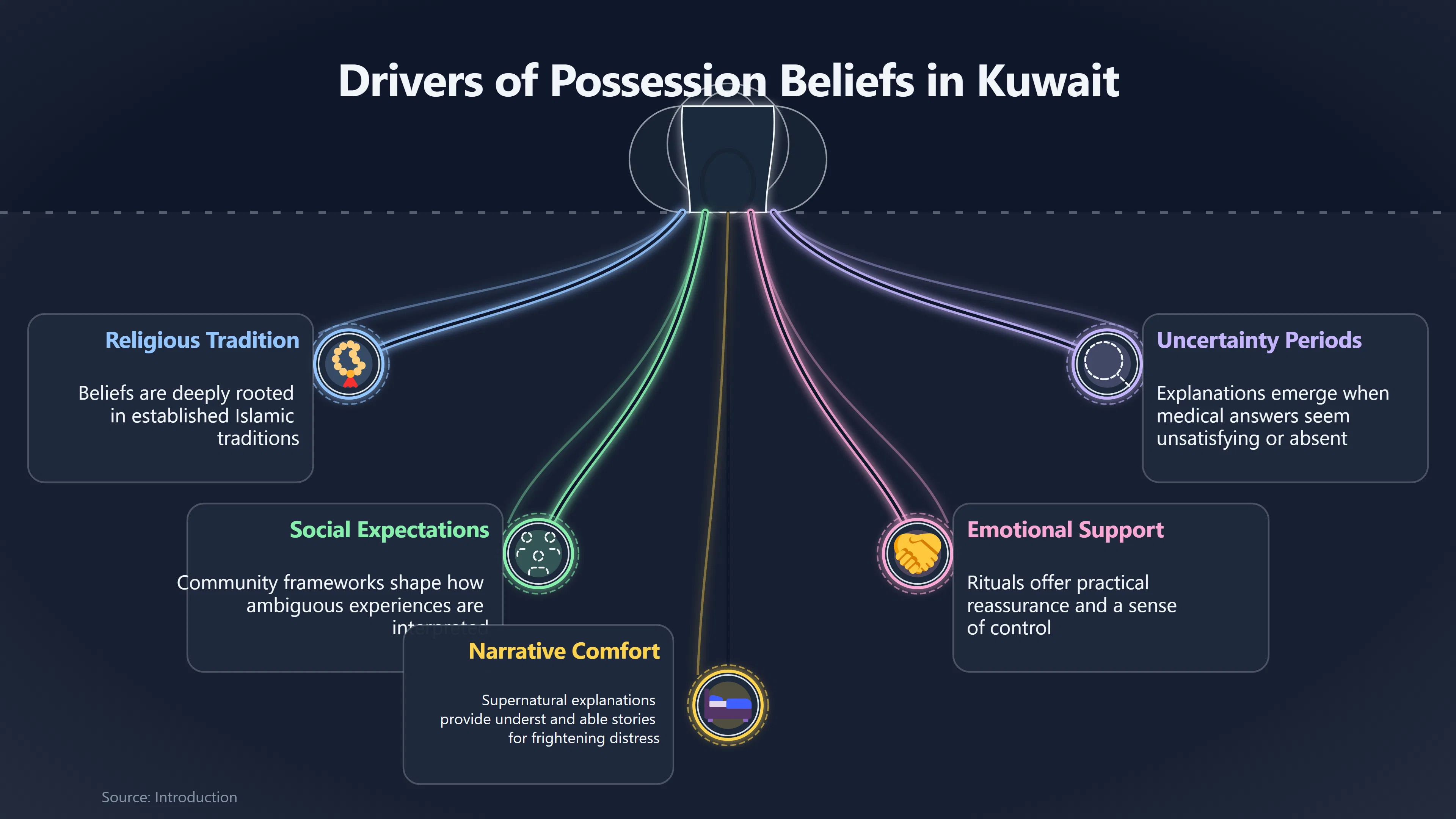
In Kuwait, as elsewhere in the Gulf, belief in the existence of spiritual beings is rooted in Islamic tradition. However, there is an important distinction between accepting that spirits exist and concluding that a particular illness or crisis is caused by possession. In practice, many families navigate a spectrum of possibilities, combining religious faith with medical treatment rather than seeing the two as mutually exclusive.
Psychiatrists working in Kuwait have long observed that some patients and relatives interpret symptoms such as dramatic personality changes, disturbing thoughts, anxiety or hallucinations through the language of possession, the evil eye or sorcery. Historically, this has often meant that a religious healer is consulted before, or alongside, a psychiatrist. Common practices have included recitation of Qur’anic verses, protective prayers, amulets and other traditional remedies intended to remove harmful spiritual influence.[PMC]pmc.ncbi.nlm.nih.govPMCPsychiatry in KuwaitApril 1, 2009…
Researchers also note that these explanations frequently arise during periods of uncertainty, when no obvious medical or social explanation seems satisfying. A sudden mental health crisis, chronic pain with no clear diagnosis, infertility or persistent family conflict may all encourage a search for supernatural meaning alongside ordinary medical investigation.[Cambridge University Press & Assessment]cambridge.orgCambridge University Press & AssessmentJinn and mental health: looking at jinn possession in modern psychiatric practice | The Psychiatri…
Ritual healing, music and performance
Ritual healing in Kuwait is diverse rather than uniform. The best-known practices today are forms of Islamic spiritual healing centred on Qur’anic recitation and prayer. Many Muslims regard these practices as legitimate expressions of faith when they avoid claims of magical power or practices forbidden within Islamic teaching.
Historically, the Gulf region also knew communal healing ceremonies that combined rhythmic music, chanting and repetitive movement. These ceremonies were especially associated with coastal communities linked through centuries of trade across the Arabian Gulf and East Africa. Although often described as possession rituals by outside observers, participants did not necessarily understand them in the same way. Depending on the community, such performances could be interpreted as healing, emotional release, management of chronic distress or inherited cultural tradition rather than evidence of a dangerous supernatural force.
Modern Kuwait has seen these older ceremonial traditions become less common, partly because of urbanisation and changing religious attitudes. Some religious authorities criticise them as innovations or superstitions, while cultural historians view them as part of the country’s wider maritime heritage. As a result, music-based healing now occupies a contested place between folklore, performance and religious debate rather than everyday mainstream practice.[PMC]pmc.ncbi.nlm.nih.govPMCPsychiatry in KuwaitApril 1, 2009…
Why supernatural explanations can feel persuasive
Possession beliefs should not simply be dismissed as irrational. Psychological and anthropological research suggests several reasons why they remain convincing for many people.
First, they provide an understandable narrative when distress is confusing or frightening. Rather than accepting uncertainty, a family may find comfort in an explanation that fits familiar religious or cultural ideas.
Second, interpretation is shaped by social expectation. When a community already recognises certain behaviours as possible signs of possession, ambiguous experiences may naturally be understood within that framework. This does not necessarily mean the person’s suffering is imagined. The distress is real even if different observers disagree about its cause.[Cambridge University Press & Assessment]cambridge.orgCambridge University Press & AssessmentJinn and mental health: looking at jinn possession in modern psychiatric practice | The Psychiatri…
Third, spiritual healing often offers practical emotional support. Religious recitation, family involvement and reassurance can reduce anxiety, strengthen hope and provide a sense of control during difficult periods. Many patients report benefiting from these aspects while also accepting psychiatric or medical treatment. Studies of Muslim communities consistently find that many people prefer cooperation between healthcare professionals and trusted religious figures rather than an exclusive choice between the two.[Cambridge University Press & Assessment]cambridge.orgCambridge University Press & AssessmentJinn and mental health: looking at jinn possession in modern psychiatric practice | The Psychiatri…
Where belief becomes risky
Most spiritual care occurs peacefully within families or recognised religious practice. Problems arise when certainty replaces careful assessment.
One danger is delayed medical treatment. If serious neurological disease, depression, psychosis or another medical condition is assumed to be possession without proper examination, valuable treatment may be postponed. Mental health specialists in Kuwait have repeatedly warned that some patients reach psychiatric services only after prolonged reliance on traditional healers.[PMC]pmc.ncbi.nlm.nih.govPMCPsychiatry in KuwaitApril 1, 2009…
Another risk is financial exploitation. Kuwait has experienced criminal cases in which individuals claiming supernatural powers persuaded vulnerable clients to pay large sums to remove supposed spirits or curses. Such cases demonstrate that genuine religious belief can be manipulated by fraudsters who promise impossible results. Authorities have periodically investigated and prosecuted alleged healers accused of deception rather than recognising them as legitimate medical practitioners.[PMC]pmc.ncbi.nlm.nih.govPMCPsychiatry in KuwaitApril 1, 2009…

Consent, medical care and the risk of coercion
The greatest ethical concern is not belief itself but what is done in its name.
Responsible religious leaders generally distinguish between gentle spiritual support and practices that inflict harm. Modern mental health literature similarly argues that cultural beliefs deserve respectful discussion while also protecting patients from coercion. Physical restraint, intimidation, repeated accusations of possession or discouraging necessary medical care can increase distress rather than relieve it.[Cambridge University Press & Assessment]cambridge.orgCambridge University Press & AssessmentJinn and mental health: looking at jinn possession in modern psychiatric practice | The Psychiatri…
Children and people experiencing severe mental illness are especially vulnerable because they may be unable to give informed consent or explain what they are experiencing. Healthcare professionals increasingly recommend collaborative approaches in which doctors, psychologists, families and appropriately qualified religious advisers communicate openly instead of competing for authority. This approach seeks to respect faith while ensuring that potentially life-threatening illnesses receive proper diagnosis and treatment.[Cambridge University Press & Assessment]cambridge.orgCambridge University Press & AssessmentJinn and mental health: looking at jinn possession in modern psychiatric practice | The Psychiatri…
Why the topic remains culturally important
Possession beliefs remain significant in Kuwait because they illuminate broader questions about health, identity and trust. They show how people interpret suffering through religious, family and cultural frameworks rather than through medicine alone. They also reveal ongoing debates within Kuwaiti society about where faith ends, folklore begins and exploitation becomes unacceptable.
Rather than representing a separate cult or a classic episode of collective hysteria, these beliefs form part of everyday social life. They continue to influence decisions about healthcare, family relationships and religious practice, while reminding both clinicians and religious communities that compassion, evidence and respect for patient welfare are essential when addressing experiences that individuals understand in profoundly different ways.[nih.gov]pmc.ncbi.nlm.nih.govPMCPsychiatry in KuwaitApril 1, 2009…
Amazon book picks
Further Reading
Books and field guides related to Why Possession Beliefs Still Shape Everyday Healing. Use these as the next step if you want deeper reading beyond the article.

The Spirit Catches You and You Fall Down
Explores the intersection of spiritual belief and medical care.

The Man Who Mistook His Wife for a Hat
Shows how unusual symptoms can have neurological rather than supernatural causes.
Thinking, Fast and Slow
Useful for understanding intuitive explanations for complex experiences.

The Geography of Thought
Helps explain differences in cultural interpretations of illness and belief.
Endnotes
1.
Source: pmc.ncbi.nlm.nih.gov
Title: PMCPsychiatry in Kuwait
Link:https://pmc.ncbi.nlm.nih.gov/articles/PMC6734882/
Source snippet
April 1, 2009...
Published: April 1, 2009
2.
Source: cambridge.org
Link:https://www.cambridge.org/core/journals/the-psychiatrist/article/jinn-and-mental-health-looking-at-jinn-possession-in-modern-psychiatric-practice/0012DFF288FA8958C7A52CAB2F29B679
Source snippet
Cambridge University Press & AssessmentJinn and mental health: looking at jinn possession in modern psychiatric practice | The Psychiatri...
3.
Source: cambridge.org
Title: University Press & Assessment Kuwait
Link:https://www.cambridge.org/core/books/abs/international-perspectives-on-mental-health/kuwait/11EF78795B99D7F01A14CB01BDA1A1A9
Source snippet
Cambridge University Press & AssessmentKuwait - International Perspectives on Mental Health...
4.
Source: pmc.ncbi.nlm.nih.gov
Link:https://pmc.ncbi.nlm.nih.gov/articles/PMC5882841/
5.
Source: cambridge.org
Title: Situated along the Arabian Penins
Link:https://www.cambridge.org/core/journals/dance-research-journal/article/averting-the-gaze-censoring-womens-zar-dance-performances-on-kuwaiti-television/B73AED10941201C245A82CFAC966C924
Source snippet
Averting the Gaze: Censoring Women’s Zar Dance Performances on Kuwaiti Television | Dance Research Journal | Cambridge CoreSeptember 2, 2...
6.
Source: cambridge.org
Link:https://www.cambridge.org/core/journals/bjpsych-open/article/exploring-the-distinction-between-jinn-possession-and-serious-mental-disorders-through-the-lens-of-the-traditional-and-faithbased-healers-in-korail-slum/94614819B5F279FDD2439D100B239AD2
Source snippet
s in Korail Slum | BJPsych Open | Cambridge CoreAugust 1, 2024 — EXPLORING THE DISTINCTION BETWEEN JINN POSSESSION AND SERIOUS MENTAL DIS...
Published: August 1, 2024
7.
Source: pubmed.ncbi.nlm.nih.gov
Link:https://pubmed.ncbi.nlm.nih.gov/29643820/
Source snippet
The Attribution of Mental Health Problems to Jinn: An Explorative Study in a Transcultural Psychiatric Outpatient Clinic - PubMed...
8.
Source: pmc.ncbi.nlm.nih.gov
Link:https://pmc.ncbi.nlm.nih.gov/articles/PMC1181833/
9.
Source: eftaa.awqaf.gov.kw
Link:https://eftaa.awqaf.gov.kw/ar/%D8%AC%D8%AF%D9%8A%D8%AF%20%D8%A7%D9%84%D9%81%D8%AA%D8%A7%D9%88%D9%89/-%D8%AD%D9%83%D9%85-%D8%A7%D9%84%D8%A7%D8%B3%D8%AA%D8%B9%D8%A7%D9%86%D9%87-%D8%A8%D8%A7%D9%84%D8%AC%D9%86-4523
Additional References
10.
Source: kspublisher.com
Title: Bawa Dan Muhammad Anka, Mal. Haliru Abd
Link:https://kspublisher.com/articles/572/
Source snippet
Jinn Possession in Humans: An Islamic Jurisprudential Analysis | Kuwait Scholars PublisherJune 24, 2025 — Middle East Journal of Islamic...
Published: June 24, 2025
11.
Source: youtube.com
Title: Reclaiming Our Mental Health Roots | Tala Al Kurd | TEDx Amman
Link:https://www.youtube.com/watch?v=H0VRzyFQgY8
Source snippet
She Was Paid Double to Sing… Then Realized They Weren't Human | True Jinn Wedding Story...
12.
Source: youtube.com
Title: Jinn Possession: Shocking True Stories from a Consultant Psychiatrist
Link:https://www.youtube.com/watch?v=8jsEghVv8KM
Source snippet
The Hidden World of the Jinn | Interview With A Real Ruqya Expert Pt 1...
13.
Source: youtube.com
Title: The Hidden World of the Jinn | Interview With A Real Ruqya Expert Pt 1
Link:https://www.youtube.com/watch?v=rmsaHSEmxRQ
Source snippet
Psychosis or Black Magic | Mufti Abdur-Rahman ibn Yusuf...
14.
Source: youtube.com
Title: Psychosis or Black Magic | Mufti Abdur-Rahman ibn Yusuf
Link:https://www.youtube.com/watch?v=mJMeqry-6cE
Source snippet
Reclaiming Our Mental Health Roots | Tala Al Kurd | TEDxAmman...
15.
Source: frontiersin.org
Link:https://www.frontiersin.org/journals/psychiatry/articles/10.3389/fpsyt.2018.00089/full
16.
Source: research.rug.nl
Link:https://research.rug.nl/en/publications/the-attribution-of-mental-health-problems-to-jinn-an-explorative-/
17.
Source: rcpsych.ac.uk
Title: www.rcpsych.ac.uk Jinn and psychiatry: comparison of beliefs
Link:https://www.rcpsych.ac.uk/docs/default-source/members/sigs/spirituality-spsig/resources/spirituality-special-interest-group-publications-jinn-and-psychiatry-comparison-of-beliefs-najat-khalifa-tim-hardie-mohammad-s-i-mullick.pdf?sfvrsn=5f13bcbb_2
Source snippet
and psychiatry: comparison of beliefs...
18.
Source: youtube.com
Link:https://www.youtube.com/watch?v=fa3VPt88KKk
19.
Source: kuna.net.kw
Title: KUN A: Traditional medicine.. Integral part of Kuwaiti society
Link:https://www.kuna.net.kw/ArticleDetails.aspx?id=2512121&language=en
Topic Tree