Within Nigeria
What Drove the Maitatsine Uprisings?
Maitatsine combined religious dissent, urban poverty and organised violence, while rumour later blurred the movement's real history.
On this page
- Muhammad Marwa and his followers
- The Kano violence and later uprisings
- Rumour, grievance and comparisons with Boko Haram
Page outline Jump by section
Introduction
The Maitatsine uprisings were among the deadliest episodes of religiously framed violence in modern Nigerian history, but they are often remembered through rumour as much as fact. Led by the preacher Muhammadu Marwa, known as Maitatsine, the movement combined radical religious teachings with deep social grievances among poor migrants and unemployed young men in northern cities. What began as an unorthodox religious movement developed into armed confrontation with the Nigerian state, culminating in the devastating Kano uprising of December 1980 and further outbreaks of violence across northern Nigeria over the next several years. Historians generally argue that neither religious doctrine alone nor simple poverty explains the movement. Instead, it emerged from a volatile mix of rapid urbanisation, economic hardship, weak state institutions and conflict with established Muslim authorities. Its legacy remains contested because later events—especially the rise of Boko Haram—have encouraged both useful comparisons and misleading simplifications.[openedition.org]books.openedition.orgOpen Edition Books Urban Violence in AfricaOpenEdition BooksUrban Violence in Africa - Violence in metropolitan Kano: A Historical Perspective - IFRA-Nigeria…

What made Muhammad Marwa’s movement different?
Muhammadu Marwa was born in what is now Cameroon and settled in Kano in the mid-1940s, where he gradually built a following among people who felt excluded from northern Nigeria’s religious and political establishment. His nickname, “Maitatsine”, derived from his reputation for harsh denunciations and curses directed at established Muslim leaders and public authorities.[openedition.org]books.openedition.orgOpen Edition Books Urban Violence in AfricaOpenEdition BooksUrban Violence in Africa - Violence in metropolitan Kano: A Historical Perspective - IFRA-Nigeria…
Marwa presented himself as a religious reformer, but many mainstream Muslim scholars regarded his teachings as profoundly unorthodox. Accounts differ over the precise content of his beliefs because many surviving descriptions were written by hostile observers after the violence. Nevertheless, most historical studies agree that he rejected established religious authorities, denounced many accepted Islamic traditions beyond the Qur’an, condemned aspects of modern life, and encouraged loyalty to his own community above existing institutions.[encyclopedia.com]encyclopedia.commarwa muhammad d 1980Marwa, Muhammad (D. 1980) | Encyclopedia.com…
The movement’s appeal cannot be understood purely in theological terms. Its followers included many recent migrants from rural areas, unemployed youths, informal workers and others struggling in rapidly expanding northern cities. Kano had grown quickly during the post-colonial period, creating overcrowded neighbourhoods where employment, housing and public services failed to keep pace. For many recruits, the movement offered community, certainty and an explanation for social inequality alongside religious teaching.[Africa Center]africacenter.orgAfrica Center Mitigating Radicalism in Northern NigeriaAfrica Center Mitigating Radicalism in Northern Nigeria
This social base helps explain why historians generally describe Maitatsine as both a religious and an urban protest movement. Religious dissent gave it its language and identity, while economic marginalisation and resentment towards political elites gave it much of its momentum.
How did the Kano violence escalate?
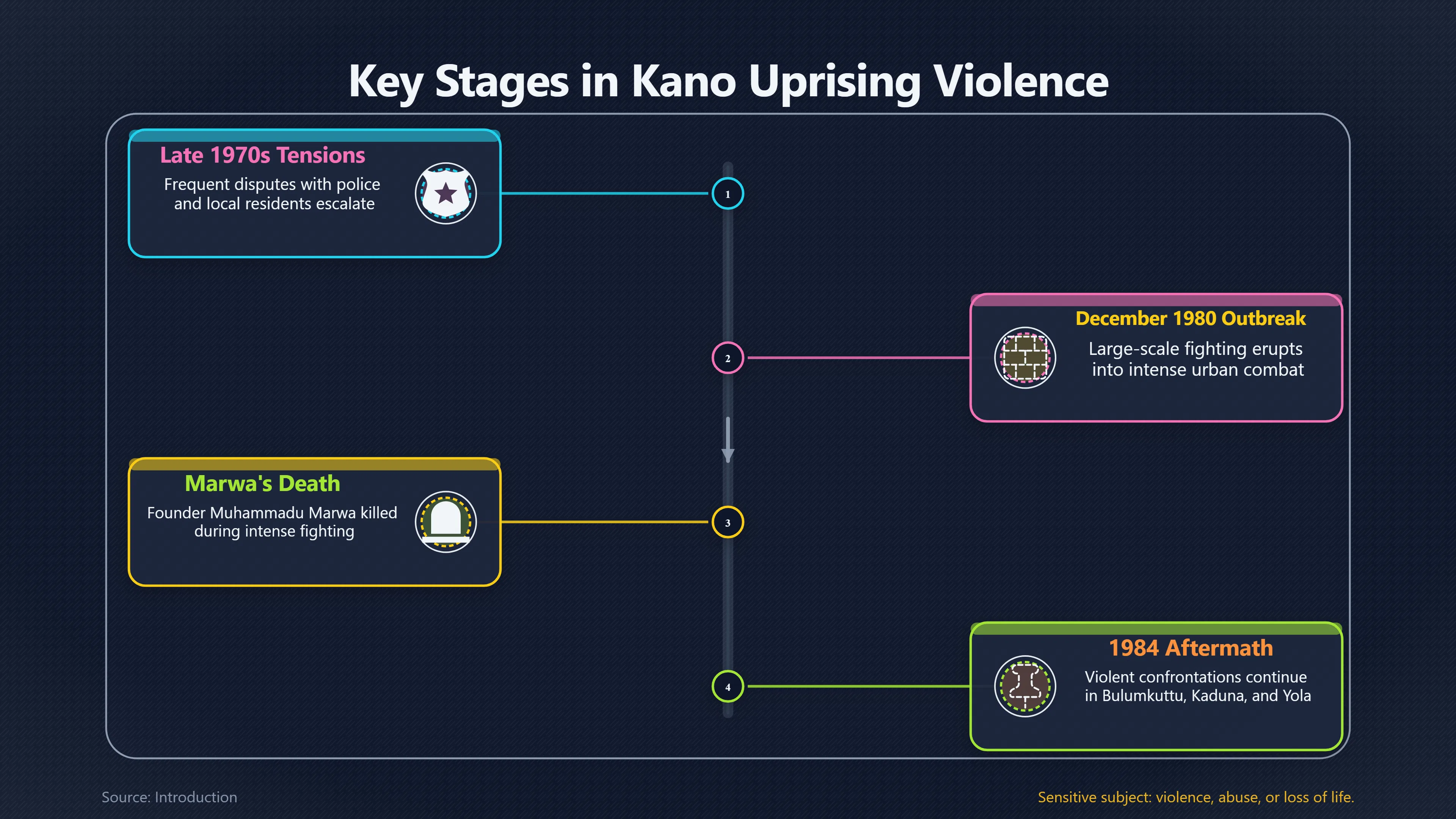
Tension between Marwa’s followers and local authorities had existed for years before open conflict erupted. Disputes with police, neighbourhood residents and mainstream Muslim organisations became increasingly frequent during the late 1970s. By December 1980, these tensions exploded into large-scale fighting in Kano.
The confrontation quickly became far more than a policing operation. Maitatsine followers fought security forces with improvised and conventional weapons, while the Nigerian military eventually intervened to regain control. Marwa himself was killed during the fighting, but only after days of intense urban combat. Estimates of the death toll vary, although official inquiries commonly placed it at more than 4,000 people, making it one of the bloodiest episodes of post-independence urban violence in Nigeria.[africacenter.org]africacenter.orgAfrica Center Mitigating Radicalism in Northern NigeriaAfrica Center Mitigating Radicalism in Northern Nigeria
The destruction shocked the country because it challenged assumptions that established religious authorities and state institutions could easily contain radical movements. It also exposed weaknesses in intelligence gathering, policing and urban governance that had allowed tensions to build over many years before erupting into violence.
Why did the violence continue after Marwa’s death?
Marwa’s death did not immediately destroy the movement. Surviving followers regrouped in other northern towns, producing additional violent confrontations during the early 1980s, including uprisings in Bulumkuttu near Maiduguri (1982), Kaduna (1982) and Yola (1984). Each outbreak was smaller than Kano but demonstrated that the movement’s grievances had not disappeared with its founder.[Encyclopedia.com]encyclopedia.commarwa muhammad d 1980Marwa, Muhammad (D. 1980) | Encyclopedia.com…
These later uprisings reflected both organisational resilience and continuing social conditions that favoured recruitment. Many participants remained young men living on the economic margins, while distrust between local communities and government authorities often intensified after military crackdowns.
The state’s response relied heavily on force. Although the uprisings were eventually suppressed, historians argue that military victories addressed immediate security threats without fully resolving the urban poverty, exclusion and institutional weaknesses that had helped sustain the movement.[Africa Center]africacenter.orgAfrica Center Mitigating Radicalism in Northern NigeriaAfrica Center Mitigating Radicalism in Northern Nigeria
Rumour, grievance and the movement’s changing reputation
The Maitatsine movement rapidly became surrounded by rumour. During and after the uprisings, stories circulated about supernatural powers, foreign conspiracies, hidden sponsors and secret networks extending across West Africa. Some rumours reflected genuine uncertainty during a period of violence, while others served political purposes by attributing complex social problems to mysterious outside forces.
Scholars studying northern Nigerian political culture note that rumours became part of the movement’s historical legacy. Competing groups used them to explain unexpected violence, discredit opponents or reinforce existing fears about religious extremism. As a result, later public memory often blurred documented events with stories that remain poorly supported by evidence.[Encyclopedia.com]encyclopedia.commarwa muhammad d 1980Marwa, Muhammad (D. 1980) | Encyclopedia.com…
This distinction matters because the verified history is already significant. There is no need to rely on sensational claims to understand why the movement became influential. Contemporary research consistently points instead towards documented interactions between religious dissent, economic hardship, urban change and state responses.
Is Maitatsine a precursor to Boko Haram?
Comparisons with Boko Haram are common, but they require care. Both movements emerged in northern Nigeria, criticised existing Muslim authorities, attracted socially marginalised followers and eventually fought the Nigerian state. Both also opposed aspects of Western influence and exploited public frustration with corruption and inequality. These similarities make comparison historically useful.[researchgate.net]researchgate.netOpen source on researchgate.net.
However, important differences are equally significant.
- Maitatsine revolved around the personal authority of Muhammadu Marwa and fragmented after his death.
- Boko Haram developed a more durable organisational structure, survived multiple leadership changes and became connected to wider transnational jihadist networks.
- Marwa’s teachings departed sharply from mainstream Islamic scholarship in distinctive ways, whereas Boko Haram grounded much of its ideology within a different strand of militant Salafi-jihadist thought, despite rejecting mainstream interpretations.
- Boko Haram’s insurgency has endured for far longer, controlled territory at various points and produced a much broader regional security crisis across the Lake Chad Basin.[researchgate.net]researchgate.netOpen source on researchgate.net.
For these reasons, historians increasingly describe Maitatsine not as the direct ancestor of Boko Haram but as an earlier example of how religious radicalism, social exclusion and weak governance could combine to produce organised violence in northern Nigeria.

Why Maitatsine still matters
The Maitatsine uprisings remain important because they illustrate how episodes often labelled simply as “religious violence” usually emerge from multiple interacting pressures. Religious doctrine mattered, but so did unemployment, migration, overcrowded cities, contested political authority and distrust of established institutions.
The movement also serves as a reminder to distinguish documented history from later mythmaking. Calling Maitatsine merely a “cult” obscures the broader social conditions that attracted followers, while reducing the movement to poverty alone ignores the genuine importance of religious belief and charismatic leadership. Understanding both dimensions provides a clearer explanation of why the uprisings occurred and why they continue to shape debates about extremism, urban marginalisation and state authority in Nigeria today.[africacenter.org]africacenter.orgAfrica Center Mitigating Radicalism in Northern NigeriaAfrica Center Mitigating Radicalism in Northern Nigeria


Endnotes
1.
Source: books.openedition.org
Title: Open Edition Books Urban Violence in Africa
Link:https://books.openedition.org/ifra/4559
Source snippet
OpenEdition BooksUrban Violence in Africa - Violence in metropolitan Kano: A Historical Perspective - IFRA-Nigeria...
2.
Source: encyclopedia.com
Title: marwa muhammad d 1980
Link:https://www.encyclopedia.com/religion/encyclopedias-almanacs-transcripts-and-maps/marwa-muhammad-d-1980
Source snippet
Marwa, Muhammad (D. 1980) | Encyclopedia.com...
3.
Source: researchgate.net
Link:https://www.researchgate.net/publication/338711486_Religious_Violence_in_Nigeria_A_Comparison_of_Boko_Haram_and_Maitatsine_Groups
4.
Source: researchgate.net
Link:https://www.researchgate.net/publication/329701504_ISLAMIC_MILITANTS_AND_INSURGENCY_IN_NORTHEASTERN_NIGERIA_A_COMPARISON_OF_THE_IDEOLOGY_AND_METHODOLOGY_OF_MAITATSINE_AND_BOKO_HARAM
5.
Source: researchgate.net
Link:https://www.researchgate.net/publication/236810237_Between_Maitatsine_and_Boko_Haram_Islamic_Fundamentalism_and_the_Response_of_the_Nigerian_State
6.
Source: researchgate.net
Link:https://www.researchgate.net/publication/280309944_Old_Wine_in_a_New_Bottle_Ideological_and_Operational_Linkages_Between_Maitatsine_and_Boko_Haram_Revolts_in_Nigeria
7.
Source: africacenter.org
Title: Africa Center Mitigating Radicalism in Northern Nigeria
Link:https://africacenter.org/publication/mitigating-radicalism-in-northern-nigeria/
8.
Source: mysitasi.mohe.gov.my
Link:https://mysitasi.mohe.gov.my/journal-website/get-meta-article?artId=75f731f1-60fc-11ef-a699-005056a6a970&env=web&jnlId=df234654-5f76-11ef-a699-005056a6a970&template=TEMP002_ARTICLE
Source snippet
Islamic militants and insurgency in northeastern Nigeria: a comparison of the ideology and methodology of maitatsine and boko haram...
Additional References
9.
Source: tandfonline.com
Link:https://www.tandfonline.com/doi/full/10.1080/09546553.2025.2511083
Source snippet
Get AccessJune 30, 2025 — Situating this argument in the northern Nigeria case, this paper examines how, decades before Boko Haram, there...
Published: June 30, 2025
10.
Source: historicalnigeria.com
Title: Maitatsine and the Yan Tatsine Uprisings | Historical Nigeria
Link:https://historicalnigeria.com/maitatsine-and-the-yan-tatsine-uprisings/
Source snippet
January 8, 2026 — MAITATSINE AND THE YAN TATSINE UPRISINGS The rise and legacy of Muhammadu Marwa’s movement and its impact on society, r...
Published: January 8, 2026
11.
Source: youtube.com
Link:https://www.youtube.com/watch?v=RnalxxGBxk0
Source snippet
3 The Movement Before Boko Haram: How Nigeria Failed the Yan Tatsine & Repeated History...
12.
Source: youtube.com
Link:https://www.youtube.com/watch?v=q9SZyRvEjRc
Source snippet
4 STORY OF MAITATSINE | BOKO HARAM ORIGIN|KANO RIOT 1980|NIGERIAN CRIME HISTORY...
13.
Source: congress.gov
Title: Nigeria: Overview and U.S
Link:https://www.congress.gov/crs-product/R47052
Source snippet
Policy | Congress.gov | Library of CongressNovember 9, 2023 — NIGERIA: OVERVIEW AND U.S. POLICY CRS PRODUCT (LIBRARY OF CONGRESS) Hide Ov...
Published: November 9, 2023
14.
Source: youtube.com
Link:https://www.youtube.com/watch?v=3SESH540Rc0
Source snippet
5 Maitatsine Uprising: A Violent Chapter In Kano's History...
15.
Source: youtube.com
Link:https://www.youtube.com/watch?v=be-4kMfqKz4
Source snippet
2 Maitatsine: The Preacher Who Instigated Nigeria's First Modern Religious Insurgency...
16.
Source: africabib.org
Link:https://africabib.org/rec.php?RID=119540886
17.
Source: tandfonline.com
Link:https://www.tandfonline.com/doi/abs/10.1080/21520844.2016.1152571
18.
Source: tandfonline.com
Link:https://www.tandfonline.com/doi/abs/10.1080/19392206.2014.977169
Topic Tree