Within Peru Beliefs
Was Taki Onqoy a Religion or Rebellion?
Taki Onqoy joined ritual dancing, prophecy and cultural resistance in a movement colonial officials treated as a threat to Spanish rule.
On this page
- What participants believed and practised
- Why colonial officials feared the movement
- What hostile records can and cannot prove
Page outline Jump by section
Introduction
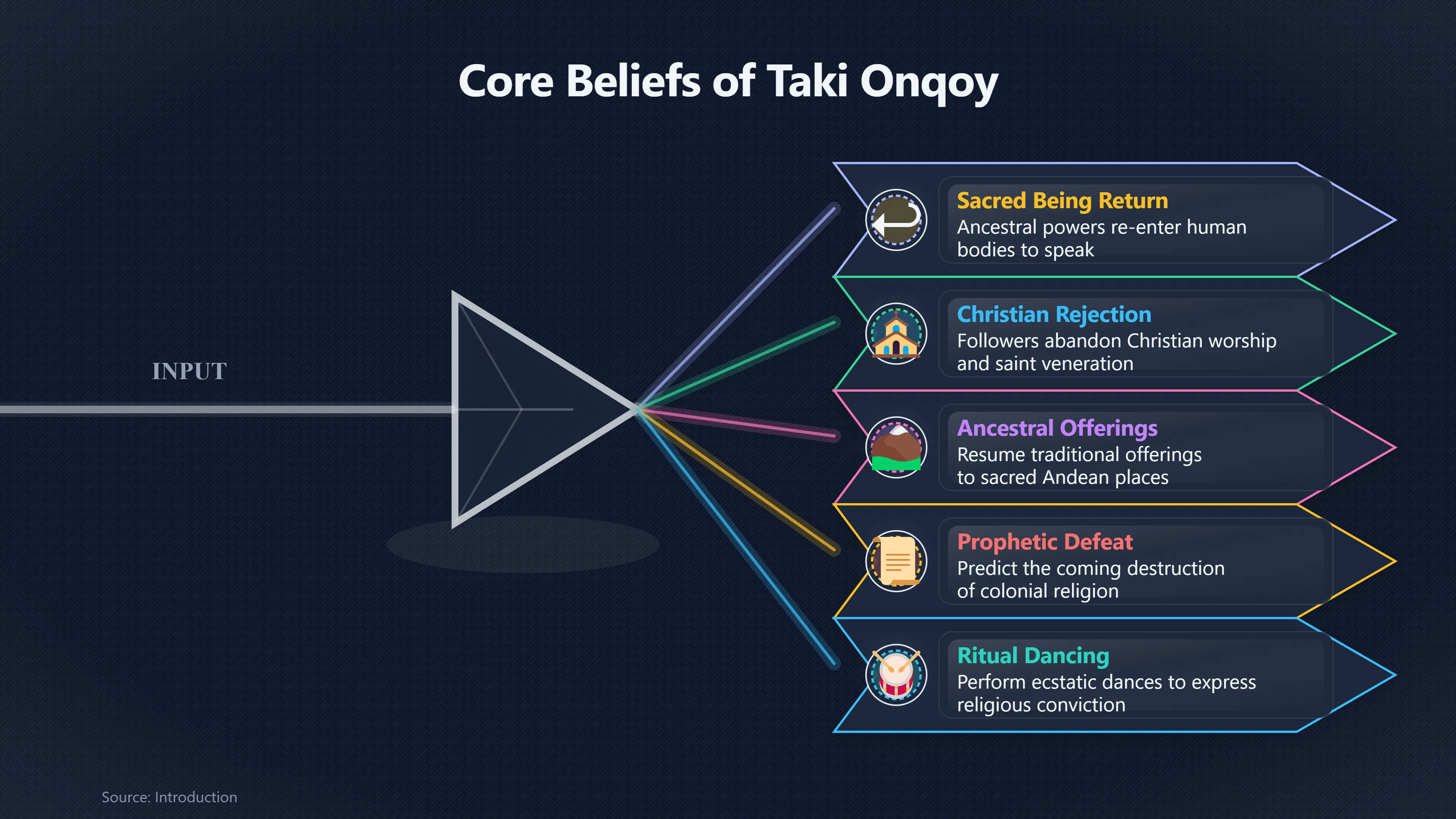
Taki Onqoy was not simply a religious movement or simply a political rebellion. It was a sixteenth-century Andean revitalisation movement that emerged in Peru during the 1560s, when Indigenous communities were struggling to make sense of conquest, epidemic disease, forced labour, Christian conversion and the destruction of long-established religious traditions. Participants believed that ancestral sacred beings were returning, speaking through chosen individuals and preparing to overthrow the spiritual order imposed by the Spanish. Colonial officials, however, interpreted the movement as a dangerous rejection of Christianity and a potential threat to Spanish authority.[Cambridge University Press & Assessment]cambridge.orgCambridge University Press & AssessmentThe Taki Onqoy and the Andean Nation: Sources and Interpretations | Latin American Research Review…

Because almost every surviving description was written by Spanish clergy and administrators trying to suppress it, Taki Onqoy remains difficult to reconstruct. Modern historians generally agree that a genuine movement existed, but they also emphasise that many details—including its size, organisation and political ambitions—cannot be accepted uncritically from hostile colonial accounts.[Cambridge University Press & Assessment]cambridge.orgCambridge University Press & AssessmentThe Taki Onqoy and the Andean Nation: Sources and Interpretations | Latin American Research Review…
Was Taki Onqoy a Religion or Rebellion?
Modern scholars increasingly argue that this question presents a false choice. The movement was fundamentally religious, yet in colonial Peru religion and political authority were inseparable.
Spanish rule relied not only upon military conquest but also upon conversion to Christianity. Accepting baptism, attending church and abandoning traditional ritual became visible signs of loyalty to the new colonial order. A movement urging people to reject Christian practices therefore challenged both ecclesiastical authority and the legitimacy of Spanish rule.
Rather than organising a conventional armed revolt, Taki Onqoy appears to have offered an alternative spiritual future. Followers reportedly proclaimed that Indigenous sacred powers would soon defeat the Christian God, destroy Spanish domination and restore the proper relationship between Andean communities and their ancestral deities. Participation itself became an act of resistance, expressed through ritual rather than warfare.[Cambridge University Press & Assessment]cambridge.orgCambridge University Press & AssessmentThe Taki Onqoy and the Andean Nation: Sources and Interpretations | Latin American Research Review…
This distinction matters because colonial authorities often blurred religious dissent and political rebellion. By defining Indigenous religious revival as dangerous “idolatry”, officials justified investigations, punishment and intensified missionary campaigns.
What Participants Believed and Practised
Although accounts differ, several themes appear consistently across the surviving documents.
Participants believed that traditional sacred beings had not disappeared despite conquest. Instead, these supernatural forces had become active once again, entering human bodies and announcing that the old spiritual order would return. This possession was expressed through ecstatic dancing, singing and prophetic speech, giving the movement its enduring association with ritual performance.[Cambridge University Press & Assessment]cambridge.orgCambridge University Press & AssessmentThe Taki Onqoy and the Andean Nation: Sources and Interpretations | Latin American Research Review…
The movement reportedly encouraged believers to:
- abandon Christian worship and confession;
- stop venerating Christian saints;
- resume offerings to ancestral sacred places and beings;
- reject Spanish religious authority;
- prepare for the coming defeat of colonial religion.
The dancing itself should not be confused with a medical “dance plague”. Historians generally reject comparisons with episodes of involuntary mass psychogenic illness in Europe. The dances described in colonial reports formed part of deliberate ritual activity expressing religious conviction rather than uncontrollable physical contagion.[Cambridge University Press & Assessment]cambridge.orgCambridge University Press & AssessmentThe Taki Onqoy and the Andean Nation: Sources and Interpretations | Latin American Research Review…
Many scholars therefore classify Taki Onqoy as a revitalisation or millenarian movement. Such movements commonly arise during periods of extreme cultural disruption, promising that a transformed world will replace one experienced as intolerably unjust.
Why Colonial Officials Feared the Movement
Spanish clergy viewed the movement through the lens of Christian heresy and apostasy. Administrators saw additional dangers.
First, Taki Onqoy directly undermined missionary work. Decades of evangelisation could be reversed if communities abandoned Christianity and returned to Indigenous ritual life.
Second, colonial government depended heavily upon Indigenous intermediaries—local leaders who cooperated with Spanish officials. A movement encouraging communities to reject colonial religious authority could weaken those political relationships.
Third, prophecy proved especially unsettling. Reports that Indigenous sacred powers would soon overturn Spanish rule transformed religious ceremonies into predictions of political reversal. Even if no military uprising existed, officials feared that such beliefs might inspire one.
This fear helps explain the vigorous response. Church investigators identified religious specialists, questioned witnesses, destroyed sacred objects and imposed punishments designed both to suppress the movement and discourage further participation. Cristóbal de Albornoz became particularly associated with campaigns against what colonial authorities classified as Indigenous “idolatry”. His investigations remain among the principal documentary sources for reconstructing the movement.[Google Books]books.google.comBooks Las informaciones de Cristóbal de Albornoz: Documentos para el estudio delGoogle BooksLas informaciones de Cristóbal de Albornoz: Documentos para el estudio del… - Cristóbal de Albornoz, Luis Millones - Googl…
What Hostile Records Can and Cannot Prove
Understanding Taki Onqoy requires recognising that nearly all surviving evidence comes from its opponents.
The principal documents were produced by Spanish investigators whose objective was to identify, prosecute and eliminate Indigenous religious practices. They were not neutral observers recording beliefs for future historians. Their reports naturally emphasised danger, organised leadership and religious deviance because those claims justified intervention.[Cambridge University Press & Assessment]cambridge.orgCambridge University Press & AssessmentThe Taki Onqoy and the Andean Nation: Sources and Interpretations | Latin American Research Review…
This creates several important uncertainties.
The movement’s scale remains debated. Earlier histories sometimes portrayed Taki Onqoy as a vast, coordinated Andean uprising. More recent research suggests participation probably varied considerably between regions, with stronger evidence in some localities than others.[Cambridge University Press & Assessment]cambridge.orgCambridge University Press & AssessmentThe Taki Onqoy and the Andean Nation: Sources and Interpretations | Latin American Research Review…
Its organisation is difficult to reconstruct. Colonial reports identify prophets and ritual specialists, but it is unclear whether these individuals belonged to a single coordinated movement or represented multiple local expressions of similar beliefs.
Political intentions remain contested. Some participants may have hoped for the literal collapse of Spanish rule, while others may simply have sought religious continuity within their own communities. The surviving documents do not always distinguish clearly between these possibilities.
Archaeological research has added further nuance by suggesting that evidence for the movement’s reach varies geographically rather than supporting the idea of a single uniform campaign across the Andes.[FlippingBook]online.flippingbook.comSemantron 25 Summer 2025 - Page 201…
Why the Movement Spread
The appeal of Taki Onqoy becomes easier to understand when viewed against the circumstances facing Indigenous communities in the 1560s.
Within a single generation many communities had experienced:
- devastating epidemic diseases;
- the collapse of the Inca state;
- forced resettlement programmes;
- tribute demands;
- compulsory labour;
- attacks on traditional religious practices;
- rapid social and demographic upheaval.
Under these conditions, a movement promising that ancestral sacred powers remained alive and would eventually restore moral balance offered both explanation and hope. Rather than seeing catastrophe as permanent, believers could interpret suffering as part of a temporary disorder before spiritual renewal.
Historians therefore often compare Taki Onqoy with other revitalisation movements that emerge after conquest or colonial disruption. Such movements frequently combine prophecy, ritual innovation and expectations of cultural restoration without fitting neatly into modern categories of either religion or politics.[Cambridge University Press & Assessment]cambridge.orgCambridge University Press & AssessmentThe Taki Onqoy and the Andean Nation: Sources and Interpretations | Latin American Research Review…
Why Taki Onqoy Still Matters
Taki Onqoy occupies an important place in Peru’s history because it illustrates how colonial power defined Indigenous religion as a security threat.
The episode also demonstrates why historians must read colonial records critically. Without Spanish investigations, little would be known about the movement. Yet those same investigations shaped the evidence by portraying Indigenous religious revival through categories such as idolatry, apostasy and rebellion.
For the history of collective belief, Taki Onqoy is best understood not as an example of irrational mass hysteria but as a revitalisation movement born from extraordinary social disruption. It joined prophecy, ritual dancing and cultural resistance into a religious response to conquest. The colonial fear it provoked reveals as much about Spanish anxieties over Indigenous survival as it does about the beliefs of the participants themselves.[Cambridge University Press & Assessment]cambridge.orgCambridge University Press & AssessmentThe Taki Onqoy and the Andean Nation: Sources and Interpretations | Latin American Research Review…
Amazon book picks
Further Reading
Books and field guides related to Was Taki Onqoy a Religion or Rebellion?. Use these as the next step if you want deeper reading beyond the article.
Magic, Witchcraft, and Religion: An Anthropological Study of...
Provides comparative perspective on revitalization movements.

1491: New Revelations of the Americas Before Columbus
Introduces pre-Columbian societies and cultural context.
Oxford Handbook of the Incas
Explains the historical setting of conquest and Indigenous society.
Gods of the Andes
Most relevant overview for understanding Taki Onqoy's religious background.
Endnotes
1.
Source: cambridge.org
Link:https://www.cambridge.org/core/journals/latin-american-research-review/article/taki-onqoy-and-the-andean-nation-sources-and-interpretations/ED01EFD372FCB96430BEF5FF1F365877
Source snippet
Cambridge University Press & AssessmentThe Taki Onqoy and the Andean Nation: Sources and Interpretations | Latin American Research Review...
2.
Source: books.google.com
Title: Books Las informaciones de Cristóbal de Albornoz: Documentos para el estudio del
Link:https://books.google.com/books/about/Las_informaciones_de_Crist%C3%B3bal_de_Albor.html?id=3isiMQAACAAJ
Source snippet
Google BooksLas informaciones de Cristóbal de Albornoz: Documentos para el estudio del... - Cristóbal de Albornoz, Luis Millones - Googl...
3.
Source: online.flippingbook.com
Link:https://online.flippingbook.com/view/179327474/201/
Source snippet
Semantron 25 Summer 2025 - Page 201...
4.
Source: cambridge.org
Link:https://www.cambridge.org/core/journals/latin-american-research-review/article/invention-of-colonial-andean-worlds/5A55B6CFE5E014910DA0CD2D1E076B19
Source snippet
Cambridge University Press & AssessmentThe Invention of Colonial Andean Worlds | Latin American Research Review | Cambridge Core...
5.
Source: cambridge.org
Title: 129-149 *
Link:https://www.cambridge.org/core/journals/latin-american-research-review/issue/843AD4F05D2DB07235CC5EA3453B5193
Source snippet
Latin American Research Review: Volume 33 - Issue 1 | Cambridge CoreOctober 5, 2022 — RESEARCH REPORTS AND NOTES [Input] * ### Bernardino...
Published: October 5, 2022
6.
Source: books.google.com
Title: Las informaciones de Cristóbal de Albor
Link:https://books.google.com/books/about/Las_informaciones_de_Crist%C3%B3bal_de_Albor.html?id=TabeoA-rOtkC
7.
Source: books.google.com
Title: Las informaciones de Cristobal de Alborn
Link:https://books.google.com/books/about/Las_informaciones_de_Cristobal_de_Alborn.html?id=mKOHzQEACAAJ
8.
Source: cambridge.org
Title: Latin American Research Review: Volume 33
Link:https://www.cambridge.org/core/journals/latin-american-research-review/volume/67BA0D29CF71ED93D2B53787EAFC3393
9.
Source: cambridge.org
Link:https://www.cambridge.org/core/journals/latin-american-research-review/article/evolving-archaeological-interpretations-of-inka-institutions-perspectives-dynamics-and-reassessments/2980368DAB10982A2A920318DDA99714
10.
Source: books.google.com
Title: Las informaciones de Cristóbal de Albor
Link:https://books.google.com/books/about/Las_informaciones_de_Crist%C3%B3bal_de_Albor.html?id=OD-3twEACAAJ
11.
Source: revistas.ufrj.br
Link:https://revistas.ufrj.br/index.php/ars/article/view/54282
12.
Source: revistas.usach.cl
Link:https://www.revistas.usach.cl/ojs/index.php/historiasocial/article/view/106
Additional References
13.
Source: youtube.com
Title: The Spanish Empire’s formula: God, gold and war | Al Jazeera Untangles
Link:https://www.youtube.com/watch?v=TJJ9ZeagPRM
Source snippet
How 168 Men Conquered The Incan Empire | Fall of the Incas EP 1...
14.
Source: youtube.com
Title: The Story of Manco Inca | The Emperor Who Rebelled Against the Spanish
Link:https://www.youtube.com/watch?v=wOinqc7yPM8
Source snippet
What Was the Neo-Inca State? - El Mapa de Sebas...
15.
Source: loc.gov
Link:https://www.loc.gov/item/hlas-bi98008923/
16.
Source: youtube.com
Title: The Empire of the Dead | The War Against Idolatry
Link:https://www.youtube.com/watch?v=ecrOB2liLMA
Source snippet
The Story of Manco Inca | The Emperor Who Rebelled Against the Spanish...
17.
Source: youtube.com
Title: What Was the Neo-Inca State?
Link:https://www.youtube.com/watch?v=tmQhK4FIVeY
Source snippet
The Spanish Empire's formula: God, gold and war | Al Jazeera Untangles...
18.
Source: patrimoniocultural.gob.cl
Link:https://www.patrimoniocultural.gob.cl/noticias/taki-onqoy-de-la-enfermedad-del-canto-la-epidemia
19.
Source: researchgate.net
Link:https://www.researchgate.net/publication/330109475_Defining_Identity_during_Revitalization_Taki_Onqoy_in_the_Chicha-Soras_Valley_Ayacucho_Peru
20.
Source: bibliotecanacional.gob.cl
Link:https://www.bibliotecanacional.gob.cl/publicaciones/vol-iv-taki-onqoy-de-la-enfermedad-del-canto-la-epidemia
21.
Source: alicia.concytec.gob.pe
Link:https://alicia.concytec.gob.pe/vufind/index.php/Record/REVUNMSM_58b49e024d1d3815067c68a8270c6ced
22.
Source: funartemaisdigital.funarte.gov.br
Link:https://funartemaisdigital.funarte.gov.br/periodicos/repressao-e-resistencia-nos-andes-coloniais-o-movimento-taki-onqoy/
Topic Tree