Within Senegal
What Caused Senegal's School Trance Outbreaks?
Episodes of fainting, screaming and trance among pupils reveal how stress, observation, possession beliefs and school pressures can overlap.
On this page
- The Lamine Gueye and Podor outbreaks
- What mass psychogenic illness can and cannot explain
- Possession, gender and protest inside schools
Page outline Jump by section
Introduction
Episodes in which groups of Senegalese school pupils suddenly faint, scream, shake, or enter trance-like states have repeatedly attracted national attention. The best-known incidents occurred at Dakar’s Lamine Guèye Secondary School and in schools around Podor in northern Senegal. Although many families and local observers interpreted these events through beliefs about spirit possession or supernatural attack, medical investigators generally found no evidence of poisoning, infectious disease or another shared physical cause. Instead, many researchers view these outbreaks as examples of mass psychogenic illness (MPI), also called mass sociogenic illness: genuine physical and psychological distress that spreads through observation, expectation and shared social circumstances rather than through a contagious pathogen.[nih.gov]pmc.ncbi.nlm.nih.govPMCEpisodes of mass hysteria in African schools: A study of literaturePMCEpisodes of mass hysteria in African schools: A study of literature
The Senegalese cases are important because they show that medical and cultural explanations are not always seen as mutually exclusive. Pupils, parents, teachers, religious leaders and health professionals often understood the same events in different ways. The outbreaks therefore reveal not only how distress can spread through a school community, but also how beliefs about possession, gender, education and social pressure shape the interpretation of unusual experiences.
The Lamine Guèye and Podor outbreaks
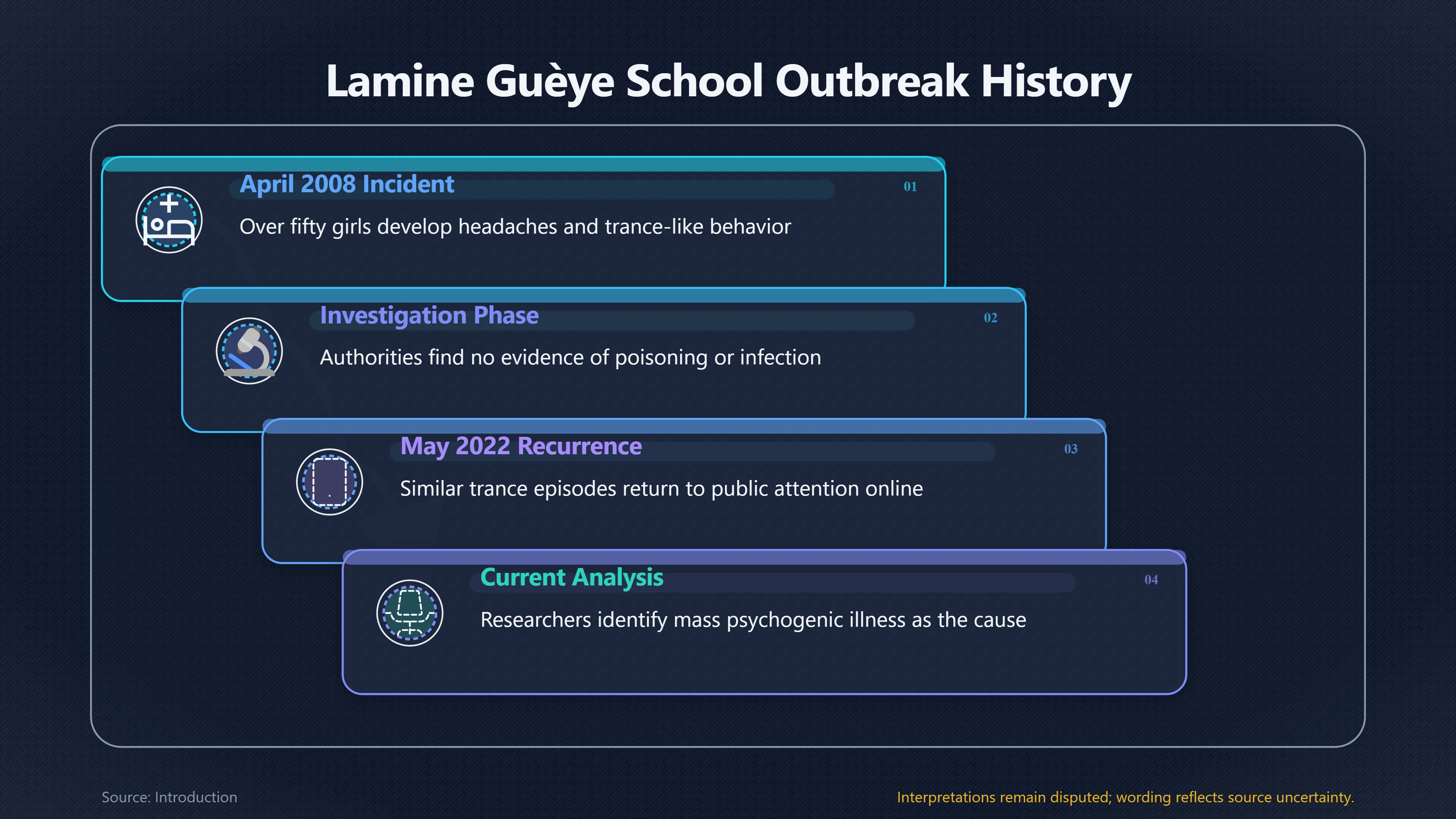
The most widely reported school episode occurred in April 2008 at Lamine Guèye Secondary School in Dakar. More than fifty pupils—almost all girls—were taken to hospital after developing headaches, screaming, fainting and apparent trance-like behaviour over the course of a school day. Authorities temporarily closed the school while emergency services investigated. Initial rumours quickly attributed the events to evil spirits or supernatural retaliation, but no environmental or infectious cause was identified.[Hindustan Times]hindustantimes.comHindustan Times Over 50 girls in Senegal succumb to "hysteria" | World NewsHindustan Times Over 50 girls in Senegal succumb to "hysteria" | World News
More than a decade later, similar scenes returned to public attention. In May 2022, pupils at the same school again experienced episodes described locally as trances, prompting parents to collect their children and fuelling widespread discussion on social media. News reports noted that the phenomenon echoed earlier outbreaks that had affected Senegalese schools, particularly among adolescent girls.[Notre Continent]sn.notrecontinent.comNotre ContinentPsychose au lycée Lamine Guèye: Quand des élèves tombent en transeMay 25, 2022…
Comparable incidents have also been reported in Podor, in Senegal’s north, where clusters of schoolgirls developed fainting, crying, shaking or altered states of consciousness over short periods. Local communities frequently interpreted these episodes through ideas of possession, while health officials generally treated them as unexplained but non-infectious events requiring reassurance rather than quarantine. Although individual outbreaks differed in detail, the pattern—a rapid onset among pupils sharing classrooms and social networks, with no confirmed toxic or infectious cause—closely resembled documented school outbreaks elsewhere in Africa.[PMC]pmc.ncbi.nlm.nih.govPMCEpisodes of mass hysteria in African schools: A study of literaturePMCEpisodes of mass hysteria in African schools: A study of literature
What mass psychogenic illness can—and cannot—explain
Mass psychogenic illness is sometimes misunderstood as meaning that sufferers are “pretending” or that “nothing happened”. Neither interpretation is accurate.
Researchers use the term when several features occur together:
- symptoms begin in one or a few people and spread rapidly through a closely connected group;
- medical examinations fail to identify a common physical cause;
- symptoms are genuine and often severe enough to require medical attention;
- seeing or hearing about affected classmates appears to increase the likelihood that others will develop similar symptoms.[New England Journal of Medicine]nejm.orgOpen source on nejm.org.
Studies from schools in Africa and Asia show remarkably consistent patterns. Outbreaks often affect adolescent girls disproportionately, emerge during periods of heightened stress, and spread most efficiently where pupils are in close visual contact. The symptoms can include fainting, dizziness, hyperventilation, headaches, crying, shaking, screaming or trance-like behaviour. Once pupils are separated, reassured and removed from the immediate setting, outbreaks often subside.[PMC]pmc.ncbi.nlm.nih.govPMCEpisodes of mass hysteria in African schools: A study of literaturePMCEpisodes of mass hysteria in African schools: A study of literature
At the same time, the diagnosis has clear limits.
Mass psychogenic illness is not simply a label applied whenever doctors cannot immediately explain an illness. Responsible investigations first seek infectious, toxic, neurological or environmental causes before concluding that no shared physical explanation fits the evidence. Classic investigations of school outbreaks have involved extensive laboratory testing and environmental assessment precisely because genuine hazards must be excluded before psychological and social mechanisms become the most convincing explanation.[New England Journal of Medicine]nejm.orgOpen source on nejm.org.
Possession, gender and protest inside schools
In Senegal, episodes of school trance cannot be understood solely through medical concepts because many participants interpret them through local religious and cultural frameworks.
For some families, trance behaviour is seen as evidence of spirit possession or another supernatural force rather than a psychological process. Religious leaders may therefore be asked to pray, perform blessings or reassure pupils alongside medical treatment. These responses reflect existing cultural beliefs rather than simple rejection of medicine.
Gender also matters. Like many documented school outbreaks worldwide, Senegalese episodes have affected predominantly adolescent girls. Researchers caution against treating this as evidence that girls are inherently more susceptible. Instead, they argue that adolescent girls often occupy similar social environments, experience comparable educational pressures and maintain dense friendship networks through which emotional responses can spread rapidly.[PMC]pmc.ncbi.nlm.nih.govPMCEpisodes of mass hysteria in African schools: A study of literaturePMCEpisodes of mass hysteria in African schools: A study of literature
Some social scientists have suggested another layer of interpretation. In highly structured school environments where pupils have limited ways to express anxiety, conflict or frustration, dramatic physical symptoms may become an indirect language of distress. This does not mean the outbreaks are conscious protest. Rather, they may reflect how psychological strain is expressed within a cultural setting where possession and trance provide socially recognised explanations for overwhelming experiences. Comparative studies from countries including Nepal and Botswana likewise conclude that social stress, trauma, peer influence and local beliefs interact rather than acting as separate causes.[PMC]pmc.ncbi.nlm.nih.govOpen source on nih.gov.
Why these outbreaks spread so quickly
School settings provide many of the conditions that favour rapid social transmission.
Pupils spend long periods together, closely observe one another and often react collectively to unexpected events. When one student suddenly collapses or appears possessed, classmates may become frightened, closely watch the affected person and begin interpreting their own bodily sensations through the same lens.
Several factors appear repeatedly in documented outbreaks:
- close visual and social contact with affected pupils;
- heightened anxiety or examination pressure;
- uncertainty about the cause of unusual symptoms;
- rumours spreading through friendship groups, families and, increasingly, social media;
- culturally familiar explanations that make frightening events seem understandable.[nejm.org]nejm.orgOpen source on nejm.org.
Once rumours become established, they can reinforce expectations and make additional cases appear more likely even without any infectious agent.

Why the Senegalese cases still matter
The Senegalese school outbreaks remain significant because they sit at the intersection of medicine, psychology and culture. They illustrate how genuine suffering can coexist with competing explanations: physicians may diagnose mass psychogenic illness, while families sincerely understand the same events as spiritual affliction.
Rather than dismissing either perspective, many public health specialists argue that effective responses require careful medical investigation, clear communication, reassurance for pupils and respectful engagement with community beliefs. The episodes at Lamine Guèye, Podor and other Senegalese schools continue to be cited as examples of how fear, expectation, social pressure and cultural meaning can combine to produce dramatic but ultimately non-infectious outbreaks within educational settings.[nih.gov]pmc.ncbi.nlm.nih.govPMCEpisodes of mass hysteria in African schools: A study of literaturePMCEpisodes of mass hysteria in African schools: A study of literature
Amazon book picks
Further Reading
Books and field guides related to What Caused Senegal's School Trance Outbreaks?. Use these as the next step if you want deeper reading beyond the article.
Extraordinary Popular Delusions and the Madness of Crowds
Rating: 4.0/5 from 5 Google Books ratings
Provides historical context for collective social phenomena that complements discussion of mass psychogenic illness.

The Spirit Catches You and You Fall Down
Explores how cultural beliefs and biomedical explanations can coexist and conflict, echoing themes in the Senegal outbreaks.

The Man Who Mistook His Wife for a Hat
Introduces readers to unusual neurological and psychological experiences, encouraging careful distinction between medical and cultural in...

The Wisdom of Crowds:Why the Many Are Smarter Than the Few an...
Helps readers understand collective behavior, group dynamics, and social influence.
Endnotes
1.
Source: pmc.ncbi.nlm.nih.gov
Title: PMCEpisodes of mass hysteria in African schools: A study of literature
Link:https://pmc.ncbi.nlm.nih.gov/articles/PMC3588562/
2.
Source: pmc.ncbi.nlm.nih.gov
Link:https://pmc.ncbi.nlm.nih.gov/articles/PMC9210177/
3.
Source: pmc.ncbi.nlm.nih.gov
Link:https://pmc.ncbi.nlm.nih.gov/articles/PMC7704439/
4.
Source: nejm.org
Link:https://www.nejm.org/doi/full/10.1056/NEJM200001133420206
5.
Source: hindustantimes.com
Title: Hindustan Times Over 50 girls in Senegal succumb to “hysteria” | World News
Link:https://www.hindustantimes.com/world/over-50-girls-in-senegal-succumb-to-hysteria/story-uokVIklUdW3boPJjjQJdvJ.html
6.
Source: sn.notrecontinent.com
Link:https://sn.notrecontinent.com/2022/05/25/psychose-au-lycee-lamine-gueye-quand-des-eleves-tombent-en-transe/
Source snippet
Notre ContinentPsychose au lycée Lamine Guèye: Quand des élèves tombent en transeMay 25, 2022...
Published: May 25, 2022
7.
Source: nejm.org
Link:https://www.nejm.org/doi/abs/10.1056/NEJM200001133420206
8.
Source: pubmed.ncbi.nlm.nih.gov
Link:https://pubmed.ncbi.nlm.nih.gov/40628243/
9.
Source: pmc.ncbi.nlm.nih.gov
Link:https://pmc.ncbi.nlm.nih.gov/articles/PMC12397962/
10.
Source: pubmed.ncbi.nlm.nih.gov
Link:https://pubmed.ncbi.nlm.nih.gov/35747341/
11.
Source: pubmed.ncbi.nlm.nih.gov
Link:https://pubmed.ncbi.nlm.nih.gov/33312130/
12.
Source: pmc.ncbi.nlm.nih.gov
Link:https://pmc.ncbi.nlm.nih.gov/articles/PMC4884863/
13.
Source: pubmed.ncbi.nlm.nih.gov
Link:https://pubmed.ncbi.nlm.nih.gov/8883976/
Additional References
14.
Source: reutersconnect.com
Link:https://www.reutersconnect.com/item/a-students-death-in-senegal-shines-light-on-a-simmering-debt-crisis/dGFnOnJldXRlcnMuY29tLDIwMjY6bmV3c21sX1JDMklLSkFFSzhESg
Source snippet
February 12, 2026 — A STUDENT'S DEATH IN SENEGAL SHINES LIGHT ON A SIMMERING DEBT CRISIS LICENSABLE PICTURE: REUTERS Image: A woman sells...
Published: February 12, 2026
15.
Source: youtube.com
Link:https://www.youtube.com/watch?v=AWprpDloucc
Source snippet
Mass Hysteria in Le Roy, New York? | Mass Psychogenic Illness...
16.
Source: wwwnc.cdc.gov
Title: Calls came
Link:https://wwwnc.cdc.gov/eid/article/32/4/25-1540_article
Source snippet
Weight of Waiting - Volume 32, Number 4—April 2026 - Emerging Infectious Diseases journal - CDCApril 9, 2026 — SCENE 2—CURVES ON A SCREEN...
Published: April 9, 2026
17.
Source: youtube.com
Title: Episode 71. Frenzy – The Turmoil of Mass Psychogenic Illness
Link:https://www.youtube.com/watch?v=e2AdorYLDF8
Source snippet
The Razor-Thin Line Between Contagion and Connection | Dan Taberski | TED...
18.
Source: youtube.com
Title: The Razor-Thin Line Between Contagion and Connection | Dan Taberski | TED
Link:https://www.youtube.com/watch?v=u0fFIJapsRY
Source snippet
Teens' tics: Mysterious illness or hysteria?...
19.
Source: youtube.com
Title: Teens’ tics: Mysterious illness or hysteria?
Link:https://www.youtube.com/watch?v=rLT5acgRoIg
Source snippet
244 - The Tanganyika Laughter Epidemic: When Stress Went Viral in 1962...
20.
Source: reutersconnect.com
Link:https://www.reutersconnect.com/item/a-member-of-the-security-forces-fires-tear-gas-to-confine-inside-a-campus-students-and-supporters-of-senegal-opposition-leader-ousmane-sonko-in-dakar/dGFnOnJldXRlcnMuY29tLDIwMjM6bmV3c21sX1JDMlMzMEE0MDNENQ?position=2&previouslyViewed=dGFnOnJldXRlcnMuY29tLDIwMjM6bmV3c21sX1JDMkNBMUFFSkY3Qw
21.
Source: sciencedirect.com
Link:https://www.sciencedirect.com/science/article/abs/pii/S1525505016302128
22.
Source: jamanetwork.com
Link:https://jamanetwork.com/journals/jamaneurology/fullarticle/786444
23.
Source: frontiersin.org
Link:https://www.frontiersin.org/journals/psychiatry/articles/10.3389/fpsyt.2020.493094/full
Topic Tree