Within Tuvalu
Is Tuvalu Really Disappearing Beneath the Sea?
The famous image of a nation vanishing beneath the sea hides a more complex struggle over land growth, flooding and habitability.
On this page
- How the sinking nation narrative spread
- Why some islands have grown despite sea level rise
- Habitability, relocation and what land area cannot show
Page outline Jump by section
Introduction
Tuvalu is often presented as the world’s archetypal “sinking nation”—a country destined to disappear beneath the Pacific Ocean. That image has become one of the most powerful symbols of climate change, appearing in documentaries, newspaper headlines and speeches at international climate summits. Yet the reality is more complicated. Tuvalu is unquestionably threatened by rising seas, more frequent coastal flooding and saltwater intrusion, but that does not mean its islands are simply shrinking into the ocean. In fact, satellite studies show that many of Tuvalu’s islands have remained stable or even grown in land area over recent decades, even while local sea level has risen faster than the global average. The real challenge is not whether dry land exists today, but whether that land remains safe, liveable and able to support communities in the decades ahead.[Nature]nature.comPatterns of island change and persistence offer alternate adaptation pathways for atoll nations | Nature CommunicationsFebruary 9…
How the sinking nation narrative spread
The idea of Tuvalu vanishing beneath the waves emerged during the 1990s and early 2000s as climate change became a global political issue. Tuvalu’s highest natural ground is only a few metres above sea level, making it an obvious symbol of vulnerability. Dramatic photographs of flooded roads, seawater washing over coral atolls and king tides reaching homes reinforced the impression that the country was physically disappearing.
The narrative became especially influential because it was rooted in genuine observations. Tide-gauge measurements and satellite records show that sea level around Tuvalu has risen significantly over recent decades, at rates above the global average. Coastal flooding has become more frequent, while saltwater increasingly contaminates groundwater and damages crops. These are real and well-documented impacts rather than imagined dangers.[wiley.com]agupubs.onlinelibrary.wiley.comWiley Online LibraryA National‐Scale Coastal Flood Hazard Assessment for the Atoll Nation of Tuvalu - Wandres - 2024 - Earth's Future - W…
However, media coverage often compressed these separate facts into a simpler story:
- sea level is rising;
- therefore the islands must be shrinking;
- therefore Tuvalu is literally sinking beneath the sea.
That conclusion sounds intuitive, but coral atolls do not always behave like solid blocks of land slowly submerged by water.
Why some islands have grown despite sea-level rise
The most influential challenge to the popular narrative came from geomorphologists—scientists who study changing landscapes—using aerial photography and satellite imagery covering every island in Tuvalu.
Their analysis of all 101 islands found that, over roughly four decades:
- Tuvalu’s total land area increased by around 2.9%.
- About three-quarters of individual islands grew in size.
- Eight of the country’s nine atolls experienced net land-area gains.
- Some islands shrank while others expanded, showing that change was highly uneven rather than uniformly negative.[Nature]nature.comPatterns of island change and persistence offer alternate adaptation pathways for atoll nations | Nature CommunicationsFebruary 9…
This does not mean climate change is harmless. Instead, it demonstrates that coral reef islands are dynamic landforms.
Why can islands become larger?
Coral atolls are built from sand, coral rubble and sediment that waves constantly move around. Storms, currents and healthy coral reefs can transport material from one part of an island to another or create new deposits along the shoreline.
Rather than remaining fixed, an atoll naturally changes shape over time. One coastline may erode while another expands. Severe storms can even leave behind fresh ridges of coral debris that permanently increase land area in some places.
The satellite evidence therefore contradicts one specific claim—that Tuvalu is steadily losing all of its land—but it does not contradict the reality of rising sea levels. Both findings can be true at the same time.[Nature]nature.comPatterns of island change and persistence offer alternate adaptation pathways for atoll nations | Nature CommunicationsFebruary 9…
Why land area is only part of the story
The misconception often arises because “more land” sounds equivalent to “greater safety”. For low-lying coral islands, those are very different questions.
An island may have slightly more surface area while simultaneously becoming much harder to inhabit.
Several problems become more severe even if the shoreline remains stable:
- higher tides reach further inland;
- storm waves overtop coastal defences more often;
- freshwater lenses beneath the islands become contaminated by saltwater;
- crops suffer from saline soils;
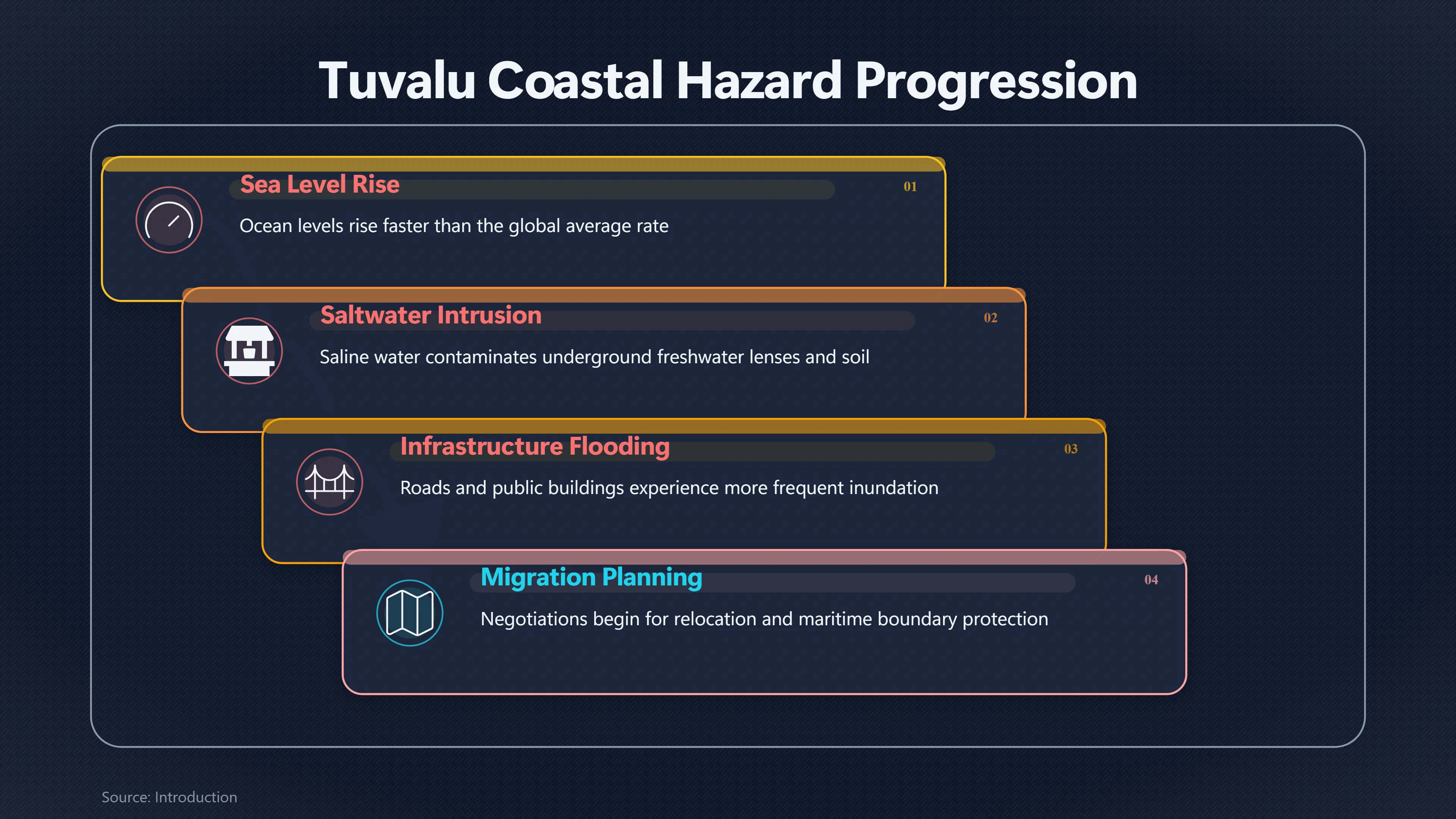
- roads, homes and public infrastructure flood more frequently.
Scientists increasingly distinguish between island persistence and human habitability. The first asks whether land continues to exist. The second asks whether people can safely live there year after year.[Wiley Online Library]agupubs.onlinelibrary.wiley.comWiley Online LibraryA National‐Scale Coastal Flood Hazard Assessment for the Atoll Nation of Tuvalu - Wandres - 2024 - Earth's Future - W…

Habitability, relocation and what land area cannot show
Recent hazard modelling illustrates why the distinction matters.
High-resolution mapping shows that even under present-day conditions, substantial parts of Tuvalu already experience periodic flooding. As sea levels continue to rise, floods that are currently considered relatively rare are projected to become much more frequent by the middle of this century, even under moderate emissions scenarios. These projections account not only for average sea level but also tides, waves and storm conditions.[Wiley Online Library]agupubs.onlinelibrary.wiley.comWiley Online LibraryA National‐Scale Coastal Flood Hazard Assessment for the Atoll Nation of Tuvalu - Wandres - 2024 - Earth's Future - W…
For many Tuvaluans, the practical questions therefore concern:
- whether freshwater supplies remain usable;
- whether schools, hospitals and roads can continue operating;
- how expensive coastal protection becomes;
- whether housing can be expanded on increasingly flood-prone land.
These concerns explain why Tuvalu has invested heavily in coastal adaptation projects while also negotiating migration arrangements with Australia. Migration planning is not necessarily an admission that the country has already disappeared; it reflects the possibility that living conditions may become increasingly difficult even if significant land remains above sea level.[Reuters]reuters.comWith a mean elevation of just 2 meters, Tuvalu has already seen a sea-level increase of 15 cm over the past three decades. NASA projects…
Why the simplified story persists
The image of a country literally drowning is emotionally powerful and easy to communicate. It serves as a compelling symbol in international debates over climate change, loss and justice.
Yet this simplicity comes at a cost. Critics sometimes point to satellite evidence showing land growth as proof that climate change concerns are exaggerated. That argument is just as misleading as claiming Tuvalu is already disappearing beneath the waves.
The scientific evidence supports neither extreme.
Instead, it suggests that:
- sea level around Tuvalu is rising rapidly;
- coral islands can naturally adjust their shape and, in some cases, gain land;
- increasing land area does not eliminate worsening flood risk;
- long-term habitability depends on water supplies, infrastructure, ecosystems and adaptation, not simply on the number of hectares above sea level.[nature.com]nature.comPatterns of island change and persistence offer alternate adaptation pathways for atoll nations | Nature CommunicationsFebruary 9…
Why the distinction matters
Within the wider history of collective fears and public narratives, the “sinking Tuvalu” story illustrates how a genuine environmental threat can become simplified into a memorable but incomplete image. The danger lies not in recognising climate risks—they are well established—but in reducing a complex physical and social problem to a single visual metaphor.
Tuvalu is not a case of a nation vanishing overnight beneath the ocean, nor is it evidence that sea-level rise poses no threat. It is a case where dynamic geology, rising seas, engineering, ecology and human adaptation interact in ways that resist simple slogans. Understanding that distinction leads to a more accurate picture of both the science and the human challenge facing one of the world’s lowest-lying nations.[nature.com]nature.comPatterns of island change and persistence offer alternate adaptation pathways for atoll nations | Nature CommunicationsFebruary 9…
Amazon book picks
Further Reading
Books and field guides related to Is Tuvalu Really Disappearing Beneath the Sea?. Use these as the next step if you want deeper reading beyond the article.
The water will come
Explains sea-level rise, coastal flooding, adaptation and the uncertain future of low-lying communities such as Tuvalu.

Great Displacement
Directly addresses relocation, managed retreat and what happens when climate change makes existing settlements difficult to inhabit.

Rising: Dispatches from the New American Shore
Examines how rising seas affect habitability, identity, migration and communities even before land physically disappears.
Climate justice
Places vulnerable island nations and communities at the centre of debates about responsibility, resilience and climate inequality.
Endnotes
1.
Source: nature.com
Link:https://www.nature.com/articles/s41467-018-02954-1
Source snippet
Patterns of island change and persistence offer alternate adaptation pathways for atoll nations | Nature CommunicationsFebruary 9...
2.
Source: agupubs.onlinelibrary.wiley.com
Link:https://agupubs.onlinelibrary.wiley.com/doi/full/10.1029/2023EF003924
Source snippet
Wiley Online LibraryA National‐Scale Coastal Flood Hazard Assessment for the Atoll Nation of Tuvalu - Wandres - 2024 - Earth's Future - W...
3.
Source: reuters.com
Link:https://www.reuters.com/investigations/sinking-tuvalu-fights-keep-maritime-boundaries-sea-levels-rise-2024-09-24/
Source snippet
With a mean elevation of just 2 meters, Tuvalu has already seen a sea-level increase of 15 cm over the past three decades. NASA projects...
4.
Source: nature.com
Link:https://www.nature.com/articles/s41467-023-41933-z
5.
Source: nature.com
Link:https://www.nature.com/articles/s41467-023-38278-y
6.
Source: nature.com
Link:https://www.nature.com/articles/s41467-023-37853-7
7.
Source: nature.com
Link:https://www.nature.com/articles/s41467-023-36171-2
8.
Source: tuvaluclimatechange.gov.tv
Link:https://www.tuvaluclimatechange.gov.tv/sites/default/files/2025-07/Tuvalu_Assessment%20of%20Climate%20Hazards%20Technical%20Report_final.pdf
9.
Source: doi.org
Title: Satellites reveal hotspots of global river extent change | Nature Communications
Link:https://doi.org/10.1038%2Fs41467-023-37061-3
10.
Source: reuters.screenocean.com
Link:https://reuters.screenocean.com/record/1697269
11.
Source: reuters.screenocean.com
Title: media id
Link:https://reuters.screenocean.com/record/1645831/media_id/1428783
Additional References
12.
Source: abc.net.au
Link:https://www.abc.net.au/news/2026-05-21/tuvalu-australia-falepili-visa-climate-migration-pacific/106674754
Source snippet
What happens now? - ABC NewsMay 21, 2026 — The majority of Tuvalu has applied to relocate to Australia to escape climate change. What hap...
Published: May 21, 2026
13.
Source: investing.com
Title: Sinking Tuvalu fights to keep maritime boundaries as sea levels rise By Reuters
Link:https://www.investing.com/news/world-news/sinking-tuvalu-fights-to-keep-maritime-boundaries-as-sea-levels-rise-3629290
Source snippet
September 24, 2024 — SINKING TUVALU FIGHTS TO KEEP MARITIME BOUNDARIES AS SEA LEVELS RISE By Published 09/24/2024, 06:12 AM Updated 09/24...
Published: September 24, 2024
14.
Source: japantimes.co.jp
Title: Tuvalu fights to retain its maritime rights amid climate change inundation
Link:https://www.japantimes.co.jp/environment/2024/09/26/climate-change/tuvalu-maritime-boundaries-sea-levels/
Source snippet
The Japan TimesSeptember 26, 2024 — Image: The Japan Times [Input] [Input] ENVIRONMENT / Climate change TUVALU FIGHTS TO RETAIN ITS MARIT...
Published: September 26, 2024
15.
Source: climaterealism.com
Title: Al Jazeera Is Wrong, Tuvalu’s Islands Are Growing, Not Disappearing
Link:https://climaterealism.com/2025/10/al-jazeera-is-wrong-tuvalus-islands-are-growing-not-disappearing/
Source snippet
October 15, 2025 — AL JAZEERA IS WRONG, TUVALU’S ISLANDS ARE GROWING, NOT DISAPPEARING By Anthony Watts October 15, 2025 In...
Published: October 15, 2025
16.
Source: youtube.com
Title: Rising sea levels threaten to wash away entire country | 60 Minutes Australia
Link:https://www.youtube.com/watch?v=XFQwAVB2BdM
Source snippet
'We are sinking': Tuvalu minister gives Cop26 speech standing in water to highlight sea level rise...
17.
Source: youtube.com
Title: Tuvalu: Living on borrowed time and shaky foundations
Link:https://www.youtube.com/watch?v=InTVdhufUUw
Source snippet
Rising sea levels threaten to wash away entire country | 60 Minutes Australia...
18.
Source: pmc.ncbi.nlm.nih.gov
Link:https://pmc.ncbi.nlm.nih.gov/articles/PMC5807422/
19.
Source: researchgate.net
Link:https://www.researchgate.net/publication/323072528_Patterns_of_island_change_and_persistence_offer_alternate_adaptation_pathways_for_atoll_nations
20.
Source: ipcc.ch
Link:https://www.ipcc.ch/srocc/chapter/chapter-4-sea-level-rise-and-implications-for-low-lying-islands-coasts-and-communities/7/
21.
Source: undp.org
Link:https://www.undp.org/pacific/stories/lidar-imagery-data-tuvalu-crucial-tool-understand-climate-change-impacts-and-plan-adaptation
Topic Tree