Within Uzbekistan
How Namangan Shaped Uzbekistan's Fear of Islamism
Adolat's rise in Namangan linked religious vigilantism to a lasting fear that independent Islam could become armed revolt.
On this page
- Adolat and the post Soviet religious opening
- The confrontation with Karimov
- From local vigilantism to armed militancy
Page outline Jump by section
Introduction
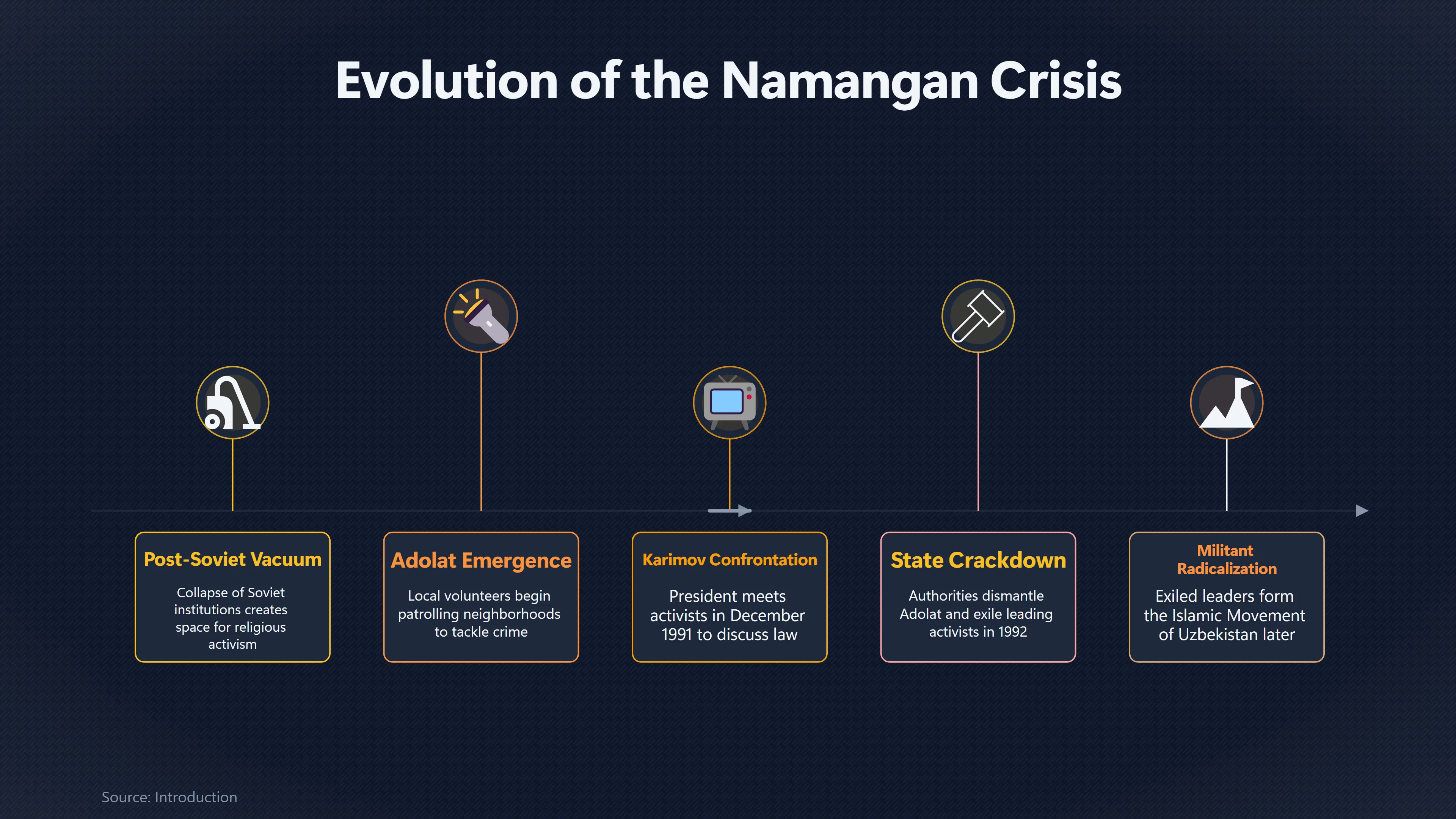
In the turbulent months after Uzbekistan became independent in 1991, the eastern city of Namangan briefly became the country’s most visible centre of Islamic political activism. The local movement known as Adolat (“Justice”) emerged at a moment when Soviet institutions were collapsing, crime was rising, and new religious freedoms were opening space for public Islamic activism. What began as a locally popular attempt to restore order through Islamic-inspired vigilante patrols quickly became a defining confrontation between religious activists and the new Uzbek state.
The episode mattered far beyond Namangan itself. Although Adolat was relatively short-lived, its challenge to President Islam Karimov helped create a lasting official belief that independent Islamic organisation could rapidly develop into an armed attempt to seize power. Later acts of genuine militant violence reinforced that perception, but historians and human rights organisations argue that the government increasingly blurred the distinction between peaceful independent Muslims, political Islamists and violent insurgents. The Namangan crisis therefore became both a real security episode and the foundation of a wider political and moral panic about “Islamic extremism” in Uzbekistan.[crisisgroup.org]crisisgroup.orgCrisis Group UZBEKISTAN AT TENCrisis GroupUZBEKISTAN AT TEN:September 13, 2024…
Adolat and the post-Soviet religious opening
The Soviet Union’s collapse left a vacuum across much of Central Asia. Communist institutions weakened rapidly, while police and courts often struggled to maintain authority. In the Ferghana Valley, where religious practice had survived underground despite decades of Soviet control, many Muslims hoped independence would bring a greater public role for Islam.
Namangan proved especially receptive to these ideas. Adolat emerged in 1991 under activists including Tokhir Yuldash and Juma Namangani, combining demands for greater public observance of Islam with practical efforts to tackle crime and corruption. Contemporary accounts describe volunteers patrolling neighbourhoods, confronting suspected criminals and enforcing their own understanding of public morality. Alcohol sales were targeted, and some businesses accused of encouraging vice were pressured to close. These actions won genuine local support among residents frustrated by lawlessness, but they also relied on coercion rather than legal authority.[crisisgroup.org]crisisgroup.orgCrisis Group UZBEKISTAN AT TENCrisis GroupUZBEKISTAN AT TEN:September 13, 2024…
The movement’s popularity reflected several overlapping pressures:
- collapsing Soviet administrative structures;
- widespread economic uncertainty;
- dissatisfaction with corrupt local officials;
- renewed public interest in Islamic identity after decades of state atheism;
- a belief among supporters that Islamic justice could restore social order more effectively than failing state institutions.
This combination made Adolat more than simply a religious organisation. It functioned, however briefly, as an alternative source of local authority.
The confrontation with Karimov
The defining moment came in December 1991, when President Islam Karimov travelled to Namangan to meet Islamic activists who had effectively occupied regional government buildings and demanded constitutional recognition of Islamic law.
Television footage from the meeting has become one of the best-known political images of early independent Uzbekistan. Surrounded by a large crowd, Karimov was publicly challenged by religious activists, including Tokhir Yuldash. Seeking to defuse an increasingly volatile situation, Karimov promised to consider some of their proposals and suggested parliament could debate aspects of the relationship between Islam and the state. Human Rights Watch notes that this recording later became politically sensitive because it showed Karimov making conciliatory statements that contrasted sharply with his later policies.[Human Rights Watch]hrw.orgHuman Rights WatchUzbekistan: Woman’s Sentence Upheld for Sharing Decades-Old Video | Human Rights WatchSeptember 4, 2024…
Although the immediate confrontation ended without large-scale bloodshed, it profoundly affected Karimov’s view of political Islam. Rather than seeing Namangan as a local crisis created by state weakness, the government increasingly interpreted it as evidence that independent Islamic movements sought to overthrow secular government altogether.
The political consequences were swift. During 1992 the authorities dismantled Adolat, arrested many activists and forced leading figures into exile. Independent Islamic organisations were progressively outlawed, while religious life became subject to tight state supervision.[ecoi.net]ecoi.netHRW – Human Rights Watch (Author): “Uzbekistan: Authoritarian President Karimov Reported Dead - Legacy Is Quarter Century of Ruthless Rep…
From local vigilantism to armed militancy
One reason the Namangan episode remains controversial is that it contains both genuine security threats and later political exaggeration.
Some leading Adolat figures did indeed move towards armed militancy after fleeing Uzbekistan. Tokhir Yuldash and Juma Namangani became central figures in the Islamic Movement of Uzbekistan (IMU), founded in the late 1990s. The IMU fought in the Tajik civil war, later established bases in Afghanistan, allied itself with the Taliban and al-Qaeda, and launched armed incursions into Kyrgyzstan and Uzbekistan in 1999 and 2000. These were real militant campaigns rather than imagined conspiracies.[Human Rights Watch]hrw.orgOpen source on hrw.org.
However, historians caution against reading this later history backwards.
The existence of future militants does not mean every participant in Adolat supported armed revolution in 1991. The movement included people motivated by local crime, religious revival, dissatisfaction with corruption and demands for greater public recognition of Islam. The radicalisation of some leaders occurred through exile, repression and participation in the Tajik civil war rather than emerging fully formed during the original Namangan confrontation.[Crisis Group]crisisgroup.orgCrisis Group UZBEKISTAN AT TENCrisis GroupUZBEKISTAN AT TEN:September 13, 2024…
This distinction is important because later official narratives often collapsed these different stages into a single continuous terrorist conspiracy.
How the takeover scare spread
The Namangan confrontation created a powerful political story that shaped official thinking throughout the Karimov era.
The government’s basic narrative was straightforward:
- local Islamic activism could rapidly become armed rebellion;
- unofficial religious organisations served as recruitment networks;
- visible signs of independent religious identity might indicate political extremism;
- preventing another “Namangan” justified extensive preventive repression.
Real acts of violence strengthened this narrative. The murders of police officers in Namangan in 1997, followed by the 1999 Tashkent bombings and later IMU attacks, convinced many officials that earlier warnings had been justified. Yet human rights organisations argue that the authorities responded by expanding suspicion far beyond those responsible for violence.[Human Rights Watch]hrw.orgOpen source on hrw.org.
Government rhetoric increasingly grouped together very different categories:
- violent insurgents such as the IMU;
- peaceful independent mosque communities;
- conservative Muslims outside state-approved institutions;
- members of non-violent Islamist organisations.
Human Rights Watch repeatedly found that the state often failed to provide evidence linking many detainees to violent activity, even while portraying them as part of a single extremist network.[Human Rights Watch]hrw.orgOpen source on hrw.org.
Why historians distinguish reality from panic
The Namangan story is neither simply a myth nor proof that every later security measure was justified.
Most specialists distinguish three separate developments.
First, there was a genuine local vigilante movement that exercised coercive authority outside the law and challenged the emerging Uzbek state.
Second, some of its leaders later became organisers of a real armed insurgency with international jihadist connections.
Third, the state expanded those genuine threats into an enduring framework that treated much broader forms of independent Islamic practice as potential precursors to terrorism.
This distinction explains why scholars generally avoid describing the entire episode as either fabricated propaganda or straightforward proof of an imminent Islamist takeover. Instead, they see an interaction between authentic security concerns and an expanding political narrative in which the fear of hidden extremism became increasingly detached from individual evidence.[crisisgroup.org]crisisgroup.orgCrisis Group UZBEKISTAN AT TENCrisis GroupUZBEKISTAN AT TEN:September 13, 2024…
Why Namangan remains culturally important
Namangan occupies a unique place in Uzbekistan’s modern political memory because it became the reference point for nearly every later debate over religion and security.
For supporters of Karimov’s secular state, the events of 1991 demonstrated how quickly political Islam might challenge fragile institutions after independence. For critics, Namangan illustrates how one local confrontation evolved into a lasting justification for broad restrictions on religious freedom and political opposition.
The episode therefore shaped far more than one city’s history. It established a durable pattern in which genuine militant threats, memories of Adolat’s vigilantism, public fears of an Islamic takeover and state campaigns against independent religious activity became closely intertwined. Understanding those distinctions is essential for interpreting later episodes in Uzbekistan, including crackdowns on alleged “Wahhabis”, prosecutions of independent Muslims and the wider politics of religious extremism under the Karimov government.
Amazon book picks
Further Reading
Books and field guides related to How Namangan Shaped Uzbekistan's Fear of Islamism. Use these as the next step if you want deeper reading beyond the article.

The Great Game: The Struggle for Empire in Central Asia
Introduces the wider historical background of Central Asia.
The New Central Asia: Geopolitics and the Birth of Nations
Provides the political and religious context for post-Soviet Central Asia.
Jihad: The Rise of Militant Islam in Central Asia
Explains the emergence of militant Islamist movements in Uzbekistan and the Ferghana Valley.
Islam After Communism: Religion and Politics in Central Asia
Focuses directly on religion and state power after Soviet rule.
Endnotes
1.
Source: hrw.org
Title: Human Rights Watch
Link:https://www.hrw.org/legacy/reports98/uzbekistan/
2.
Source: almanac.afpc.org
Title: Uzbekistan | AFPC Almanac
Link:https://almanac.afpc.org/almanac/countries/uzbekistan
3.
Source: ecoi.net
Link:https://www.ecoi.net/en/document/1253405.html
Source snippet
HRW – Human Rights Watch (Author): “Uzbekistan: Authoritarian President Karimov Reported Dead - Legacy Is Quarter Century of Ruthless Rep...
4.
Source: ecoi.net
Link:https://www.ecoi.net/en/document/2023672.html
Source snippet
HRW – Human Rights Watch (Author): “WORLD REPORT 1999 - Uzbekistan”, Document #2023672 - ecoi.net...
5.
Source: ecoi.net
Link:https://www.ecoi.net/en/document/2114778.html
Source snippet
HRW – Human Rights Watch (Author): “Uzbekistan: Woman’s Sentence Upheld for Sharing Decades-Old Video”, Document #2114778 - ecoi.netSepte...
6.
Source: crisisgroup.org
Title: Crisis Group UZBEKISTAN AT TEN
Link:https://www.crisisgroup.org/sites/default/files/21-uzbekistan-at-ten-repression-and-instability.pdf
Source snippet
Crisis GroupUZBEKISTAN AT TEN:September 13, 2024...
Published: September 13, 2024
7.
Source: hrw.org
Link:https://www.hrw.org/report/2004/03/29/creating-enemies-state/religious-persecution-uzbekistan
8.
Source: hrw.org
Link:https://www.hrw.org/news/2024/09/04/uzbekistan-womans-sentence-upheld-sharing-decades-old-video
Source snippet
Human Rights WatchUzbekistan: Woman’s Sentence Upheld for Sharing Decades-Old Video | Human Rights WatchSeptember 4, 2024...
Published: September 4, 2024
9.
Source: hrw.org
Link:https://www.hrw.org/reports/2003/uzbekistan0903/7.htm
10.
Source: hrw.org
Title: Human Rights Watch Background on the Campaign of Religious Persecution
Link:https://www.hrw.org/legacy/backgrounder/eca/uzbek-aug/persecution.htm
Source snippet
Human Rights WatchBackground on the Campaign of Religious Persecution - Memorandum to the U.S. Government Regarding Religious Persecution...
11.
Source: hrw.org
Title: abuses mahalla comittees
Link:https://www.hrw.org/report/2003/09/22/house-house/abuses-mahalla-comittees
12.
Source: russiasperiphery.pages.wm.edu
Title: islam karimov
Link:https://russiasperiphery.pages.wm.edu/central-asia/uzbekistan/general/islam-karimov/
Additional References
13.
Source: youtube.com
Link:https://www.youtube.com/watch?v=ky5Kzyqm37o
Source snippet
Oqlanmagan – The Unexonerated: Film Screening and Discussion...
14.
Source: youtube.com
Title: AP Excl, Uzbek militant in Pakistan calls for suicide attacks
Link:https://www.youtube.com/watch?v=TMTK-YlYedc
Source snippet
Uzbek leader Karimov says Andijan uprising was planned abroad...
15.
Source: youtube.com
Title: Oqlanmagan – The Unexonerated: Film Screening and Discussion
Link:https://www.youtube.com/watch?v=S7grp_tpYZ4
Source snippet
AP Excl, Uzbek militant in Pakistan calls for suicide attacks...
16.
Source: jamestown.org
Link:https://jamestown.org/program/enlightened-islam-uzbek-style-islam-karimov-is-getting-rid-of-his-most-dangerous-rival/
17.
Source: researchgate.net
Link:https://www.researchgate.net/publication/233181900_Hizb_ut-Tahrir_al-Islami_Evaluating_the_Threat_Posed_by_a_Radical_Islamic_Group_That_Remains_Nonviolent
18.
Source: scribd.com
Title: Historical and Contemporary
Link:https://www.scribd.com/document/304418000/Historical-and-Contemporary-Introduction-to-Military-Security-and-Strategic-Issues-in-Central-Asia
19.
Source: carnegieendowment.org
Link:https://carnegieendowment.org/research/2014/08/jihadism-in-central-asia-a-credible-threat-after-the-western-withdrawal-from-afghanistan
20.
Source: jamestown.org
Link:https://jamestown.org/trouble-in-central-asia-repression-by-the-authorities-only-serves-to-consolidate-the-islamists-position/
21.
Source: rferl.org
Link:https://www.rferl.org/a/1088743.html
22.
Source: dokumen.pub
Link:https://dokumen.pub/chaos-violence-dynasty-politics-and-islam-in-central-asia-0822961687-9780822961680.html
Topic Tree