Within Turkey's Collective Fears
When Rumours Made Neighbours Seem Dangerous
From Kahramanmaras and Sivas to anti-Syrian attacks, rumours helped recast prejudice and mobilisation as defensive violence.
On this page
- How threatening stories spread
- Sectarian and refugee targets
- Why moral panic cannot excuse organised violence
Page outline Jump by section
Introduction
Rumours have repeatedly intensified violence against minorities in Turkey, but they should not be confused with the causes of that violence. In the country’s most serious episodes of sectarian and anti-refugee unrest, false or exaggerated stories did not create prejudice from nothing. Instead, they provided a language of emergency that portrayed neighbours as an immediate threat and presented collective punishment as self-defence. Historians and social scientists therefore distinguish between the rumours themselves and the deeper political, religious and social tensions that allowed them to spread. Understanding this distinction is essential: rumours help explain how violence escalates, but they do not excuse organised attacks or erase the responsibility of those who planned, encouraged or carried them out.
How threatening stories spread
Rumour panics work by transforming isolated incidents, stereotypes or deliberate misinformation into claims that an entire community is dangerous. In Turkey, these stories have often circulated through a mixture of local gossip, partisan publications, political speeches, religious networks and, more recently, social media.
Several recurring patterns appear across different periods:
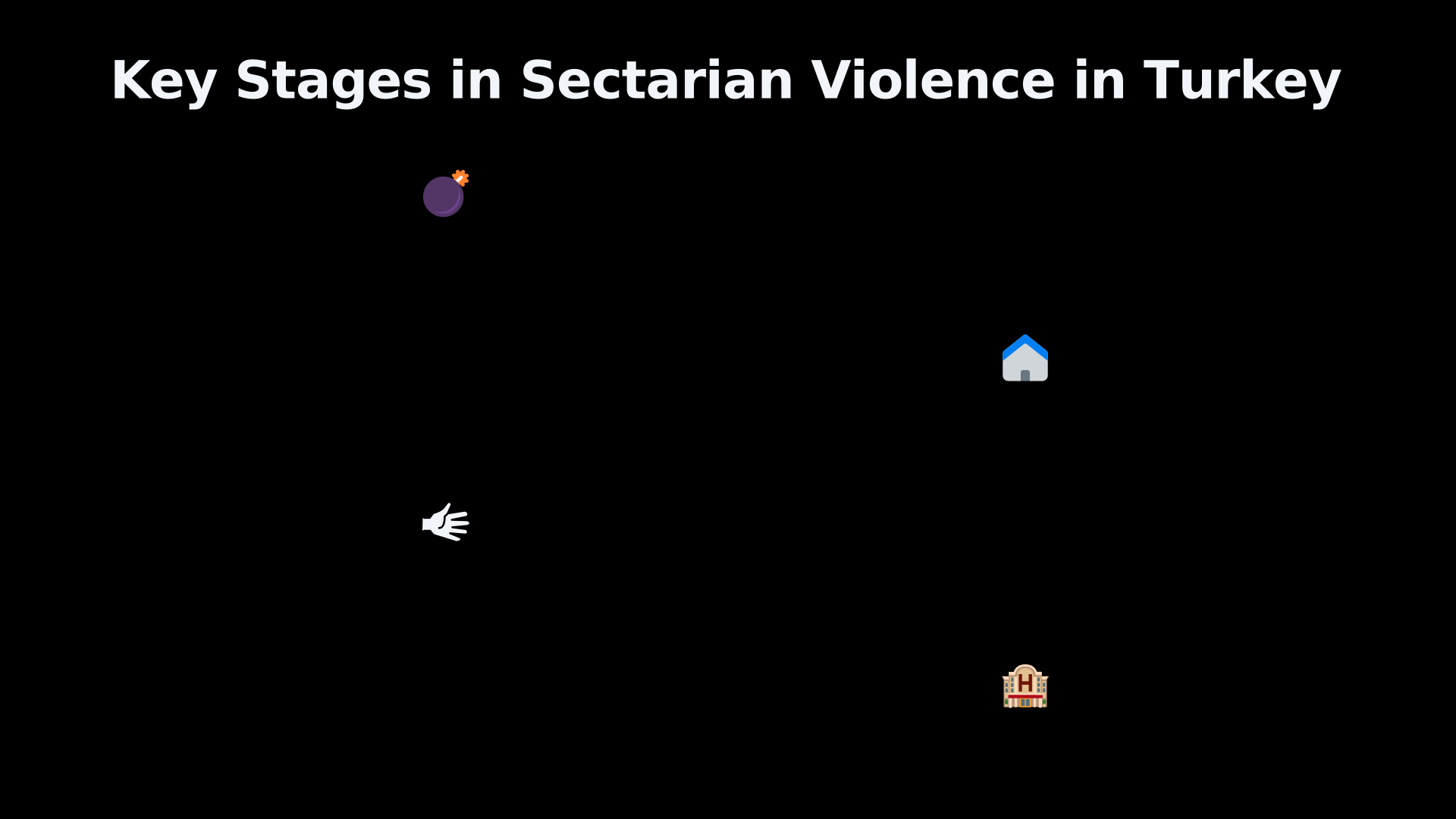
- A single event is portrayed as evidence that an entire minority poses a threat.
- Religious or national identity becomes linked with accusations of conspiracy, sacrilege or criminality.
- Ordinary caution is replaced by language suggesting immediate collective danger.
- Violence is reframed as a defensive response rather than an attack on innocent people.
Researchers describe this as a form of moral panic because fear spreads beyond the available evidence, encouraging people to judge entire communities by rumour rather than verified facts. At the same time, historians stress that the resulting attacks are not spontaneous outbreaks of irrationality alone. They often involve existing political organisations, local mobilisation and failures by authorities to intervene effectively.[wiley.com]onlinelibrary.wiley.comWiley Online LibraryEthnography of the Madımak Massacre Commemorations in Sivas: Changing Narratives, Collective Identities, and Fragment…
Sectarian targets: from Kahramanmaraş to Sivas
Two of the best-known examples involve Turkey’s Alevi minority.
Kahramanmaraş, 1978
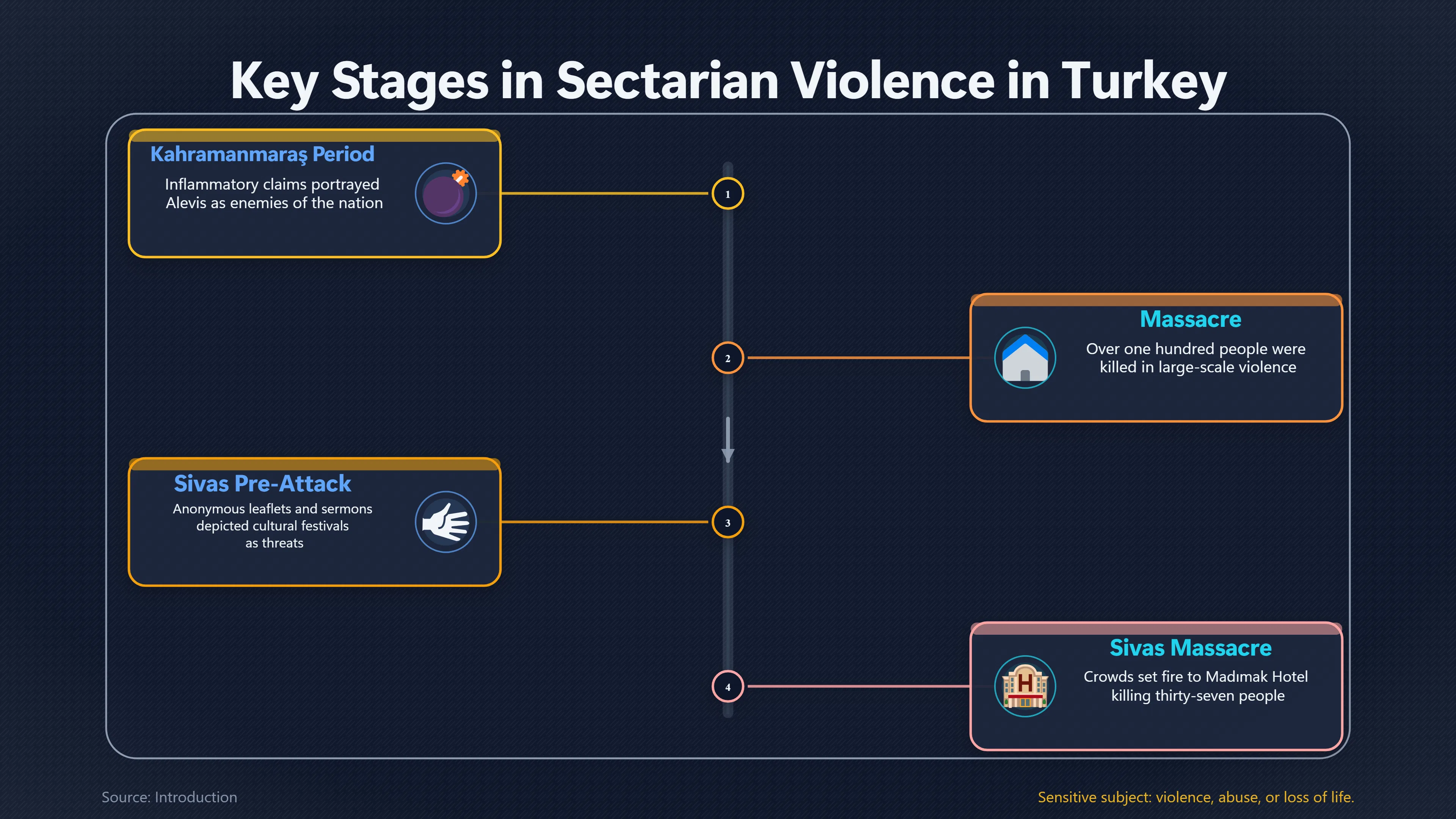
The killings in Kahramanmaraş were preceded by a climate of inflammatory claims portraying Alevis as enemies of religion and of the nation. False stories and provocative allegations circulated after bomb attacks and shootings, encouraging the belief that Sunni Muslims faced an organised assault. Rather than remaining isolated rumours, these narratives became rallying cries for collective violence.
The result was a large-scale massacre in which more than one hundred people, overwhelmingly Alevis, were killed and thousands of homes and businesses were damaged. Later scholarship generally concludes that rumours acted as accelerants within an already polarised political environment rather than providing a sufficient explanation on their own.
Sivas, 1993
The Sivas massacre followed a similar but more visible pattern. Before the attack on the Madımak Hotel, anonymous leaflets, sermons and public agitation depicted participants in the Pir Sultan Abdal cultural festival—particularly the writer Aziz Nesin—as enemies of Islam. Claims that religion itself was under attack helped transform a literary and cultural gathering into a supposed existential threat.
After Friday prayers, crowds gathered, slogans spread through the city, and the hotel was eventually set on fire, killing thirty-seven people. Parliamentary investigations and later state reviews found serious failures by public authorities to prevent an attack that showed clear warning signs. Subsequent research emphasises that rumours about blasphemy and anti-religious conspiracy helped legitimise hostility towards Alevis but cannot explain away the organised nature of the violence.[wikisource.org]tr.wikisource.orgVikikaynak…
Refugees as new targets of rumour
The arrival of millions of Syrians after the Syrian civil war created a different kind of rumour panic. Instead of focusing on sectarian identity, many stories portrayed refugees collectively as criminals, economic parasites or a hidden security threat.
Many claims circulating online or by word of mouth exaggerated isolated crimes into evidence of widespread criminality or falsely attributed offences to Syrians without verification. Researchers studying rumours on social media note that emotionally charged and unverified claims often spread faster than later corrections, particularly during periods of uncertainty.[arXiv]arxiv.orgAnalysing How People Orient to and Spread Rumours in Social Media by Looking at Conversational ThreadsNovember 23, 2015…
The violence in Ankara’s Altındağ district in August 2021 illustrates this mechanism. A fatal altercation involving a Syrian teenager quickly developed into attacks against Syrian-owned homes, vehicles and businesses that had no connection with the original crime. Human rights organisations described the attacks as organised hate crimes and warned that collective punishment was being justified through narratives treating all Syrians as responsible for one individual’s actions.[hrw.org]hrw.orgHuman Rights WatchWorld Report 2022: Turkey | Human Rights Watch…
The broader political atmosphere also mattered. Human Rights Watch documented growing xenophobic rhetoric directed at Syrians during this period, with refugee policy becoming increasingly politicised in public debate. Such rhetoric did not necessarily invent every rumour, but it created an environment in which threatening stories were more readily believed.[Human Rights Watch]hrw.orgHuman Rights WatchWorld Report 2024: Türkiye | Human Rights Watch…
Why rumours become believable
Rumours are most effective when they reinforce fears that already exist.
In Turkey, historians identify several recurring conditions:
- periods of political instability or intense polarisation;
- economic hardship and competition over jobs or housing;
- longstanding sectarian prejudice;
- distrust of official information;
- rapid circulation of unverified material through newspapers in earlier decades and social media today.
Psychological research on rumours consistently finds that uncertainty encourages people to accept claims that appear to explain confusing events, especially when those claims fit existing expectations. Once repeated by trusted neighbours, local leaders or widely shared online accounts, unsupported allegations can begin to feel like established facts despite lacking reliable evidence.[arXiv]arxiv.orgAnalysing How People Orient to and Spread Rumours in Social Media by Looking at Conversational ThreadsNovember 23, 2015…
Why moral panic cannot excuse organised violence
It is important not to confuse a rumour panic with an accidental crowd reaction. In both the Kahramanmaraş and Sivas cases, later investigations and historical research point to evidence of prior mobilisation, inflammatory campaigning and significant failures by authorities. Likewise, attacks on Syrian refugees have often involved organised groups targeting neighbourhoods, homes and businesses rather than only individuals connected to the original incident.[com.tr]aa.com.tr1993 sivas sabotage is massacre turkish presidencyAnadolu Agency1993 Sivas sabotage is massacre: Turkish presidency…
For this reason, scholars distinguish between three different elements:
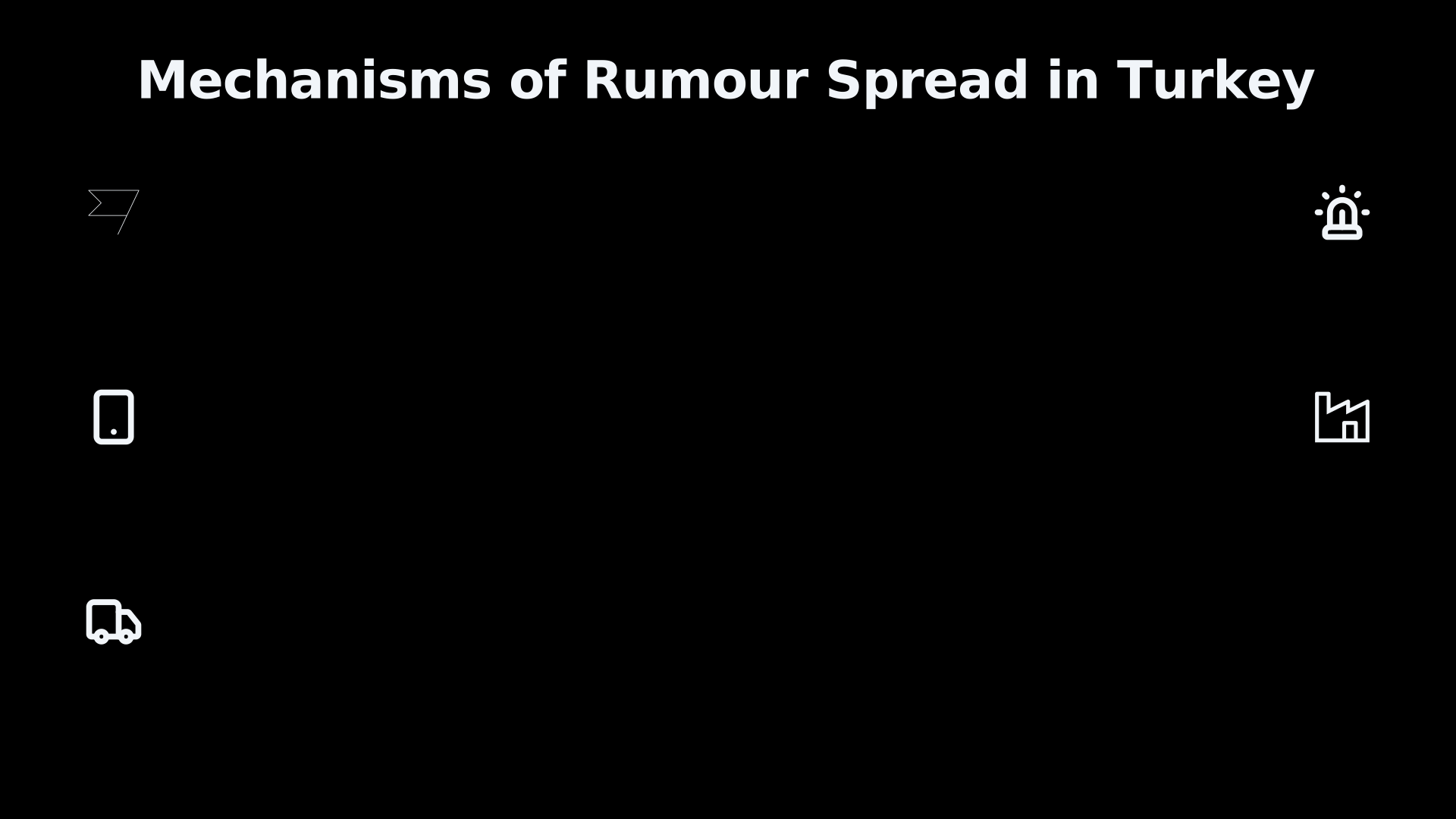
- The rumour, which frames a minority as an immediate danger.
- The moral panic, in which many people begin accepting that framing without sufficient evidence.
- The organised violence, in which identifiable individuals and groups choose to attack people who are not responsible for the alleged threat.
Keeping these distinctions clear prevents collective fear from becoming an excuse for collective punishment.
Why these episodes still matter
Turkey’s history shows that rumours rarely invent hostility from nothing, but they can dramatically accelerate it. Whether directed against Alevis in the late twentieth century or Syrian refugees in the twenty-first, threatening stories have repeatedly transformed individual incidents into narratives about supposedly dangerous communities.
The lasting lesson is not simply that rumours are false. It is that when societies begin judging entire minorities through unverified stories, ordinary neighbours can quickly be recast as enemies. Careful investigation, responsible reporting and refusal to generalise from isolated events remain among the strongest safeguards against repeating these patterns.
Amazon book picks
Further Reading
Books and field guides related to When Rumours Made Neighbours Seem Dangerous. Use these as the next step if you want deeper reading beyond the article.



The Anatomy of Fascism
Useful for understanding mobilization, propaganda and collective violence.
TURKEY: A MODERN HISTORY
Places episodes of sectarian and political violence into national context.
Endnotes
1.
Source: onlinelibrary.wiley.com
Link:https://onlinelibrary.wiley.com/doi/10.1111/sena.70032
Source snippet
Wiley Online LibraryEthnography of the Madımak Massacre Commemorations in Sivas: Changing Narratives, Collective Identities, and Fragment...
2.
Source: arxiv.org
Link:https://arxiv.org/abs/2112.03003
3.
Source: tr.wikisource.org
Link:https://tr.wikisource.org/wiki/Sivas_Katliam%C4%B1na_ili%C5%9Fkin_TBMM_Ara%C5%9Ft%C4%B1rmas%C4%B1Komisyonu_Raporu/Sivas_Olaylar%C4%B1n%C4%B1n_Olu%C5%9F%C5%9Eekli
Source snippet
Vikikaynak...
4.
Source: uscirf.gov
Title: Sivas Massacre and Turkey’s Persecution of the Alevi Community | USCIRF
Link:https://www.uscirf.gov/news-room/uscirf-spotlight/sivas-massacre-and-turkeys-persecution-alevi-community
Source snippet
Sivas Massacre and Turkey’s Persecution of the Alevi Community | USCIRF...
5.
Source: arxiv.org
Link:https://arxiv.org/abs/1511.07487
Source snippet
Analysing How People Orient to and Spread Rumours in Social Media by Looking at Conversational ThreadsNovember 23, 2015...
Published: November 23, 2015
6.
Source: ihd.org.tr
Title: İnsan Hakları Derneği
Link:https://ihd.org.tr/en/ihd-statement-on-attacks-against-asylum-seekers-in-ankara-altindag/
Source snippet
İHD Statement on Attacks against Asylum-Seekers in Ankara, Altındağ – İHD...
7.
Source: tr.wikisource.org
Title: Sivas Katliamına ilişkin TBMM Araştırması Komisyonu Raporu
Link:https://tr.wikisource.org/wiki/Sivas_Katliam%C4%B1na_ili%C5%9Fkin_TBMM_Ara%C5%9Ft%C4%B1rmas%C4%B1_Komisyonu_Raporu
8.
Source: tr.wikisource.org
Title: Muhalefet gerekçeleri ve şerhler
Link:https://tr.wikisource.org/wiki/Sivas_Katliam%C4%B1na_ili%C5%9Fkin_TBMM_Ara%C5%9Ft%C4%B1rmas%C4%B1Komisyonu_Raporu/Muhalefet_gerek%C3%A7eleri_ve%C5%9Ferhler
9.
Source: tr.wikisource.org
Link:https://tr.wikisource.org/wiki/Sivas_Katliam%C4%B1na_ili%C5%9Fkin_TBMM_Ara%C5%9Ft%C4%B1rmas%C4%B1_Komisyonu_Raporu/Rapor
10.
Source: aa.com.tr
Title: 1993 sivas sabotage is massacre turkish presidency
Link:https://www.aa.com.tr/en/turkey/1993-sivas-sabotage-is-massacre-turkish-presidency/141208
Source snippet
Anadolu Agency1993 Sivas sabotage is massacre: Turkish presidency...
11.
Source: hrw.org
Link:https://www.hrw.org/world-report/2022/country-chapters/turkey
Source snippet
Human Rights WatchWorld Report 2022: Turkey | Human Rights Watch...
12.
Source: hrw.org
Link:https://www.hrw.org/news/2022/08/17/questions-and-answers-turkeys-threatened-incursion-northern-syria
13.
Source: hrw.org
Link:https://www.hrw.org/world-report/2024/country-chapters/turkey
Source snippet
Human Rights WatchWorld Report 2024: Türkiye | Human Rights Watch...
14.
Source: hrw.org
Link:https://www.hrw.org/news/2022/10/24/turkey-hundreds-refugees-deported-syria
15.
Source: hrw.org
Title: Illegal Transfers of Syrians to Turkey | Human Rights Watch
Link:https://www.hrw.org/news/2021/02/03/illegal-transfers-syrians-turkey
Additional References
16.
Source: youtube.com
Link:https://www.youtube.com/watch?v=N6gr6o4A2OU
Source snippet
A survivor of the Madimak Massacre recounts what happened that day...
17.
Source: youtube.com
Title: Anti-Syrian riots spread in Turkey | Al Jazeera News Feed
Link:https://www.youtube.com/watch?v=9HkmvqxqTLE
Source snippet
A call for truth and justice from Berlin on the 33rd anniversary of the Sivas Massacre...
18.
Source: youtube.com
Link:https://www.youtube.com/watch?v=T990AwAXmBo
Source snippet
Protests and arrests as anti-Syrian riots rock Turkey...
19.
Source: youtube.com
Title: Protests and arrests as anti-Syrian riots rock Turkey
Link:https://www.youtube.com/watch?v=gUb2YGtltZg
Source snippet
Anti-Syrian riots spread in Turkey | Al Jazeera NewsFeed...
20.
Source: washingtoninstitute.org
Link:https://www.washingtoninstitute.org/policy-analysis/turkish-backlash-how-street-interviews-spread-anti-syrian-refugee-sentiment
21.
Source: researchgate.net
Title: (PDF) Penalizing migration and a culture of impunity
Link:https://www.researchgate.net/publication/386150818_Penalizing_migration_and_a_culture_of_impunity
22.
Source: umag.org.tr
Title: 396 our hearts are still burning sivas july 2 1993
Link:https://www.umag.org.tr/en/publications/396-our-hearts-are-still-burning-sivas-july-2-1993.html
23.
Source: youtube.com
Title: A survivor of the Madimak Massacre recounts what happened that day
Link:https://www.youtube.com/watch?v=SHNLpxx6WU8
24.
Source: lemonde.fr
Title: Turkey accused of deporting Syrian refugees
Link:https://www.lemonde.fr/en/international/article/2022/10/24/turkey-accused-of-deporting-syrian-refugees_6001569_4.html
25.
Source: aleviansiklopedisi.com
Title: sivas massacre 2 july 1993 6108
Link:https://www.aleviansiklopedisi.com/en/madde-x/sivas-massacre-2-july-1993-6108/
Published: july 1993
Topic Tree